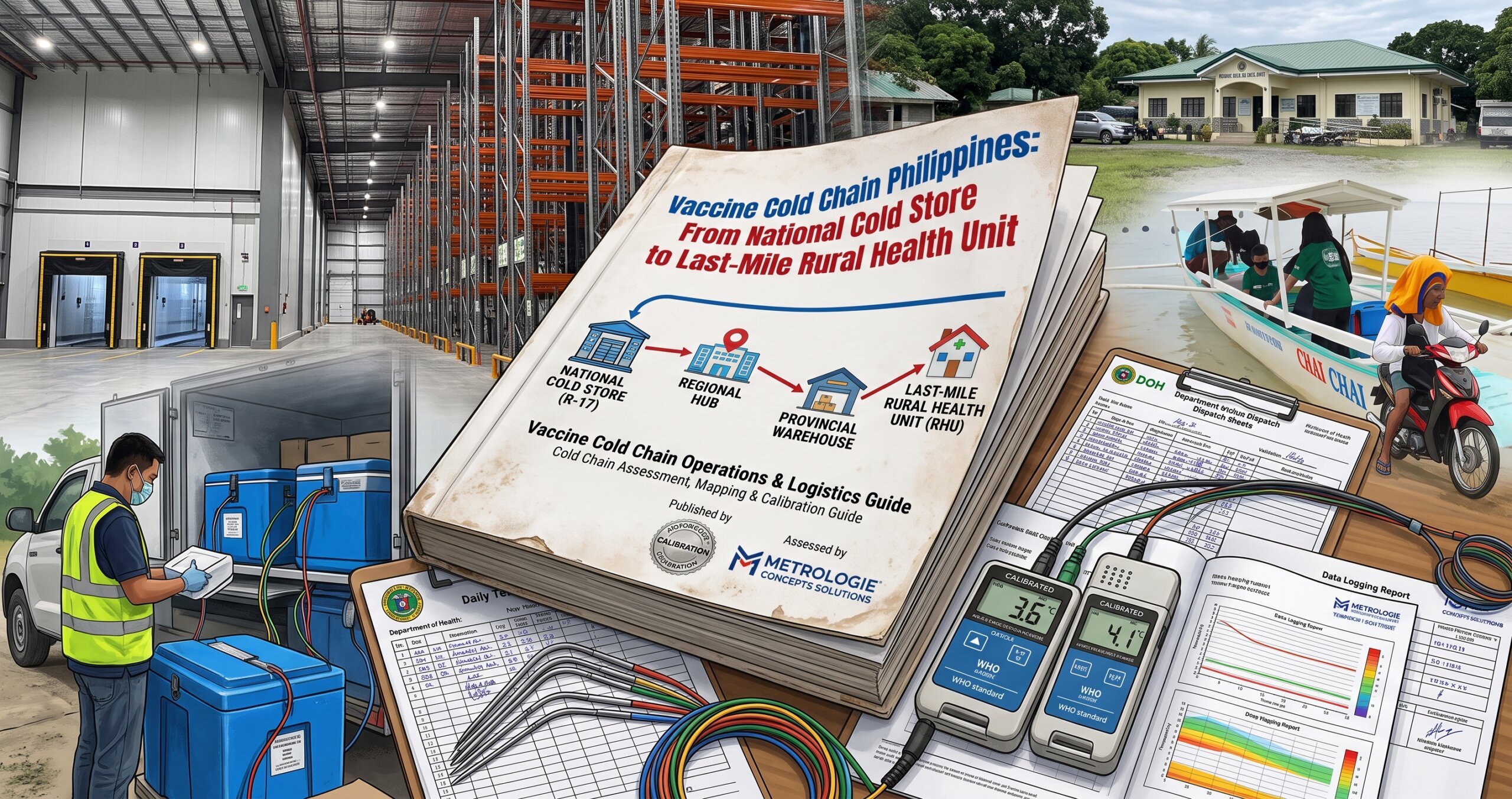
Every childhood vaccine administered at a barangay health station in Samar, every dengue vaccine given at a city health centre in Cebu, every routine immunisation provided at a rural health unit in Bukidnon — each of these vaccination events is the final step in a cold chain that may have begun six months earlier at a DOH national cold store in Metro Manila.
Between the national cold store and the health worker’s injection site, the vaccine has passed through multiple storage and transport links: DOH regional warehouse, provincial health office cold room, municipal health office refrigerator, rural health unit reach-in refrigerator, and finally a vaccine carrier brought to the community vaccination site. At each link, the vaccine must maintain its temperature within +2°C to +8°C (for most vaccines) without being frozen and without exceeding the upper limit. One break in this chain — a faulty refrigerator, an ice pack that froze the vaccine, a power failure with no backup — can render vaccines ineffective without any visible indication of compromise.
<cite index=’6-1′>Approximately 65% of rural health facilities in the Philippines lack proper refrigeration systems, which hampers vaccine cold chain integrity.</cite> This infrastructure gap, combined with the Philippines’ archipelago geography, typhoon vulnerability, and variable power supply in many regions, makes the Philippine national immunisation cold chain one of the most technically challenging in Southeast Asia.
At the same time, the stakes could not be higher. <cite index=’5-1′>The DOH, with support from UNICEF and WHO, unveiled key strategies underpinning a landmark plan to achieve 95% immunisation coverage for children in the Philippines.</cite> Every percentage point of immunisation coverage depends not just on reaching communities but on delivering vaccines that are still potent when they arrive. And vaccine potency depends entirely on cold chain integrity at every link from national cold store to injection site.
This article provides the most comprehensive guide available to the Philippine national immunisation cold chain — the infrastructure, the standards, the temperature requirements, the specific challenges of the Philippine context, and the cold chain management practices at each level that protect vaccine potency from national cold store to last-mile barangay health station.
| What This Article CoversThe five-level structure of the Philippine National Immunisation Programme (NIP) cold chain — national, regional, provincial, municipal, and barangay levelsTemperature requirements and equipment standards at each cold chain levelThe freeze risk — the most underappreciated cold chain failure in the Philippine vaccine programmeThe Vaccine Vial Monitor (VVM) system and how it worksThe role of thermal mapping at national and regional warehouse levelTyphoon and power supply resilience in the Philippine cold chainThe specific cold chain challenges of the Philippine archipelagoPractical guidance for LGU health officers and PHO cold chain coordinators |
1. The Philippine National Immunisation Programme: Cold Chain Structure
The Philippine National Immunisation Programme (NIP), formerly the Expanded Programme on Immunisation (EPI), is implemented through a decentralised system that reflects the Philippines’ devolved health system structure. <cite index=’7-1′>The NIP is managed by coordinators at national, regional, provincial, and municipal levels. Immunisation is delivered through public and private sector providers using facilities like Rural Health Units. LGUs took responsibility for vaccine storage, on-site programme implementation and vaccine administration.</cite>
This devolution of responsibility creates a cold chain management challenge: the vaccines are procured centrally by DOH, but the cold chain infrastructure — particularly at the municipal and barangay levels — is primarily the responsibility of Local Government Units (LGUs), which have widely varying technical capacity, budget, and prioritisation of cold chain management.
The Five Levels of the Philippine Vaccine Cold Chain
The Philippine NIP cold chain operates through five levels, each with defined cold chain equipment requirements, temperature monitoring standards, and storage capacities:
| Cold Chain Level | Responsible Entity | Typical Cold Chain Equipment | Storage Duration | Key Cold Chain Challenge |
| National level | DOH — National Center for Pharmaceutical Access and Management | Walk-in cold rooms (2°C–8°C); walk-in freezer rooms (−20°C); backup generators; continuous monitoring | 6-month national buffer stock | Temperature distribution uniformity in large cold rooms; seasonal mapping under Philippine summer conditions; continuous power with generator backup |
| Regional level (17 regions) | DOH Centers for Health Development (CHDs) | Walk-in cold room or large refrigerators; freezers for freeze-dried vaccines; backup generator | 1 to 3 months regional supply | Inter-island transport to remote regional areas; power supply reliability in some regions; typhoon resilience |
| Provincial level (82 provinces) | Provincial Health Office (PHO) | Refrigerators (household-type or purpose-built); freezers; cold boxes for distribution | 1 to 2 months provincial supply | Refrigerator adequacy for volume; calibration and monitoring programmes; distribution logistics to municipal level |
| Municipal / City level | Municipal Health Office (MHO) / City Health Office (CHO) | Vaccine refrigerators; cold boxes; vaccine carriers; ice packs | 1 to 2 weeks supply | Equipment reliability; power supply in rural municipalities; cold chain training for RHU staff |
| Barangay level | Rural Health Unit (RHU), Barangay Health Station (BHS), community sites | Vaccine carrier with conditioned ice packs; thermometers | Daily supply for vaccination sessions; BHS typically no permanent cold storage | Most BHSs have no cold chain equipment; vaccines supplied fresh for each session; ice pack conditioning critical |
2. Vaccines in the Philippine NIP: Temperature Requirements and Freeze Sensitivity
The vaccines included in the Philippine National Immunisation Programme span a range of temperature sensitivities — and critically, some vaccines that appear stable are actually severely damaged by freezing, even brief exposure to temperatures below 0°C. Understanding both the heat sensitivity and the freeze sensitivity of each vaccine is fundamental to managing the Philippine cold chain correctly.
The Standard Cold Chain Range: +2°C to +8°C
Most vaccines in the Philippine NIP must be maintained at +2°C to +8°C at all storage levels — from national cold store to the vaccine carrier at the point of administration. The vaccines in this category include:
- BCG (bacillus Calmette-Guérin) vaccine — birth dose for tuberculosis prevention; also freeze-sensitive in its reconstituted form
- Hepatitis B vaccine — birth dose and primary series; severely damaged by freezing
- DTP-containing vaccines (DPT, DTwP, pentavalent/hexavalent vaccines) — primary series; highly freeze-sensitive due to aluminum adjuvants
- Measles-Mumps-Rubella (MMR) and MR vaccines — primary and booster doses
- Pneumococcal Conjugate Vaccine (PCV) — primary series; freeze-sensitive
- Rotavirus vaccines — routine vaccination; some formulations require +2°C to +8°C, others −20°C or colder
- Influenza vaccines — seasonal and pandemic vaccination programmes
- COVID-19 vaccines (mRNA and others) — specific temperature requirements vary significantly by manufacturer
The Frozen Vaccine Category: −20°C
Some vaccines in the Philippine NIP require frozen storage at −20°C or colder — typically because they contain live attenuated viral components that lose activity if allowed to remain at refrigerator temperatures for extended periods:
- Oral Polio Vaccine (OPV) — the most temperature-sensitive vaccine in the EPI; must be stored at −20°C or colder; begins losing potency rapidly if held above +8°C even briefly
- Varicella (chickenpox) vaccine — −20°C storage required for potency maintenance
- Some measles-containing live attenuated vaccines — manufacturer-specific requirements; verify for each product
The frozen vaccine cold chain creates a specific challenge at the lower levels of the Philippine cold chain: most rural health units and barangay health stations do not have −20°C freezer storage. OPV and other frozen vaccines must therefore be distributed fresh for each vaccination session, transported in cold boxes with dry ice or pre-conditioned frozen ice packs that maintain adequate temperature during the transport period.
The Critical Freeze Sensitivity Issue
The most significant and most underappreciated cold chain failure in the Philippine immunisation programme is not heat exposure — it is freeze damage. Many of the most important vaccines in the Philippine NIP are severely damaged by freezing, even brief exposure to sub-zero temperatures that leaves no visible change in the vaccine’s appearance.
Vaccines containing aluminum salts as adjuvants — including all DTP-containing vaccines (pentavalent, hexavalent), hepatitis B, Hib, IPV, PCV, and hepatitis A — are highly sensitive to freezing. When these vaccines freeze, the aluminum adjuvant particles aggregate irreversibly. After thawing, the vaccine appears physically similar to unaffected vaccine — it is typically not visually distinguishable from a good vaccine. But its immunogenicity may be substantially or completely destroyed. A child vaccinated with freeze-damaged vaccine is not protected.
Freeze damage in the Philippine vaccine cold chain most commonly occurs at two points:
- Ice pack conditioning failure: Ice packs that are not adequately conditioned (allowed to partially thaw) before being placed in contact with freeze-sensitive vaccines in a cold box can expose vaccines to direct contact with surfaces below 0°C. The vaccine immediately adjacent to the underconditioned ice pack may be frozen while the vaccine carrier thermometer reads +4°C.
- Refrigerator cold spots: Household refrigerators used for vaccine storage at the RHU level often have severe cold spots — zones near the back wall, near the freezer compartment, or near the evaporator coil where temperatures regularly fall below 0°C even when the thermostat reads +4°C. Vaccines stored in these zones are freeze-exposed without any visible indication.
| The Freeze Risk Is Greater Than the Heat Risk in Many Philippine Cold Chain SettingsInternational cold chain experience consistently shows that freeze-damaged vaccines are more common than heat-damaged vaccines in cold chain systems at the district and health facility level. In the Philippines, this risk is particularly high at the RHU level, where household refrigerators with uncharacterised cold spots are the primary storage equipment.Thermal mapping of RHU and PHO vaccine refrigerators identifies freeze-risk zones and informs product placement rules that keep freeze-sensitive vaccines away from sub-zero zones. This is one of the highest-impact uses of thermal mapping in the Philippine public health cold chain. |
3. The Vaccine Vial Monitor: The Philippine Cold Chain’s Built-In Heat Indicator
The Vaccine Vial Monitor (VVM) is one of the most important tools in the Philippine national vaccine cold chain — and one of the most commonly misunderstood by health workers at the facility level.
What the VVM Is
The VVM is a small heat-sensitive chemical indicator attached to the vaccine vial that changes colour progressively as the vaccine is exposed to heat. It provides a visual cumulative heat exposure indicator that allows health workers to make a rapid assessment of whether a vaccine has been exposed to damaging heat — even when no temperature monitoring was present during storage.
The VVM consists of a square inner box within a round outer circle. The critical rule is simple: if the inner square is the same colour as or darker than the outer circle, the vaccine should not be used. If the inner square is lighter than the outer circle, the vaccine can be used — provided all other conditions are met.
The Four VVM States
| VVM Stage | Visual Appearance | Interpretation | Action |
| Stage 1 (Usable) | Inner square is lighter than outer circle | Vaccine has not been exposed to damaging heat; cold chain has been adequately maintained | Use the vaccine if it is within expiry date and has been stored correctly |
| Stage 2 (Usable — use first) | Inner square has changed slightly; still lighter than outer circle | Cumulative heat exposure is occurring; vaccine is still usable but should be prioritised for immediate use | Use the vaccine at this session; do not return to cold chain for future sessions |
| Stage 3 (Discard) | Inner square is the same colour as outer circle — the ‘discard point’ | Cumulative heat exposure has reached the manufacturer’s threshold; vaccine potency may be compromised | Do not use; discard according to vaccine waste protocol; report to cold chain supervisor |
| Stage 4 (Discard) | Inner square is darker than outer circle | Severe heat exposure; vaccine potency is likely destroyed | Do not use; discard immediately; investigate cold chain failure |
What the VVM Cannot Tell You
While the VVM is a valuable tool, it has critical limitations that health workers must understand:
- The VVM does not detect freeze damage — because it is a heat indicator. A vaccine that has been frozen and thawed may have an intact (Stage 1) VVM while being completely immunogenically inactive. The VVM gives no warning of freeze exposure. This is why the Shake Test (for freeze-sensitive vaccines) and cold chain verification must complement VVM checking — not rely on it alone.
- The VVM tracks cumulative heat exposure — it is not a single threshold indicator. A vaccine stored slightly above 8°C for a few hours accumulates VVM change more slowly than one stored at 15°C for the same period. The VVM changes with cumulative thermal history, not instantaneous temperature.
- The VVM does not replace temperature monitoring — it supplements it. Cold chain programmes that rely entirely on VVM checking without maintaining proper temperature monitoring and records are not meeting WHO cold chain management standards.
4. Cold Chain at the National and Regional Level: Infrastructure and Qualification
The National Cold Store
The DOH national cold store in Metro Manila is the primary entry point for all vaccines imported or procured for the national immunisation programme. <cite index=’3-1′>The national DOH maintained responsibility for forecasting, procuring and monitoring the supply of vaccines, with capacity to store up to a six-month national supply. A new storage facility is currently in development with eight cold rooms and a digitised inventory system.</cite>
The national cold store is the highest-compliance cold chain facility in the Philippine national immunisation system — with walk-in cold rooms qualified to pharmaceutical-grade standards, continuous electronic monitoring, backup generator systems, and formal IQ/OQ/PQ qualification documentation.
Thermal mapping of national cold store cold rooms should follow the same methodology as pharmaceutical warehouse mapping — with WHO seasonal mapping requirements applying to ensure that summer-condition performance is documented. Given that the national cold store serves as the buffer for the entire country’s vaccine supply, any compliance failure at this level has nationwide implications for vaccine availability.
DOH Regional Warehouses (CHDs)
The 17 DOH Centers for Health Development operate regional cold chain facilities that receive vaccines from the national cold store and distribute them to provincial health offices. Regional cold chain facilities vary significantly in their infrastructure quality — some regions, particularly those that received UNICEF and international development partner support for cold chain strengthening, have well-equipped and properly monitored facilities. Others face infrastructure gaps.
<cite index=’1-1′>UNICEF provided cold chain equipment to the Department of Health. To ensure that the cold chain in the Philippines is disaster-resilient, UNICEF provided special equipment such as solar-powered and flood-proof refrigerators, back-up power generators, and refrigerators that can run for more than 10 days without electricity in areas that are prone to being affected by typhoons.</cite>
The Caraga region of Mindanao provides a specific example of cold chain strengthening investment: <cite index=’0-1′>the Provincial Health Office in Tandag City, Surigao Del Sur received a walk-in cold storage system donated by the Australian Government and UNICEF that will house COVID-19 and other routine childhood vaccines.</cite> This type of targeted infrastructure investment is gradually improving cold chain capacity at the regional and provincial level — but the need remains significant across many regions.
Typhoon Resilience at the Regional Level
Regional cold chain facilities in Eastern Visayas, Western Visayas, Bicol, and Eastern Mindanao face typhoon-related cold chain disruption risks that are more severe than any other region in the Philippines. The combination of frequent direct typhoon impacts, extended power outages, and sometimes physical facility damage creates cold chain continuity challenges that require specific resilience planning:
- Backup power: Regional cold chain facilities in typhoon-prone areas must have backup generators with adequate fuel storage for extended outages — UNICEF and international partners have provided generators to many regions, but generator maintenance and fuel management remain ongoing challenges
- Solar-powered refrigeration: UNICEF has provided solar-powered refrigerators to health facilities in typhoon-prone areas — these refrigerators continue operating during extended power outages without generator fuel dependency
- Pre-typhoon cold chain protocol: PHO cold chain coordinators in typhoon-affected areas should implement a pre-typhoon cold chain protocol that includes: pre-cooling cold rooms to the lowest end of the acceptable range before the typhoon arrives, verifying generator fuel supply, and pre-positioning emergency cold boxes and ice packs for potential product transfer if facility damage occurs
5. Cold Chain at the Provincial and Municipal Level
Provincial Health Office Cold Chain
The Provincial Health Office (PHO) cold chain facility receives vaccines from the DOH regional warehouse and distributes them to municipal health offices within the province. PHO cold chain typically uses refrigerators (sometimes multiple units) rather than walk-in cold rooms, reflecting the smaller storage volume at this level.
At the PHO level, the most critical cold chain management gap is often calibration — many PHO vaccine refrigerators have been operating for years with no formal calibration of the thermometers or monitoring sensors used to verify storage temperatures. Without calibrated monitoring, the temperature records produced at the PHO level cannot be verified as accurate. A thermometer that reads +5°C but actually measures +9°C produces compliant-looking records while the vaccines it monitors are being held above the upper limit.
PHO cold chain coordinators — typically public health nurses or sanitary inspectors with cold chain management responsibilities added to other roles — may not have formal metrology or cold chain calibration training. The Cold Chain and Logistics Management Training conducted by the DOH’s Immunisation programme covers these skills, but <cite index=’8-1′>some health workers have no training on Basic EPI Skills and Cold Chain and Logistics Management. Most of the issues observed during on-site monitoring are related to cold chain and logistics management.</cite>
Municipal Health Office / Rural Health Unit Cold Chain
At the municipal level, vaccine cold chain is typically managed by the Rural Health Unit (RHU) or City Health Office — the primary public health facility responsible for vaccine storage and distribution to barangay-level vaccination sessions.
RHU vaccine storage typically uses standard household refrigerators — not purpose-built vaccine refrigerators — which creates several cold chain compliance challenges:
- Cold spots near the back wall and freezer compartment: Standard household refrigerators frequently have zones where temperatures fall below 0°C, particularly near the evaporator or near the freezer compartment divide. Freeze-sensitive vaccines stored in these zones are at constant freeze risk. <cite index=’27-1’>Most BHSs do not have cold chain equipment to store the vaccines.</cite>
- Temperature stability during door openings: Household refrigerators are opened frequently for non-vaccine purposes (food, medications) — the higher door-opening frequency compared to a dedicated vaccine refrigerator creates greater temperature instability and more frequent recovery cycles
- No calibrated monitoring: Most RHU refrigerators use a consumer-grade thermometer or the refrigerator’s built-in thermostat display — neither of which is calibrated to a traceable reference standard
- No alarm capability: Household refrigerators do not have temperature alarm systems — temperature excursions are discovered only when staff check the thermometer during working hours, creating overnight and weekend monitoring gaps
The Two-Plus-Eight Rule and Open Vial Policy
At the RHU level and at community vaccination sessions, the WHO Two-Plus-Eight Rule and Open Vial Policy provide practical guidance for managing partially used vaccine vials:
- Two-Plus-Eight Rule: Multi-dose vaccines that have been opened may be used in subsequent sessions (up to 4 weeks) if: the vaccine has not passed its expiry date, the VVM has not reached the discard point, the vaccine has been stored under appropriate cold chain conditions, and the vaccine has not been contaminated (proper aseptic technique has been used for each withdrawal)
- Open Vial Policy exceptions: BCG, yellow fever, and lyophilized meningococcal A vaccines must be discarded at the end of each session regardless of the Two-Plus-Eight criteria — these vaccines have very short post-reconstitution stability
These policies have significantly reduced vaccine wastage in the Philippine NIP — but they depend on health workers having reliable, calibrated temperature monitoring to confirm that vaccines have been maintained within the required temperature range between sessions.
6. Temperature Monitoring at Each Level: What Is Required and What Is Typically Used
WHO EPI Cold Chain Monitoring Requirements
WHO Expanded Programme on Immunisation guidelines specify temperature monitoring requirements at each level of the cold chain. The minimum requirements are:
- National and regional cold stores: Continuous electronic temperature monitoring with alarm capability and data recording; records reviewed daily
- Provincial and municipal cold rooms/refrigerators: Thermometer reading minimum twice daily (morning and afternoon) with recorded temperatures; some facilities using continuous electronic monitoring
- Rural Health Units: Minimum twice-daily thermometer readings recorded on the WHO vaccine refrigerator temperature monitoring chart; some RHUs using electronic monitoring
- Community vaccination sessions: Vaccine carrier thermometer checked before leaving the facility and at the vaccination site; temperatures recorded
The Gap Between Required and Actual at the RHU Level
At the RHU level, the gap between what WHO EPI guidelines require and what actually happens in many Philippine facilities is significant. The most common monitoring gaps at the facility level include:
- Incomplete temperature records — readings not recorded consistently on both morning and afternoon shifts, or on weekends and holidays when regular staff may be absent
- Uncalibrated thermometers — the facility’s only temperature indicator has never been calibrated against a traceable reference standard
- No recognition of freeze events — health workers are not trained to recognise freeze indicators or conduct the Shake Test on potentially freeze-damaged vaccines
- No cold spot mapping of the refrigerator — products are stored in all positions within the refrigerator without knowing which positions have sub-zero temperatures
Improving Monitoring at the RHU Level: Practical Steps
For PHO cold chain coordinators and LGU health officers looking to improve temperature monitoring at the RHU level within the constraints of public health budgets and rural infrastructure, the following practical steps provide the most cost-effective improvements:
- Calibrate the RHU’s thermometers: Annual calibration of the maximum-minimum thermometers used for vaccine refrigerator monitoring at a PAB-accredited laboratory is the single most important step — it converts a monitoring programme based on uncertain readings into one based on verified measurements. The cost of calibrating one or two thermometers annually is minimal.
- Map the cold spots in the RHU refrigerator: A simple mapping exercise — placing multiple calibrated thermometers at different positions in the refrigerator and recording the temperature at each position over 24 hours — reveals the freeze-risk zones. This mapping does not require a formal thermal mapping study; it requires calibrated instruments and a few hours of data collection. The result: specific product placement rules that keep freeze-sensitive vaccines away from sub-zero zones.
- Implement continuous monitoring where feasible: Affordable wireless temperature monitoring solutions — some costing as little as ₱3,000 to ₱8,000 for the sensor and smartphone-accessible platform — can provide 24/7 monitoring with SMS alerts for RHU refrigerators. These systems do not meet pharmaceutical-grade calibration standards without additional calibration verification, but they provide early warning of temperature excursions that manual twice-daily readings miss entirely.
- Train staff on the Shake Test and freeze recognition: The Shake Test is a simple, no-equipment-required assessment of freeze damage for freeze-sensitive vaccines. Training all RHU staff in the test procedure and in recognising the signs of freeze exposure (excessive flocculation, aggregated particles that do not re-suspend) significantly improves the probability of catching freeze-damaged vaccines before they are administered.
7. Inter-Island Cold Chain: The Philippine Archipelago Challenge
The Philippine archipelago — 7,641 islands served by a combination of road, sea, and air transport — creates cold chain distribution challenges that are unique among national immunisation programmes in Southeast Asia. Moving vaccines from a DOH regional warehouse in, say, Cebu City to a rural health unit in a remote island municipality of Eastern Samar involves multiple transport modes, each with different cold chain control characteristics.
The Inter-Island Ferry Segment
For island-to-island vaccine distribution, the ferry transport segment is a cold chain vulnerability that is often managed informally rather than systematically. Key risks in the inter-island ferry cold chain include:
- Duration of exposure: Inter-island ferry crossings in the Philippine archipelago can take 4 to 24 hours or longer — a duration that exceeds the holdover time of many standard vaccine carriers, particularly in Philippine summer ambient conditions
- Temperature during loading and unloading: Port environments in Philippine summer can be extremely hot — cargo sitting on open dock areas waiting for loading or after unloading may be exposed to temperatures well above the +8°C upper limit before it enters the refrigerated transport environment
- No active refrigeration during crossing: Most inter-island vaccine transport uses passive insulated cold boxes rather than actively refrigerated containers — the vaccine is cold when it goes in, and the cold box keeps it cold for a defined holdover time
For provinces and municipalities served by inter-island ferry, the PHO cold chain coordinator should: know the holdover time of the cold boxes used for inter-island transport (ideally validated under Philippine tropical ambient conditions), plan distributions to ensure vaccines reach health facilities well within the validated holdover time of the transport containers, and have a protocol for what to do if transport is delayed beyond the validated holdover window.
The Remote Island Municipality Last Mile
For vaccine distribution to very remote island municipalities — accessible only by outrigger boat (bangka) rather than regular ferry — the cold chain is almost entirely dependent on manually managed cold boxes and ice packs, with no active refrigeration and no electronic monitoring. In these environments:
- Ice management is the critical skill — health workers transporting vaccines by bangka to island barangays must know how to condition ice packs correctly, pack vaccines in the cold box to minimise freeze risk, and manage ice replacement during the distribution day
- Same-day use planning is essential — vaccines transported to remote islands should be used on the same day, with no excess stock brought to a location without adequate cold storage
- UNICEF solar-powered refrigerators are particularly valuable for remote island municipalities — these refrigerators provide reliable cold chain storage independent of grid power, which is the dominant mode in most remote Philippine islands
8. Building a Stronger Philippine Vaccine Cold Chain: Priorities for LGUs and PHOs
For Provincial Health Office cold chain coordinators and LGU health officers seeking to strengthen the vaccine cold chain in their area, the following priorities offer the greatest impact for the investments available.
Priority 1: Calibrate Your Monitoring Equipment
The foundation of any meaningful cold chain monitoring programme is calibrated instruments. Annual calibration of the thermometers used at PHO and RHU cold storage facilities should be the first investment in cold chain programme improvement — before purchasing new refrigerators, before building new cold rooms, before any other technical upgrade. Without calibrated monitoring, you do not know whether your current cold chain is maintaining the required temperature range, and any new infrastructure you install will be monitored just as uncertainly as the old infrastructure.
PHOs and LGUs can arrange PAB-accredited calibration for their monitoring thermometers through Metrologie Solutions Philippines and other PAB-accredited calibration laboratories. The cost is modest — typically ₱1,500 to ₱4,000 per thermometer — and the impact on cold chain programme credibility is immediate.
Priority 2: Map the Cold Spots in Your Vaccine Refrigerators
The most impactful single cold chain action for most Philippine RHUs is identifying and documenting the cold spots in their vaccine refrigerators — the zones where temperatures fall below 0°C and pose freeze risk to freeze-sensitive vaccines. This can be done with minimal equipment (calibrated thermometers, a 24-hour data collection period, and a documented result) and immediately enables evidence-based product placement rules that protect vaccines from the most common cold chain failure mode at the facility level.
Priority 3: Train Cold Chain Workers at Every Level
Cold chain failures in the Philippine national immunisation programme are often knowledge failures — health workers who do not know how to condition ice packs, do not recognise freeze damage, do not know that certain vaccines must never be allowed to freeze, and do not know how to respond to a temperature excursion. <cite index=’5-1′>Santiago City in Cagayan Valley strengthened its cold chain management, ensuring the quality and efficacy of vaccines</cite> — and this kind of local cold chain improvement is achievable at any provincial or municipal level with the right training programme.
The DOH’s Cold Chain and Logistics Management Training, conducted through CHD-level training events, is the primary vehicle for cold chain worker training in the national programme. PHO cold chain coordinators should ensure that all staff with cold chain responsibilities — nurses, midwives, barangay health workers who transport vaccines — have completed this training and that records are maintained.
Priority 4: Formal Thermal Mapping for PHO and Higher-Level Cold Rooms
For provincial health offices and regional warehouses with dedicated vaccine cold rooms, formal thermal mapping studies — conducted to the methodology described throughout this article series — provide the most complete picture of cold room temperature distribution, freeze-risk zones, and power failure holdover performance. A thermal mapping study at the PHO cold room level:
- Identifies specific positions within the cold room where freeze-sensitive vaccines must not be stored
- Documents the holdover time before the vaccines reach damaging temperatures in a power failure — critical for typhoon season emergency planning
- Provides calibrated evidence that the cold room meets the +2°C to +8°C requirement throughout its full volume — not just at the thermostat position
- Satisfies DOH programme quality monitoring requirements and international partner technical reviews that increasingly look for formal cold chain qualification evidence
| Metrologie Solutions Philippines: Supporting the Philippine Vaccine Cold ChainWe provide thermal mapping, PAB-accredited calibration, and cold chain training for DOH regional and provincial health offices, PHO cold chain facilities, and private vaccine distributors throughout the Philippines.Our thermometer and monitoring sensor calibration services provide the traceable measurement foundation that makes RHU-level temperature records meaningful. Our thermal mapping studies for PHO and CHD cold rooms follow WHO EPI methodology, identifying freeze zones, hot spots, and power failure holdover times.Contact us at metrologiesolutions.com to discuss cold chain support for your health facility or cold chain programme. |
9. Frequently Asked Questions: Philippine Vaccine Cold Chain
Why do so many Philippine vaccination failures happen even when health workers say the cold chain was maintained?
The most common reason is freeze damage — a cold chain failure mode that is invisible without specific testing (the Shake Test or laboratory potency testing). Health workers who check the thermometer and see +5°C believe the cold chain was maintained — but if there is an uncharacterised cold spot in the refrigerator near the evaporator coil where temperatures fall to −2°C, vaccines stored in that zone have been frozen despite the acceptable mid-refrigerator temperature reading. The Shake Test on suspect vials, refrigerator cold spot mapping, and ice pack conditioning discipline are the interventions that address this invisible failure mode.
Our rural health unit has a household refrigerator with no temperature alarm. Is this acceptable?
A household refrigerator without alarm capability does not meet WHO EPI ideal cold chain equipment standards — but it is the reality for a large proportion of Philippine RHUs, and DOH guidance acknowledges this. The practical minimum requirements for an RHU vaccine refrigerator are: a maximum-minimum thermometer (calibrated, read and recorded twice daily), a functioning door seal, adequate power supply or backup ice pack arrangements for power failures, and no food items stored alongside vaccines. Improving beyond this minimum — with a purpose-built vaccine refrigerator, calibrated electronic monitoring, and alarm capability — should be a PHO and LGU budgeting priority, as it significantly reduces freeze and heat excursion risk.
Our province regularly experiences typhoon-related power failures of 3 to 5 days. How should we manage vaccine cold chain during extended outages?
For provinces with frequent extended power failures, the cold chain emergency plan must account for outages beyond the holdover time of the cold boxes and refrigerators used. This typically requires: a backup generator for PHO and RHU cold rooms with adequate fuel for at least 7 days; solar-powered refrigerators as the primary equipment at health facilities in the most vulnerable municipalities; pre-positioned dry ice supplies for extended outages; and a documented protocol for what to do when no power restoration can be expected within the cold room holdover time (transfer vaccines to the nearest facility with power or dry ice; contact PHO for emergency distribution of fresh vaccines after the outage). If your province lacks these resources, document the gap and escalate to the CHD and DOH — cold chain emergency preparedness is part of the National Immunisation Acceleration Plan.
How do we know if vaccines that went through a power failure are still potent?
The first assessment tool is the VVM — check the VVM on all vials that experienced the power failure. If any VVM has reached Stage 3 or Stage 4 (inner square same colour as or darker than outer circle), those vials should be discarded. For freeze-sensitive vaccines (all DTP-containing vaccines, hepatitis B, Hib, IPV, PCV, PCV), also conduct the Shake Test — compare the vial against a known unaffected control vial of the same vaccine. If the suspect vials show persistent flocculation that does not re-suspend, they are freeze-damaged and should be discarded. If both VVM checking and Shake Test results are acceptable, document the excursion event (temperatures reached, duration, VVM status, Shake Test result) and consult the PHO cold chain coordinator for final disposition guidance.
What is the role of private vaccine distributors in the Philippine national immunisation cold chain?
Private vaccine distributors play a dual role in the Philippine vaccine cold chain — they supply private healthcare providers (clinics, hospitals, paediatricians) who administer vaccines outside the national programme, and they sometimes serve as logistics partners for DOH in distributing vaccines to specific health facilities. Private distributors handling vaccines are subject to FDA cold chain management requirements (or, for veterinary vaccines, BAI requirements as of 2025) and must maintain the same cold chain infrastructure, monitoring, and documentation standards described throughout this article series. Private distributors can also contribute to the public health cold chain by sharing their cold chain infrastructure expertise, calibration resources, and trained personnel with provincial health offices in the regions they serve.
Conclusion: Every Cold Chain Link Protects a Child
The Philippine national immunisation cold chain is an interconnected system of infrastructure, people, knowledge, and practice that spans from a sophisticated national cold store in Metro Manila to a health worker carrying a vaccine carrier across a shallow inter-island crossing on a bangka. Every link in this chain must function correctly for a vaccine administered to a child in a remote barangay to be the same potent, protective vaccine that left the national cold store weeks or months earlier.
The Philippines has made significant progress in cold chain infrastructure — with international partner support bringing solar-powered refrigerators, backup generators, and improved cold rooms to some of the most vulnerable regions. But <cite index=’2-1′>approximately 65% of rural health facilities lack proper refrigeration systems</cite>, and cold chain management knowledge gaps persist at the health worker level. The National Immunisation Acceleration Plan’s goal of 95% coverage for Filipino children depends not just on reaching communities but on arriving with potent vaccines.
For Provincial Health Office cold chain coordinators, LGU health officers, and public health nurses managing vaccination programmes, the practical priorities are clear: calibrate your monitoring equipment, map the cold spots in your refrigerators, train your staff in freeze recognition and ice pack conditioning, and build the power-failure resilience that Philippine typhoon season demands. These are the investments that protect every vaccine from the moment it leaves the national cold store to the moment it is administered to a child.
Metrologie Solutions Philippines supports the Philippine public health cold chain through calibration services, thermal mapping studies, and cold chain training for health facilities at every level of the national immunisation system.
| Support Your Vaccine Cold Chain ProgrammeContact Metrologie Solutions Philippines to discuss PAB-accredited thermometer calibration for PHO and RHU cold chain facilities, thermal mapping studies for PHO cold rooms and regional warehouses, and cold chain training for health workers.Website: metrologiesolutions.com | Services: Vaccine Cold Room Mapping · Thermometer Calibration · Cold Chain Training |
| About Metrologie Solutions PhilippinesMetrologie Solutions Philippines supports the Philippine national immunisation cold chain through thermal mapping, PAB-accredited calibration, and cold chain training services for DOH regional and provincial health offices, provincial health offices, rural health units, and private vaccine distributors. We help build the calibrated measurement foundation that makes temperature monitoring in the national vaccine cold chain meaningful — from NIP warehouse cold room qualification through RHU monitoring sensor calibration.Website: metrologiesolutions.com | Services: Vaccine Cold Room Mapping · Calibration · Cold Chain Training · Monitoring System Review |