In every thermal mapping study, the protocol comes first. Before a single sensor is deployed, before a data logger is calibrated, before the first temperature reading is recorded — the mapping protocol must be written, reviewed, and approved.
This is not a procedural formality. The protocol is the document that transforms a temperature measurement exercise into a GMP-compliant qualification study. It defines what you intend to prove, how you intend to prove it, what instruments will be used, where sensors will be placed, how long data will be collected, what acceptance criteria will determine pass or fail, and who has reviewed and approved the entire plan before execution begins. Without an approved protocol, a thermal mapping study is just a collection of temperature data — not a qualification.
For Philippine QA teams in pharmaceutical companies, food businesses, logistics operators, and healthcare facilities, writing a compliant thermal mapping protocol is one of the most important quality management skills to master. A poorly written protocol — one that lacks defined acceptance criteria, does not justify sensor placement, or was written after the study rather than before it — will not survive regulatory scrutiny. An FDA Philippines inspector reviewing your qualification documentation, a WHO auditor evaluating your cold chain compliance, or a multinational pharmaceutical principal conducting a distributor qualification audit will all look at the protocol as the foundation of your mapping study’s validity.
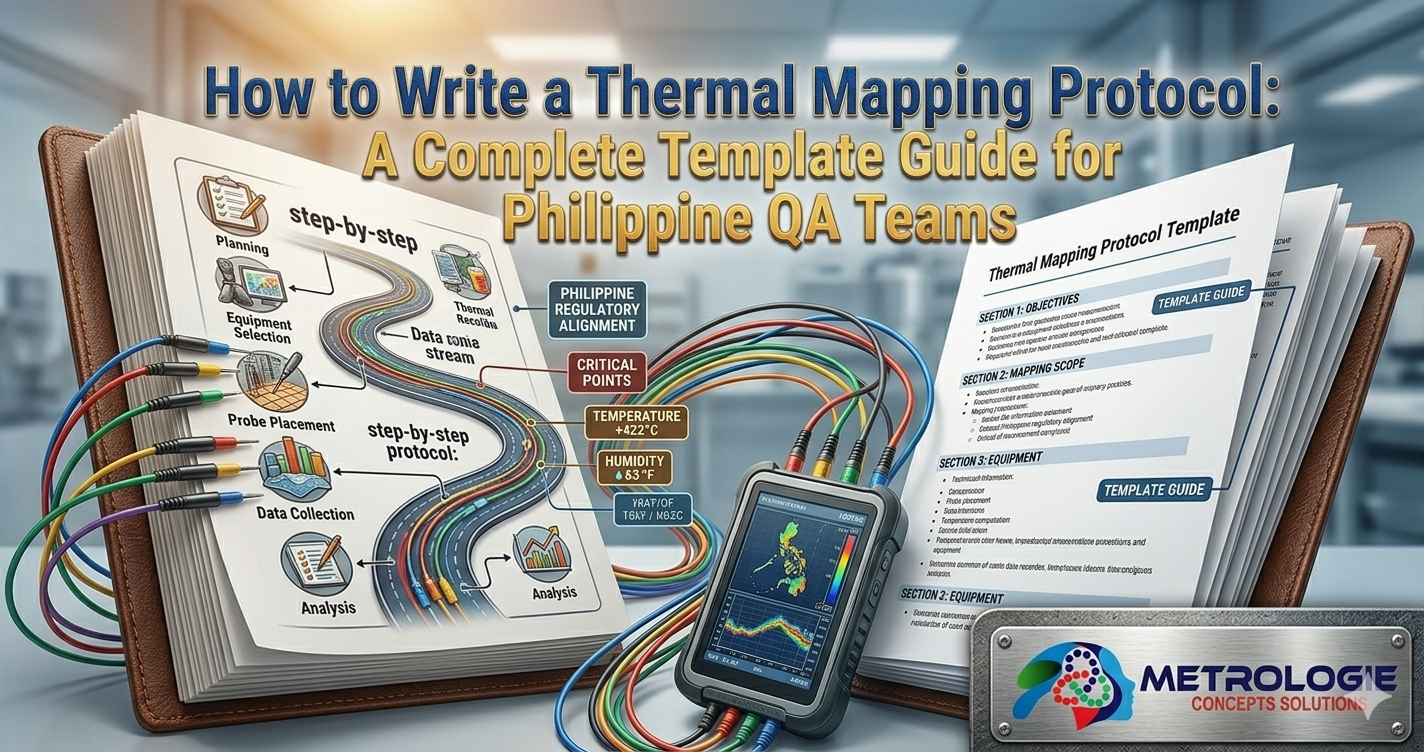
This guide provides the most comprehensive and practical explanation of thermal mapping protocol requirements available for Philippine QA professionals. It covers every section of a compliant protocol, explains why each element is required by WHO and GMP standards, provides specific guidance on Philippine-context considerations, and includes a detailed section-by-section template that Philippine QA teams can use as the starting framework for their own protocols.
The Fundamental Rule of Protocol Writing
- The protocol must be approved BEFORE the study begins. This is one of the most basic and most frequently violated requirements in thermal mapping practice in the Philippines.
- A protocol written after the study — to retrospectively document what was done — is not a GMP document. It is a reconstruction, and it will not be treated as evidence of a prospectively planned, controlled study by any competent regulatory inspector or auditor.
- Write and approve the protocol first. Execute the study second. Analyse and report third. This sequence is non-negotiable.
1. What a Thermal Mapping Protocol Is — and Why It Matters
A thermal mapping protocol is a formal, pre-approved quality document that defines the design, methodology, acceptance criteria, and responsibilities for a thermal mapping study. It is the GMP equivalent of a study plan — the document that tells every reviewer, before the study is conducted, exactly how it will be done and what it must demonstrate to be considered a success.
The protocol serves five distinct functions in a thermal mapping programme:
Function 1: Establishing the Scientific Basis of the Study
The protocol defines why sensors are placed where they are, how many sensors are adequate for the storage area being mapped, and what conditions the study must be conducted under to produce representative data. Without these documented justifications, a reviewer cannot assess whether the study was scientifically sound — they can only see the results without understanding whether the study design was adequate to produce valid results.
Function 2: Defining Acceptance Criteria Before the Data Is Seen
This is the most critical function of the protocol. The acceptance criteria — the specific temperature range that must be maintained throughout the study for the storage area to qualify — must be defined before any data is collected. If acceptance criteria are defined after the data is reviewed, there is always the risk that they have been set to ensure the study passes rather than to genuinely protect product quality. Pre-defined acceptance criteria are the cornerstone of the objectivity that makes a qualification study meaningful.
Function 3: Creating the Audit Trail for Regulatory Compliance
When a Philippine FDA inspector, WHO auditor, or principal auditor reviews your thermal mapping documentation, the protocol is one of the first documents they will ask for. It demonstrates that the study was planned in advance, that qualified personnel reviewed and approved the plan, and that the study was conducted according to a pre-approved methodology — not improvised on the day. An approved protocol with pre-dated signatures is irreplaceable audit trail evidence.
Function 4: Protecting the Organisation If Results Are Challenged
A thermal mapping study whose results are challenged — for example, by an FDA inspector who questions whether the study was adequate — can only be defended if the protocol demonstrates that the study was designed appropriately, conducted according to the approved plan, and evaluated against pre-defined criteria. Without a protocol, there is no documented basis for defending the study’s methodology against any challenge.
Function 5: Enabling Consistent, Reproducible Studies
A well-written protocol enables the same study to be repeated under consistent conditions — for example, for seasonal remapping studies or periodic requalification. Without a documented protocol, each remapping study may be conducted differently by different teams, making it impossible to compare results meaningfully across study cycles.
2. The Regulatory Basis for Protocol Requirements in the Philippines
The requirement for a written, pre-approved protocol for thermal mapping studies is embedded in multiple regulatory frameworks applicable to Philippine businesses. Understanding which framework applies to your organisation helps you write a protocol that meets all relevant requirements simultaneously.
WHO TRS 961 Supplement 8 Requirements
WHO Technical Report Series No. 961, Supplement 8 — the global reference standard for pharmaceutical warehouse temperature mapping — states that a temperature mapping study should be performed in accordance with a pre-approved protocol. The Supplement specifies that the protocol should define: the scope of the study, the acceptance criteria, the number and position of sensors, the duration of the study, the conditions under which the study will be conducted, and the responsibilities of all personnel involved. These elements form the minimum content of any WHO-compliant thermal mapping protocol.
GMP and PIC/S Requirements
Good Manufacturing Practice guidelines — including the PIC/S GMP guidelines followed by Philippine pharmaceutical manufacturers — require that qualification studies (including thermal mapping as part of OQ/PQ) be conducted according to pre-approved protocols. PIC/S Annex 15 on Qualification and Validation specifies that qualification protocols should state predetermined acceptance criteria, be reviewed and approved by an authorised person before execution, and provide a systematic approach to documenting qualification activities. These requirements apply to all GMP-covered pharmaceutical facilities in the Philippines.
FDA Philippines: Circular 2021-003
While FDA Circular 2021-003 does not prescribe the specific format of thermal mapping protocols, its requirement for documented qualification of storage areas — aligned with WHO Good Distribution Practice guidelines — implicitly requires that the qualification be conducted according to a pre-approved plan. An FDA inspector reviewing a cold chain compliance file who finds a mapping study without a protocol will recognise immediately that the study was conducted without the formal quality framework required by WHO GDP standards.
ISPE Good Practice Guide
The ISPE Good Practice Guide: Controlled Temperature Chambers (Second Edition, 2021) provides the most detailed industry technical guidance on mapping protocol content for pharmaceutical controlled temperature environments. The ISPE guide requires that protocols include: a risk assessment that justifies sensor placement, defined test conditions for both OQ and PQ phases, specific requirements for power failure testing, requirements for ambient conditions documentation, and defined data integrity requirements for the logging and storage of mapping data.
3. The Complete Thermal Mapping Protocol: Section by Section
A compliant thermal mapping protocol for a Philippine pharmaceutical, food, or logistics facility consists of a defined set of sections, each serving a specific purpose in the overall qualification framework. The following is the complete section-by-section guide, including the content requirements for each section, the regulatory basis for each requirement, and Philippine-specific considerations that should be reflected in the protocol.
Section 1: Protocol Header and Identification
- Protocol Title: A descriptive title that identifies the study type (Thermal Mapping / OQ / PQ), the storage area being mapped, and the temperature category. Example: “Thermal Mapping Protocol — Operational Qualification (OQ) — Pharmaceutical Cold Room C-01, +2°C to +8°C — [Facility Name]”
- Protocol Number: A unique document control number assigned by the quality management system. Example: TMP-2025-001. This number links the protocol to the corresponding report and all associated calibration certificates.
- Version Number: The current version of the protocol (V1.0 for initial; V1.1 for minor amendments; V2.0 for major revisions). Changes from previous versions must be documented in a revision history section.
- Effective Date: The date from which this protocol is approved for use. Must be a date BEFORE the study begins — never backdated.
- Facility / Site Name: The full legal name and address of the facility where the study will be conducted.
- Storage Area Identifier: The unique identifier for the storage area being mapped (e.g., Cold Room C-01, Warehouse Zone B, Pharmaceutical Refrigerator PR-05).
Section 2: Purpose and Scope
- Study Purpose: A clear statement of what the protocol is designed to demonstrate. Example: “This protocol defines the methodology for conducting an Operational Qualification thermal mapping study of Cold Room C-01 to demonstrate that the room maintains a temperature between +2°C and +8°C throughout its entire storage volume under empty conditions.”
- Study Phase: Whether this is an IQ, OQ, or PQ study — or a seasonal requalification study. The distinction matters for sensor placement (OQ: empty room; PQ: loaded room).
- Scope of Coverage: The physical boundaries of the study — the exact dimensions of the storage area covered, and any areas explicitly excluded from the study with justification for the exclusion.
- Regulatory Basis: The specific regulatory frameworks and standards this study is designed to comply with — e.g., WHO TRS 961 Supplement 8; GMP / PIC/S Annex 15; FDA Circular No. 2021-003; ISPE Good Practice Guide: Controlled Temperature Chambers (2021). Listing these references demonstrates the regulatory awareness of the protocol author and provides the reviewer with context for evaluating the protocol’s requirements.
Section 3: Risk Assessment and Rationale for Study Design
- Storage Area Risk Assessment: A systematic evaluation of the thermal risk factors present in the storage area being mapped. For Philippine facilities, this should explicitly address: known or suspected hot spots (loading dock zone, south/west-facing walls, ceiling area near uninsulated roof); known or suspected cold spots (areas adjacent to evaporator coils, freezer plate areas); HVAC configuration and identified dead zones; power supply reliability and generator activation time; seasonal ambient conditions at the facility location (citing PAGASA data for the relevant region).
- Risk-to-Sensor-Count Link: A documented connection between the risk assessment findings and the sensor placement strategy. Regulators and auditors increasingly expect protocols to justify sensor count and placement through a risk-based argument — not just through geometric rules. The risk assessment provides the documented basis for this justification.
- Seasonal Context Statement: An explicit statement of which season this study covers and why that season was selected. For a summer study: “This study will be conducted during April-May [year] to capture the worst-case ambient conditions for CRT storage in the Philippines, as required by WHO TRS 961 Supplement 8 for facilities in climates with significant seasonal variation.” For a wet season study, the rationale changes accordingly.
Section 4: Acceptance Criteria
- Primary Temperature Range: The specific temperature range that must be maintained throughout all sensor locations for the full study period. This is the most important number in the protocol. Example: “All sensor readings must remain within +2°C to +8°C throughout the study period.”
- Uniformity Criterion: The maximum acceptable temperature difference between the hottest and coldest sensors at any point during the study period (excluding door-opening transients). Example: “Temperature uniformity shall not exceed 5°C at any time during steady-state operation.” This criterion ensures the room’s temperature distribution is acceptable — not just that the overall range is met.
- Excursion Duration Limit: If brief temperature excursions are permissible (e.g., during door openings or defrost cycles), the maximum duration of any single excursion must be specified. Example: “Temperature excursions above +8°C due to door openings are permitted for a duration not exceeding 10 minutes, provided the temperature returns to within +2°C to +8°C within 15 minutes of door closure.”
- Power Failure Test Criterion: The minimum acceptable holdover time for the power failure simulation. Example: “The time from power interruption to the hottest sensor reaching +8°C shall be not less than 30 minutes under empty room conditions.” This criterion drives the generator specification and emergency response SOP trigger time.
- Rationale for Criteria: A documented justification for each acceptance criterion — why these specific values are appropriate for the products stored and the regulatory framework applicable. Criteria without rationale will be questioned by regulators.
Section 5: Equipment List and Calibration Requirements
- Data Logger Specifications: The make, model, serial number, and measurement range of each data logger to be used. The specification must confirm that the logger is appropriate for the temperature range of the study (accuracy ≤ ±0.5°C; recording interval 5 to 15 minutes; battery life exceeding study duration).
- Calibration Requirement: Explicit statement that all data loggers must have a valid, current calibration certificate from a laboratory accredited by the Philippine Accreditation Bureau (PAB) to ISO/IEC 17025 before deployment. Example: “All data loggers shall be calibrated within [30 days] prior to study commencement by a PAB-accredited laboratory. Calibration certificates shall be attached to the study report.”
- Calibration Temperature Points: The specific temperature points at which each data logger will be calibrated — must cover the expected study temperature range. For a +2°C to +8°C cold room study: calibration points at 0°C, +5°C, and +10°C minimum.
- Post-Study Calibration (Optional but Recommended): Statement of whether post-study calibration will be conducted. Best practice is to calibrate loggers again after the study to confirm accuracy did not drift during the study period. If any post-study calibration reveals drift exceeding ±0.5°C, the affected data period must be reviewed and potentially rejected.
- Ambient Conditions Recording Equipment: Specification of the instrument that will record outdoor temperature and humidity throughout the study period. This instrument must also be calibrated and its serial number and calibration certificate must be documented.
Section 6: Sensor Placement Plan
- Total Sensor Count: The number of data loggers to be deployed, with reference to the risk assessment in Section 3 and the WHO/ISPE guidance on minimum sensor density for the storage area size. Example: “18 data loggers will be deployed across Cold Room C-01 (volume approximately 45 cubic metres) in accordance with WHO TRS 961 Supplement 8 sensor placement guidance.”
- Sensor Position Table: A numbered list or table identifying every sensor by its unique ID, its physical position (e.g., ‘DL-01: Top-Front-Left corner, 0.5m from ceiling, 0.3m from front wall, 0.3m from left wall’), and the risk rationale for its placement (e.g., ‘DL-01: Geometric corner coverage per WHO TRS 961 guidance’).
- Floor Plan Diagram Reference: Reference to the annotated floor plan diagram (attached to the protocol as Appendix A) showing all sensor positions marked by ID. The diagram must show the cold room dimensions, the positions of the evaporator unit, door, and any HVAC diffusers, and all sensor positions labelled by ID.
- Mounting Method: How sensors will be secured at their positions — e.g., suspended from racking, taped to walls, placed on dedicated stands. The mounting method must ensure sensors cannot be accidentally displaced during the study period.
- Position of Existing Monitoring Sensor: An explicit statement of where the existing permanent monitoring sensor is located, and confirmation that a mapping sensor will be placed adjacent to it to validate its representative positioning.
Section 7: Study Conditions
- Room Loading Condition: For OQ: ‘The storage area will be empty (or minimally loaded with empty pallets/cartons simulating rack structure only).’ For PQ: ‘The storage area will be loaded to approximately [70-80]% of normal operational stock capacity with product or equivalent thermal mass.’
- HVAC/Refrigeration Operating Settings: The thermostat setpoint and HVAC operating configuration during the study. Example: “The cold room shall be operated with thermostat setpoint at +4°C throughout the study period. No changes to the thermostat setting or HVAC configuration shall be made during the study period.”
- Door Opening Protocol: The frequency and duration of door openings to be simulated during the study period. Must represent normal operational conditions. Example: “Door openings will be simulated at a frequency of [X] openings per working shift (8 hours), each door opening lasting approximately [Y] minutes, consistent with normal loading and dispensing operations.” Philippine context note: door opening temperature impact is more severe in summer; the study conditions must reflect the actual operational access pattern.
- Power Supply Conditions: Whether the study will be conducted on main power or backup generator power. Primary studies should be conducted on normal main power to capture real operational conditions including any power interruption events that occur naturally during the study period.
- Ambient Temperature Monitoring: Confirmation that outdoor temperature and humidity will be recorded continuously throughout the study period by a calibrated instrument. Required for WHO Supplement 8 compliance and for seasonal study documentation.
Section 8: Study Duration
- Minimum Study Duration: The minimum number of hours of continuous data collection, with justification. Example for a pharmaceutical cold room: “The study shall run for a minimum of 72 continuous hours, sufficient to capture multiple defrost cycles, diurnal temperature variation, and a representative door-opening event profile.” Example for a large pharmaceutical warehouse: “The study shall run for a minimum of 7 days to capture full weekly operational cycles including weekend low-activity periods.”
- Study Start and End Conditions: The conditions under which the study period officially begins — typically after a defined stabilisation period. Example: “Data collection for qualification analysis shall commence only after the cold room has operated continuously at setpoint for a minimum of 24 hours following sensor deployment.” Pre-stabilisation data may be collected but is excluded from acceptance criteria analysis.
- Study Extension Criteria: Conditions under which the study duration will be extended. Example: “If any data logger records a technical failure (missing data, battery exhaustion) during the study period, the study duration will be extended to provide a complete 72-hour dataset from all functioning sensors.”
Section 9: Power Failure Test Protocol
- Test Timing: When in the study the power failure simulation will be conducted. Best practice: after a minimum of 48 hours of stable baseline data collection, so that the room temperature profile is fully established before the test. Example: “The power failure test shall be conducted between Hours 48 and 72 of the study, when the storage area has demonstrated stable temperature distribution at normal operating conditions.”
- Test Procedure: Step-by-step instructions for conducting the test. Example: “(1) Record all sensor temperatures and confirm the storage area is at its normal operating temperature range. (2) Interrupt power to the refrigeration/HVAC system at [main circuit breaker/disconnect switch location]. (3) Continue recording all sensor temperatures at the standard interval. (4) Monitor until either: the hottest sensor reaches the upper acceptance limit (+8°C), OR a maximum of [60] minutes has elapsed — whichever occurs first. (5) Restore power. (6) Continue monitoring until all sensor temperatures return to within acceptance criteria.”
- Test Acceptance Criterion: The minimum holdover time requirement, as specified in Section 4 of the protocol. Example: “The power failure test passes if the time from power interruption to the first sensor reaching +8°C is not less than 30 minutes.”
- Data Recording: Confirmation that all sensor data will be collected throughout the power failure test at the standard recording interval, with the time of power interruption and power restoration logged as formal test events.
Section 10: Data Management and Integrity
- Data Download Procedure: How and when sensor data will be downloaded — at the end of the study period, with immediate backup of raw data files. Example: “Data loggers will be retrieved and data downloaded immediately upon study completion. Raw data files will be backed up to [secure server location] within 24 hours of download.”
- Data Integrity Requirements: Requirements for protecting data from alteration. For GMP pharmaceutical applications: raw data files must be in a tamper-evident format; any manual data entry or corrections must be documented with reason, date, and initials (ALCOA+ principles: Attributable, Legible, Contemporaneous, Original, Accurate). For non-GMP food and logistics applications, data integrity requirements may be less stringent but raw data must still be retained unaltered.
- Missing Data Handling: The procedure if any data logger fails to record data for part of the study period. Example: “If any data logger records a gap in data exceeding [30 minutes], the affected logger’s data for the gap period will be excluded from analysis, and the gap will be documented in the mapping report with an explanation of its cause. If the gap occurs during a critical period (door opening simulation or power failure test), a protocol deviation will be raised and the affected test phase will be repeated.”
- Data Retention: How long all study data — raw data files, analysis spreadsheets, calibration certificates, ambient conditions records, and the final report — will be retained. For pharmaceutical facilities: the life of the storage area plus a minimum of five years. The retention location (physical filing system, electronic document management system) must be specified.
Section 11: Deviations and Non-Conformances
- Deviation Definition: What constitutes a protocol deviation for this study. Example: “A protocol deviation occurs when any planned element of this protocol is not executed as written — including: sensor deployment at a position different from the approved sensor plan without prior amendment, study duration shorter than the specified minimum, power failure test conducted at a different stage than specified, or ambient conditions recording gap exceeding [2 hours] during the study period.”
- Deviation Handling Procedure: The procedure for documenting and resolving deviations. Example: “Any deviation from this protocol shall be documented in a Deviation Report, identifying the deviation, its cause, its potential impact on study validity, and the corrective action taken. All deviations shall be reviewed and classified (minor or major) by the QA reviewer before the study report is finalised. A major deviation may require the affected study phase to be repeated.”
- Protocol Amendment Process: How the protocol can be amended if study conditions require a change before or during the study. Example: “Amendments to this protocol require a written protocol amendment document, reviewed and approved by the QA manager, before the amended procedure is executed. Verbal amendments are not permitted.”
Section 12: Roles, Responsibilities, and Approval Signatures
- Protocol Author: Name, title, and date of the person who wrote the protocol. Signature required.
- Study Executor: Name, title, and qualifications of the person(s) responsible for conducting the study — deploying sensors, monitoring the study in progress, and retrieving sensors. Signature required.
- QA Reviewer: Name, title, and date of the QA manager or quality team member who reviewed the protocol for completeness and compliance with applicable standards. Signature required before study begins.
- Qualified Person / Management Approver: Name, title, and date of the authorised person who approves the protocol for execution. This is the final approval signature that makes the protocol an effective document. Signature must be dated BEFORE the study start date.
- Approval Date vs. Study Start Date: The protocol approval date must precede the study start date. Any mapping study where the protocol approval date is the same as or after the study start date fails the GMP requirement for pre-approved protocols. This is a common deficiency in Philippine pharmaceutical facility documentation reviews.
4. Philippine-Specific Protocol Elements: What Global Templates Miss
Most thermal mapping protocol templates available online were written for temperate-climate pharmaceutical operations in Europe, North America, or Singapore. They do not adequately address the specific requirements of Philippine operating conditions. Here are the Philippine-specific elements that must be incorporated into any mapping protocol for a Philippine facility.
Seasonal Context Documentation
Every thermal mapping protocol for a Philippine facility must explicitly state which season the study covers and why. This is required by WHO TRS 961 Supplement 8’s seasonal mapping provision. The protocol should state: the target months for the study, the PAGASA climate data for the facility location that demonstrates significant seasonal variation, and whether this study is the hot dry season study or the wet season study in the facility’s two-season mapping programme.
A protocol that does not address seasonality will produce a study that cannot demonstrate the seasonal coverage required by WHO Supplement 8 — regardless of how otherwise well-designed the study is.
PAGASA Ambient Temperature Reference
The protocol should specify the expected ambient temperature range during the study period, referenced to PAGASA historical data for the specific city or province where the facility is located. Example: “This study will be conducted during April-May [year] in [City], [Province]. Based on PAGASA historical climate data, maximum daytime temperatures during this period range from [X°C] to [Y°C]. This study is therefore conducted under worst-case ambient conditions for CRT pharmaceutical storage in this location.”
This reference to PAGASA data contextualises the study results for any reviewer who needs to assess whether the study was conducted under representative worst-case conditions.
Power Interruption Context
For facilities in areas with known power supply instability, the protocol should document the local power supply reliability context and the backup power configuration available at the facility. Example: “This facility is served by [utility provider]. Power interruptions averaging [X hours per month] have been recorded at this facility over the past 12 months. Backup power is provided by a [generator capacity] diesel generator with automatic transfer switch, with a verified transfer time of [X seconds]. The power failure test duration criterion of [Y minutes] in this protocol is set to exceed the maximum brownout duration experienced at this facility, providing a meaningful test of holdover adequacy.”
Urban Heat Island Acknowledgement (Metro Manila and Major Cities)
For facilities in Metro Manila and other urban industrial areas, the protocol should acknowledge the urban heat island effect and its potential impact on effective ambient conditions at the facility location. The risk assessment section should note whether the facility is located in a built-up industrial area where ambient temperatures may be $2^\circ\text{C}$ to $4^\circ\text{C}$ higher than PAGASA station readings, and whether the study will be conducted under conditions representative of this elevated urban ambient.
Rainy Season Power Failure Test Specification
For wet season studies, the power failure test specification should address the typhoon-season power interruption risk profile — which may involve longer outages than the summer profile. A wet season protocol power failure test criterion should be calibrated to the typhoon-season brownout risk for the facility location, not just the average brownout duration.
5. The Ten Most Common Protocol Mistakes Philippine QA Teams Make
Reviewing thermal mapping protocols and documentation for Philippine pharmaceutical and food companies regularly reveals the same recurring mistakes. Here are the ten most common — and how to avoid them.
Mistake 1: Protocol Signed After the Study Date
This is the single most serious protocol deficiency in Philippine thermal mapping documentation reviews. If the QA manager’s approval signature on the protocol is dated on the same day as or after the study start date, the study was conducted without a pre-approved protocol — violating the most fundamental GMP documentation requirement for qualification studies. Every protocol approval signature must be dated before the study commences. Build time for protocol review and approval into the mapping study project schedule.
Mistake 2: Acceptance Criteria Not Specified — or Specified as a Range That Is Too Broad
Some Philippine protocols specify acceptance criteria such as “temperature must be within acceptable limits” or “temperature must meet regulatory requirements” — without specifying what those acceptable limits are. This is not an acceptance criterion; it is a placeholder. A compliant protocol specifies the exact temperature range, any permitted excursion duration, and the justification for these specific values.
Mistake 3: Sensor Placement Not Justified
A protocol that lists sensor positions without explaining why those positions were chosen — what risk assessment rationale, what WHO guidance, what specific risk factor at each position justifies its inclusion — is an incomplete protocol. Regulators and auditors expect sensor placement to be justified through a risk-based argument. “We placed sensors at these 8 corners because that is what everyone does” is not adequate justification.
Mistake 4: No Reference to Seasonal Requirements
Many Philippine mapping protocols contain no mention of seasonal variation, seasonal mapping requirements, or which season the study covers. This omission is particularly significant given that WHO TRS 961 Supplement 8 explicitly requires seasonal studies for Philippine facilities. A protocol that does not address seasonality cannot demonstrate that the study was planned as part of a compliant two-season qualification programme.
Mistake 5: Calibration Requirements Not Specified or Not Traceable
Some protocols state that “calibrated data loggers will be used” without specifying: what accuracy is required, what temperature points will be covered in the calibration, whether the calibrating laboratory must be PAB-accredited, or how calibration traceability will be documented. These omissions undermine the entire measurement validity of the study.
Mistake 6: No Power Failure Test Protocol
Many Philippine mapping protocols do not include a power failure test section at all. For pharmaceutical cold chain facilities subject to FDA Circular 2021-003 and WHO GDP requirements, this omission means the qualification study does not address one of the most practically important compliance questions for Philippine operations — how long can the storage area protect products when power is interrupted.
Mistake 7: Study Conditions Not Defined or Not Representative
Protocols that specify only “normal operating conditions” without defining what those conditions are — HVAC setpoint, room loading level, door opening frequency — leave the study executor with no guidance on how to conduct the study, and leave reviewers with no basis for assessing whether the study was conducted representatively. Study conditions must be defined specifically enough that two different executors would conduct the study the same way.
Mistake 8: No Deviation Handling Section
Protocols without a defined deviation handling procedure leave QA teams uncertain about how to respond when something does not go according to plan during the study — a sensor failure, an unplanned power interruption, a study condition that cannot be maintained as specified. The deviation section is not a bureaucratic addition; it is a practical guide for managing the unexpected.
Mistake 9: Protocol Not Version Controlled
When a protocol is revised — because the study design changes, additional sensors are added, or acceptance criteria are modified — the revision must be documented with a new version number, a revision history section explaining what changed and why, and new approval signatures. Protocols without version control create confusion about which version governed a particular study and make it difficult to trace how the qualification programme evolved over time.
Mistake 10: Generic Template Not Adapted to the Specific Facility
Using a generic template downloaded from the internet without adapting it to the specific facility, storage area, product types, regulatory context, and Philippine operating conditions produces a protocol that is superficially complete but lacks the specific details that make a protocol genuinely useful and genuinely compliant. Every protocol element — from sensor positions to acceptance criteria to study conditions — must reflect the specific reality of the facility being mapped.
6. Protocol Review Checklist: Before You Approve, Check These 20 Items
Before any QA manager signs a thermal mapping protocol, the following checklist should be completed. Every item on this list corresponds to a WHO, GMP, or FDA requirement, or to a practical element necessary for a defensible qualification study.
| # | Checklist Item | Regulatory Basis | Status |
| 1 | Protocol title clearly identifies storage area, temperature category, and study phase (OQ/PQ/seasonal) | GMP document control; WHO Supp. 8 | ☐ Pass ☐ Fail |
| 2 | Unique document control number assigned | GMP document control | ☐ Pass ☐ Fail |
| 3 | Version number and effective date specified | GMP Annex 15; PIC/S | ☐ Pass ☐ Fail |
| 4 | Study purpose and scope clearly defined — including what the study intends to prove | WHO TRS 961 Supp. 8; ISPE GPG | ☐ Pass ☐ Fail |
| 5 | Applicable regulatory references listed (WHO, FDA Circular 2021-003, GMP, ISPE) | FDA Circular 2021-003; WHO GDP | ☐ Pass ☐ Fail |
| 6 | Risk assessment completed — identifies hot spots, cold spots, HVAC dead zones, and Philippine-specific risks | ISPE GPG; WHO Supp. 8; risk-based approach | ☐ Pass ☐ Fail |
| 7 | Acceptance criteria specified with exact temperature range, uniformity criterion, and excursion limits | WHO TRS 961 Supp. 8; GMP Annex 15 | ☐ Pass ☐ Fail |
| 8 | Rationale documented for each acceptance criterion | GMP; ISPE GPG | ☐ Pass ☐ Fail |
| 9 | Power failure test criterion specified (minimum holdover time) | WHO TRS 961 Annex 9; FDA Circular 2021-003 | ☐ Pass ☐ Fail |
| 10 | Data logger specifications listed (make, model, serial number, accuracy, range) | WHO TRS 961 Supp. 8; GMP | ☐ Pass ☐ Fail |
| 11 | PAB-accredited pre-study calibration required — explicitly stated in protocol | WHO TRS 961 Supp. 8; ISO/IEC 17025 | ☐ Pass ☐ Fail |
| 12 | Calibration temperature points cover full study temperature range | WHO TRS 961 Supp. 8 | ☐ Pass ☐ Fail |
| 13 | All sensor positions identified with unique ID and position description | WHO TRS 961 Supp. 8; ISPE GPG | ☐ Pass ☐ Fail |
| 14 | Sensor placement risk-justified — each position linked to a risk assessment rationale | ISPE GPG; WHO Supp. 8 risk-based approach | ☐ Pass ☐ Fail |
| 15 | Floor plan diagram with all sensor positions attached as appendix | WHO TRS 961 Supp. 8; GMP documentation | ☐ Pass ☐ Fail |
| 16 | Study conditions defined — room loading, HVAC setpoint, door opening frequency | WHO TRS 961 Supp. 8; ISPE GPG | ☐ Pass ☐ Fail |
| 17 | Seasonal context documented — which season, PAGASA reference, Philippine-specific risk | WHO TRS 961 Supp. 8 seasonal requirement | ☐ Pass ☐ Fail |
| 18 | Power failure test procedure defined step by step | WHO TRS 961 Annex 9; ISPE GPG | ☐ Pass ☐ Fail |
| 19 | Deviation handling procedure defined | GMP Annex 15; PIC/S | ☐ Pass ☐ Fail |
| 20 | All approval signatures are dated BEFORE the study start date | GMP Annex 15 — pre-approved protocol | ☐ Pass ☐ Fail |
7. When to Write the Protocol Yourself vs. When to Engage a Specialist
A common question from Philippine QA teams is whether they should write the mapping protocol themselves or whether it should be written by the specialist service provider conducting the study. The answer depends on the capacity of the internal QA team and the complexity of the study — but the general principle is that the organisation being qualified is ultimately responsible for the quality and completeness of its own qualification documentation, regardless of who writes the first draft.
When Internal QA Team Protocol Writing Is Appropriate
Internal QA teams should write, or at least lead the writing of, thermal mapping protocols when: the QA team has sufficient technical knowledge of GMP qualification requirements and WHO TRS 961 Supplement 8 to produce a compliant document; the storage area has been mapped before and the previous protocol can serve as a reference for the new protocol; and the organisation has a mature quality management system with document control procedures that support the formal protocol writing and approval process.
Internal protocol writing builds QA team competency, ensures the protocol reflects deep knowledge of the specific facility and its regulatory context, and creates internal ownership of the qualification documentation that is important for long-term compliance programme management.
When Engaging a Specialist Service Provider for Protocol Development Is Appropriate
Engaging a specialist service provider for protocol development is appropriate when: the QA team is new to thermal mapping and lacks the technical background to write a WHO and GMP compliant protocol; the storage area is being mapped for the first time and there is no previous protocol to reference; the study involves complex requirements (ultra-cold storage, multi-zone mapping, transport container qualification) that require specialist technical expertise; and international principal qualification requirements demand a higher level of protocol rigour than the internal team can currently produce.
When a specialist service provider writes the protocol, the internal QA team should still review it carefully before approval — because the QA manager who signs the approval signature is certifying that the protocol is appropriate for the facility and compliant with all applicable requirements. A QA manager who signs a protocol without understanding its content cannot defend it if challenged.
The Collaborative Model — Best Practice for Philippine Facilities
The most effective model for Philippine pharmaceutical and food businesses building their thermal mapping capabilities is collaborative protocol development: the service provider prepares the initial draft based on a detailed site assessment, the internal QA team reviews it, raises questions and suggests amendments based on facility-specific knowledge, and the final protocol reflects both the technical expertise of the provider and the facility-specific knowledge of the internal team. Over time, the internal team’s capability increases with each study, until the team can lead protocol development independently with the service provider in a review and execution role only.
8. Frequently Asked Questions: Thermal Mapping Protocol Writing in the Philippines
Does the protocol need to be written in a specific format or template?
No regulatory framework specifies a mandatory format or template for thermal mapping protocols. The requirements are about content — what the protocol must include — not about format or layout. However, a clear, well-structured format that follows the logical sequence of study design to execution to analysis makes the protocol easier to review and audit. The section structure described in this article reflects industry best practice for pharmaceutical mapping protocols and is well-suited to Philippine FDA and WHO GDP audits.
Can the protocol and the report be combined into a single document?
In some industry practices, particularly for simpler or repeat studies, the protocol and report are combined into a single Protocol and Report document, where the protocol sections are filled in before the study and the report sections are completed after. This combined format can be efficient for routine requalification studies where the protocol is well-established. However, for new qualification studies and for pharmaceutical GMP applications, maintaining a separate pre-approved protocol and a separate post-study report provides clearer evidence of the pre-approval requirement and is generally preferred by regulators.
What if our acceptance criteria are challenged by an FDA inspector as being too lenient?
Acceptance criteria should be justified in the protocol with specific, documented rationale — typically referencing the storage requirements of the most temperature-sensitive product stored, the pharmacopeial or regulatory standard defining those requirements, and the product manufacturer’s storage specifications. If your acceptance criteria are the same as the regulatory product storage requirements (e.g., $+2^\circ\text{C}$ to $+8^\circ\text{C}$ for refrigerated pharmaceuticals), they are by definition adequate. If your criteria are broader than the regulatory requirements, you need a documented justification for why broader limits are acceptable for your specific products.
We conduct our mapping study with an external service provider. Who owns the protocol?
The organisation responsible for the qualified storage area — the pharmaceutical company, food business, logistics operator, or healthcare facility — owns the qualification documentation, including the mapping protocol. The service provider may draft the protocol, but the organisation’s QA manager must review, approve, and take responsibility for its content. The protocol is the organisation’s document — it must be filed in the organisation’s document management system, controlled under the organisation’s version control procedures, and approved by the organisation’s authorised personnel.
How detailed does the sensor placement justification need to be?
The level of detail required for sensor placement justification has been increasing as regulatory expectations evolve. At minimum, the protocol should state the total number of sensors, confirm that this number is consistent with WHO TRS 961 Supplement 8 guidance for the storage area volume, and identify the specific risk factor that each sensor location addresses (geometric coverage, hot spot risk, cold spot risk, HVAC dead zone, etc.). A more detailed justification — linking each sensor position to a specific finding from the risk assessment section — is best practice and makes the protocol much more defensible if challenged. An inspector who asks ‘why did you place a sensor at position DL-07?’ should find the answer in the protocol’s risk assessment and sensor placement rationale.
Conclusion: The Protocol Is Where Compliance Begins
A thermal mapping study is only as good as the protocol that governs it. Without a pre-approved, technically sound, Philippine-context-aware protocol, a mapping study produces data — but not qualification evidence. The protocol is what transforms temperature measurements into a legally and scientifically defensible demonstration of compliance.
For Philippine QA teams building or improving their thermal mapping programmes, protocol quality is the foundation. A well-written, WHO-compliant, FDA Circular 2021-003-aligned protocol that addresses seasonal requirements, risk-based sensor placement, Philippine power supply realities, and pre-defined acceptance criteria is the document that makes every other element of the mapping study meaningful.
Metrologie Solutions Philippines helps Philippine QA teams develop, review, and improve their thermal mapping protocols — ensuring they meet every applicable standard and provide the defensible documentation foundation that Philippine pharmaceutical, food, and healthcare organisations need. We also conduct full thermal mapping studies from protocol through report, with PAB-traceable calibration and GMP-quality documentation.
Whether you need your protocol reviewed, your first protocol written, or a complete thermal mapping programme developed from scratch — contact Metrologie Solutions Philippines. Good compliance starts with a good protocol.
Need Your Protocol Reviewed or a New Protocol Written?
- Metrologie Solutions Philippines offers protocol review and development services for Philippine QA teams — ensuring your thermal mapping protocols meet WHO TRS 961 Supplement 8, FDA Circular 2021-003, GMP, and ISPE requirements before your next study begins.
- We also conduct complete thermal mapping studies from protocol through final report, with PAB-accredited calibration and documentation that will satisfy any regulatory inspection.
- Website: metrologiesolutions.com | Services: Protocol Development · Thermal Mapping · Calibration · QA Training
About Metrologie Solutions Philippines
Metrologie Solutions Philippines is the Philippines’ leading provider of thermal mapping services and metrology training. We help QA teams across pharmaceutical, food, logistics, and healthcare sectors design compliant mapping protocols, conduct studies to WHO TRS 961 Supplement 8 and FDA Circular 2021-003 standards, and produce GMP-quality documentation that survives the most rigorous regulatory inspection. Contact us to review your existing protocols or to conduct your next mapping study.