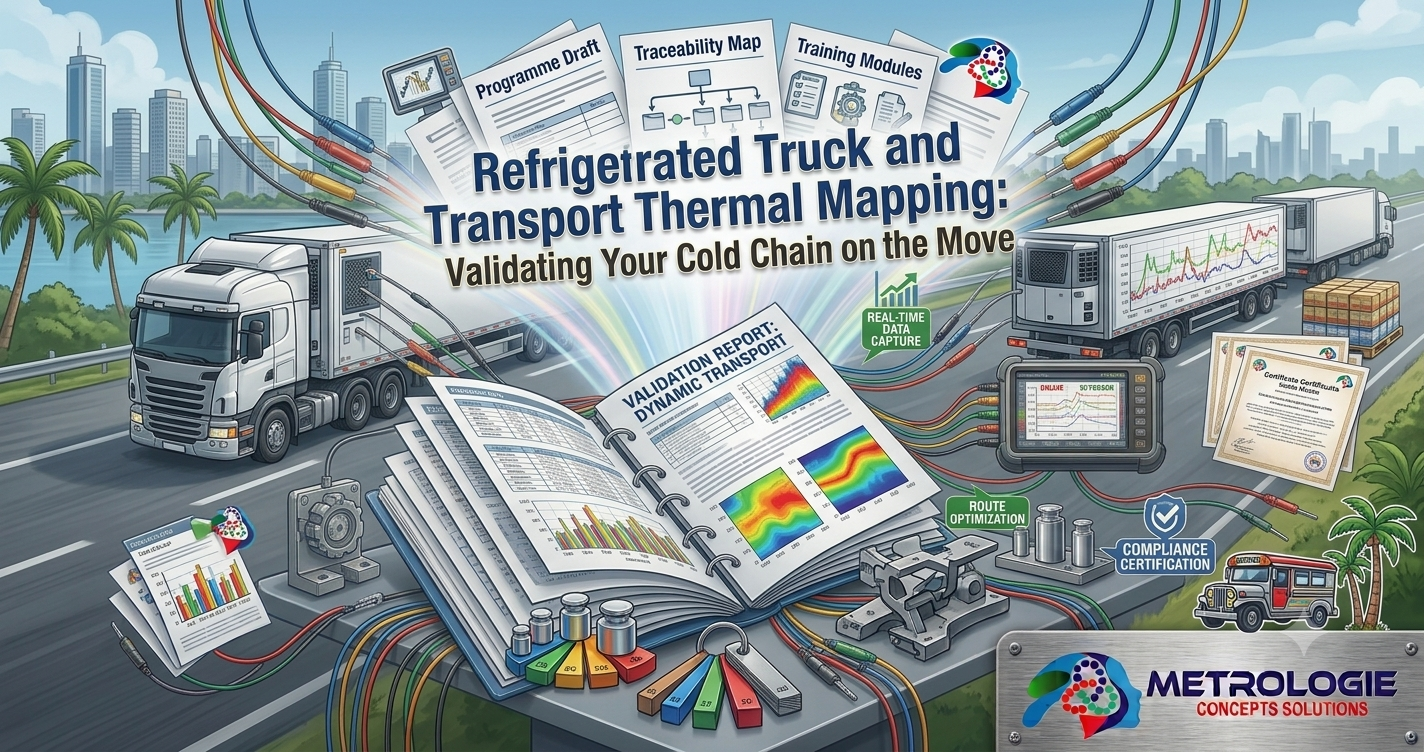
The cold chain does not stop when products leave the warehouse. For pharmaceutical distributors, food manufacturers, and cold chain logistics operators in the Philippines, the transport leg — from distribution centre to hospital, from national cold store to provincial health office, from food processing plant to supermarket — is where some of the most significant temperature compliance risks actually occur.
A pharmaceutical distributor may have a perfectly mapped, fully qualified cold room. Its monitoring sensors are positioned at the hot spots identified in the mapping study. Its calibration certificates are current and PAB-accredited. Its SOPs are approved and trained. And then, on a 37°C April afternoon, its reefer truck makes a two-hour delivery run from Parañaque to Makati, stopping at three hospitals, with the refrigeration unit door opened at each stop and the internal temperature spiking each time.
What happens to the temperature inside that reefer truck? Is the refrigeration unit adequate for Philippine summer ambient conditions? How quickly does the temperature recover after each door opening? Where are the hot spots inside the cargo hold — is the product nearest the door exposed to significantly higher temperatures than the product at the rear? And if the refrigeration unit malfunctions mid-route, how long before the product temperature exceeds its specification?
The answers to these questions — which determine whether your transport cold chain is actually compliant or merely assumed to be compliant — can only come from one source: transport thermal mapping.
Transport thermal mapping is the application of temperature distribution study methodology to refrigerated vehicles and transport containers — characterising how temperature behaves throughout the cargo space during an actual or simulated transport mission, under the ambient conditions of the Philippine operating environment. It is the validation that the warehouse side of the cold chain has long required extended to the movement side — and it is increasingly a regulatory expectation for Philippine pharmaceutical distributors, vaccine cold chain operators, and food logistics companies.
| Why Transport Thermal Mapping Is Different from Warehouse MappingWarehouse thermal mapping characterises a static space under controlled conditions. Transport thermal mapping must characterise a dynamic environment: a vehicle moving through Philippine traffic, with ambient temperatures changing as the vehicle moves between sheltered and exposed locations, doors opened and closed at multiple delivery stops, refrigeration units cycling under varying loads, and the specific thermal characteristics of the vehicle’s insulation and refrigeration system performing against Philippine summer and wet season conditions.The methodology is similar — calibrated sensors, documented protocol, formal report — but the operational context, the acceptance criteria, and the specific Philippine factors that matter most are distinctly different. |
1. The Philippine Transport Cold Chain: Scale, Stakes, and Growing Compliance Pressure
The Philippines’ cold transport market serves a vast and growing range of temperature-sensitive products across one of the world’s most geographically complex distribution environments. <cite index=’18-1′>The Philippine cold transport market encompasses the movement of temperature-sensitive products along the supply chain using thermal and refrigerated packaging techniques and logistical planning, with 4-, 6-, and 8-wheeler reefer trucks carrying between 1 to 10 tons operating primarily for short-distance deliveries, while 20-footer and 40-footer reefer trailers serve longer routes.</cite>
<cite index=’21-1′>The Philippine logistics market is forecasted to grow from USD 21 billion in 2023 to USD 30 billion by 2025, with ASEAN and the Philippines experiencing high demand for refrigerated trucks under 1.5 tons capacity for delivering perishables across the archipelago.</cite> This growth is driven by pharmaceutical distribution expansion, food export growth, e-commerce grocery delivery, and vaccine cold chain strengthening — all of which create transport cold chain compliance obligations that the industry is still developing the systems to meet.
The Regulatory Pressure Is Increasing
FDA Circular 2021-003 — the primary Philippine cold chain compliance regulation for pharmaceutical products — addresses not only storage facilities but the entire cold chain, including transport. The circular requires that pharmaceutical products be maintained within required temperature conditions throughout their journey from supplier to patient. For pharmaceutical distributors operating reefer trucks, this means that the transport vehicle and its refrigeration system must be validated as capable of maintaining the required temperature conditions for the products it carries.
WHO Technical Report Series No. 1010 Annex 7 (2021) — the most recent update to WHO Good Storage and Distribution Practice guidelines, referenced by the Philippine FDA — specifically strengthens transport temperature verification requirements relative to the previous WHO TRS 961 Annex 9, emphasising consistent mapping methodology for both warehouses and transport vehicles. This alignment signals the direction of regulatory travel: transport temperature qualification, not just warehouse qualification, is increasingly the expected standard.
For pharmaceutical distribution companies seeking or renewing Licences to Operate, for 3PL cold chain providers undergoing multinational principal qualification audits, and for vaccine cold chain operators supporting national immunisation programmes, transport thermal mapping is transitioning from a best practice to a compliance requirement.
The Philippine Archipelago: The Most Demanding Transport Cold Chain in Southeast Asia
Distributing temperature-sensitive products across the Philippine archipelago — 7,641 islands, accessed by combination of road, sea, and air transport — creates a cold chain transport environment with few parallels in the region. The specific challenges that make Philippine transport cold chain validation especially important include:
- Multi-modal transport: Many Philippine distribution routes require product to move through multiple transport modes — truck from distribution centre to port, ferry across open water, truck again from port to destination. Each modal transition is a potential temperature excursion point, and the total duration of the multi-modal journey may be 12 to 48 hours or more.
- Philippine tropical ambient conditions: Transport vehicles operating in Philippine summer (March to May) operate against ambient temperatures of 35°C to 38°C or higher. Refrigeration units that maintain adequate temperatures in moderate weather may be marginally adequate or inadequate at Philippine summer peak. Container and box truck bodies without adequate insulation can see internal temperatures well above the setpoint during prolonged summer exposure.
- Traffic congestion and extended dwell times: Urban traffic congestion in Metro Manila, Cebu, and other Philippine cities means that delivery vehicles may be stationary in full sun for extended periods. A reefer truck sitting in EDSA traffic for an hour in April, with the refrigeration unit working against 38°C ambient and direct solar radiation on the vehicle body, faces a significantly higher thermal load than the same vehicle moving at highway speed.
- Multiple delivery stops: Pharmaceutical distribution vehicles making multiple hospital, pharmacy, or clinic deliveries in a single route open the cargo compartment door at each stop, each opening admitting a pulse of hot ambient air. The cumulative effect of multiple door openings during a hot afternoon delivery run can drive cargo compartment temperatures significantly above the refrigeration unit’s setpoint.
- Power supply during ferry transport: Inter-island reefer container transport via ferry raises the question of refrigeration power during the sea voyage. Reefer containers operating on generator power during the sea crossing face potential fuel issues, generator reliability concerns, and the challenge of maintaining temperature during long inter-island passages in tropical conditions.
2. The Regulatory Framework: What Philippine and International Standards Require
Understanding the specific regulatory requirements for transport thermal mapping helps logistics and QA managers prioritise what needs to be done and why.
WHO TRS 1010 Annex 7 (2021): The Updated Standard
WHO Technical Report Series No. 1010 Annex 7 — the 2021 update to Good Storage and Distribution Practice for medical products — represents the most current international guidance on pharmaceutical transport temperature management. The 2021 update explicitly addresses transport temperature qualification, requiring consistent methodology between warehouse qualification and transport vehicle qualification. Key transport-specific requirements include:
- Transport vehicles and containers used for pharmaceutical products must be qualified before use — demonstrating that they can maintain required temperature conditions under actual or simulated operating conditions
- Transport qualification studies must be conducted under conditions representative of the most challenging ambient conditions the vehicle will operate in — for Philippine distribution, this means hot season ambient conditions
- The qualification study must establish the maximum transport duration for which the vehicle or container can maintain temperature compliance — the qualified duration that defines the maximum route length for which the vehicle is validated
- Qualification must be repeated after any modification to the vehicle or refrigeration system, and periodically requalified to confirm ongoing compliance
FDA Circular 2021-003: The Philippine Requirement
FDA Circular 2021-003 requires that pharmaceutical establishments implement cold chain management covering the full journey of pharmaceutical products — including transport. The circular references WHO Good Distribution Practice guidelines, incorporating the WHO TRS 1010 transport qualification requirements into Philippine regulatory expectations. For pharmaceutical distribution companies operating reefer vehicles, this means that transport qualification documentation — which in practice means transport thermal mapping studies — is a component of full FDA circular compliance.
WHO Vaccine Cold Chain Requirements
For vaccine cold chain transport specifically, WHO vaccine cold chain guidelines set strict requirements for transport container qualification. Vaccine transport containers — cold boxes, insulated carriers, and reefer containers used for vaccine distribution — must be qualified for their specific use case, including qualification under Philippine tropical ambient conditions. The qualified duration (holdover time under Philippine ambient) is a critical specification for planning vaccine distribution routes, particularly for the inter-island routes that characterise the Philippine vaccine supply chain.
3. Transport Thermal Mapping vs. Warehouse Thermal Mapping: Key Differences
Understanding how transport thermal mapping differs from the warehouse and cold room mapping covered in earlier articles in this series helps logistics operators and QA managers prepare appropriately for transport qualification studies.
| Dimension | Warehouse / Cold Room Mapping | Transport Vehicle / Container Mapping |
| Study environment | Static enclosed space with stable physical boundaries | Dynamic environment — vehicle moving, vibrating, with changing external conditions |
| Ambient conditions | Relatively stable during study (seasonal variation aside) | Continuously changing as vehicle moves through urban, highway, and port environments |
| Primary acceptance metric | Temperature range maintained throughout full volume | Qualified duration — the time the vehicle maintains temperature compliance under defined ambient conditions |
| Sensor positions | Grid covering full storage volume | Strategic positions: door-adjacent zones, rear of cargo area, near refrigeration unit, centre of cargo at multiple heights |
| Study duration | 72 hours to 7 days (stationary) | Duration of simulated or actual transport mission (typically 4 to 24+ hours) |
| Door opening events | Simulated at operational frequency | Timed to match actual multi-stop delivery pattern |
| Philippine-specific challenge | Solar gain through roof and walls; HVAC capacity in summer | Tropical ambient, solar exposure on vehicle body, traffic congestion dwell time, multi-stop door openings |
| Key output | Hot/cold spot map; power failure holdover time | Qualified duration; door opening temperature impact; worst-case ambient route profile |
| Regulatory basis | WHO TRS 961 Supplement 8; FDA Circular 2021-003 | WHO TRS 1010 Annex 7; FDA Circular 2021-003; vaccine cold chain guidelines |
4. Types of Transport Cold Chain Mapping Studies
Transport thermal mapping is not a single uniform study — it encompasses several distinct study types, each addressing a specific aspect of transport cold chain validation. Philippine cold chain operators need to understand which types of studies apply to their specific operations.
Type 1: Refrigerated Vehicle (Reefer Truck/Van) Qualification
This is the most common type of transport thermal mapping study for Philippine pharmaceutical distributors and food logistics operators. The study characterises the temperature distribution inside a reefer truck or refrigerated van cargo hold during a simulated or actual delivery mission under Philippine operating conditions.
The qualification study addresses:
- Temperature distribution throughout the cargo hold under loaded conditions — where are the hot spots (typically near the rear doors, away from the refrigeration unit) and cold spots (typically near the refrigeration unit evaporator)?
- Temperature response to door openings — how much does cargo hold temperature rise at each delivery stop, and how quickly does it recover after door closure?
- Refrigeration unit performance under Philippine summer ambient — is the refrigeration system adequate for maintaining the required temperature range when ambient is 35°C to 38°C?
- Temperature behaviour in Metro Manila traffic conditions — does extended stationary time in traffic (without vehicle movement to assist condenser airflow) create additional thermal stress on the refrigeration unit?
- Holdover time after refrigeration failure — how long can the insulated cargo hold maintain temperature compliance if the refrigeration unit fails mid-route?
Type 2: Insulated Container and Cold Box Qualification
For Philippine vaccine and pharmaceutical distribution that uses insulated containers — cold boxes, vaccine carriers, phase-change material (PCM) insulated containers — transport mapping characterises the container’s temperature holdover performance under Philippine tropical ambient conditions.
This is critically important for Philippine cold chain operations because: international manufacturer specifications for insulated containers are typically based on temperate-climate ambient conditions (often 25°C or 30°C); Philippine field conditions can be 35°C to 43°C in direct sunlight during summer; and the holdover time under Philippine conditions may be significantly shorter than the manufacturer’s specification, potentially invalidating the route length assumptions built on those specifications.
The insulated container qualification study establishes the actual holdover time under Philippine ambient conditions — typically expressed as a time-temperature profile showing the container’s internal temperature rising from the initial cold temperature to the upper acceptance limit under a defined ambient temperature. This Philippine-specific holdover time is the operational specification that defines the maximum mission duration for which the container is qualified.
Type 3: Lane (Route) Qualification Studies
A lane qualification study extends beyond qualifying a single vehicle or container to qualifying a specific distribution route — mapping the complete temperature journey experienced by products as they move from origin to destination along a defined route under representative conditions.
Lane qualification is the most comprehensive form of transport cold chain validation. It captures not only the thermal performance of the transport vehicle but also the loading and unloading events, inter-modal transfers, port handling conditions, and any storage or staging events that occur at intermediate points along the route. For Philippine pharmaceutical distribution routes that pass through seaports, airport cargo terminals, or inter-island ferry crossings, these intermediate handling events may contribute significant thermal risk that vehicle qualification alone does not address.
Lane qualification studies are increasingly required by multinational pharmaceutical principals as a condition of Philippine distributor qualification for products with narrow temperature specifications — particularly biologics, vaccines, and specialty pharmaceuticals.
Type 4: Last-Mile Cold Chain Validation
<cite index=’21-1′>The rise of online grocery and food delivery apps has created demand for localized cold storage and micro-hubs for maintaining product freshness and reducing wastage in last-mile cold delivery.</cite> For pharmaceutical and food e-commerce operators using motorcycle riders, bicycle couriers, or small delivery vans for last-mile cold chain, a specialised transport mapping study characterises the temperature performance of the insulated delivery containers used for last-mile distribution.
Last-mile transport mapping in the Philippines addresses the specific challenge of small-volume, high-frequency delivery in tropical urban environments — where delivery containers may be loaded in an air-conditioned facility, transported on a motorcycle in direct sun, and opened repeatedly at customer addresses over a two to three hour delivery mission.
5. Step-by-Step: How Transport Thermal Mapping Is Conducted
The methodology for transport thermal mapping follows the same general framework as warehouse mapping — pre-approved protocol, calibrated sensors, data collection, analysis, and formal report — with adaptations for the dynamic transport environment.
Step 1: Define the Transport Mission Parameters
Before designing the study protocol, define the specific transport mission being qualified: the vehicle type and its refrigeration system specifications; the route to be simulated (origin, destination, number and location of intermediate delivery stops); the ambient conditions target (the most demanding ambient conditions the route will experience — Philippine summer conditions for June-October typhoon season routes); the product temperature requirement (+2°C to +8°C, -20°C, or other); and the maximum acceptable cargo temperature excursion at delivery stops.
The mission parameters directly determine the study design — how many sensors are needed, where they are positioned, how long the study runs, and what ambient conditions it is conducted under.
Step 2: Protocol Development
A written protocol must be prepared and approved before any sensors are deployed. For transport studies, the protocol must additionally specify:
- The simulation conditions — if the study simulates a typical delivery mission rather than an actual live mission, the protocol must define how the delivery scenario will be simulated (simulated loading, simulated door openings at defined intervals, simulated ambient conditions)
- The ambient recording requirements — outdoor temperature and humidity must be continuously recorded throughout the transport study to contextualise the results
- The door-opening protocol — the frequency, duration, and ambient temperature at the time of each simulated delivery stop
- The loading condition — the cargo hold must be loaded with product or equivalent thermal mass to a level representative of typical delivery missions
Step 3: Sensor Calibration and Placement
As with all thermal mapping studies, all data loggers must be calibrated by a PAB-accredited laboratory before deployment. The calibration must cover the full temperature range expected during the transport study.
Sensor placement in a refrigerated vehicle cargo hold focuses on the zones most likely to show temperature extremes:
- Immediately adjacent to the rear cargo doors — the primary hot spot in any refrigerated vehicle, subject to warm air infiltration at every delivery stop
- Near the refrigeration unit evaporator or air delivery outlet — the primary cold spot; also where freeze risk may be highest for freeze-sensitive products
- At the rear of the cargo hold, far from the refrigeration unit — captures the temperature gradient from front to rear of the vehicle
- At multiple heights within the cargo hold — captures temperature stratification from floor to ceiling
- In the centre of the main product load — captures the temperature experienced by the bulk of the product
- Adjacent to any vehicle wall with significant external sun exposure — captures solar heat gain through the vehicle body
Step 4: Conducting the Transport Study
The transport study is conducted either as a live mission study (sensors deployed in the vehicle during an actual delivery mission) or as a simulated mission study (sensors deployed in the vehicle while it follows the defined mission parameters in a controlled setting, or parked under ambient conditions representative of the worst-case mission scenario).
For Philippine regulatory compliance purposes, the most meaningful and defensible study is a live mission study conducted under the most thermally demanding conditions the route faces — ideally a summer (April to May) mission study when ambient temperatures are at their peak. A study conducted in December, when ambient temperatures are 24°C to 27°C, does not validate performance during summer peak conditions and should not be presented as a complete qualification study for year-round operation.
During the study, the following data is continuously recorded:
- Temperature at all sensor positions throughout the full mission duration
- Outdoor ambient temperature and humidity
- Time and duration of each door opening event
- Any refrigeration system events (compressor cycling, defrost events, alarms)
- Vehicle location data (from GPS, if available) to correlate temperature events with route conditions such as traffic stops or port handling
Step 5: Data Analysis and Qualified Duration Determination
After the transport study, sensor data is analysed to produce the key qualification outputs:
- Temperature profile for each sensor position throughout the mission — showing the full time-temperature history of each location in the cargo hold
- Hot spot identification — the sensor position that shows the highest temperatures during the mission (typically near the rear doors)
- Cold spot identification — the sensor position that shows the lowest temperatures (typically near the evaporator)
- Door opening impact analysis — the temperature rise at the hot spot during each door opening event and the recovery time back to the setpoint after door closure
- Refrigeration system performance assessment — does the system maintain the setpoint under peak ambient conditions, or does cargo hold temperature drift upward over the course of the mission?
- Qualified duration determination — the maximum mission duration for which the vehicle demonstrated compliance under the ambient conditions of the study. For studies conducted in Philippine summer conditions, this qualified duration defines the maximum delivery route length for which the vehicle is validated.
Step 6: Formal Qualification Report
The transport thermal mapping report must contain all standard thermal mapping documentation requirements (calibration certificates, sensor placement map, raw data, statistical analysis, hot and cold spot identification) plus the transport-specific elements: the mission profile (route description, delivery stops, door opening events), the ambient conditions record for the study period, the qualified duration conclusion, and operational recommendations based on the study findings.
The qualified duration is the most important operational output — it directly drives the maximum route length specification for pharmaceutical and vaccine transport missions using the qualified vehicle or container.
6. Philippine-Specific Factors in Transport Thermal Mapping
Transport thermal mapping studies conducted outside the Philippines — by vehicle manufacturers, international PT scheme providers, or using temperate-climate validation data — do not adequately characterise performance under Philippine tropical conditions. Here are the specific Philippine factors that every transport mapping study must address.
Factor 1: Philippine Summer Ambient — The Critical Test
The Philippine summer (March to May) creates the most demanding ambient conditions for transport cold chain operations in the country. Ambient temperatures of 35°C to 38°C in major urban areas, and higher in some inland locations, combined with intense solar radiation, create a refrigeration load on transport vehicles that is significantly greater than temperate-climate conditions.
A reefer truck that qualifies for its designed temperature range during a December study (25°C ambient) may show inadequate temperature recovery after door openings during an April study (37°C ambient) — because the refrigeration system is operating at full capacity to maintain the setpoint and has little thermal margin to handle door-opening heat infiltration. Only a summer-season transport study reveals whether the vehicle is truly adequate for year-round Philippine distribution.
For transport mapping studies, Metrologie Solutions Philippines recommends conducting the primary qualification study during April or May — when ambient temperatures are at their Philippine peak — to ensure the qualified duration reflects worst-case performance rather than best-case seasonal performance.
Factor 2: Metro Manila Traffic Congestion
During normal highway operation, a refrigerated vehicle’s condenser receives adequate airflow from vehicle movement to reject heat efficiently. During extended traffic stops — which can last 20 to 60 minutes in Metro Manila’s most congested corridors — condenser airflow is significantly reduced or eliminated, reducing refrigeration system efficiency and increasing cargo hold temperature drift.
For pharmaceutical distribution vehicles operating in Metro Manila, the transport mapping study protocol should include extended stationary periods simulating typical traffic stop durations, to characterise how cargo hold temperatures behave during peak-hour gridlock under Philippine summer ambient conditions. Findings from these tests may drive operational decisions — for example, restricting pharmaceutical delivery schedules to off-peak hours when traffic is lighter and ambient temperatures are lower.
Factor 3: Multi-Modal Transport and Inter-Island Passage
For distribution routes that include inter-island ferry transport, the transport mapping study must specifically address the ferry crossing segment — including refrigeration power supply during the crossing, cargo hold temperature during loading and unloading at the port, and the ambient conditions at sea versus on land.
Open-deck ferry transport in Philippine tropical conditions exposes refrigerated containers to direct solar radiation and maritime ambient conditions that may differ significantly from land-based conditions. A transport mapping study that includes a ferry crossing segment should deploy sensors throughout the crossing to characterise how cargo temperature behaves during the inter-island passage.
Factor 4: Ice Pack Conditioning for Insulated Containers
For pharmaceutical and vaccine cold boxes and insulated containers, the conditioning of ice packs or phase-change material (PCM) before loading is a critical factor in both the holdover performance and the freeze risk of the container. Ice packs that are not adequately conditioned (partially thawed before loading) create a freeze risk for freeze-sensitive vaccines and pharmaceuticals — contact with fully frozen ice packs can damage products as severely as heat exposure.
The transport mapping study for insulated containers must explicitly test the conditioning protocol — validating that the specified conditioning procedure produces a container that: maintains the required temperature range for the full qualified duration, and does not expose any zone within the container to sub-zero temperatures that would damage freeze-sensitive products.
7. After the Transport Mapping Study: Operational Protocols and Route Management
A completed transport thermal mapping study produces more than a compliance certificate — it produces the operational specifications that should drive day-to-day transport cold chain management decisions.
The Qualified Duration as a Route Planning Tool
The most immediately actionable output of a transport mapping study is the qualified duration — the maximum time the vehicle or container can maintain temperature compliance under the ambient conditions of the study. This number directly answers the operational question: how long can our delivery route be and still remain within the qualified temperature specification?
For pharmaceutical distribution operations, the qualified duration should be incorporated into route planning as a hard constraint:
- Routes that exceed the qualified duration must be split into segments with intermediate cold storage, not conducted as a single extended mission
- Seasonal adjustments may be needed — if the qualified duration under summer conditions is shorter than the same study under cool season conditions, routes that are acceptable in December may need to be shortened or rescheduled during April and May
- Multi-stop deliveries must be planned so that the cumulative door-opening time and the total mission duration remain within the qualified mission profile
Door Opening Protocols
The door opening impact analysis from the transport mapping study provides the data needed to establish evidence-based door opening protocols:
- Maximum door-open duration per delivery stop — based on the temperature recovery data showing how long the cargo hold takes to return to setpoint after a door opening of defined duration
- Maximum number of stops before a temperature recovery rest is required — if multiple consecutive door openings with short inter-stop intervals push cargo temperatures cumulatively higher, the route may need minimum inter-stop dwell times built in
- Hot season delivery window restrictions — if the door opening impact analysis shows significantly worse temperature recovery during peak summer afternoon conditions, deliveries may be restricted to morning hours during summer months
Emergency Procedures Based on Holdover Data
If the transport mapping study includes a refrigeration failure simulation — measuring how quickly cargo hold temperature rises when the refrigeration unit stops — this holdover data drives emergency protocol specifications:
- The alarm threshold for refrigeration unit malfunction — an alarm should trigger well before the cargo temperature reaches the acceptance limit, giving the driver time to take corrective action (pull over, contact dispatch, arrange alternative transport)
- The maximum time from refrigeration failure to corrective action — the holdover time minus a safety margin defines the maximum response window before product safety is at risk
- The product transfer protocol — if the vehicle cannot be repaired or reach a cold room within the holdover window, which products must be transferred immediately to an alternative cold transport, and how is this transfer documented
| Metrologie Solutions Philippines Transport Mapping ServicesWe conduct transport thermal mapping studies for refrigerated trucks, delivery vans, insulated pharmaceutical containers, vaccine cold boxes, and inter-island reefer containers across the Philippines.Our studies are conducted under actual Philippine tropical ambient conditions — with summer-season studies prioritised for worst-case qualification — using PAB-accredited calibrated instruments and producing documentation that meets WHO TRS 1010, FDA Circular 2021-003, and WHO vaccine cold chain requirements.Contact us at metrologiesolutions.com to discuss transport thermal mapping for your cold chain operations. |
8. Frequently Asked Questions: Transport Thermal Mapping in the Philippines
Is transport thermal mapping required by the Philippine FDA?
FDA Circular 2021-003 requires that pharmaceutical establishments implement cold chain management for pharmaceutical products throughout their supply chain — including transport. The circular references WHO Good Distribution Practice guidelines, which include WHO TRS 1010 Annex 7’s transport temperature qualification requirements. While the circular does not name transport thermal mapping by this specific term, the requirement to demonstrate that transport vehicles maintain the required temperature conditions for pharmaceutical products — through documented qualification studies — is a clear implication of the circular’s scope. FDA inspectors reviewing cold chain compliance documentation for pharmaceutical distributors may ask for evidence of transport temperature qualification as part of a full cold chain compliance review.
Can we use the reefer truck manufacturer’s temperature specifications instead of conducting our own study?
No — for the same reason that a pharmaceutical cold room cannot be qualified using the HVAC manufacturer’s specifications instead of a site-specific thermal mapping study. Manufacturer specifications are typically produced under controlled laboratory or factory conditions at standardised ambient temperatures — not under Philippine tropical conditions, not with the specific cargo loading and delivery stop pattern of your routes, and not in your specific vehicle’s current condition (which may have aged insulation, worn door seals, or a refrigeration unit with reduced capacity compared to its original specification). A site-specific transport mapping study under Philippine operating conditions produces qualification data that reflects your actual transport cold chain performance, not the manufacturer’s idealised specifications.
How often should transport thermal mapping studies be repeated?
Transport qualification should be repeated: after any modification to the vehicle’s refrigeration system or insulation; after significant vehicle ageing (most organisations requalify reefer vehicles every two to three years as standard practice); after changes to distribution routes that significantly alter the mission profile (for example, adding a new inter-island route that was not covered by the original qualification); seasonally, if the qualified duration under summer conditions is materially shorter than under cool season conditions and this affects route planning; and whenever transport monitoring data shows patterns suggesting that the vehicle’s temperature performance may have changed since the original qualification.
What sensors do we need for a reefer truck transport mapping study?
For a standard pharmaceutical reefer truck (5 to 10 tonne capacity) the minimum sensor configuration typically includes: two sensors near the rear cargo doors (the primary hot spot at different heights); two sensors near the refrigeration unit (the primary cold spot); two to three sensors at the rear of the cargo hold (far from the refrigeration unit, capturing the front-to-rear temperature gradient); sensors at floor level and near ceiling level in the centre of the cargo area (capturing height stratification); and one sensor adjacent to any vehicle side wall with significant sun exposure. Total: typically 10 to 16 sensors for a standard reefer truck qualification study. Larger vehicles or those with complex cargo configurations require more sensors.
Do we need separate transport mapping studies for each delivery route?
Not necessarily — if routes share similar characteristics (similar maximum duration, similar delivery stop patterns, similar vehicle type), a single transport mapping study conducted under the most thermally demanding route conditions may qualify all similar routes simultaneously. However, routes with significantly different characteristics — for example, an urban Metro Manila multi-stop delivery route versus a long-distance provincial delivery via SLEX — should be treated as separate qualification scenarios, as the temperature profiles during these missions will differ substantially. A pharmaceutical logistics manager considering transport qualification should map their routes by thermal demand profile and design qualification studies to cover each distinct profile rather than conducting a separate study for every individual route.
Conclusion: The Cold Chain Is Only as Strong as Its Weakest Transport Link
The most rigorous warehouse qualification programme in the Philippines is incomplete if the transport vehicles carrying products between qualified storage points have never been thermally validated. Cold chain compliance is end-to-end or it is not compliance at all — and for Philippine pharmaceutical distributors, food exporters, and vaccine cold chain operators working in one of the world’s most geographically challenging archipelago environments, the transport leg represents some of the greatest cold chain risk in the entire supply chain.
Transport thermal mapping — conducted under actual Philippine tropical ambient conditions, with calibrated instruments, documented protocols, and formal qualification reports — is the tool that makes this risk visible, quantifiable, and manageable. It establishes the qualified duration that route planners need to design compliant delivery schedules. It provides the door-opening impact data that operations managers need to write evidence-based delivery protocols. It reveals the seasonal variation that distribution managers need to plan for as Philippine summer temperatures exceed the capabilities of inadequately sized or aged refrigeration systems.
And as Philippine FDA enforcement of cold chain requirements strengthens, as WHO GDP standards align warehouse and transport qualification requirements, and as multinational pharmaceutical principals apply increasingly rigorous distributor qualification standards to their Philippine partners — transport thermal mapping transitions from a competitive differentiator to a compliance necessity.
Metrologie Solutions Philippines provides transport thermal mapping services for the full range of Philippine cold chain transport scenarios — reefer trucks, pharmaceutical vans, insulated vaccine containers, and inter-island distribution lanes — with the Philippine-specific expertise and PAB-accredited calibration that your transport qualification documentation requires.
| Ready to Qualify Your Transport Cold Chain?Contact Metrologie Solutions Philippines to discuss transport thermal mapping for your refrigerated vehicles, delivery vans, insulated containers, or pharmaceutical distribution routes across the Philippine archipelago.Website: metrologiesolutions.com | Services: Transport Thermal Mapping · Warehouse Mapping · Calibration · Cold Chain Compliance |
| About Metrologie Solutions PhilippinesMetrologie Solutions Philippines is the country’s leading provider of transport and refrigerated vehicle thermal mapping services. We conduct lane qualification studies for pharmaceutical distributors, food logistics operators, and cold chain 3PLs across the Philippine archipelago — under actual Philippine tropical ambient conditions, with PAB-accredited calibrated instruments, and with documentation that meets WHO TRS 1010, FDA Circular 2021-003, and WHO GDP requirements.Website: metrologiesolutions.com | Services: Transport Thermal Mapping · Calibration · Warehouse Mapping · Training |