
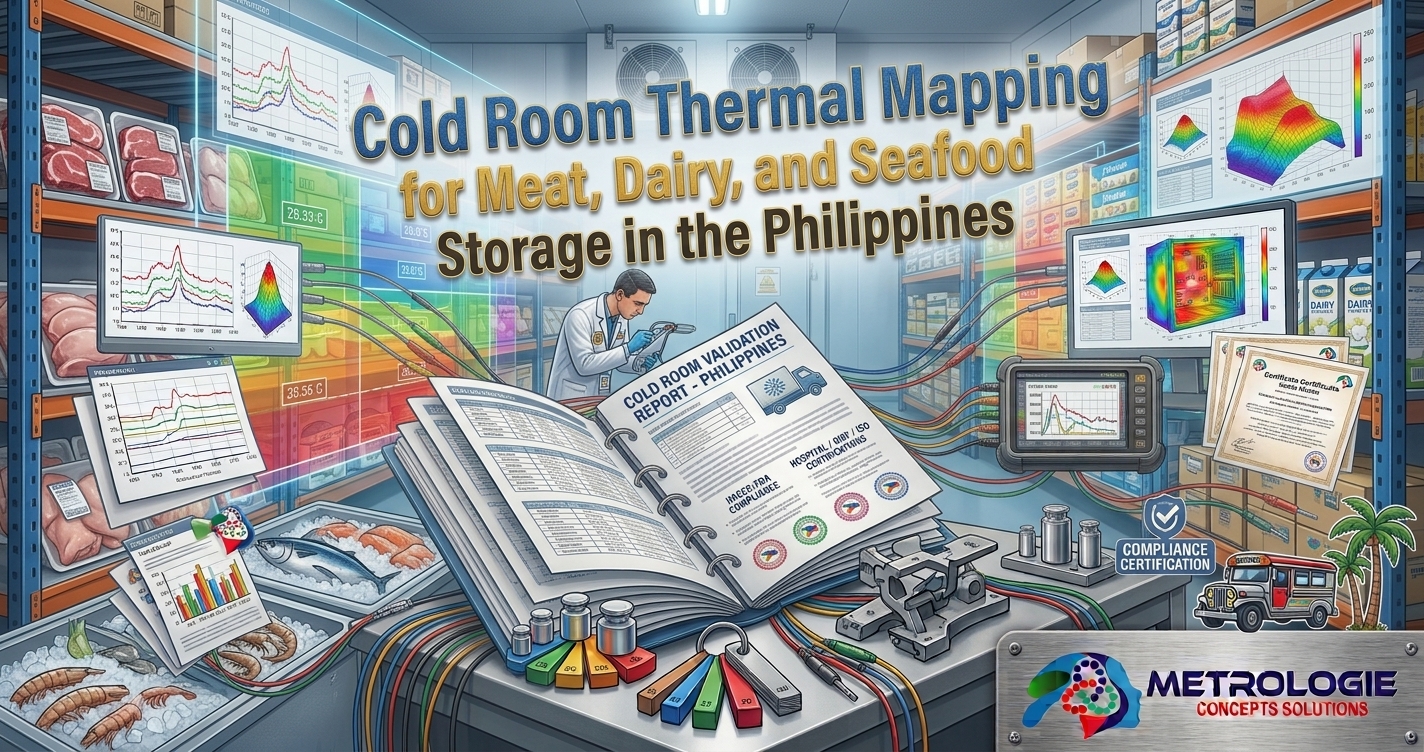
Three product categories sit at the heart of the Philippine food cold chain: meat, dairy, and seafood.
Additionally, each category presents a distinctly different thermal mapping challenge.
Metrology and calibration services and solutions address the differences in temperature needs, safety consequences, regulatory requirements, and operating conditions.
Metrology and calibration services and solutions guide mapping of meat processing cold room at 0–4°C to show none reaches 7°C. Moreover, attention should focus on the blast chiller door zone and the ceiling hotspot under an insulated Philippine warehouse roof. A seafood cold store near 0°C must keep the volume within a 2–3°C band above zero, unlike a 6°C window. A dairy cold room at 2–4°C must guard against heat and freeze risk near the evaporator. Sub-zero exposure near the evaporator degrades quality.
This article provides targeted, Philippines-oriented guidance on thermal mapping for cold rooms storing meat, dairy, and seafood.
It covers temperature requirements by product, regulatory frameworks (NMIS, BFAR, FDA), and validation adequacy.
Additionally, it notes Metrology and calibration services and solutions features and unique thermal mapping considerations for each cold room type.
If you are operating a meat processing cold room, a seafood export cold store, or a dairy chilled product facility in the Philippines — this article is written specifically for your situation.
| Three Products, Three Different Cold Room Thermal Mapping ChallengesMeat: Wide temperature band (0°C to 4°C for chilled, -18°C for frozen) but severe food safety consequences above 7°C; NMIS accreditation compliance requires documented cold room performanceSeafood: Narrow temperature requirement (ideally -1°C to 2°C for fresh fish); EU and Japan export compliance drives the highest documentation standards in Philippine food cold storage; BFAR certification requires demonstrated cold chain controlDairy: Tight chilled requirement (1°C to 4°C) with freeze risk at the lower end; condensation and humidity management critical in wet season; smaller cold room volumes but precision demands rival pharmaceutical applications |
1. The Philippine Food Cold Chain Regulatory Landscape for Meat, Dairy, and Seafood
Each of the three major cold-stored food categories in the Philippines is regulated by a different primary agency, with different accreditation and certification requirements. Understanding which regulatory body governs your cold storage facility — and what that body requires for temperature control documentation — is the starting point for planning your cold room thermal mapping program.
Meat: National Meat Inspection Service (NMIS)
The National Meat Inspection Service (NMIS), an agency under the Department of Agriculture, is responsible for regulation and oversight of the handling, inspection, processing, storage, and preservation of domestic and imported livestock, meat, and meat products in the Philippines. <cite index=’3-1′>NMIS promulgates and implements policies, procedures, guidelines, rules and regulations governing post-production flow of livestock and meat and meat products through the various stages of marketing and proper handling, inspection, processing, storage and preservation.</cite>
NMIS accreditation of meat establishments — including cold storage warehouses, slaughterhouses, meat processing plants, and poultry dressing plants — requires compliance with cold storage temperature standards. <cite index=’7-1′>Under DA Administrative Order No. 22, thawing and repacking from bulk packaging must be done in an NMIS-accredited meat establishment under a temperature-controlled environment of 10°C.</cite> NMIS accreditation inspections assess cold storage temperature management, and cold room thermal mapping provides the strongest possible evidence of controlled cold storage performance for NMIS reviewers.
The key cold storage temperature requirements for NMIS-regulated meat establishments are:
- Chilled fresh and processed meat (pork, beef, chicken): 0°C to 4°C for most products; some processed meats permit up to 7°C
- Frozen meat and meat products: -18°C or colder throughout the frozen storage volume
- Thawing and tempering rooms: Temperature-controlled at 10°C maximum per DA AO 22
- Blast chilling: Product must reach core temperature below 7°C within defined time limits; blast chiller performance validation is a key thermal mapping application for meat processors
Seafood: Bureau of Fisheries and Aquatic Resources (BFAR)
The Bureau of Fisheries and Aquatic Resources (BFAR) under the Department of Agriculture governs the cold storage, processing, and export of fish, shellfish, and other aquatic products in the Philippines. BFAR administers the certification of fish and fishery product establishments, including the cold storage facilities used for fresh, chilled, and frozen seafood.
For Philippine seafood exporters, BFAR certification is the gateway to international markets — particularly the European Union and Japan, which are the most significant export destinations for Philippine seafood. EU import requirements for Philippine seafood products require BFAR certification of the exporting establishment, which in turn requires demonstrated compliance with HACCP and temperature control standards equivalent to those required under EU Regulation (EC) 852/2004 and 853/2004.
The temperature requirements for seafood cold storage that BFAR certification requires Philippine processors to demonstrate include:
- Fresh chilled fish (whole, gutted, filleted): 0°C to 2°C — ideally maintained as close to 0°C as possible without freezing; for fresh tuna destined for Japan, the requirement may be -60°C or colder for super-frozen tuna
- Chilled shellfish: 0°C to 4°C depending on species
- Frozen fish and seafood: -18°C or colder throughout the frozen storage volume
- Live shellfish (oysters, clams, mussels): 5°C to 10°C for holding; specific requirements per species
Dairy: FDA Philippines and Product-Specific Regulations
Fresh dairy products in the Philippines are regulated by the FDA Philippines for product safety and the Department of Agriculture through the Bureau of Animal Industry (BAI) for raw milk quality. Cold storage requirements for dairy products are aligned with international Codex Alimentarius standards and Philippine FDA food product registration requirements.
The Philippine dairy sector handles a mix of imported fresh dairy products (for the premium retail market) and domestically produced fresh milk (primarily in Central Luzon and the Cordillera region). Cold storage for fresh dairy requires:
- Fresh pasteurized milk and fresh dairy products: 1°C to 4°C — the tightest chilled storage window of the three major product categories, with freeze risk below 0°C and rapid spoilage above 4°C
- Fresh cheese (imported and domestic artisan): 2°C to 6°C depending on cheese type
- Butter and cream: 0°C to 4°C
- Frozen dairy (ice cream, frozen yogurt): -18°C or colder; for premium ice cream with mix-ins, -20°C to -25°C to prevent texture degradation
2. Temperature Requirements: The Precision Challenge for Each Product Category
The specific temperature requirements for meat, dairy, and seafood cold rooms create different calibration and thermal mapping challenges. Understanding these differences is essential for designing studies with appropriate sensor density, acceptance criteria, and safety margins.
| Product Category | Cold Room Type | Required Temperature | Temperature Window Width | Primary Safety Risk Above Limit | Primary Risk Below Limit | Mapping Challenge |
| Fresh chilled pork/beef/chicken | Chilled meat cold room | 0°C to 4°C | 4°C wide | Salmonella, E. coli, Listeria growth accelerates above 4°C; spoilage accelerates above 7°C | Freeze damage to surface layers; quality loss in premium cuts | Wide enough to manage but severe consequences above critical limit; hot spot near door most critical |
| Frozen meat (-18°C standard) | Blast freezer / frozen storage | −18°C or colder | No upper limit specified, but −18°C is the floor | Bacterial survival, texture degradation, accelerated spoilage on partial thaw | Not applicable — product is frozen | Power failure holdover critical; defrost cycle temperature spikes must stay below −12°C |
| Fresh chilled tuna and premium fish | Chilled seafood cold room | −1°C to +2°C | 3°C — very narrow | Rapid bacterial growth and histamine formation above 4°C (tuna); EU rejection if temperature records unsatisfactory | Freeze damage; fresh fish cell rupture below −2°C; quality destruction in export products | Narrowest acceptable window; very tight sensor accuracy requirement; must demonstrate near-zero precision |
| Frozen seafood | Blast freezer / frozen storage | −18°C or colder | No upper limit specified | Texture degradation, drip loss on thaw, bacterial survival | Not applicable | Same as frozen meat; defrost spikes most critical |
| Fresh pasteurised milk | Dairy chill room | 1°C to 4°C | 3°C — tight | Psychrotrophic spoilage bacteria grow above 4°C; Listeria risk above 6°C | Ice crystal formation in liquid milk below 0°C; product rejection | Tight window requires high-precision calibration (±0.25°C); freeze zone near evaporator must be mapped |
| Fresh cheese (soft) | Dairy chill room | 2°C to 6°C | 4°C | Mould and spoilage above 6°C; food safety risk above 10°C | Surface freezing; texture damage in fresh cheeses below 0°C | Less critical than milk but freeze risk at evaporator still relevant; humidity management important |
| Ice cream | Frozen storage | −18°C or colder; −20°C preferred | No upper limit | Ice crystal growth, texture degradation, structural collapse at −12°C | Not applicable | Temperature uniformity critical — warm spots in deep storage create quality differentiation between pallets |
3. Meat Cold Room Thermal Mapping: The NMIS Compliance Scenario
Meat processing cold rooms in the Philippines range from small walk-in chillers at local meat processing plants to large multi-zone cold storage facilities at NMIS-accredited export-level establishments. The thermal mapping requirements are similar across this range in principle, but the scale and complexity of the study differ significantly.
The Blast Chiller: The Most Critical Thermal Mapping Application in Meat Processing
For meat processing facilities, the blast chiller — used to rapidly reduce the core temperature of freshly slaughtered or cooked meat products from above 60°C to below 7°C — is typically the highest-priority thermal mapping application. Blast chiller validation is a food safety requirement because: partial cooling (achieving surface temperatures of 4°C but not reducing the core temperature below 7°C within the required time) creates an anaerobic bacterial growth environment within the product; and the blast chiller’s performance at rated capacity may differ significantly from its performance at the actual loads run in normal production.
Blast chiller thermal mapping differs from conventional cold room mapping in key ways:
- The study measures temperature over time as product loads cool — not steady-state temperature distribution in a static environment
- Sensors must be positioned to capture both air temperature distribution within the blast chiller chamber AND product core temperatures at multiple positions within a representative product load
- The acceptance criterion is not a temperature range but a time-to-temperature requirement — the time within which the product core must reach the specified temperature (typically 7°C within 90 minutes for surface temperature, with core temperature reaching 7°C within a product-dependent period)
- Philippine summer ambient conditions critically affect blast chiller performance — a blast chiller sized for temperate operations may take significantly longer to achieve the required core temperature when the chiller room itself is being cooled against 35°C ambient
Chilled Meat Cold Room: The NMIS Temperature Demonstration
For the main chilled meat cold room — holding fresh carcasses, cuts, and processed meat products at 0°C to 4°C — thermal mapping must demonstrate that the entire storage volume maintains temperatures within the critical range under the most demanding conditions of Philippine operations.
The most common thermal mapping findings in Philippine chilled meat cold rooms:
- Loading dock door zone exceeding 4°C during busy receiving periods: When multiple carcasses or product pallets are being moved in and out during morning receiving, the door zone in a Philippine chilled meat cold room can reach 8°C to 12°C for extended periods — well above the food safety critical limit. The study must capture this by simulating the actual receiving operation frequency and duration.
- Upper rack zone hot spots exceeding 4°C in summer: Under a poorly insulated metal warehouse roof, the ceiling of the chilled meat cold room can be 4°C to 6°C warmer than the thermostat-monitored middle zone. Meat hanging from ceiling hooks in a traditional carcass cold room, or stacked on the top shelf in a box-in cold room, may be at temperatures above the critical limit even when the room’s thermostat shows compliance.
- Cold spots below 0°C near the evaporator: Surface freeze damage on premium meat cuts stored closest to the evaporator coil or air blast outlet. These zones must be identified and marked as no-storage zones for premium cut meat, with product placement SOPs updated accordingly.
Frozen Meat Storage: Power Failure Holdover Is the Priority
For frozen meat storage at -18°C, the thermal mapping focus shifts from spatial temperature distribution (which is typically more uniform in freezer rooms than in chilled rooms) to power failure holdover performance — the most critical food safety variable for frozen meat storage in the Philippines.
Philippine power supply reliability varies significantly by location, with provincial and rural facilities facing greater brownout frequency and duration than Metro Manila. A frozen meat storage room that loses power during typhoon season, in a facility without adequate backup generation, may experience temperatures rising above -12°C — the point at which frozen meat texture begins to degrade and bacterial survival becomes more significant — within two to four hours at Philippine ambient conditions.
The power failure holdover test for frozen meat cold rooms must be conducted under Philippine summer or wet season ambient conditions (30°C to 38°C ambient) to establish the realistic worst-case holdover time for emergency response protocol planning.
4. Seafood Cold Room Thermal Mapping: The Most Demanding Food Cold Chain Application
Thermal mapping for seafood cold rooms — particularly those serving the Philippine export market — represents the most technically demanding food cold chain mapping application in the Philippines. The combination of narrow temperature windows, severe food safety consequences at small temperature deviations, and demanding international export documentation standards creates the highest precision requirement of any food storage thermal mapping scenario.
Why Seafood Cold Storage Is the Most Challenging to Map
Three characteristics of seafood cold storage make it more demanding to map than meat or dairy:
- The narrowest required temperature window: Fresh chilled tuna and premium fish must be held as close to 0°C as possible without freezing — a practical operating window of perhaps 0°C to 2°C in the most demanding applications. This compares to the 4°C window for chilled meat and 3°C window for fresh dairy. A mapping study for fresh tuna cold storage with this narrow window requires data loggers calibrated to ±0.25°C or better — twice the accuracy needed for pharmaceutical CRT mapping.
- The most severe food safety consequences: Certain seafood species — particularly scombroid fish like tuna, mackerel, and sardines — produce histamine when bacteria decompose the amino acid histidine in the fish flesh. Histamine accumulates rapidly above 4°C and cannot be destroyed by subsequent freezing or cooking. Histamine fish poisoning from temperature-abused tuna is one of the most common seafood-related food safety incidents globally, and it is invisible — histamine-contaminated fish looks, smells, and tastes normal until consumed.
- The most demanding international documentation requirements: Philippine tuna and seafood exporters to the EU, Japan, and the USA face the most rigorous food safety documentation requirements in the Philippine food export sector. EU Competent Authority assessments of Philippine seafood processing facilities — conducted by BFAR — include cold storage temperature control documentation review. A EU rejection of a Philippine seafood lot citing inadequate temperature documentation has severe commercial consequences for the exporting company.
Specific Thermal Mapping Considerations for Seafood Cold Rooms
Sensor placement for seafood cold rooms requires attention to several seafood-specific risk zones:
- The ice-seafood interface zone: Fresh fish held in ice — a common practice in Philippine seafood handling — creates a temperature environment that may vary significantly from the room air temperature. Sensors at the fish-ice interface level capture the actual product temperature environment, not just the room air temperature.
- The receiving staging area: Fresh tuna arriving from fishing vessels in the Philippines is often at elevated temperatures (8°C to 15°C or higher depending on vessel hold conditions) when it arrives at the processing facility. The receiving and pre-sorting area — where fish is received, inspected, and sorted before entering the cold room — must be characterized as a temperature-controlled zone in HACCP plans. Thermal mapping of this area under summer ambient conditions reveals whether the receiving environment is adequate to prevent further temperature-related quality degradation before the product enters the main cold room.
- Blast freezer validation for IQF and block-frozen products: For seafood processors producing individually quick frozen (IQF) or block-frozen products, blast freezer thermal mapping is required to demonstrate that the product achieves the required core temperature (-18°C) within the specified freezing time. Super-frozen tuna products destined for Japan must typically achieve -60°C — a separate, more demanding blast freezer validation scenario.
BFAR and EU Documentation Requirements for Seafood Cold Room Mapping
For BFAR-certified seafood processing establishments exporting to the EU, the cold room thermal mapping documentation package must be formatted and maintained to meet both BFAR certification requirements and EU Competent Authority assessment standards. Key documentation elements:
- Pre-approved study protocol referencing Codex Alimentarius temperature standards and relevant EU regulations
- PAB-accredited calibration certificates for all data loggers used in the study — EU auditors expect internationally recognized calibration credentials
- Seasonal study coverage — the EU assessment of Philippine seafood establishments will ask whether thermal mapping was conducted under the most demanding ambient conditions. A December study presented at a February EU assessment will draw scrutiny about summer performance.
- Power failure holdover documentation — particularly critical for Philippine seafood cold storage given typhoon season power disruption risk
- Clear linkage between the mapping findings and the HACCP CCP documentation — the mapping report should explicitly reference the HACCP critical limit for the seafood cold storage CCP
5. Dairy Cold Room Thermal Mapping: Precision in a Small Space
Fresh dairy cold rooms in the Philippines are typically smaller than meat or seafood cold rooms — serving hospital food services, premium hotel and restaurant supply chains, supermarket distribution, or specialty dairy processors. The smaller volume might suggest simpler mapping, but the precision requirements and dual-risk nature (both freeze damage and heat damage) make dairy cold room mapping technically demanding.
The Dual-Risk Problem: Freeze and Heat Simultaneously
A fresh dairy cold room operating at 1°C to 4°C faces a challenge that is unique among food cold storage environments: the acceptable temperature window sits in a zone where both heat and cold are simultaneously dangerous to the product. The upper limit (4°C) prevents spoilage bacteria. The lower limit (approaching 0°C) prevents ice crystal formation in liquid dairy products and surface freeze damage in fresh cheeses and yogurt.
In practice, this means that the zone adjacent to the evaporator coil — where temperatures in a poorly designed dairy cold room may fall to -1°C to -2°C — is as much of a compliance failure as the hot spot near the door. Thermal mapping of a dairy cold room must identify both extremes: the door-zone hot spot that may approach or exceed 4°C during busy delivery or dispensing periods, AND the evaporator-zone cold spot where temperatures may fall below 0°C.
The product placement implications of this dual-risk mapping are specific to dairy:
- Fresh liquid milk and yogurt: Must not be stored adjacent to the evaporator — ice crystal formation in milk begins below -0.5°C, and a zone reading -1.5°C will damage product quality irreversibly
- Fresh soft cheeses: Most vulnerable to freeze damage among dairy products — must be stored in the warmest validated zone of the cold room, typically the middle shelves away from both the evaporator and the door
- Hard and semi-hard cheeses: More tolerant of temperature variation but still require temperatures above 0°C to prevent moisture loss and rind damage
Humidity Management in Philippine Dairy Cold Rooms
High ambient humidity during the Philippine wet season creates a specific challenge for dairy cold rooms: condensation on cold room surfaces, on product packaging, and on the evaporator coils. Condensation in dairy cold rooms creates mold contamination risk — particularly for fresh cheeses where surface mold development is both a quality and food safety concern.
Thermal mapping of dairy cold rooms should include wet season mapping as a priority — not just for temperature distribution assessment, but for characterizing the humidity and condensation conditions that exist during the high-humidity wet season months. Findings from wet season dairy cold room mapping often drive operational decisions about dehumidification, defrost cycle frequency, and product packaging requirements.
Dairy Cold Room Power Failure: The Fastest Food Safety Risk of the Three Product Categories
Among the three product categories, fresh liquid dairy products are the most vulnerable to rapid quality and safety degradation during power failures. The combination of a tight temperature window (1°C to 4°C), high initial bacterial loading in even freshly pasteurized milk, and rapid spoilage kinetics at temperatures above 4°C means that a power failure holdover that would be manageable for meat or frozen seafood can cause significant quality and safety losses in fresh dairy.
For dairy cold rooms in the Philippines, the power failure holdover test should establish the minimum acceptable time from power failure to refrigeration restoration — and this time must be compared against the realistic generator response time at the facility. For facilities without backup generation, the holdover time determines the maximum brownout duration that can be tolerated before emergency product protection measures (transfer to an alternative cold room, addition of ice) must be initiated.
6. The Philippine Climate and Seasonal Mapping Obligations
The previous article in this series (Article 7: Seasonal Thermal Mapping) covered the general seasonal mapping obligation for Philippine facilities. Here, we apply that framework specifically to meat, dairy, and seafood cold rooms — which each have distinct seasonal mapping priorities.
Meat Cold Rooms: Summer Study Is the Priority
For chilled meat cold rooms (0°C to 4°C), the hot dry season study (March to May) is the most critical. The combination of peak ambient temperatures (35°C to 38°C in Metro Manila and CALABARZON), maximum solar gain through poorly insulated Philippine warehouse roofs, and the frequent loading dock door openings during busy morning receiving periods creates the most severe thermal challenge of the year for meat cold room refrigeration systems.
Common findings from summer studies of Philippine chilled meat cold rooms that were not revealed in cool-season studies: refrigeration systems that cannot recover the door-zone hot spot temperature below 4°C within 15 minutes of a door opening during peak morning operations; ceiling-level sensors reading 6°C to 7°C under an uninsulated roof while the thermostat at mid-height reads 2°C; and blast chillers taking 40% longer to achieve the required chilling time for a full carcass load compared to their cool-season performance.
Seafood Cold Rooms: Both Seasons Are Critical for EU Export Compliance
For seafood cold rooms — particularly those serving the EU export market — both the summer study and the wet season study are expected by EU Competent Authority assessors and BFAR certification reviewers. The summer study demonstrates that the cold room maintains the narrow temperature window required for fresh seafood quality at peak Philippine ambient conditions. The wet season study demonstrates that the additional humidity load of Philippine monsoon season does not compromise cold room performance — relevant for avoiding condensation-related spoilage and maintaining fresh fish quality during the high-humidity wet season.
For Philippines-to-Japan super-frozen tuna operations, the blast freezer qualification study should be conducted under the most thermally demanding conditions — typically the Philippine summer, when the blast freezer must reject maximum heat while cooling product against the highest ambient temperature of the year.
Dairy Cold Rooms: Wet Season Humidity Is the Priority
For fresh dairy cold rooms, the wet season study is arguably more important than the summer study — because humidity is the dominant additional risk for dairy cold storage in the Philippine wet season. High wet season humidity creates condensation on dairy packaging, mold growth risk on cheese surfaces, and increased defrost cycle frequency that may create more frequent temperature spikes within the dairy cold room.
Summer mapping is still required for dairy cold rooms — the narrow 1°C to 4°C window makes summer heat stress potentially significant — but the wet season mapping should be specifically designed to capture humidity conditions and assess their impact on dairy cold room temperature control and condensation management.
7. Building Your Mapping Protocol: Differences by Product Type
A thermal mapping protocol for a meat cold room differs from one for a seafood cold room or a dairy cold room in several important respects. Here is a practical comparison of the key protocol differences by product type.
| Protocol Element | Meat Cold Room | Seafood Cold Room (Fresh) | Dairy Cold Room |
| Acceptance criteria (chilled) | 0°C to 4°C (all sensors); no sensor above 4°C during study | −1°C to +2°C (premium chilled fish); 0°C to 4°C (general seafood) | 1°C to 4°C; no sensor below 0°C (freeze risk); no sensor above 4°C |
| Data logger accuracy requirement | ±0.5°C adequate for most applications | ±0.25°C or better required for premium fresh fish applications | ±0.25°C recommended given tight window and dual risk |
| Loading condition | Representative meat product load at 70–80% capacity | Representative seafood load; include ice bed simulation if applicable | Representative dairy product load; include liquid dairy simulation |
| Door opening frequency simulation | Simulate morning receiving operations — potentially 6–10 door openings in a 2-hour window | Simulate receiving from fishing vessel arrivals — may be fewer but longer door openings | Simulate daily dispensing pattern — moderate frequency but extended duration for larger deliveries |
| Sensor priority positions | Door zone hot spot; ceiling hot spot under Philippine roof; evaporator cold spot | Door zone; receiving staging area; ice-fish interface level; evaporator zone; top tier (highest from refrigeration) | Evaporator cold spot (freeze risk); door zone hot spot; every shelf level |
| Power failure test priority | High — particularly for blast chillers | Very high — seafood spoils rapidly; histamine risk above 4°C | Very high — dairy window is narrow; spoilage rapid above 4°C |
| Seasonal study priority | Summer (March–May) most critical | Both seasons required for export compliance | Wet season most critical for humidity/condensation management |
| Regulatory documentation format | NMIS accreditation; HACCP CCP documentation | BFAR certification; EU Competent Authority format; HACCP CCP | FDA Philippines food license; Codex Alimentarius; HACCP CCP |
8. Frequently Asked Questions: Cold Room Thermal Mapping for Meat, Dairy, and Seafood
Do NMIS-accredited meat establishments need formal thermal mapping reports, or just temperature monitoring records?
NMIS accreditation inspections assess cold storage temperature control capability as part of the overall establishment accreditation assessment. Temperature monitoring records demonstrate that temperatures are being tracked — but they do not demonstrate that the monitoring sensor is at the worst-case location, or that the full cold room volume maintains required temperatures. For NMIS accreditation at the higher-tier levels (particularly for export-eligible establishments), formal thermal mapping documentation that demonstrates full cold room performance under Philippine operating conditions provides significantly stronger evidence of cold storage compliance than monitoring records alone.
What data logger accuracy is required for fresh tuna cold storage mapping?
For fresh tuna cold storage with a temperature requirement of -1°C to +2°C (a 3°C window), data loggers with ±0.5°C accuracy are insufficient — at this accuracy level, a logger at the very edge of the acceptable window could be recording 2°C when the true temperature is anywhere from 1.5°C to 2.5°C. For fresh tuna and other premium chilled seafood applications where the food safety and export quality implications of temperature exceedances are severe, data loggers with accuracy of ±0.25°C or better should be used — and calibrated to ±0.25°C accuracy by a PAB-accredited laboratory before deployment.
How does a dairy cold room thermal mapping study handle the freeze risk near the evaporator?
The freeze risk near the evaporator is treated as a compliance failure in exactly the same way as a heat exceedance above the acceptance criteria upper limit. If any sensor records a temperature below 0°C during the dairy cold room mapping study, the cold room has failed to demonstrate compliance with the full acceptance criteria — temperatures must remain within 1°C to 4°C at all sensor positions throughout the study. The mapping report must: document the sub-zero zone, specify it as a no-storage zone for liquid dairy and soft fresh cheese, and recommend corrective action to address the root cause (typically: repositioning the evaporator air discharge to reduce the cold zone, adjusting the thermostat setpoint upward slightly, or adding an air deflector to prevent evaporator air from directly striking the storage product area adjacent to the unit).
Can a single thermal mapping study cover both the chilled product area and the frozen product area of a combined meat cold storage facility?
No — each distinct temperature zone in a cold storage facility requires its own mapping study with its own protocol, acceptance criteria, sensor placement, and data collection period. A chilled meat room at 0°C to 4°C and a frozen meat store at -18°C or colder are different environments with different temperature ranges, different sensor calibration requirements, different acceptance criteria, and different failure modes. They must be mapped separately. The reports for each zone are separate documents within the overall facility qualification package.
What Philippine-specific factors most commonly cause fresh seafood cold room failures in summer thermal mapping studies?
Based on thermal mapping experience in Philippine seafood cold storage facilities, the most common summer study failure causes are: refrigeration system capacity insufficient for Philippine summer ambient (the system cannot maintain temperatures within the narrow fresh seafood window when ambient is 36°C to 38°C); inadequate insulation allowing solar gain through external walls or roof panels to drive temperatures above the upper limit in wall-adjacent and ceiling-level zones; loading dock temperature spikes exceeding the acceptance limit when large seafood deliveries arrive during afternoon peak heat hours; and evaporator cold spots creating sub-zero freeze zones in facilities where the thermostat setpoint has been lowered to compensate for inadequate system capacity — a workaround that solves the heat problem while creating a freeze damage problem.
Conclusion: Precision Temperature Validation for the Philippines’ Most Important Cold-Chain Food Categories
The Philippine meat, dairy, and seafood industries rely on cold chain temperature control to protect food safety, maintain product quality, and meet the stringent requirements of domestic regulators and international export markets. The cold room thermal mapping study is the foundational validation that makes every other element of that cold chain management meaningful.
Without thermal mapping, meat cold rooms may have undetected hot spots at the loading dock that expose chilled cuts to temperatures supporting rapid bacterial growth. Seafood cold rooms may have warming zones that push fresh tuna toward the histamine accumulation threshold that would trigger EU market rejection. Dairy cold rooms may have evaporator freeze zones destroying the texture of fresh yogurt and soft cheese that customers and retailers expect to be pristine.
The mapping study makes these invisible risks visible — identifying them, documenting them, and enabling the operational and infrastructure changes that bring the cold room into full compliance. And conducted in the Philippine summer, when ambient conditions are at their most demanding, the mapping study provides the specific evidence that NMIS inspectors, BFAR certification reviewers, EU Competent Authority assessors, and international food safety certification auditors need to be confident that your cold storage facility genuinely protects the products it holds.
Metrologie Solutions Philippines provides specialist thermal mapping for meat, dairy, and seafood cold rooms throughout the Philippines — with the product-specific expertise, the precision calibration capability, and the documentation quality that the Philippines’ most demanding food cold chain applications require.
| Ready to Map Your Food Cold Room?Contact Metrologie Solutions Philippines to discuss thermal mapping for your meat cold room, seafood cold store, or dairy chill facility — with acceptance criteria matched to your NMIS, BFAR, or FDA food license requirements, and summer-condition mapping that demonstrates genuine worst-case compliance.Website: metrologiesolutions.com | Services: Food Cold Room Thermal Mapping · HACCP Temperature Validation · Calibration |
| About Metrologie Solutions PhilippinesMetrologie Solutions Philippines provides specialist cold room thermal mapping services for meat processing facilities, seafood cold stores, dairy operations, and food export establishments across the Philippines. Our studies meet the requirements of NMIS, BFAR, FDA Philippines, Codex Alimentarius temperature standards, and international food safety certification schemes — with PAB-accredited calibrated instruments and GMP-quality documentation.Website: metrologiesolutions.com | Services: Cold Room Thermal Mapping · Calibration · HACCP Temperature Validation · Training |