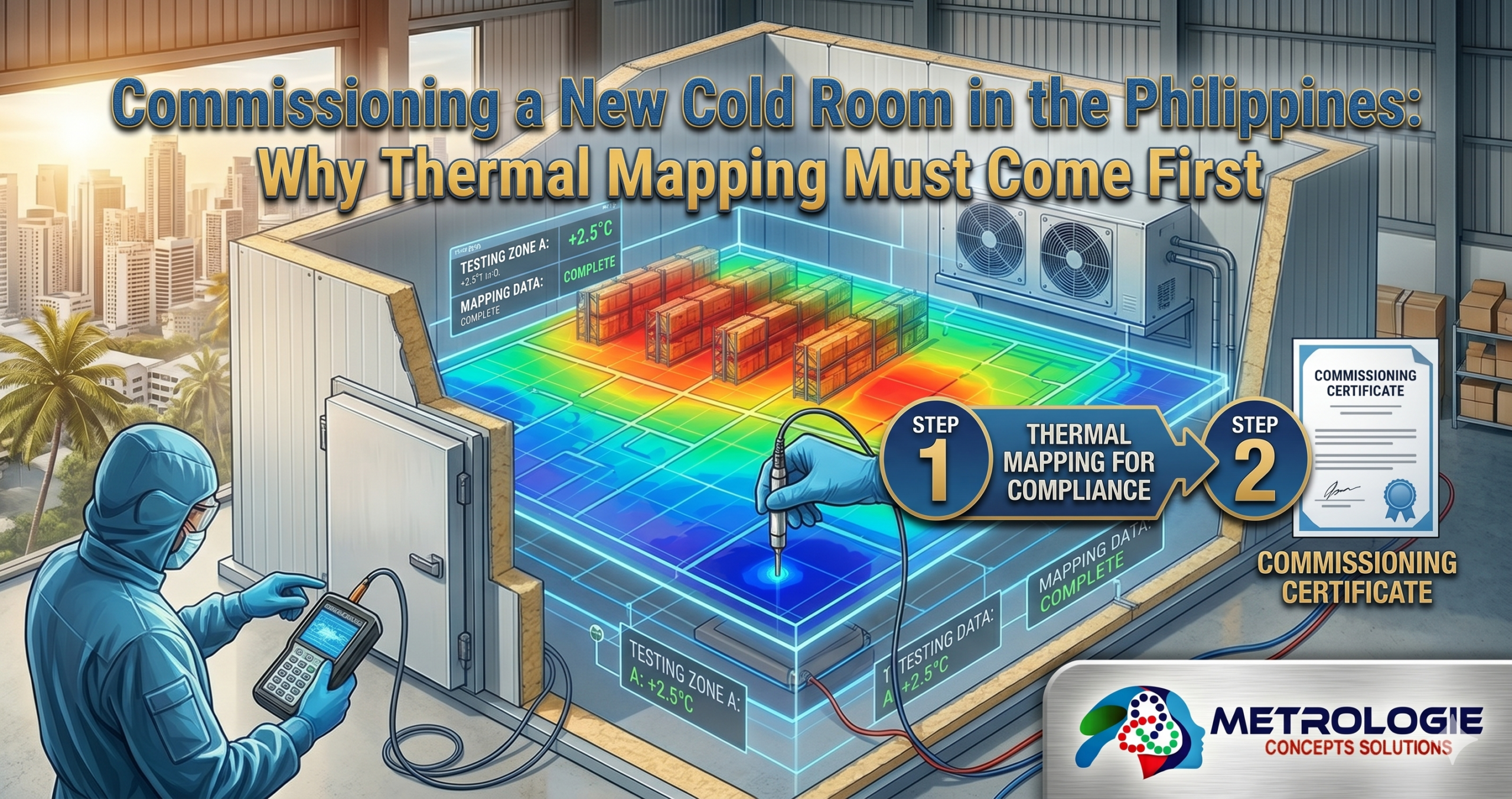
You have just commissioned a new cold room. The panels are installed, the compressor is running, the thermostat is set to the required temperature, and the refrigeration contractor has declared the system operational. The temptation — especially after weeks or months of construction, installation delays, and equipment procurement — is to start using it immediately.
Stop. Before a single product enters that cold room, you need a thermal mapping study.
This is not a bureaucratic formality. It is not a box to tick on a compliance checklist. It is the answer to the most fundamental question about your new cold room: does it actually work?
A running refrigeration system and a thermostat reading the correct temperature do not answer this question. They tell you the temperature at one point — the thermostat sensor — under conditions that may not represent the real operating environment. They do not tell you whether the corner behind the pallet rack is 4°C warmer than the thermostat reading. They do not tell you whether the zone near the evaporator coil drops below 0°C on cold Philippine mornings, risking freeze damage to vaccines or insulin. They do not tell you how quickly temperatures rise when the compressor stops during a power outage. They do not tell you whether your cold room can maintain its required temperature range during the hottest week of a Philippine summer.
Thermal mapping tells you all of this. It is the scientific process that transforms a refrigeration contractor’s installation into a validated, qualified, documented cold room — one that you can use with confidence, present to regulators with pride, and defend to clients and auditors with complete, professional evidence.
This article is the definitive guide for any Philippine business that is commissioning a new cold room and needs to understand exactly what thermal mapping involves, why it must be done before products are stored, how the IQ/OQ/PQ qualification process works in a Philippine context, and how to get it right the first time.
| The Central Rule of Cold Room Commissioning in the PhilippinesWHO Technical Report Series No. 961, Annex 9 states clearly: ‘Qualify new temperature-controlled storage areas and new refrigeration equipment before it becomes operational.’FDA Circular No. 2021-003 requires that all temperature-controlled storage areas used for pharmaceutical products be properly qualified before products are stored in them.No exceptions. No grace periods. No ‘we’ll do the mapping after we start operations.’ Before products go in, the mapping must be done. |
1. The False Confidence of a Running Cold Room
The most dangerous moment in a new cold room’s life is the period immediately after the refrigeration contractor declares it operational. At this point, the business owner or QA manager sees a cold room that appears to be working — the temperature display shows 5°C, the compressor is cycling normally, the door seals feel tight — and feels confident that the system is ready to use.
This confidence is almost always premature. Here is why.
What a Running Cold Room Cannot Tell You
A newly installed cold room can tell you the temperature at one location — wherever the thermostat or control sensor is positioned. It cannot tell you:
- Whether the temperature is uniform throughout the room, or whether there are hot spots and cold spots that differ from the thermostat reading by several degrees
- Whether any zone within the room drops below 0°C under normal operating conditions — a critical concern for freeze-sensitive pharmaceutical products
- Whether the insulation panels are properly sealed at all joints, or whether there are thermal bridges causing localized heat ingress
- Whether the refrigeration capacity is adequate to maintain the required temperature range during a Philippine summer, when ambient temperatures outside may be 35°C or higher
- How quickly the temperature rises throughout the room when power is interrupted — and therefore how long you have to respond before products are at risk
- Whether the existing thermostat sensor is positioned at the most representative location, or whether it is in a comfortable zone that masks problems elsewhere in the room
- Whether the room meets the regulatory acceptance criteria — a specific, documented demonstration that all points within the storage volume remain within the required temperature range over a sustained period under real operating conditions
None of these questions can be answered by looking at a temperature display. They can only be answered by a thermal mapping study — a systematic measurement of temperature at multiple points throughout the room, over a representative time period, under real operating conditions, with calibrated instruments and a formal documented report.
The Cost of Getting It Wrong
The consequences of skipping thermal mapping and using an unqualified cold room fall into three categories, each of which is more costly than the mapping study itself:
- Product quality failure: If your cold room has an undetected hot spot that regularly reaches 10°C in a room set to 5°C, every vaccine, biologic, or insulin product stored in that zone may be damaged — visibly identical to an undamaged product but with significantly reduced potency or efficacy. The product may be used, the patient may suffer, and the business bears the liability.
- Regulatory sanctions: An FDA inspector who asks for your cold room qualification documentation and finds none — or who discovers that you have been storing pharmaceutical products in an unqualified cold room — will issue a formal deficiency finding. The consequences range from a corrective action requirement to suspension of your Licence to Operate.
- Client and principal consequences: A pharmaceutical principal conducting a distributor qualification audit who discovers that your cold room has never been mapped may terminate the distribution agreement, pending completion of the qualification programme. The revenue at risk from a single client termination typically dwarfs the cost of a mapping study many times over.
2. Understanding the IQ/OQ/PQ Qualification Lifecycle for Philippine Cold Rooms
The international standard for qualifying any pharmaceutical manufacturing or storage equipment follows a structured lifecycle known as IQ/OQ/PQ — Installation Qualification, Operational Qualification, and Performance Qualification. This framework, embedded in GMP guidelines worldwide and referenced in WHO Good Distribution Practice, is the systematic approach to proving that a cold room is correctly installed, performs as designed, and maintains compliance under real operational conditions.
Understanding what each phase involves — and where thermal mapping fits within the lifecycle — is essential for any Philippine business commissioning a new cold room for pharmaceutical, food, or other regulated use.
Installation Qualification (IQ): Proving Correct Installation
The IQ phase verifies that the cold room has been installed correctly and in accordance with its design specifications. This is the documentation phase that confirms: what was installed, where it was installed, and whether the installation matches the approved design.
IQ documentation for a Philippine cold room typically includes:
- Design drawings — the approved construction and engineering drawings for the cold room, including panel specifications, insulation thickness, door type and specifications, evaporator and condenser unit specifications and locations
- Installation verification — confirmation that the as-built cold room matches the approved drawings, including panel dimensions, insulation values, door seal specifications, and refrigeration equipment model numbers
- Equipment list and certificates — documentation for all installed equipment including refrigeration units, control systems, temperature monitoring devices, alarm systems, and backup power connections
- Utility connections — verification that electrical supply, drainage, and refrigerant charge meet design specifications
- Calibration status of control instruments — confirmation that the thermostat, pressure gauges, and any installed monitoring equipment are calibrated with current certificates
- Safety systems verification — confirmation that safety cutouts, alarms, and emergency systems are installed and functional
IQ is typically completed by the refrigeration contractor in coordination with the client’s QA team, before any operational testing begins. In many Philippine cold room installations, the contractor provides some IQ documentation as part of the commissioning handover package — but this is rarely complete enough to satisfy GMP or WHO GDP requirements without supplementation by the client’s QA team.
Operational Qualification (OQ): Proving the System Works
The OQ phase tests the cold room’s performance under controlled conditions — specifically, in an empty or minimally loaded state — to demonstrate that the refrigeration system can achieve and maintain the required temperature range throughout the entire storage volume.
This is where thermal mapping enters the picture. OQ thermal mapping is conducted in the empty cold room, with sensors distributed throughout the volume according to a pre-approved protocol. The study:
- Demonstrates the baseline temperature distribution throughout the cold room with no product thermal mass present
- Identifies hot spots and cold spots under clean, unloaded conditions — revealing any HVAC airflow distribution problems, insulation weaknesses, or refrigeration system inadequacies in their most exposed form
- Documents the temperature uniformity — the difference between the hottest and coldest measured points — which must be within acceptable limits for the room to qualify
- Tests the cold room’s performance during simulated door openings — capturing the temperature spike at the door-adjacent zone and the recovery time back to specification
- Conducts a power failure simulation — measuring the time for temperatures to rise from the setpoint to the upper acceptance limit when refrigeration is interrupted
- Documents performance under ambient conditions representative of the most challenging operating season
The OQ study produces a formal qualification report that either confirms the cold room meets its acceptance criteria — and is therefore ready to proceed to the PQ phase — or identifies deficiencies that must be corrected before qualification can proceed.
Performance Qualification (PQ): Proving Real-World Compliance
The PQ phase tests the cold room’s performance under conditions that simulate actual operational use — specifically, with the room loaded to a representative stock level and with the door opening frequency and loading/unloading patterns that reflect normal operations.
PQ thermal mapping for a pharmaceutical or food cold room includes:
- Temperature distribution mapping with the room loaded to approximately 70% to 80% of normal storage capacity — demonstrating that product thermal mass does not create unexpected temperature gradients or compliance failures
- Performance during loading and unloading operations — capturing the temperature behaviour during representative stock movements
- Demonstration that the room maintains compliance under the combination of product thermal load, door opening frequency, and ambient conditions representative of peak operational stress
- Power failure testing under loaded conditions — which may show different holdover characteristics than the empty-room OQ test, as product thermal mass affects how quickly temperatures rise after refrigeration loss
The PQ report, together with the IQ and OQ reports, completes the formal qualification package for the cold room. This package is the documentary evidence that the cold room is suitable for its intended use and is the basis for the ongoing monitoring and maintenance programme.
| Qualification Phase | What It Proves | Key Activities | Thermal Mapping Role |
| IQ — Installation Qualification | The cold room was installed correctly per design specifications | Design review; as-built verification; equipment documentation; utility checks; calibration status | Confirm thermostat and monitoring sensor calibration; document sensor positions |
| OQ — Operational Qualification | The cold room achieves and maintains the required temperature range under controlled conditions | Empty room thermal mapping; hot/cold spot identification; door opening tests; power failure simulation; ambient condition documentation | PRIMARY: full spatial temperature mapping under empty conditions; power failure holdover test |
| PQ — Performance Qualification | The cold room maintains compliance under real operational conditions | Loaded room thermal mapping; loading/unloading cycle tests; door frequency simulation; seasonal study | Full spatial mapping under loaded conditions; seasonal worst-case ambient conditions |
3. The Philippine Context: Why New Cold Room Qualification Is More Critical Here Than Almost Anywhere
The IQ/OQ/PQ qualification requirement for new cold rooms exists in regulatory frameworks worldwide. But the Philippine operating environment creates specific conditions that make the thermal mapping step especially critical — and especially likely to reveal problems that simply cannot be assumed away.
The Tropical Climate: Your Cold Room’s Permanent Enemy
In temperate countries, a cold room maintaining +2°C to +8°C operates against an ambient of perhaps 15°C to 22°C for most of the year. The refrigeration system works moderately. Hot spots are limited. Power failure holdover times are relatively generous.
In the Philippines, a cold room maintaining +2°C to +8°C operates against a Philippine summer ambient of 34°C to 38°C for several months every year. The refrigeration system works at maximum capacity. Hot spots near poorly insulated walls, near the door, or near any thermal bridge in the panel construction are dramatically elevated. Power failure holdover times are shorter. And any weakness in the cold room’s construction or refrigeration design that would be manageable in a temperate climate becomes a critical compliance failure in the Philippine summer.
A cold room that a refrigeration contractor commissions and declares operational in December — when Manila ambient is 24°C — may fail catastrophically in April when ambient is 37°C. The contractor’s commissioning test at 24°C ambient does not predict April performance. Only thermal mapping conducted under hot season ambient conditions proves that the cold room can sustain compliance throughout the Philippine year.
The Power Supply Reality
Power interruptions remain an operational reality for many Philippine businesses — particularly those outside Metro Manila’s core distribution network, in provinces, and in areas served by local cooperative electric companies. For a new cold room, the power failure holdover time — measured during thermal mapping — is not an academic number. It is the operational specification that determines whether a brownout results in a routine event (generator activates before temperature limit is reached) or a product safety emergency (temperature limit breached before action is taken).
Many Philippine cold room operators do not know their cold room’s holdover time. They have not tested it. They assume their generator will activate before products are at risk. In some cases this is true; in others it is not. Thermal mapping makes this assumption unnecessary — it replaces it with data.
Insulation Quality Variation
Cold room insulation quality in the Philippines varies significantly based on the contractor, the panel supplier, and the construction quality control. Philippine cold room construction uses polyurethane sandwich panels, typically 75mm to 150mm thick for pharmaceutical cold rooms, with the panel joints sealed with mastic or equivalent sealant. Insulation failures — panel joint gaps, inadequately sealed penetrations, thermal bridges at corners and door frames — are common in cold rooms built without rigorous construction quality control.
Thermal mapping reveals insulation failures with precision. A hot spot that appears at a specific wall location during the OQ study, with no apparent airflow explanation, often points to an insulation deficiency at that location — a gap in the panel joint, an unsealed penetration, or a compressed panel section that has lost its insulating value. Identifying these during qualification, before operations begin, enables correction at a fraction of the cost of correcting them after regulatory findings or product losses.
The FDA Circular 2021-003 Enforcement Environment
The Philippine FDA’s enforcement of cold chain management requirements under FDA Circular 2021-003 is tightening. Establishments seeking or renewing Licences to Operate are subject to increasingly thorough review of cold chain qualification documentation. The standard is clear: storage areas must be qualified before use. A newly commissioned cold room that begins storing pharmaceutical products without completing IQ/OQ/PQ is in direct violation of the circular from the first day of operation.
4. Before the Thermal Mapping Study: What Must Be in Place
Thermal mapping is the centrepiece of the OQ and PQ qualification phases — but it cannot happen in isolation. A set of prerequisites must be in place before the mapping study begins, both to ensure the study produces valid results and to satisfy the documentation requirements of GMP and WHO GDP qualification frameworks.
Prerequisite 1: Construction Completion and IQ Sign-Off
The cold room must be fully constructed and the IQ documentation complete before OQ thermal mapping begins. This means: all panels installed and sealed, all doors fitted with functioning seals, the refrigeration system fully charged and operational, all electrical systems connected and tested, and the IQ documentation reviewed and approved by the QA manager or qualified person.
Attempting to map a cold room whose construction is still in progress — with temporary door seals, open penetrations, or an incompletely charged refrigeration system — produces data that does not represent the cold room’s final operational state and cannot form the basis of a valid qualification report.
Prerequisite 2: System Stabilisation
A newly installed refrigeration system requires a stabilisation period — typically 24 to 72 hours of continuous operation — before thermal mapping begins. During stabilisation, the refrigerant charge distributes fully through the system, the compressor reaches its normal operating rhythm, and the cold room interior temperature settles to the setpoint. Beginning a mapping study during system stabilisation produces data that captures start-up dynamics rather than steady-state performance.
For the OQ study, the cold room should be allowed to stabilise at its operating setpoint for a minimum of 24 hours before sensors are deployed and data collection begins.
Prerequisite 3: Written Qualification Protocol Approved
The mapping protocol must be written, reviewed, and approved before any sensor is deployed. This is a GMP and WHO GDP requirement — the protocol establishes the acceptance criteria, the sensor placement plan, the study duration, and the power failure test methodology before the data is collected. A protocol written after the study to describe what was done is not a valid GMP document.
The protocol must be approved by a qualified person or QA manager and must specify:
- The IQ documentation reference — confirming that IQ has been completed before OQ begins
- The acceptance criteria — the temperature range that must be maintained throughout the cold room volume
- The number and positions of all sensors — with justification for each position
- The study duration — minimum 72 hours for OQ, longer for PQ or for larger rooms
- The ambient conditions requirements — outdoor temperature and humidity must be recorded throughout the study
- The power failure test protocol — the procedure for interrupting refrigeration and monitoring temperature rise
- The approval signatures required
Prerequisite 4: Data Logger Calibration
All data loggers must be calibrated by a PAB-accredited laboratory before deployment. This calibration must be current — performed within a timeframe that ensures the calibration is valid at the time of the study — and must cover the temperature range relevant to the cold room being mapped. For a pharmaceutical cold room at +2°C to +8°C, calibration must cover the range from approximately 0°C to 12°C with accuracy of ±0.5°C or better.
The calibration certificates — with the PAB-accredited laboratory’s details, the reference standard used, the calibration points, any corrections, and the measurement uncertainty — become part of the mapping report and are the documentary evidence that the measurement data can be trusted.
Prerequisite 5: Baseline Ambient Conditions Documentation
A continuous record of outdoor temperature and humidity — measured by a calibrated instrument at the facility location — must begin before the mapping study starts and continue throughout its duration. This ambient conditions record is the contextual evidence that tells future reviewers of the mapping report what external conditions existed during the study, enabling them to assess whether the study was conducted under representative or worst-case ambient conditions.
5. Sensor Placement Strategy for New Cold Room Mapping
For a new cold room, sensor placement follows the same core principles as any thermal mapping study — but with additional attention to the specific construction characteristics of the room that may create temperature distribution anomalies.
The Minimum Sensor Positions for Any Cold Room
Based on WHO TRS 961 Supplement 8 and ISPE Good Practice Guide principles, the following sensor positions are the minimum for any new cold room thermal mapping study:
- All eight geometric corners of the cold room interior at product storage height — the top-front, top-rear, bottom-front, and bottom-rear positions on the left and right sides of the room
- The centre of the cold room at mid-height — the reference position representing the main body temperature
- Adjacent to the door on the door-side wall — the primary hot spot zone in any cold room, where warm air infiltration from door openings is most pronounced
- Immediately adjacent to the evaporator coil outlet or air discharge point — the primary cold spot and the most likely location for freeze-zone formation
- At ceiling height above the evaporator — capturing any temperature stratification between the evaporator level and the room ceiling
- At floor level near the centre of the room — capturing the cold air pooling effect at floor level, which in some cold room configurations can create a floor-level freeze zone
- Adjacent to any existing thermostat sensor — validating whether the control sensor is positioned at a representative location
- Near any identified thermal risk locations — locations noted during the IQ phase where insulation quality, penetrations, or construction joints may create heat ingress
For larger pharmaceutical cold rooms, the number of sensors increases proportionally. WHO guidance recommends additional sensors for every additional defined zone of the room volume. A 50 square metre pharmaceutical cold room typically requires 15 to 20 sensors for a compliant mapping study.
Philippine-Specific Sensor Placement Considerations
In addition to the standard sensor positions, Philippine cold room mapping studies should pay particular attention to the following locations based on the specific characteristics of the Philippine operating environment:
- External wall positions: Any wall of the cold room that forms part of or is adjacent to an external building wall — particularly south-facing and west-facing walls that receive maximum solar radiation during Philippine summer afternoons. These walls experience solar-driven heat ingress that does not occur in temperate-climate cold rooms and that can create hot spots in the zones adjacent to them.
- Roof-adjacent positions: Cold rooms constructed within warehouse buildings where the roof has limited insulation are vulnerable to heat ingress through the ceiling. Sensors at ceiling height in multiple positions capture this solar and radiant heat effect.
- Penetration-adjacent positions: Every penetration of the cold room envelope — pipe sleeves, cable conduits, structural connections — is a potential thermal bridge. Sensors within 0.5 to 1 metre of identified penetrations capture any heat ingress through these weak points.
- Generator-transition positions: For cold rooms dependent on generator backup, a sensor near the door or in the most heat-vulnerable zone during the power failure test captures the critical temperature rise data for the Philippine-specific scenario of a generator that takes 30 to 90 seconds to activate after power loss.
6. The OQ Thermal Mapping Study: Step-by-Step for a New Philippine Cold Room
Here is the complete step-by-step process for conducting the OQ thermal mapping study for a new Philippine cold room — the most important single step in the entire commissioning process.
Day 0: Pre-Deployment Preparation
Before sensors are deployed, complete the following:
- Confirm IQ is complete and signed off — all construction and installation documentation approved
- Confirm the cold room has stabilised at its operating setpoint for a minimum of 24 hours
- Confirm all data loggers have current PAB-accredited calibration certificates
- Confirm the approved OQ protocol is on file with QA signatures
- Begin outdoor ambient temperature and humidity recording
- Prepare the sensor placement map — a floor plan of the cold room with every sensor position marked and labelled with a unique ID
Day 1: Sensor Deployment
Deploy data loggers at all positions specified in the approved protocol. Each logger should be:
- Fixed securely at its designated position — not resting on a shelf where it can be accidentally moved by personnel during the study
- Labelled with its unique ID — matching the sensor placement map
- Programmed with the correct recording interval (typically 5 to 15 minutes)
- Verified operational — confirm each logger is recording before leaving the cold room
After deployment, allow a further 4 to 8 hours for the loggers to equilibrate at the cold room temperature before beginning the formal data collection period.
Days 1 to 4: Data Collection Period
The OQ data collection period runs for a minimum of 72 hours continuously. During this period:
- The cold room operates at its standard setpoint under empty conditions
- Door openings are simulated at the frequency specified in the protocol — typically a controlled simulation of the number of door openings expected per shift during normal operations
- Outdoor ambient conditions are recorded continuously
- The cold room is monitored daily to confirm sensors are operational and no unexpected events (power failure, equipment alarm) have occurred outside the study protocol
Power Failure Test: The Critical Safety Test
After a minimum of 48 hours of stable baseline data collection, the power failure simulation is conducted. This is the test that determines how long your new cold room can protect its products during a power interruption — the most practically important datum in the entire qualification study for a Philippine facility.
The power failure test procedure:
- Record the current temperature at all sensor locations — confirming the room is at its normal operating temperature before the test begins
- Interrupt power to the refrigeration system — by switching off the compressor at the distribution board, or as specified in the protocol
- Continue recording all sensor temperatures at the normal recording interval throughout the power failure period
- Monitor until either: (a) the hottest sensor (hot spot) reaches the upper acceptance limit (for example, +8°C for a pharmaceutical cold room), or (b) a defined maximum test duration is reached
- Restore power and allow the cold room to return to its setpoint
- Record the time from power interruption to the point at which the hot spot sensor reached the upper limit — this is the holdover time
The holdover time is the maximum duration of power interruption that can be tolerated before products in the cold room are at risk. This number directly informs: the required generator response time, the alarm threshold for power failure events, and the product evacuation trigger in the cold room emergency response SOP.
Day 4 or 5: Sensor Retrieval and Data Download
At the end of the data collection period, retrieve all sensors and download their data. Confirm that all sensors have recorded continuously throughout the full study period without interruption. Sensors that failed to record continuously must be investigated — if the gap occurred during a critical part of the study (such as during a door opening simulation or during the power failure test), the affected data period may need to be extended or repeated.
Data Analysis and OQ Report
The downloaded data is analysed to produce:
- Individual temperature profiles for every sensor location — time-temperature graphs showing the full study period
- Statistical summary: minimum, maximum, mean, and standard deviation for each sensor and for the room overall
- Hot spot identification: the sensor with the highest recorded temperatures — typically near the door
- Cold spot identification: the sensor with the lowest recorded temperatures — typically near the evaporator
- Freeze zone identification: any sensor that recorded temperatures below 0°C — critical for freeze-sensitive products
- Temperature uniformity: the difference between the maximum and minimum mean temperatures across all sensors — must be within defined limits
- Door opening impact: the temperature profile at the door-adjacent sensor during door opening simulations
- Power failure curve: the time-temperature profile from power interruption to upper limit, with the holdover time clearly marked
- Ambient conditions context: outdoor temperature and humidity data for the full study period
- Compliance determination: does the cold room meet the acceptance criteria throughout the study?
- Permanent monitoring sensor placement recommendations: the hot spot and cold spot positions must become the permanent monitoring sensor locations
7. Common Failure Modes in New Philippine Cold Rooms
Based on cold room qualification experience across the Philippines, certain failure modes appear consistently in OQ mapping studies for newly commissioned cold rooms. Understanding these failure modes helps businesses address them proactively during construction — and helps QA teams know what to look for when reviewing OQ results.
Failure Mode 1: Hot Spot at the Door Exceeding Acceptance Criteria
The most common OQ finding in Philippine cold room mapping studies is a hot spot at or near the door that exceeds the upper acceptance temperature. This occurs because every door opening introduces warm, humid ambient air into the cold room. In Philippine conditions — where ambient temperatures at the loading bay level may be 30°C to 36°C during operating hours — each door opening creates a significant thermal event.
Contributing factors include: inadequate door sealing (worn or missing door gaskets), excessively long door-open times during deliveries, absence of strip curtains or air curtains at the door, and inadequate HVAC airflow distribution near the door zone.
Corrective actions include: installation of strip curtains or air curtains at the door, door seal replacement, staff training on minimising door-open times, and — if the HVAC system cannot recover adequately — repositioning of supply air diffusers to direct conditioned air toward the door zone.
Failure Mode 2: Freeze Zone Adjacent to the Evaporator Coil
The second most common finding is a cold spot near the evaporator coil that drops below 0°C — creating a freeze zone that is unsuitable for storing freeze-sensitive products (vaccines, insulin, many biologics). This is particularly common in cold rooms where the evaporator is oversized relative to the room volume, or where the thermostat setpoint is set lower than necessary to compensate for perceived hot spots elsewhere.
The freeze zone finding directly impacts product storage layout. The mapping report must specify that the zone within a defined distance of the evaporator coil is unsuitable for freeze-sensitive products. The permanent monitoring system must include a sensor in this zone to provide ongoing alerts if temperatures approach the freeze threshold.
Failure Mode 3: Insulation Failure at Panel Joints or Penetrations
Hot spots at specific wall or ceiling locations — not associated with the door or HVAC system — often indicate insulation failures. These may be caused by panel joint gaps, inadequately sealed penetrations, or thermal bridges at structural connections. In Philippine cold rooms, construction quality variation means that insulation failures are more common than in markets with higher contractor quality standards.
Insulation failures identified during OQ must be corrected by the refrigeration contractor before the cold room can proceed to PQ. The correction typically involves sealing the identified gap with appropriate sealant and verifying the fix through a follow-up spot measurement or repeat mapping of the affected zone.
Failure Mode 4: Inadequate Refrigeration Capacity for Philippine Summer
A cold room that qualifies satisfactorily during an OQ study conducted in December or January — when ambient temperatures are 24°C to 26°C — may fail a summer OQ or PQ study when ambient temperatures are 35°C to 38°C, because the refrigeration system lacks sufficient capacity to overcome the peak summer ambient load.
This failure mode is the most serious because it cannot be corrected by operational measures — it requires either HVAC upgrade or additional insulation to reduce heat ingress. It is also the most preventable: cold rooms designed with Philippine summer conditions as the design ambient — rather than year-round average conditions — are correctly sized for the most demanding months and rarely fail summer qualification studies.
For businesses commissioning new cold rooms in the Philippines, the design requirement should specify performance at 38°C ambient — not at average ambient or cool-season ambient — to ensure the room is adequately designed for the full range of Philippine operating conditions.
Failure Mode 5: Inadequate Holdover Time
A power failure test that reveals a holdover time shorter than the generator activation time is a safety-critical finding. If the cold room temperature reaches the upper acceptance limit before the generator activates and refrigeration is restored, products are at risk during every power interruption.
For Philippine cold rooms in areas with frequent power interruptions, the holdover time must exceed the maximum expected power-off-to-generator time by a comfortable margin. Where holdover time is inadequate, the options are: upgrade the cold room insulation to extend holdover time, reduce the generator activation time, or install an uninterruptible power supply (UPS) to bridge the gap between power failure and generator activation.
8. After OQ: Moving to PQ, Seasonal Mapping, and Ongoing Qualification
A successful OQ mapping study proves that your new cold room can achieve and maintain the required temperature range under controlled conditions. It is the critical first step — but it is not the end of the qualification process. Here is what follows.
Corrective Actions and OQ Repeat (If Required)
If the OQ study identifies any failure — hot spots exceeding acceptance criteria, freeze zones, inadequate holdover time, or other compliance issues — corrective actions must be implemented and documented before proceeding to PQ. After corrective actions are complete, a follow-up OQ study (or targeted spot mapping of the corrected zones) must confirm that the corrections resolved the identified issues. Only after a clean OQ result can the qualification move to the PQ phase.
Performance Qualification (PQ) Study
Once OQ is complete, the PQ study is conducted with the cold room loaded to a representative stock level. The PQ study confirms that the cold room maintains its compliance when product thermal mass and normal loading/unloading operations are added to the picture. PQ mapping follows the same sensor placement and duration as the OQ study, with the additional challenge of the loaded condition.
In most cases, a successful OQ is a reliable predictor of a successful PQ — product thermal mass tends to moderate temperature swings and buffer temperature recovery after door openings. However, PQ mapping occasionally reveals new issues, particularly in cold rooms with very dense pallet storage that restricts airflow in ways the empty OQ did not expose.
Seasonal Qualification: Summer and Wet Season Studies
As discussed in Article 7 of this series on seasonal thermal mapping, Philippine cold rooms must be qualified in both the hot dry season (March to May) and the wet season (June to October) to demonstrate year-round compliance under worst-case ambient conditions.
If the initial OQ study is conducted outside the hot dry season, a summer qualification study is mandatory before the cold room’s qualification can be considered complete. Many Philippine businesses complete their initial qualification in the cooler months and then conduct summer and wet season studies in the first full year of operation to build the complete seasonal qualification baseline.
Permanent Monitoring System Setup
Based on the OQ (and subsequently PQ) mapping results, permanent temperature monitoring sensors are installed at the hot spot and cold spot locations identified by the study. The monitoring system is configured with alarm thresholds set to provide adequate response time before products reach out-of-specification temperatures — typically alarm at 6.5°C lower and 7.5°C upper for a +2°C to +8°C cold room, giving operations staff response time before the acceptance limits are breached.
Ongoing Maintenance of Qualified Status
Once qualified, the cold room must maintain its qualified status through ongoing compliance activities:
- Annual recalibration of all monitoring sensors by a PAB-accredited laboratory
- Periodic requalification — typically every 2 years, or after any modification that may affect temperature distribution
- Seasonal remapping — summer season study annually for ambient temperature cold rooms; wet season study every 1 to 2 years
- Change control — any modification to the cold room structure, HVAC system, or operating procedures must be assessed for impact on qualification validity, with remapping triggered when the impact assessment indicates potential effect on temperature distribution
9. The Complete New Cold Room Qualification Documentation Package
The IQ/OQ/PQ qualification of a new Philippine cold room produces a formal documentation package that is the evidence of compliance for regulatory inspections, client audits, and quality management system records. Here is the complete list of documents that a fully compliant qualification programme produces.
| Document | Phase | Content | Who Prepares |
| User Requirements Specification (URS) | Pre-IQ | Defines what the cold room must do — temperature range, capacity, regulatory standards, ambient design conditions | Client QA team |
| Design Qualification (DQ) review | Pre-IQ | Confirms the cold room design meets the URS — refrigeration capacity, insulation specifications, door type, monitoring connections | Client QA with contractor |
| IQ protocol and report | IQ | Pre-approved protocol; as-built verification; equipment list; utility connections; calibration status documentation | Client QA with contractor input |
| OQ protocol | OQ | Pre-approved study design: acceptance criteria, sensor placement plan, study duration, power failure test, ambient recording requirements | Metrologie Solutions / Client QA |
| Data logger calibration certificates (pre-study) | OQ/PQ | PAB-accredited calibration for all loggers used; must be current and show traceability | PAB-accredited calibration laboratory |
| Ambient conditions record | OQ/PQ | Continuous outdoor temperature and humidity data for the full study period | Metrologie Solutions during study |
| OQ thermal mapping report | OQ | Full report: sensor placement map, time-temperature profiles, statistical analysis, hot/cold spot ID, freeze zone ID, power failure curve, compliance conclusion | Metrologie Solutions |
| PQ protocol | PQ | Pre-approved study design for loaded-condition mapping | Metrologie Solutions / Client QA |
| PQ thermal mapping report | PQ | Full report for loaded conditions: same elements as OQ report, plus loading/unloading cycle analysis | Metrologie Solutions |
| Permanent monitoring sensor placement record | Post-PQ | Documents the hot spot and cold spot positions where permanent sensors are installed, with reference to OQ/PQ findings | Client QA with Metrologie input |
| Qualification summary report | Post-PQ | Executive summary of the complete IQ/OQ/PQ programme, signed by QA manager / qualified person | Client QA |
| Summer seasonal study report | Year 1 | OQ-equivalent study conducted during April-May — the most critical compliance test for Philippine cold rooms | Metrologie Solutions |
| Wet season study report | Year 1 | OQ-equivalent study conducted during July-September | Metrologie Solutions |
10. Frequently Asked Questions: New Cold Room Commissioning in the Philippines
Can we store products in our new cold room while waiting for the OQ mapping study to be completed?
No. WHO Technical Report Series No. 961, Annex 9 states that new temperature-controlled storage areas must be qualified before becoming operational. FDA Circular 2021-003 requires that storage areas be properly qualified before pharmaceutical products are stored in them. Storing products in an unqualified cold room — even temporarily — is a regulatory violation that creates both compliance risk and product quality risk. The OQ study should be completed before product introduction, and the IQ documentation should be complete before the OQ study begins.
Our refrigeration contractor says the cold room is commissioned and ready to use. Do we still need thermal mapping?
Yes, absolutely. A refrigeration contractor’s commissioning declaration confirms that the refrigeration system has been installed and is operating — it does not constitute a GMP or WHO GDP qualification of the cold room for pharmaceutical or regulated food product storage. Contractor commissioning typically involves functional testing of the refrigeration system at a single point (the thermostat), not the spatial temperature distribution mapping at multiple points required by WHO TRS 961 and FDA Circular 2021-003. The two processes serve completely different purposes and neither substitutes for the other.
What is the typical timeline from cold room construction completion to full IQ/OQ/PQ qualification?
From construction completion to full IQ/OQ/PQ qualification, allow four to eight weeks for a standard pharmaceutical cold room in the Philippines. This includes: 3 to 5 days for system stabilisation; 1 week for IQ documentation and protocol development; 5 to 7 days for OQ data collection; 1 to 2 weeks for OQ data analysis and report; 5 to 7 days for PQ data collection; and 1 to 2 weeks for PQ data analysis and report. Summer seasonal mapping, if the initial qualification is conducted in the cooler months, adds a follow-up study in the April-May period.
How much does IQ/OQ/PQ qualification cost for a new pharmaceutical cold room in the Philippines?
The cost depends on the cold room size, the number of sensors required, the number of qualification phases involved, and the documentation standard required by your quality system and regulatory obligations. Contact Metrologie Solutions Philippines for a detailed quotation tailored to your specific cold room and compliance requirements. We provide transparent, comprehensive pricing that covers the complete qualification programme — protocol development, calibrated equipment, data collection, data analysis, and formal qualification reports.
What happens if our OQ mapping study fails? Can we still use the cold room?
No. If the OQ study reveals compliance failures — hot spots exceeding acceptance criteria, freeze zones, inadequate holdover time, or other issues — the cold room cannot be used for regulated product storage until the failures are corrected and a follow-up mapping study confirms the corrections are effective. Corrective actions must be implemented by the refrigeration contractor or cold room supplier and documented in a formal Corrective Action Report before remapping proceeds.
Do we need to re-qualify our cold room after the refrigeration contractor services the compressor?
It depends on the nature of the service. Routine preventive maintenance — such as cleaning condenser coils, replacing air filters, and checking refrigerant pressure — does not typically invalidate cold room qualification if it does not alter the refrigeration system’s performance characteristics. However, refrigerant recharge, compressor replacement, expansion valve replacement, or any modification that changes the system’s cooling capacity or operating parameters should trigger a re-assessment of qualification validity — and, in most cases, a new OQ mapping study to confirm that post-service performance meets acceptance criteria.
Conclusion: Begin Right, Stay Compliant
A new cold room is a significant investment for any Philippine business. The construction costs, the refrigeration system, the monitoring equipment, the backup power provision — these represent hundreds of thousands, often millions, of pesos in capital expenditure. And the products that will be stored in that cold room — pharmaceutical products, vaccines, food products — represent product value, patient safety obligations, and commercial relationships that may be worth far more.
Thermal mapping before first use is the step that protects all of that investment. It proves the cold room works. It identifies and enables correction of construction and design deficiencies before they become product failures or regulatory sanctions. It establishes the baseline qualification documentation that protects the business through every regulatory inspection and client audit the cold room will face over its operating life. And it positions the permanent monitoring system where it can do the most good — at the worst-case locations identified by mapping — rather than where someone guessed it should go.
WHO Technical Report Series No. 961 is clear. FDA Circular 2021-003 is clear. GMP is clear. Qualify before you use. Map before you store. Commission with documentation, not with assumption.
Metrologie Solutions Philippines is ready to be your partner in this process — from the initial site assessment and protocol development through OQ and PQ mapping, seasonal qualification studies, and the ongoing calibration and requalification programme that keeps your cold room compliant throughout its operational life.
| Start Your New Cold Room Qualification TodayContact Metrologie Solutions Philippines to schedule a consultation for your new cold room IQ/OQ/PQ qualification. Whether your cold room is already built and waiting for qualification, or you are still in the construction phase and want to plan your qualification timeline — our team will guide you through the complete process.We serve pharmaceutical companies, food businesses, logistics operators, hospitals, and any Philippine organisation commissioning a new cold room that must meet WHO, FDA, GMP, or HACCP standards.Website: metrologiesolutions.com | Services: Cold Room Commissioning · IQ/OQ/PQ Qualification · Thermal Mapping · Calibration |
| About Metrologie Solutions PhilippinesMetrologie Solutions Philippines is the country’s leading provider of cold room commissioning support, thermal mapping, and temperature validation services. We specialise in new cold room IQ/OQ/PQ qualification for pharmaceutical companies, food businesses, logistics operators, and healthcare facilities across the Philippines. Our studies follow WHO TRS 961 methodology with PAB-accredited calibrated equipment, and produce complete qualification documentation packages ready for FDA Circular 2021-003 inspections and multinational principal audits.Website: metrologiesolutions.com | Services: Cold Room Commissioning · Thermal Mapping · Calibration · Training |