The Philippines is in the middle of a quiet but significant skills shortage — and it is happening in one of the most foundational disciplines of modern industry: the science and practice of measurement.
Across pharmaceutical distribution centres in CALABARZON, semiconductor manufacturing facilities in Clark and Cavite, food processing plants in Bulacan and Batangas, hospital laboratories in Metro Manila, and cold chain logistics operations expanding from Luzon to Mindanao, there is a consistent and growing demand for one type of professional that many Filipinos have never heard of as a career choice: the calibration technician.
A calibration technician is the person who ensures that measurement instruments — thermometers, pressure gauges, scales, data loggers, flow meters, electrical testers — are accurate. They compare those instruments against traceable reference standards, document any deviations, issue calibration certificates, and maintain the measurement integrity on which quality control, regulatory compliance, and product safety depend.
It is skilled, technical, and increasingly well-compensated work. <cite index=’31-1′>The average salary for a calibration technician in the Philippines is approximately ₱18,028 per month</cite>, with significant upward potential as experience, specialisations, and credentials accumulate. Senior calibration engineers and metrology specialists in regulated industries — pharmaceutical, semiconductor, and aerospace — can earn substantially more. And for Filipinos with strong TESDA NC II qualifications and specialist skills, overseas opportunities in Singapore, the Middle East, Japan, and Europe offer income multiples far beyond domestic rates.
This article is the most complete career guide available for Filipinos considering or advancing a career in calibration and metrology. It covers what the job actually involves, the full career progression from entry-level technician to senior metrologist, the TESDA NC II pathway and what it requires, salary ranges at each career stage, the industries that hire calibration professionals in the Philippines, the skills that accelerate career growth, and the advanced credentials and opportunities available to committed metrology professionals.
| Is a Calibration Technician Career Right for You?You might be suited for a calibration career if you: enjoy precision, accuracy, and technical problem-solving; have a good foundation in mathematics, physics, or engineering; take satisfaction in knowing that your work ensures the reliability of measurement across your organisation; prefer systematic, methodical work with clear quality standards; and want a career that combines practical hands-on work with technical documentation and quality management.Calibration and metrology careers are particularly well-suited to individuals who want the employability and earning potential of a technical specialist role without the time and cost of a four-year engineering degree — though engineering graduates who choose calibration as a specialty also find it a rewarding and differentiated career path. |
1. What a Calibration Technician Actually Does
Before exploring the career path, it is important to understand precisely what calibration technicians do — because the role is more varied, more technically demanding, and more consequential than most people outside the field appreciate.
Core Responsibilities
The fundamental work of a calibration technician is instrument comparison and documentation. At its most basic, this means: taking a measurement instrument (for example, a temperature data logger, a pressure gauge, or a digital caliper), comparing its readings against a reference standard of known higher accuracy under controlled conditions, documenting the results, and issuing a calibration certificate that records those results.
But this description understates the technical depth of the work. A competent calibration technician must:
- Understand the operating principles and measurement characteristics of every instrument type they calibrate — what sources of error affect each instrument, how to detect those errors, and how to distinguish a calibration result that is within acceptable limits from one that indicates a problem
- Maintain and operate calibration reference standards — including calibration baths, dry-block calibrators, dead-weight pressure testers, gauge block sets, electrical calibrators, and other precision reference equipment — in ways that preserve their accuracy and traceability
- Calculate and document measurement uncertainty in accordance with the GUM (Guide to the Expression of Uncertainty in Measurement) and ISO/IEC 17025:2017 requirements — quantifying the doubt associated with each calibration result and expressing it correctly on calibration certificates
- Maintain calibration records and documentation systems — tracking calibration due dates, maintaining calibration certificates, managing calibration schedules, and ensuring records are complete, accurate, and retrievable
- Perform on-site calibration at client facilities — deploying calibration equipment in field conditions, managing the practical challenges of calibrating instruments in industrial environments, and communicating results to client QA teams
- Identify and escalate out-of-tolerance results — recognising when an instrument’s readings fall outside acceptable limits, documenting the out-of-tolerance condition, and communicating with clients about the implications for measurements made with that instrument
Specialisation Areas
Calibration technicians typically develop specialisations in one or more measurement disciplines. The most common specialisations in the Philippine calibration market include:
- Temperature calibration: Calibrating thermometers, temperature sensors, data loggers, thermal couples, and temperature controllers. The most in-demand specialisation for pharmaceutical, food, and cold chain applications.
- Dimensional/mechanical calibration: Calibrating linear measurement tools — calipers, micrometers, dial gauges, gauge blocks, height gauges. The most common specialisation in manufacturing and engineering environments.
- Pressure and force calibration: Calibrating pressure gauges, manometers, load cells, force gauges, and torque wrenches. Critical in pharmaceutical, industrial, and hydraulic system applications.
- Electrical calibration: Calibrating multimeters, oscilloscopes, power analysers, signal generators, and other electrical measurement instruments. Common in electronics manufacturing and power industry applications.
- Mass and weighing calibration: Calibrating analytical balances, industrial scales, and mass standards. Important in pharmaceutical manufacturing, food production, and laboratory environments.
- Flow calibration: Calibrating flow meters and flow measurement systems. Specialised application in pharmaceutical manufacturing, water treatment, and industrial process control.
2. The Philippine Calibration Job Market: Where the Opportunities Are
Understanding the Philippine job market for calibration technicians helps career planners identify which industries, locations, and specialisations offer the strongest employment prospects and the best salary potential.
The Industries That Hire Calibration Professionals
Calibration technicians are employed across a wide range of Philippine industries — any sector that relies on accurate measurement for quality control, regulatory compliance, or process management needs calibration support. The major employer categories in the Philippines are:
| Industry Sector | Why They Need Calibration Technicians | Primary Measurement Types | Location Concentration |
| Pharmaceutical manufacturing & distribution | GMP and FDA Circular 2021-003 require calibrated instruments; thermal mapping data loggers; monitoring sensors | Temperature, pressure, humidity, mass, volume | CALABARZON, Metro Manila, Central Luzon |
| Semiconductor and electronics manufacturing | Precision manufacturing quality control; cleanroom environment measurement; process control instruments | Electrical, dimensional, temperature, pressure | Clark (Pampanga), Cavite, Laguna, Biñan |
| Food and beverage manufacturing | HACCP critical control point measurement; process temperature and pressure; weight measurement for formulation | Temperature, mass, pressure, volume | Bulacan, Laguna, Batangas, Metro Manila |
| PAB-accredited calibration laboratories | Direct employer of calibration specialists; all measurement types | All major measurement types | Metro Manila, CALABARZON, major urban centres |
| Hospital and healthcare laboratory | Medical device calibration; laboratory instrument calibration; temperature monitoring for storage | Temperature, pressure, electrical, volumetric | Metro Manila, regional hospitals nationwide |
| Oil, gas, and petrochemical | Process safety instrumentation; pressure and temperature measurement for refinery operations | Pressure, temperature, flow, electrical | Batangas, Laguna, Cavite coastal areas |
| Government and national metrology | DOST-ITDI NML; PAB; reference laboratory positions | All measurement types at highest accuracy levels | Metro Manila (predominantly) |
| 3PL and cold chain logistics | Thermal mapping data loggers; cold room monitoring sensors; transport container validation | Temperature, humidity | CALABARZON, Metro Manila, Cebu |
Salary Ranges in the Philippine Calibration Market
Calibration technician salaries in the Philippines vary significantly by industry sector, level of experience, specialisation, and geographic location. <cite index=’31-1′>The average salary for a calibration technician in the Philippines is approximately ₱18,028 per month</cite>, but this average conceals a wide range from entry-level positions to senior specialist roles.
Based on job market data from Jobstreet, Indeed Philippines, and industry salary surveys, here are the indicative salary ranges at each career level:
| Career Level | Experience | Monthly Salary Range (PHP) | Annual Salary Range (PHP) | Notes |
| Junior/Entry-Level Technician | 0 to 2 years | ₱14,000 – ₱18,000 | ₱168,000 – ₱216,000 | Fresh graduates with TESDA NC II or related technical diploma; dimensional and basic temperature calibration |
| Calibration Technician | 2 to 5 years | ₱18,000 – ₱28,000 | ₱216,000 – ₱336,000 | Mid-level with specialisation; multi-discipline calibration capability; PAB lab experience |
| Senior Calibration Technician | 5 to 8 years | ₱28,000 – ₱40,000 | ₱336,000 – ₱480,000 | Advanced specialisation; supervisory capacity; ISO/IEC 17025 expertise; uncertainty evaluation |
| Calibration Engineer | 5+ years (degree) | ₱35,000 – ₱55,000 | ₱420,000 – ₱660,000 | Engineering degree holders; laboratory management; DOST-ITDI or PAB-accredited lab |
| Metrology Specialist / Lab Manager | 8+ years | ₱45,000 – ₱75,000+ | ₱540,000 – ₱900,000+ | Senior technical leadership; laboratory accreditation management; pharmaceutical or semiconductor sector |
| OFW / International Calibration | 3+ years | ₱80,000 – ₱200,000+ | ₱960,000 – ₱2,400,000+ | Singapore, Middle East, Japan — significant salary premium for Philippine calibration specialists abroad |
| Salary Growth in the Philippine Calibration FieldCalibration is one of the Philippine TVET sectors where experience and credentials produce consistently increasing salary trajectories. A technician who starts at ₱15,000/month with TESDA NC II and invests in measurement uncertainty training, ISO/IEC 17025 knowledge, and a temperature calibration specialisation can realistically reach ₱35,000 to ₱45,000/month within five to seven years — representing a 130% to 200% salary growth through skills investment rather than academic degree completion.The semiconductor and pharmaceutical sectors consistently pay the highest domestic salaries for calibration professionals in the Philippines. |
3. The TESDA NC II Pathway: Your Entry Ticket to Calibration
For most Filipinos entering the calibration field without a four-year engineering or science degree, the TESDA Laboratory and Metrology/Calibration Services NC II is the primary formal entry credential. Understanding exactly what this qualification covers, how to obtain it, and what doors it opens is essential for anyone planning a calibration career.
What the TESDA NC II Covers
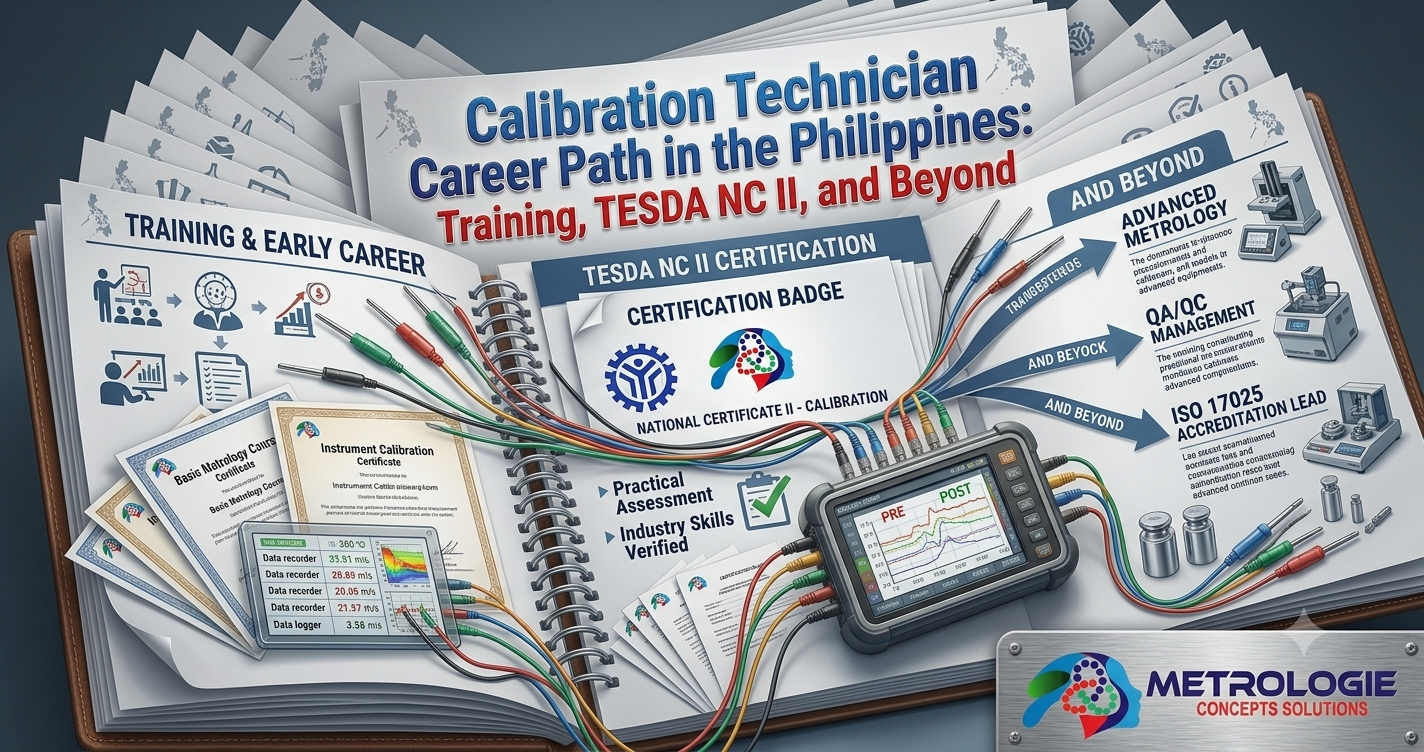
The TESDA Laboratory and Metrology/Calibration Services NC II is a National Certificate Level II qualification within the Philippine TVET Qualification Framework. It is classified under the Sector: Electronics, specifically the Metrology and Calibration sub-sector.
The qualification is built around four core competency units:
- Maintaining laboratory equipment and tools — care, handling, and maintenance of calibration instruments and laboratory equipment; ensuring cleanliness and functionality of the laboratory environment
- Performing dimensional and mechanical calibration — calibrating calipers, micrometers, dial gauges, and other dimensional measurement tools; using gauge blocks and other reference standards; documenting dimensional calibration results
- Performing other calibration activities — calibrating temperature, pressure, and other measurement instruments at a basic level; following established calibration procedures; documenting calibration results
- Applying basic calibration and laboratory quality system concepts — understanding of measurement uncertainty at an awareness level; calibration documentation and record-keeping; basic knowledge of calibration quality systems
The NC II is designed to produce technicians capable of performing calibration under supervision and following established procedures — it is an entry-level qualification, not a comprehensive metrology education. The skills and knowledge gaps that are not covered by NC II — measurement uncertainty calculation, ISO/IEC 17025 requirements, advanced temperature calibration methodology — are what differentiate entry-level technicians from senior calibration specialists, and these are areas where ongoing professional development training makes a significant difference to career trajectory.
How to Obtain the TESDA NC II
There are two main pathways to obtaining the TESDA NC II for Laboratory and Metrology/Calibration Services:
- Through a TESDA-registered training programme: Enrol in a training programme offered by a TESDA-registered training centre or institution that offers Laboratory and Metrology/Calibration Services NC II. Complete the prescribed number of training hours (which varies by provider but typically ranges from 160 to 320 hours of combined lecture and practical training). Upon completion, you will be eligible to take the TESDA competency assessment.
- Through Recognition of Prior Learning (RPL): If you have existing work experience in calibration or laboratory work — even without formal training — TESDA allows experienced workers to apply for competency assessment directly, without completing a formal training programme. This RPL pathway is particularly valuable for experienced calibration technicians who have been working in the field for years without a formal TESDA qualification.
The TESDA competency assessment consists of a written knowledge component and a practical demonstration component. Successful candidates are issued a National Certificate (NC II) that is recognised by employers throughout the Philippines. Failed candidates can retake the assessment after a specified waiting period.
Where to Find TESDA-Registered Training Providers
TESDA maintains a registry of all training providers registered to offer specific qualifications. To find a registered provider for Laboratory and Metrology/Calibration Services NC II near you:
- Visit the TESDA website (tesda.gov.ph) and search the TESDA Registry of Approved Programs (TVET-ARSP)
- Filter by the sector ‘Electronics’ and the qualification ‘Laboratory and Metrology/Calibration Services NC II’
- The registry will show all registered providers, their locations, and their contact information
Technical institutions offering this qualification include selected TESDA Technology Institutes (TTIs) and private technical schools — primarily concentrated in Metro Manila and major urban centres, with some provincial providers. For candidates outside Metro Manila, online theoretical components combined with practical training arrangements may be possible with some providers.
4. The Full Career Pathway: Stage by Stage
A calibration career in the Philippines follows a progression from entry-level technical work through increasing specialisation and expertise to senior technical leadership and management roles. Here is the complete career pathway, with specific guidance at each stage.
| Stage 1 | Junior Calibration Technician | 0 to 2 years |
| Salary range: ₱14,000 – ₱18,000/month | Typical roles: Calibration technician, laboratory assistant, quality control technician |
| Key skills to develop: Basic dimensional calibration (calipers, micrometers, dial gauges); temperature calibration of simple instruments; calibration documentation and record-keeping; safe handling of calibration equipment; following established calibration proceduresCredentials to pursue: TESDA Laboratory and Metrology/Calibration Services NC II; Introduction to Metrology training (MET-101) |
| Stage 2 | Calibration Technician | 2 to 5 years |
| Salary range: ₱18,000 – ₱28,000/month | Typical roles: Calibration technician, instrumentation technician, laboratory technician |
| Key skills to develop: Multi-discipline calibration capability (temperature + dimensional, or temperature + pressure); competent measurement uncertainty evaluation and documentation; reading and assessing calibration certificates; on-site calibration at client facilities; mentoring junior techniciansCredentials to pursue: Measurement Uncertainty training (MET-102); Temperature Calibration specialisation (MET-104); Pressure Calibration (MET-107 if applicable) |
| Stage 3 | Senior Calibration Technician | 5 to 8 years |
| Salary range: ₱28,000 – ₱40,000/month | Typical roles: Senior calibration technician, calibration team leader, laboratory supervisor |
| Key skills to develop: Advanced specialisation (pharmaceutical temperature calibration, or semiconductor electrical calibration); ISO/IEC 17025 working knowledge; calibration schedule management; calibration team supervision; client technical consultation; complex uncertainty budget preparation; out-of-tolerance investigationCredentials to pursue: ISO/IEC 17025 training (MET-103); Internal Auditor training (MET-108); Thermal Mapping specialisation (MET-105) for temperature/cold chain specialists |
| Stage 4 | Calibration Engineer | 5+ years (engineering degree) or 8+ years (technician track) |
| Salary range: ₱35,000 – ₱55,000/month | Typical roles: Calibration engineer, metrology engineer, quality systems engineer, laboratory quality manager |
| Key skills to develop: Laboratory management and ISO/IEC 17025 quality system responsibility; PAB accreditation assessment preparation and maintenance; advanced measurement uncertainty methodology; calibration programme design for client organisations; technical assessment and problem-solving at engineering levelCredentials to pursue: Engineering degree (preferred but not essential for experienced technician track); ISO/IEC 17025 Internal Auditor; advanced measurement uncertainty; ASQ Certified Calibration Technician (CCT) examination (international) |
| Stage 5 | Metrology Specialist / Laboratory Manager | 8+ years |
| Salary range: ₱45,000 – ₱75,000+/month | Typical roles: Metrology specialist, chief metrologist, calibration laboratory manager, metrology consultant |
| Key skills to develop: Deep technical expertise across multiple measurement disciplines; PAB accreditation management; laboratory business development; training programme development and delivery; metrology policy and standards engagement; technical leadership for complex measurement problemsCredentials to pursue: Extensive professional development; potentially pursuing international certifications (ASQ CCT); professional network through Quality and Metrology Society (Qualimets); DOST-ITDI engagement |
5. Specialisations That Accelerate Career Growth and Salary
Among all the factors that determine salary trajectory and career advancement speed in Philippine calibration, specialisation is the most powerful. A generalist calibration technician who can calibrate dimensional tools competently has good employment security but limited premium salary potential. A specialist who combines pharmaceutical temperature calibration expertise with ISO/IEC 17025 knowledge and thermal mapping competence is in a different market — with access to pharmaceutical sector salaries, cold chain compliance opportunities, and international client work that commands significantly higher rates.
Temperature Calibration Specialisation: The Highest Demand in 2025
Temperature calibration is the single most in-demand calibration specialisation in the Philippines in 2025, driven by: the rapid expansion of pharmaceutical cold chain infrastructure (both domestic distribution and export preparation); the growing food cold chain market; hospital pharmacy and healthcare cold storage compliance requirements; and increasing FDA and WHO enforcement of cold chain qualification standards.
A calibration technician who specialises in pharmaceutical temperature calibration — calibrating data loggers to PAB-accredited ISO/IEC 17025 standards, conducting thermal mapping studies, providing temperature calibration for hospital monitoring sensors — is positioned at the exact intersection of the Philippines’ highest-growth compliance needs. This specialisation commands premium rates and is the primary focus of Metrologie Solutions Philippines’ training and services.
ISO/IEC 17025 Knowledge: The Laboratory Quality Credential
Calibration technicians who develop deep working knowledge of ISO/IEC 17025 — the standard against which PAB accredits calibration laboratories — differentiate themselves significantly from peers with only technical calibration skills. ISO/IEC 17025 knowledge enables technicians to: work effectively in PAB-accredited laboratory environments, prepare for and contribute to PAB accreditation assessments, advise clients on calibration documentation requirements, and move into laboratory quality management roles.
The path to ISO/IEC 17025 competence typically involves: structured training on the standard’s requirements (MET-103 level), followed by practical experience in a laboratory that is already PAB-accredited, and eventually taking responsibility for specific elements of the laboratory’s quality system under the supervision of an experienced laboratory manager.
Semiconductor Industry Specialisation: The Highest Domestic Salaries
The Philippine semiconductor and electronics manufacturing sector — concentrated in Clark Special Economic Zone (Pampanga), Laguna Technopark, CEPZA (Cavite), and Bataan Economic Zone — offers the highest domestic salaries for calibration professionals in the Philippines. Semiconductor manufacturing requires calibration of electrical measurement instruments, dimensional gauging, and process control sensors to extremely high accuracy standards, and the companies operating in this sector — predominantly multinational electronics manufacturers — pay salaries that can reach ₱45,000 to ₱70,000/month for experienced senior calibration engineers.
The pathway to semiconductor sector calibration typically requires electrical calibration specialisation in addition to general calibration competence, and benefits from an engineering degree background — though experienced technicians with strong electrical calibration credentials can also enter this market.
6. The International Opportunity: OFW Calibration Careers
For Filipino calibration professionals with solid technical credentials, the international job market offers income multiples that are unavailable domestically. <cite index=’22-1′>TESDA certifications are a primary pathway to overseas employment for Filipino workers</cite>, and calibration and metrology is one of the technical fields where Philippine-trained professionals are actively sought in international markets.
Singapore: The Nearest Premium Market
Singapore has a highly developed calibration and metrology sector, driven by its semiconductor manufacturing, pharmaceutical manufacturing, and precision engineering industries. Singapore-based PAB-equivalent accredited laboratories and calibration service providers regularly hire experienced Philippine calibration technicians and engineers, with monthly compensation packages ranging from SGD 1,800 to SGD 3,500 or more (equivalent to approximately ₱75,000 to ₱145,000/month) for qualified technicians.
Singapore values Philippine calibration professionals who have: demonstrated experience with ISO/IEC 17025, measurement uncertainty competence, pharmaceutical or semiconductor industry experience, and English communication skills. Singapore’s accreditation body (SAC) operates under the same ILAC MRA framework as PAB — meaning that PAB-accredited calibration experience is directly recognised as relevant in Singapore.
Middle East: Volume and Accessibility
The Middle East — particularly Saudi Arabia, UAE, Qatar, and Kuwait — has significant demand for calibration technicians across oil and gas, manufacturing, and construction sectors. Monthly compensation packages for Filipino calibration technicians in the Middle East range from approximately USD 800 to USD 1,800 (approximately ₱46,000 to ₱104,000/month), with additional benefits including accommodation, transport, and medical coverage provided by the employer.
Middle East calibration opportunities are most accessible to technicians with pressure and temperature calibration experience, as these are the most in-demand measurement types in oil, gas, and industrial process control applications.
Japan and South Korea
Japan and South Korea have both implemented programmes for bringing in skilled foreign workers to address domestic technical skills shortages. Both countries have significant calibration and precision measurement industry sectors, and Filipino calibration technicians with demonstrated technical competence and willingness to learn the local language are among the profiles these programmes target. Compensation in Japan typically ranges from JPY 200,000 to JPY 350,000/month (approximately ₱70,000 to ₱120,000/month), with strong social benefits and quality of life considerations.
7. Building Your Calibration Career: A Practical Action Plan
For anyone at any stage of their calibration career journey in the Philippines, the following action plan provides concrete, prioritised steps for moving forward.
If You Are Just Starting Out (Student or Fresh Graduate)
- Identify a TESDA-registered training provider for Laboratory and Metrology/Calibration Services NC II in your area — check the TESDA website (tesda.gov.ph) for the registry of approved programmes
- Enrol in and complete the NC II training programme, focusing on mastering the practical calibration skills that will be assessed in the competency assessment
- Take the TESDA competency assessment and obtain your NC II certificate
- Apply for entry-level calibration technician positions at PAB-accredited calibration laboratories, pharmaceutical companies, or manufacturing firms in your area — these are the environments where you will build the foundational practical experience that feeds every subsequent career stage
- Within your first two years, pursue Introduction to Metrology training (MET-101) to build the theoretical foundation that the NC II curriculum does not fully cover
If You Are an Experienced Technician Ready to Advance
- If you do not yet have the TESDA NC II, pursue Recognition of Prior Learning (RPL) assessment — your existing experience likely qualifies you for direct assessment without completing a training programme
- Identify your specialisation gap — which measurement type(s) do you want to deepen? Temperature calibration for pharmaceutical/cold chain? Electrical calibration for semiconductor? Pursue targeted training in that area.
- Complete measurement uncertainty training (MET-102) — this is the single skill gap that most experienced Philippine calibration technicians have, and it is the most significant differentiator between mid-level technicians and senior specialists
- Develop ISO/IEC 17025 working knowledge through MET-103 training and practical involvement in your laboratory’s quality system activities
- Build a portfolio of calibration certificates that you have produced — demonstrating measurement uncertainty statements, multi-point calibration coverage, and PAB-traceable documentation
If You Are Targeting International Opportunities
- Ensure your TESDA NC II is current and your calibration specialisation is well-documented with work experience records
- Add measurement uncertainty competence (MET-102) and ISO/IEC 17025 knowledge (MET-103) to your credential profile — these are the skills most requested by international calibration employers
- Consider pursuing the ASQ Certified Calibration Technician (CCT) examination — this international credential signals your knowledge to employers who may be less familiar with TESDA NC II
- For Singapore specifically, research Singapore-based calibration service providers and recruitment agencies that work with Filipino technical professionals — direct application is often more effective than going through general OFW placement agencies
- For Middle East opportunities, engage with POEA-registered recruitment agencies that specialise in technical manufacturing roles, and ensure your TESDA documentation is legalised for the target country
| Metrologie Solutions Philippines: Your Career Development PartnerWe offer the training courses that accelerate calibration career progression at every stage — from MET-101 Introduction to Metrology for beginners to advanced measurement uncertainty (MET-102) and ISO/IEC 17025 internal auditing (MET-108) for experienced technicians targeting senior roles.We also provide TESDA NC II assessment preparation coaching for candidates ready to formalise their credentials, and we offer mentoring support for calibration professionals building their first independent calibration capability.Contact us at metrologiesolutions.com to discuss your career development goals and the training pathway most appropriate for your current stage. |
8. Frequently Asked Questions: Calibration Technician Career in the Philippines
Do I need an engineering degree to become a calibration technician in the Philippines?
No. The TESDA NC II in Laboratory and Metrology/Calibration Services is the primary formal entry credential for calibration technicians in the Philippines, and it does not require a college or engineering degree. Many of the Philippines’ most experienced and highly paid calibration specialists reached senior positions through the TESDA and professional development pathway rather than through academic degree programmes. That said, engineering degree holders (particularly Electrical, Mechanical, Electronics, and Chemical Engineers) who choose calibration as a career path have certain advantages in higher-level roles — particularly in semiconductor, pharmaceutical, and government metrology positions where engineering licensure adds value.
How long does it take to get the TESDA NC II in Laboratory and Metrology/Calibration Services?
The training duration depends on the training provider. Most TESDA-registered training programmes for Laboratory and Metrology/Calibration Services NC II run from 160 to 320 hours of combined lecture and practical training — equivalent to approximately one to three months of full-time training, or longer on a part-time basis. After completing training, you must pass a competency assessment to receive the NC II certificate. For candidates pursuing Recognition of Prior Learning (RPL), there is no required training period — you go directly to competency assessment based on your existing experience.
What is the difference between a calibration technician and a calibration engineer in the Philippines?
The distinction is primarily one of educational background and technical scope rather than a rigidly defined boundary. Calibration technicians typically have TESDA NC II or vocational qualifications and focus on performing calibration work following established procedures. Calibration engineers typically have engineering degrees (Electrical, Mechanical, Electronics, or Chemical Engineering) and may take on roles that involve designing calibration programmes, managing laboratory accreditation, conducting complex uncertainty analyses, and providing engineering-level technical consultation. In practice, experienced calibration technicians who invest in professional development — particularly ISO/IEC 17025, measurement uncertainty, and laboratory management skills — often perform work comparable to calibration engineers and earn similar salaries over time.
Which industries pay the highest salaries for calibration technicians in the Philippines?
Based on current job market data, the highest-paying domestic employers for calibration technicians in the Philippines are: semiconductor and electronics manufacturing companies in Clark, Laguna, and Cavite (₱35,000 to ₱55,000/month for experienced technicians); large pharmaceutical manufacturers (₱30,000 to ₱50,000/month for senior calibration specialists); and government metrology positions at DOST-ITDI (competitive with private sector for senior roles, with strong job security and benefits). For international opportunities, Singapore consistently offers the highest risk-adjusted income for Filipino calibration professionals.
Can I build a calibration business in the Philippines with TESDA NC II and experience?
Yes, and many successful independent calibration service providers in the Philippines started exactly this way. To build a viable calibration business, you need: the technical competence to perform calibrations accurately and document them properly (TESDA NC II plus professional development); reference standards of your own or access to reference standards (a significant capital investment); and ideally, PAB accreditation for your calibration laboratory (which gives your certificates international recognition and makes them acceptable for pharmaceutical, food, and other regulated industry clients). PAB accreditation requires meeting ISO/IEC 17025 requirements — which means investing in quality system development, equipment, and demonstrated technical competence before applying for assessment.
Conclusion: Metrology Is a Career Worth Pursuing
The calibration and metrology field in the Philippines is at an inflection point. The combination of pharmaceutical cold chain expansion, food export growth, semiconductor manufacturing investment, and tightening regulatory enforcement is creating a sustained, structural increase in demand for skilled calibration professionals — at a rate that the current supply of trained technicians cannot fully meet.
For Filipinos who choose this path, the rewards are real and growing. <cite index=’31-1′>The average calibration technician salary in the Philippines is approximately ₱18,028 per month</cite>, with strong upward progression for those who invest in specialisation, certification, and professional development. The international market — particularly Singapore, Japan, and the Middle East — offers income opportunities that few other TVET pathways can match. And the work itself is foundational: ensuring that measurements can be trusted, that temperature data can be relied upon, that the instruments on which product quality and patient safety depend are doing what they claim to do.
The TESDA NC II is the starting point. Professional development in measurement uncertainty, ISO/IEC 17025, and measurement specialisations is the accelerator. And the combination of technical excellence, regulatory knowledge, and a commitment to precision — the core attributes of the best calibration professionals — is the foundation of a career that compounds in value over time.
Metrologie Solutions Philippines is here to support every stage of that journey — with training programmes, TESDA NC II preparation, measurement uncertainty coaching, and the practical experience of a working PAB-accredited calibration and thermal mapping operation that mentors the next generation of Philippine metrology professionals.
| Start Your Calibration Career Journey TodayWhether you are a student considering TESDA NC II, an experienced technician ready to advance, or an employer building a calibration team — Metrologie Solutions Philippines can help.Contact us at metrologiesolutions.com to discuss TESDA NC II preparation, professional development training, or career mentoring in calibration and metrology.Website: metrologiesolutions.com | Services: Metrology Training · TESDA NC II Prep · Measurement Uncertainty · Calibration |
| About Metrologie Solutions PhilippinesMetrologie Solutions Philippines provides professional metrology training, TESDA NC II assessment preparation, and calibration services for individuals and organisations throughout the Philippines. Whether you are starting your career as a calibration technician or advancing to a senior metrology specialist role, we offer the training, mentoring, and certification preparation support you need at every stage of your career.Website: metrologiesolutions.com | Services: Metrology Training · TESDA NC II Prep · Calibration · Thermal Mapping |