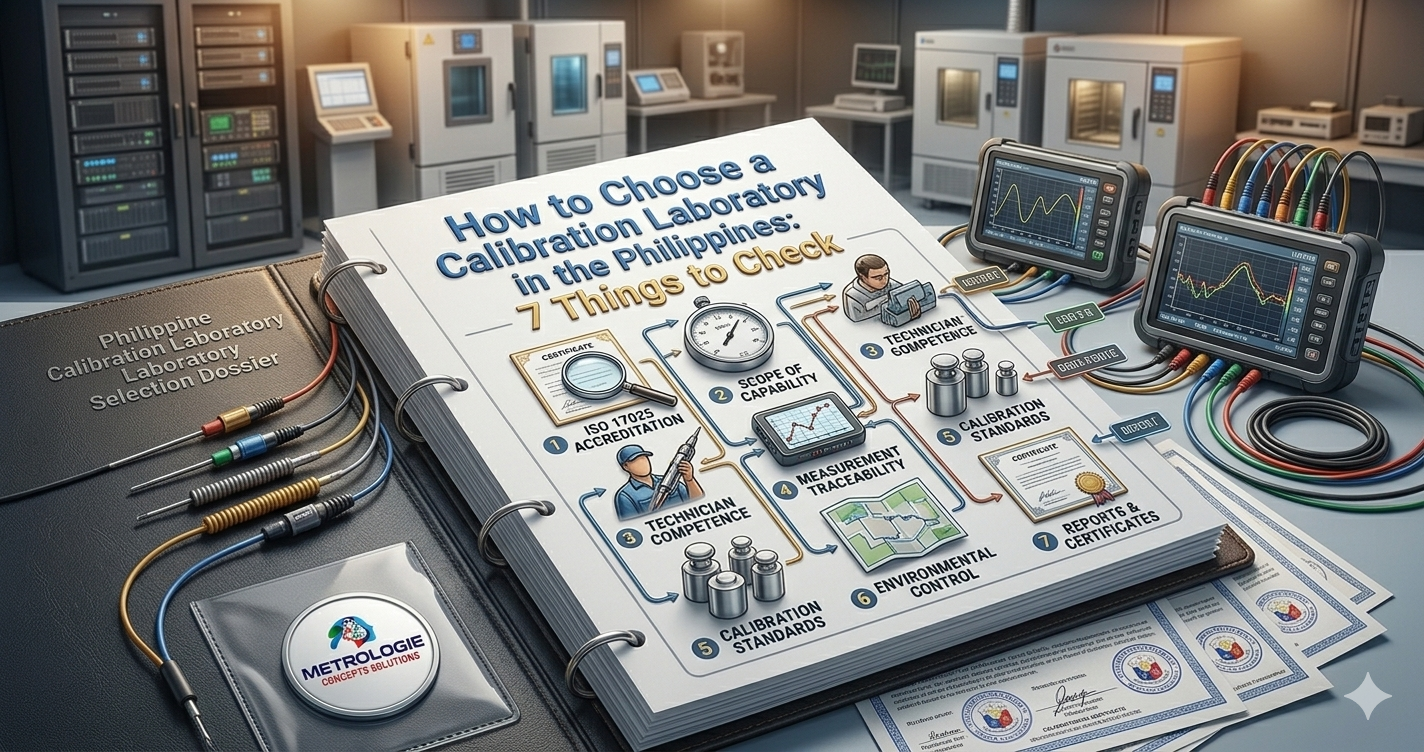
| Every thermal mapping study, every temperature monitoring system, every pharmaceutical manufacturing process, and every regulated measurement in the Philippines depends on calibration. Specifically, it depends on calibrated instruments — measurement devices that have been verified against traceable reference standards and found to measure accurately within defined limits. The calibration certificate attached to your measurement equipment is not just a piece of paper in a compliance file. It is the documented evidence that your measurements can be trusted — that the temperature your data logger shows is the temperature that actually exists, not some unchecked assumption. It is the link in the metrological traceability chain that connects your instrument, through a hierarchy of increasingly accurate reference standards, to the international definition of the unit being measured. When a Philippine FDA inspector reviews your thermal mapping documentation, one of the first things they will examine is the calibration certificates for the data loggers used in the study. When a WHO auditor evaluates your cold chain compliance, they will ask who calibrated your monitoring equipment and whether that calibration is traceable to recognised standards. When a multinational pharmaceutical principal audits your distribution facility, they will verify that your monitoring sensors were calibrated by a laboratory with the appropriate accreditation. In all of these situations, the quality of your calibration — and therefore the credibility of your entire temperature compliance programme — depends on choosing the right calibration laboratory. In the Philippines, not all calibration providers offer the same quality, the same accreditation credentials, or the same level of measurement traceability. Choosing the wrong provider can invalidate your entire thermal mapping study, expose your organisation to regulatory findings, and leave you unable to defend your measurements if challenged. This guide gives you the seven most important things to check when choosing a calibration laboratory in the Philippines — starting with the most fundamental and non-negotiable, and progressing to the practical factors that distinguish outstanding calibration partners from merely acceptable ones. The Bottom Line Before You Start In the Philippines, the Philippine Accreditation Bureau (PAB) — an agency under the Department of Trade and Industry (DTI) — is the sole national body authorised to accredit calibration laboratories to the international standard ISO/IEC 17025. PAB accreditation is the only calibration credential that provides internationally recognised measurement traceability in the Philippines. If a calibration laboratory cannot show you a current PAB accreditation certificate with your required measurement type listed in its scope of accreditation, no other credential, claim, or certificate they provide will satisfy WHO, GMP, FDA Circular 2021-003, or any serious pharmaceutical principal audit. Start there. Why Calibration Matters for Philippine Businesses Before the seven checks, it is worth understanding exactly what calibration is and why it matters — because the importance of choosing a qualified calibration laboratory is directly proportional to how critical accurate measurement is to your operations. Calibration is the process of comparing a measurement instrument against a reference standard of known accuracy, under defined conditions, and documenting the relationship between the instrument’s readings and the reference. A calibration certificate records this comparison — showing the nominal value that was tested, the reference value (what the reference standard showed), the instrument reading, the difference between them, and the measurement uncertainty associated with the calibration. For a pharmaceutical company using a temperature data logger to demonstrate that its cold room maintained +2°C to +8°C, the calibration certificate is the evidence that the data logger’s readings can be trusted. Without a calibration certificate from a competent laboratory, the readings are just numbers with no documented basis for confidence in their accuracy. The consequences of relying on uncalibrated or improperly calibrated instruments are direct and severe in regulated industries: A data logger that reads 5°C but actually measures 8°C produces a passing thermal mapping result for a cold room that is actually failing — giving false confidence in a non-compliant storage environment A temperature monitoring sensor that drifts 1.5°C over its operational life — without being recalibrated to detect the drift — may be triggering alarms at the wrong threshold for months A thermal mapping study conducted with data loggers calibrated by a non-accredited laboratory produces documentation that FDA inspectors and WHO auditors will not accept as valid qualification evidence A food processor whose temperature monitoring relies on uncalibrated instruments cannot demonstrate HACCP compliance for critical control point temperature management The 7 Things to Check When Choosing a Calibration Laboratory in the Philippines #1 PAB Accreditation — The Non-Negotiable First Check The Philippine Accreditation Bureau (PAB), operating under the Department of Trade and Industry, is the Philippines’ national accreditation body. It accredits calibration laboratories to PNS ISO/IEC 17025:2017 — the international standard for the competence of testing and calibration laboratories. PAB accreditation is the only credential in the Philippines that provides internationally recognised measurement traceability. Why PAB accreditation matters: PAB is a signatory to the ILAC (International Laboratory Accreditation Cooperation) Mutual Recognition Arrangement (MRA). This MRA means that calibration certificates issued by PAB-accredited laboratories are recognised by accreditation bodies in over 100 countries — including the countries where WHO, FDA, and multinational pharmaceutical principals are headquartered. A calibration certificate from a PAB-accredited laboratory in the Philippines carries the same international credibility as a certificate from UKAS-accredited laboratories in the UK or DAkkS-accredited laboratories in Germany. How to verify PAB accreditation: Go to the PAB website (pabaccreditation.dti.gov.ph) and access the Directory of Accredited Calibration Laboratories. This directory lists every currently accredited calibration laboratory in the Philippines, their accreditation number, and their scope of accreditation. Any laboratory claiming PAB accreditation should be verifiable in this directory. What to look for on the certificate: A PAB-accredited calibration certificate must display the PAB logo and the laboratory’s PAB accreditation number (format: LA-YYYY-XXXN). The certificate should also show the PAB ILAC MRA mark — a combined PAB and ILAC MRA logo — which confirms international recognition of the accreditation. Red flag: A laboratory that claims to be ‘ISO 17025 certified’ without PAB accreditation is not the same thing. ISO 17025 certification (from an unaccredited certification body) does not confer the measurement traceability and international recognition that PAB accreditation provides. In the Philippines, PAB accreditation — not ISO 17025 certification — is the relevant credential for calibration laboratories. #2 Scope of Accreditation — Check That Your Measurement Type Is Covered PAB accreditation is not a blanket credential that covers all measurement types. Each laboratory is accredited for a specific scope — the precise measurement quantities, measurement ranges, and instruments it is technically competent to calibrate. A laboratory may be fully accredited for pressure calibration but not for temperature calibration. A laboratory accredited for temperature calibration may only cover 0°C to 150°C — not the -80°C to +150°C range needed for ultra-cold thermal mapping. For thermal mapping of pharmaceutical cold rooms (+2°C to +8°C), the calibration laboratory must have temperature calibration within its accredited scope, covering the range relevant to the study — typically 0°C to +10°C at minimum. For ambient temperature pharmaceutical warehouse mapping (20°C to 30°C), the scope must cover that range. For frozen storage or ultra-cold mapping, the scope must extend to the relevant sub-zero temperatures. How to verify the scope: The laboratory’s Scope of Accreditation document is public — it should be available from the laboratory on request and can also be accessed through the PAB directory. The scope document lists every measurement type, measurement range, and measurement uncertainty the laboratory is accredited for. Compare your calibration requirements against this scope before engaging the laboratory. For thermal mapping data loggers specifically, verify that: (a) temperature calibration is in scope, (b) the calibration temperature range covers the range relevant to your application, and (c) the measurement uncertainty achievable within that scope meets the requirements of your protocol (typically ±0.5°C or better). Red flag: A laboratory that calibrates your data loggers at a single temperature point (e.g., only at 5°C for a pharmaceutical cold room) rather than at multiple points across the full study range is not providing adequate calibration for thermal mapping applications. WHO TRS 961 Supplement 8 requires calibration at multiple temperature points spanning the full study range. #3 Measurement Traceability — Follow the Chain to International Standards Metrological traceability is the property of a measurement result that can be related to a reference through an unbroken chain of calibrations, each contributing to measurement uncertainty. In plain language: your instrument’s calibration must be traceable back — through a documented chain of increasingly accurate references — to the international definition of the unit being measured. In the Philippines, the traceability chain for temperature calibration runs: your instrument → the calibration laboratory’s reference standard → the National Metrology Laboratory (NML) operated by the Industrial Technology Development Institute (DOST-ITDI) → international measurement standards maintained by the International Bureau of Weights and Measures (BIPM) in France. Each link in this chain must be documented with calibration certificates. What to look for in the certificate: The calibration certificate must include a traceability statement — a declaration that the measurements are traceable to national or international measurement standards. The statement should identify the reference standard used by the laboratory and its own calibration status. Some certificates also include a traceability chain diagram showing the full hierarchy from the laboratory’s working standard to the national primary standard. Why this matters for pharmaceutical compliance: WHO TRS 961 Supplement 8 requires that calibration of data loggers used for thermal mapping be traceable to national or international measurement standards. FDA Circular 2021-003 references WHO Good Distribution Practice, which includes this traceability requirement. A calibration certificate without a documented traceability statement is not acceptable for pharmaceutical thermal mapping or monitoring applications. Red flag: A laboratory that cannot explain its traceability chain, that calibrates against other instruments without documented reference standards, or whose certificates contain no traceability statement is not providing GMP-compliant calibration. #4 Measurement Uncertainty — Verify the Numbers Are in the Certificate Measurement uncertainty is the quantification of doubt about a calibration result — the range within which the true value of the measured quantity is expected to lie, with a stated level of confidence. A calibration without a stated measurement uncertainty is an incomplete calibration — it tells you what the instrument read but not how much confidence you should have in that reading. For thermal mapping data loggers, the combined measurement uncertainty of the calibration — encompassing the uncertainty of the reference standard, the uncertainty of the calibration process, and any environmental contributions — should be no greater than ±0.25°C to ±0.5°C at a 95% confidence level (k=2) for pharmaceutical applications. If the calibration uncertainty is larger than this, it significantly reduces the confidence that a data logger reading of (for example) 7.8°C is actually within the +2°C to +8°C acceptance range. Expressed Measurement Uncertainty (CMC): PAB-accredited laboratories publish their Calibration and Measurement Capabilities (CMC) — the best measurement uncertainty they can achieve for each calibration type within their accredited scope. Check that the CMC for temperature calibration at the range relevant to your application is adequate for your compliance needs. What to look for in the certificate: The calibration certificate must state the measurement uncertainty for each calibration point, the coverage factor (k), and the confidence level (typically 95%). Example: ‘Expanded measurement uncertainty: ±0.25°C at k=2 (95% confidence level).’ If the certificate does not state measurement uncertainty, it is not a complete, GMP-compliant calibration certificate. Red flag: Certificates that state only the instrument reading and the reference reading without any statement of measurement uncertainty are incomplete. Certificates that state ‘within specifications’ without quantifying the uncertainty are similarly incomplete. A good calibration certificate is a measurement document, not a pass/fail statement. #5 Temperature Calibration Range and Multi-Point Coverage A data logger used for pharmaceutical thermal mapping must be calibrated at multiple temperature points spanning the full range expected during the study — not just at a single midpoint temperature. Single-point calibration cannot characterise a data logger’s accuracy across its full operating range, because the relationship between actual temperature and displayed temperature may be linear (consistent offset) or non-linear (varying offset at different temperatures). For pharmaceutical cold room thermal mapping (+2°C to +8°C): Calibration should cover at minimum three points within and around the study range — for example, 0°C, +5°C, and +10°C. For CRT pharmaceutical warehouse mapping (20°C to 30°C): three to five points covering 15°C to 35°C. For ambient power failure testing where temperatures may rise above 30°C: extend the calibration range to cover the expected maximum temperature during the power failure test. Why multi-point calibration matters: A data logger that reads accurately at +5°C may have a significant positive offset at +8°C and a negative offset at +2°C — giving systematically incorrect readings at both ends of the acceptance range. Single-point calibration at +5°C would not detect these end-range errors. Multi-point calibration across the full study range maps the data logger’s accuracy profile and identifies any non-linearity that might affect study results. Post-study calibration: Best practice (and increasingly an expectation in pharmaceutical GMP environments) is to calibrate data loggers again after the mapping study is completed — confirming that the loggers maintained their accuracy throughout the study period. If any post-study calibration reveals drift greater than ±0.5°C, the study data for the drifted logger must be reviewed and potentially adjusted or the affected data period excluded. Red flag: A calibration laboratory that offers only single-point temperature calibration for data loggers is not providing adequate service for pharmaceutical thermal mapping applications. Insist on multi-point calibration covering your full study temperature range. #6 Certificate Format, Content, and Readability A calibration certificate is a formal measurement document. Its content and format must meet defined requirements to be useful as compliance evidence. Many Philippine QA teams have discovered — at the worst possible moment, during an FDA inspection or client audit — that their calibration certificates lack critical information that renders them inadequate for regulatory compliance purposes. Required content on a GMP-compliant calibration certificate: • Laboratory identification: Name, address, and PAB accreditation number of the calibration laboratory • PAB accreditation mark and ILAC MRA mark (for internationally recognised certificates) • Certificate number and date of issue • Description and unique identification of the instrument calibrated (make, model, serial number) • Date(s) of calibration • Environmental conditions during calibration (temperature and relative humidity in the calibration laboratory at time of calibration) • Reference standard(s) used, with their own calibration certificate numbers and traceable status • Calibration results: for each calibration point, the nominal (test) value, the reference value, the instrument reading, and the deviation (error) • Measurement uncertainty for each calibration point (expanded, k=2, 95% confidence) • Traceability statement • Calibration due date or recommended recalibration interval • Authorised signatory’s name, title, and signature Red flag: Certificates that are single-page tick-box formats stating only ‘PASS’ or ‘CALIBRATED’ without tabulated measurement data are not adequate for pharmaceutical GMP compliance. These minimal certificates may be acceptable for industrial or commercial applications but will not survive pharmaceutical regulatory scrutiny. #7 Industry Experience, Technical Support, and Turnaround Time The first six checks establish the minimum technical and regulatory competence of a calibration laboratory. This seventh check addresses the practical working relationship aspects that determine whether a laboratory is genuinely useful to your compliance programme over the long term. Industry experience: A calibration laboratory with experience in pharmaceutical, food, and healthcare applications understands the specific compliance requirements of these sectors — including the documentation standards, the regulatory frameworks, and the practical demands of thermal mapping programmes. A laboratory that primarily serves industrial or manufacturing clients may provide technically valid calibration but produce documentation in formats that are not optimised for pharmaceutical GMP compliance. Technical support and consultation: When your QA team has a question about calibration — whether a particular measurement uncertainty is adequate for your protocol’s acceptance criteria, whether post-study calibration is needed, or how to interpret an out-of-specification calibration result — a capable calibration laboratory should be able to provide clear, informed answers. The ability to provide technical consultation is a meaningful differentiator between providers. Turnaround time and scheduling flexibility: For thermal mapping studies, data loggers must be calibrated before deployment and returned to the client with certificates in time for the study start. Calibration laboratories that have long lead times or inflexible scheduling can delay mapping studies and disrupt compliance programme timelines. Ask specifically about turnaround time for temperature calibration of data loggers, and whether rush services are available when study timelines require them. On-site calibration capability: Some calibration applications — particularly ongoing calibration of permanently installed monitoring sensors — are better served by on-site calibration (the calibration laboratory sending a technician with reference standards to calibrate equipment in place) rather than requiring the client to remove and ship instruments to the laboratory. Check whether your calibration provider offers on-site services for installed monitoring equipment. Geographic coverage: For Philippine businesses with facilities outside Metro Manila — in CALABARZON, Central Luzon, Cebu, or Mindanao — verify that the calibration laboratory can service your location, whether through on-site visits or through a logistics arrangement that ensures instruments can be sent and returned without extended downtime. Red Flags: Signs a Calibration Laboratory Is Not Meeting the Standard In addition to the seven positive checks above, there are specific warning signs that indicate a calibration laboratory may not be providing the quality of service that your compliance programme requires. Here is a consolidated list of red flags to watch for: Red Flag What It Means Risk to Your Compliance No PAB accreditation — or accreditation cannot be verified on PAB website The laboratory has not been assessed for technical competence by the national accreditation body CRITICAL: Certificates not internationally recognised; will not satisfy WHO, FDA, or principal audit requirements Temperature calibration not in accredited scope Even if PAB-accredited, the laboratory is not certified for temperature measurement CRITICAL: Calibration outside accredited scope cannot be presented as PAB-accredited work Calibration range does not cover your study temperature range The laboratory calibrates at temperatures different from those relevant to your application HIGH: Data logger accuracy at study temperatures is unverified; study results cannot be trusted Single-point temperature calibration only The laboratory does not characterise the data logger across its operating range HIGH: Non-linearity errors at range extremes go undetected; acceptance criteria compliance at limits is uncertain Certificate contains no measurement uncertainty The calibration is incomplete — it provides a comparison result without quantifying the confidence level of that result HIGH: Certificate fails GMP documentation requirements; WHO auditors and FDA inspectors will identify the deficiency Certificate contains no traceability statement The calibration chain back to national/international standards is not documented HIGH: Certificate fails WHO and GMP traceability requirements Certificate does not display PAB accreditation number or logo The laboratory is issuing certificates that do not reference their accredited status MEDIUM: Certificates may not be recognisable as PAB-accredited work by reviewers; confusion about credential validity Laboratory cannot explain its reference standards or traceability chain The laboratory does not understand or cannot articulate the basis of its measurement traceability MEDIUM-HIGH: Suggests a laboratory that is accredited in name but may not fully implement the technical requirements of ISO/IEC 17025 Very low prices significantly below market rates for accredited calibration Prices far below market may indicate non-accredited service being presented as equivalent to accredited work MEDIUM: Worth investigating — confirm accreditation and scope before proceeding on price alone Long turnaround times with no flexibility for urgent study schedules Operational constraint that can disrupt mapping study timelines LOW-MEDIUM: Compliance risk is not from the calibration quality but from scheduling failures that delay required studies Understanding the Philippine Accreditation Bureau (PAB): What Every QA Manager Should Know The Philippine Accreditation Bureau (PAB) is the national accreditation body of the Philippines, operating under the Department of Trade and Industry (DTI). Its role is formally mandated under Executive Order No. 802, which designates PAB as the central authority for accreditation in the Philippines. Understanding how PAB works helps QA managers verify accreditation claims, interpret PAB certificates, and understand the significance of PAB accreditation in the context of international regulatory requirements. PAB’s Role in the International Recognition System PAB is a signatory member of the International Laboratory Accreditation Cooperation (ILAC) Mutual Recognition Arrangement. This MRA is the global framework through which accreditation bodies worldwide recognise each other’s accreditation — meaning that a calibration certificate issued by a PAB-accredited laboratory carries the same international recognition as certificates from accredited laboratories in Europe, North America, Australia, Japan, and Singapore. For Philippine pharmaceutical companies whose products are exported, or whose international principals conduct audits against global standards, PAB-accredited calibration certificates meet the calibration documentation requirements of those international standards — because PAB’s accreditation itself is internationally recognised through the ILAC MRA. What PAB Accreditation Involves for a Calibration Laboratory To obtain PAB accreditation, a calibration laboratory must: establish and implement a quality management system meeting the requirements of PNS ISO/IEC 17025:2017; demonstrate technical competence in the specific measurement types and ranges for which accreditation is sought; undergo an assessment by PAB-appointed technical assessors who review the laboratory’s documentation, equipment, procedures, and staff competence; and maintain continuing compliance with PAB conditions for accreditation, including surveillance assessments at defined intervals. The accreditation process ensures that each PAB-accredited laboratory has been independently assessed and found competent for its specific scope. This competence assessment — not just the possession of a quality manual — is what makes PAB accreditation meaningful. How to Verify PAB Accreditation The PAB maintains a searchable Directory of Accredited Calibration Laboratories on its website at pabaccreditation.dti.gov.ph. This directory is the definitive reference for verifying whether a calibration laboratory is currently accredited and what measurements are within its accredited scope. To verify a specific laboratory’s accreditation: search for the laboratory by name or accreditation number, confirm that the accreditation is current (check the validity date), and review the Scope of Accreditation document to confirm that temperature calibration — in the required range — is included in the accredited scope. PAB Accreditation Number Format PAB calibration laboratory accreditation numbers follow the format LA-YYYY-XXXN, where LA denotes a calibration laboratory, YYYY is the year of initial accreditation, XXX is a sequential number, and N is a letter suffix (A for the first scope, B for the second, etc.). For example, LA-2023-420A indicates a calibration laboratory first accredited in 2023, with sequential number 420 and scope designation A. When a laboratory provides a calibration certificate, verify that the accreditation number on the certificate matches the number in the PAB directory. A certificate bearing an accreditation number that does not appear in the PAB directory has not been issued by a currently accredited laboratory. How Often Should You Calibrate Your Temperature Monitoring Equipment? Choosing the right calibration laboratory is only the first step. The second is establishing the right calibration frequency — how often your temperature monitoring sensors, data loggers, and reference thermometers must be calibrated to maintain valid, GMP-compliant measurement assurance. Regulatory Guidance on Calibration Frequency WHO Technical Report Series No. 961 recommends that calibration devices be verified against certified reference standards at least once a year. This annual minimum applies to the permanent temperature monitoring sensors in pharmaceutical cold rooms, warehouses, and hospital pharmacies. FDA Circular 2021-003’s reference to WHO Good Distribution Practice guidelines incorporates this annual calibration requirement for Philippine pharmaceutical establishments. ISPE guidance recommends that the calibration interval be justified by the measurement uncertainty requirements of the application and the demonstrated stability of the instrument over time. For high-risk pharmaceutical storage applications — vaccines, biologics, blood products — six-month calibration intervals are increasingly expected by quality auditors and pharmaceutical principals. Calibration Frequency by Application Application Minimum Calibration Frequency Recommended Frequency Regulatory Basis Data loggers for thermal mapping studies Immediately before each study (pre-study) and ideally immediately after (post-study) Per study: pre + post calibration WHO TRS 961 Supplement 8; GMP Annex 15 Permanent monitoring sensors in pharmaceutical cold rooms (+2°C to +8°C) Annually Every 6 months for high-risk biologics/vaccines WHO TRS 961; FDA Circular 2021-003; ISPE GPG Permanent monitoring sensors in CRT pharmaceutical warehouses Annually Annually; verify at each seasonal remapping study WHO GDP; FDA Circular 2021-003 Hospital pharmacy and blood bank refrigerator sensors Annually Every 6 months (tight temperature window; patient safety criticality) WHO; AABB (blood bank); DOH hospital licensing HACCP temperature monitoring at food critical control points Annually Annually; more frequent if monitoring data shows drift HACCP; FDA food licensing requirements Reference thermometers / platinum resistance thermometers Annually Annually to 2 years depending on stability ISO/IEC 17025 requirements; GMP measurement control The Out-of-Tolerance Finding: What to Do When Calibration Fails When a calibration check reveals that an instrument’s readings are outside its acceptable tolerance — either during a routine calibration cycle or during a post-study calibration check — the finding must be managed systematically. Steps required: Document the out-of-tolerance finding formally — the instrument ID, the calibration point where the deviation was found, the magnitude of the deviation, and the date of discovery Initiate an investigation to determine when the drift likely occurred — whether it was a sudden event (suggesting equipment damage or malfunction) or a gradual drift (suggesting normal ageing) Assess the impact on any measurements made with the instrument while it was out of tolerance — for monitoring data, this means reviewing the temperature records during the affected period; for mapping study data, this may mean reassessing whether the study results remain valid Take corrective action — repair, adjustment, or replacement of the instrument Recalibrate the instrument and confirm it is within tolerance before returning it to service Frequently Asked Questions: Calibration Laboratories in the Philippines Is there a difference between ‘PAB accredited’ and ‘ISO 17025 certified’? Yes — a significant one. PAB accreditation means the laboratory has been assessed by the Philippine national accreditation body (PAB) and found technically competent for its accredited scope, with international recognition through the ILAC MRA. ISO 17025 certification — issued by a certification body rather than an accreditation body — indicates that the laboratory has implemented a quality management system consistent with ISO 17025 but does not confer the same technical competence assessment or international recognition. For pharmaceutical GMP and WHO GDP compliance purposes, PAB accreditation is the required credential in the Philippines. ISO 17025 certification alone is not an acceptable substitute. Our calibration laboratory has ISO 17025 certification but not PAB accreditation. Will our calibration certificates be accepted by the FDA and WHO auditors? Most likely not for pharmaceutical applications. FDA Circular 2021-003 references WHO Good Distribution Practice guidelines, which require measurement traceability through accredited calibration laboratories. WHO explicitly references accreditation bodies that are signatories to the ILAC MRA — of which PAB is one. ISO 17025 certification bodies are not signatories to the ILAC MRA and do not provide the same internationally recognised measurement traceability. For pharmaceutical GMP, thermal mapping, and cold chain compliance in the Philippines, PAB-accredited calibration is the required standard. Can we calibrate our temperature data loggers ourselves in-house? Yes, if your internal calibration laboratory is itself PAB-accredited for temperature calibration. Many large pharmaceutical manufacturers operate internal calibration laboratories that are PAB-accredited to ISO/IEC 17025 — in which case their in-house calibration meets the same standard as external PAB-accredited service providers. However, if your internal laboratory is not PAB-accredited, calibrations performed in-house do not meet the accreditation requirement for pharmaceutical GMP, thermal mapping, and FDA Circular 2021-003 compliance. What should a calibration certificate for a temperature data logger look like for our thermal mapping study? A complete, GMP-compliant calibration certificate for a temperature data logger used in a pharmaceutical thermal mapping study should include: the PAB accreditation number and logo; the PAB ILAC MRA mark; the data logger’s make, model, and serial number; the calibration date; the environmental conditions in the calibration laboratory; the reference standard used and its own calibration status; tabulated results for each calibration point showing nominal value, reference value, instrument reading, and deviation; the measurement uncertainty at each point (expanded, k=2); a traceability statement; and the authorised signatory’s signature. A certificate that lacks any of these elements is incomplete for pharmaceutical compliance purposes. How do we maintain calibration records for a regulatory inspection? All calibration certificates for temperature monitoring equipment should be maintained in a structured, retrievable filing system — whether physical or electronic. For each piece of monitoring equipment, the file should contain: the current calibration certificate (most recent), all historical calibration certificates for the life of the instrument, any out-of-tolerance findings and their investigation records, and the equipment maintenance history. Calibration records for equipment used in thermal mapping studies should be retained for the life of the storage area plus a minimum of five years, and must be immediately producible for FDA inspection on request. Conclusion: Your Calibration Partner Is the Foundation of Your Measurement Confidence Every temperature reading in your cold room, every sensor in your monitoring system, every data logger in your thermal mapping study is only as reliable as the calibration behind it. And in the Philippines, the calibration is only as reliable as the laboratory that performed it. The seven checks in this guide — PAB accreditation, scope verification, traceability, measurement uncertainty, multi-point coverage, certificate content, and practical service quality — are not arbitrary bureaucratic requirements. They are the criteria that distinguish calibration that can be trusted, defended to regulators, and relied upon for compliance decisions from calibration that merely looks like a certificate. The good news is that checking these seven things is straightforward. The PAB directory is publicly accessible. Calibration certificates are readable documents — once you know what to look for. And qualified calibration service providers in the Philippines are ready to explain their credentials, their traceability chains, and their measurement capabilities to any client who asks. Metrologie Solutions Philippines is a PAB-accredited calibration laboratory providing temperature calibration services for data loggers, thermometers, thermal mapping instruments, and temperature monitoring systems across the Philippines. Our calibration certificates meet every requirement described in this guide — PAB accreditation mark, ILAC MRA recognition, multi-point temperature calibration, measurement uncertainty statements, full traceability documentation, and complete certificate content for GMP and WHO GDP compliance. Ready to Verify Your Calibration Credentials Are Fully Compliant? Contact Metrologie Solutions Philippines for a consultation on your calibration programme — whether you need data logger calibration for a thermal mapping study, annual recalibration of your monitoring sensors, or a complete review of your calibration documentation for FDA inspection readiness. Website: metrologiesolutions.com | Services: Temperature Calibration · Thermal Mapping · Calibration Programme Review · Training About Metrologie Solutions Philippines Metrologie Solutions Philippines is a PAB-accredited calibration laboratory and the country’s leading provider of thermal mapping, instrument calibration, and metrology training. We calibrate temperature data loggers, data loggers, thermometers, pressure gauges, dimensional tools, and electrical instruments across pharmaceutical, food, healthcare, and industrial sectors throughout the Philippines. Our calibration certificates meet the documentation requirements of WHO, FDA Circular 2021-003, GMP, and ISPE standards. Website: metrologiesolutions.com | Services: Calibration · Thermal Mapping · Training · Cold Chain Compliance |