
In the global logistics and manufacturing sectors, the Philippines represents one of the most challenging environments for temperature-controlled operations. As a tropical archipelago characterized by high ambient temperatures, relentless humidity, and the increasing intensity of the El Niño-Southern Oscillation (ENSO), maintaining a stable “Cold Chain” is a battle against the elements.
For businesses dealing with life-saving pharmaceuticals, fresh agricultural exports, or sensitive chemicals, Thermal Mapping is the only scientific defense. It is no longer just a regulatory “box to tick”—it is a critical survival strategy.
The Tropical Challenge: Heat, Humidity, and the Archipelago
The Philippines operates under a Type 1 and Type 2 tropical climate, where the average year-round temperature hovers around 27°C, often peaking well above 35°C during the dry season. This high baseline temperature puts immediate pressure on any cooling infrastructure.
The Impact of High Ambient Temperatures
Unlike temperate regions where external temperatures might fluctuate between cool and mild, the Philippine external environment is almost always “hot.” This creates a massive temperature gradient ($\Delta T$) between the outside air and a 2°C to 8°C cold room.
- Heat Ingress: Every door opening, every poorly insulated wall, and every structural gap becomes a highway for heat to enter the facility.
- Solar Radiation: The intense tropical sun can heat the roofs of warehouses to over 60°C, radiating thermal energy downward through the ceiling, often creating “Hot Spots” at the highest levels of pallet racking.
The Humidity Factor
Humidity in the Philippines often exceeds 80%. High humidity is more than just a discomfort; it carries latent heat.
- Evaporator Strain: HVAC and refrigeration units must work twice as hard to remove moisture from the air before they can effectively lower the temperature.
- Condensation Risks: Inconsistent thermal control in high humidity leads to condensation on product packaging, which can result in mold growth, degraded labels, and compromised sterility for medical supplies.
What is Thermal Mapping?
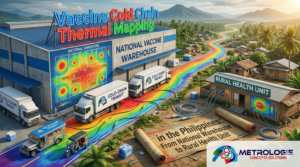
Thermal mapping is a scientific validation process used to document the temperature distribution within a three-dimensional space over a set period. By placing sensors at various heights and locations—including corners, near vents, and close to doors—companies can visualize how air moves and where it fails to reach.
The 3D Reality of Air Stratification
In the Philippines, high-ceiling warehouses are prone to Air Stratification. Because heat rises, the temperature at the top of a 12-meter rack can be significantly higher than at the bottom. Thermal mapping identifies these vertical gradients, ensuring that sensitive products aren’t accidentally stored in a “danger zone” near the ceiling.
The Regulatory Mandate: FDA Philippines and International Standards
The Food and Drug Administration (FDA) Philippines has significantly tightened its requirements for Good Distribution and Storage Practices (GDSP). Under current guidelines, any facility handling vaccines, biologics, or temperature-sensitive medicines must provide documented proof of thermal stability.
FDA Circular No. 2021-003
This circular emphasizes that establishments must conduct thermal mapping to:
- Identify the hottest and coldest points in the facility.
- Determine the impact of power failures (the “Holdover Time”).
- Assess the effect of frequent door openings during peak operations.
Failing an FDA audit due to a lack of thermal mapping doesn’t just result in a fine—it can lead to the suspension of your License to Operate (LTO), effectively halting your business.
Preventing “The Invisible Loss”: Spoilage and Financial Risk
In a country where logistics are already complicated by island-to-island transport, a failure in thermal stability is catastrophic.
The Cost of a Temperature Excursion
When a batch of medicine or a shipment of high-value seafood exceeds its safety range, it is considered a Temperature Excursion.
- Pharmaceuticals: Many vaccines are “thermolabile,” meaning they lose potency permanently if they get too warm. In 2025-2026, with the rise of biologics and personalized medicine, the value of a single pallet can exceed ₱10 million.
- Food Exports: The Philippines is a global leader in mango and seafood exports. Even a 2-degree deviation can trigger bacterial growth, leading to rejected shipments at international borders and massive financial losses.
Optimizing Energy Efficiency in a High-Cost Region
The Philippines has some of the highest electricity rates in Southeast Asia. For a warehouse operator, cooling costs are often the largest overhead. Thermal mapping provides the data needed to stop “over-cooling.”
Targeted Cooling vs. Brute Force
Without mapping, facility managers often set thermostats at a dangerously low level (e.g., setting a 15°C to 25°C room at 18°C) just to be “safe.”
- Thermal Mapping Insight: Mapping might reveal that the room is perfectly stable at 22°C, and only a specific corner near a loading dock needs an extra air curtain.
- Savings: Adjusting the setpoint based on mapping data can reduce energy consumption by 10% to 15%, saving millions of pesos over a year.
The Critical Scenarios for Mapping in the Philippines
In the tropical context, mapping must be performed under three specific “Worst-Case” scenarios:
| Scenario | Why it’s Critical in the Philippines |
| The Summer Peak | Testing the facility when the ambient temperature is at its annual high (March–May). |
| The High-Humidity Season | Testing during the monsoon season (July–October) to check for latent heat load and condensation. |
| Power Interruption (Holdover) | Calculating how long the room stays safe during a “brownout” before the backup generator takes over. |
Summary: The Strategic Value of Data
| Benefit | Impact on Philippine Business |
| Product Integrity | Ensures medicines and food remain safe and effective for consumers. |
| Compliance | Meets the stringent requirements of FDA Philippines and WHO. |
| Risk Mitigation | Identifies “Hot Spots” before they cause millions in product spoilage. |
| Energy Savings | Allows for more efficient HVAC settings in a high-cost energy market. |
| Global Credibility | Enables local businesses to meet international export standards (ISO/HACCP). |
Conclusion: A Future-Proof Cold Chain
As climate change continues to push tropical temperatures even higher, the “old way” of managing warehouses—relying on a single wall-mounted thermometer—is a recipe for disaster. Thermal mapping provides the 3D visibility required to navigate the Philippine climate with confidence.
By investing in professional thermal mapping, Filipino businesses transform their storage facilities from simple “cool rooms” into scientifically validated, energy-efficient, and audit-proof assets. In the heat of the Philippines, data is the best coolant.