By Metrologie Solutions Philippines | Vaccine Cold Chain & Metrology Experts | Updated 2025
Every vaccine administered in the Philippines carries an invisible history — a temperature record that began at the manufacturer, continued through international and domestic cold chain, passed through a national or regional warehouse, traveled to a provincial or city health office, and finally arrived at the rural health unit, barangay health center, or hospital pharmacy where a child, a pregnant mother, or an elderly patient received their dose.
If that temperature history contains even one significant breach — a hot spot in a cold room that nobody knew about, a power outage whose impact was never measured, a refrigerator whose temperature distribution was never validated — the vaccine in the syringe may no longer be effective. The patient believes they are protected. They are not.
This is not a theoretical risk. Research on Philippine vaccine cold chains has documented gaps at multiple levels — from rural health units lacking backup generators, to refrigerators without functioning thermometers, to provincial stores operating on unvalidated equipment. And unlike spoiled food or degraded packaging, a temperature-compromised vaccine leaves no visible sign of its failure.
Thermal mapping is the tool that makes these invisible risks visible. It is the scientific process by which every storage unit in the Philippine vaccine cold chain — from the national cold store in Muntinlupa to the pharmaceutical refrigerator in a rural health unit in Mindanao — is validated to prove that it actually maintains the 2°C to 8°C range required for vaccine potency, throughout its entire volume, under the conditions it will face in real operations.
This guide provides the most comprehensive and Philippines-specific explanation of vaccine cold chain thermal mapping available. It covers the full cold chain from top to bottom, explains what thermal mapping requires at each level, addresses the unique challenges of the Philippine operating environment, and provides practical guidance for every organisation involved in the Philippine vaccine supply chain.
| What This Guide AnswersWhy temperature uniformity — not just average temperature — is what determines vaccine potencyHow the Philippine vaccine cold chain is structured and what thermal mapping is required at each levelThe specific WHO, DOH, and FDA Circular 2021-003 requirements for vaccine cold chain validationWhy the dual risks of heat AND freezing make Philippine vaccine thermal mapping especially criticalHow thermal mapping is conducted for vaccine cold rooms, refrigerators, and transport containersThe unique challenges of the Philippine tropical climate, power infrastructure, and archipelago geographyWhat happens when a vaccine cold chain fails — and how thermal mapping prevents it |
1. Why Vaccine Temperature Integrity Is a Matter of Life and Death
Vaccines are among the most temperature-sensitive products handled anywhere in the pharmaceutical supply chain. Unlike most drugs, which may lose potency gradually and partially under temperature stress, many vaccines can suffer irreversible, complete potency loss from a single significant temperature event. And this loss is invisible — a vaccine vial that has been heat-damaged looks identical to an undamaged one. There is no colour change, no precipitate, no odour. The only way to know is through the temperature record — which means the only way to prevent it is through thermal mapping and continuous monitoring.
The Two-Sided Temperature Risk: Heat AND Freezing
Most people associate vaccine cold chain failure with heat — vaccines being left out of refrigeration, transported in warm vehicles, stored in malfunctioning cold rooms. And heat is indeed a primary risk, particularly in the Philippines where ambient temperatures regularly exceed 32°C and can peak above 40°C during the dry season.
But the cold side of the chain is equally dangerous, and for different vaccine types. The World Health Organization classifies vaccines into groups based on their temperature sensitivity:
- Heat-sensitive vaccines (e.g., OPV, measles, MMR, varicella): These vaccines can tolerate brief exposures above 8°C better than previously thought but are damaged by freezing. They must be stored at +2°C to +8°C and must never be exposed to temperatures below 0°C.
- Freeze-sensitive vaccines (e.g., DTP, hepatitis A and B, HPV, pneumococcal, meningococcal, influenza, inactivated polio): These vaccines are severely damaged by freezing. Exposure to sub-zero temperatures destroys the aluminium adjuvant that gives these vaccines their effectiveness, rendering them inactive — yet they look completely normal after thawing.
- Ultra-cold vaccines (e.g., some mRNA vaccines, certain biologics): These products require storage at -20°C to -25°C or colder, with separate ultra-cold chain requirements down to -60°C to -80°C for specific mRNA products.
This dual risk is critical for Philippine vaccine cold chain management because both failures are possible simultaneously. A cold room thermostat set too low — or a cooling coil positioned such that it creates a freeze zone near the unit’s rear wall — can freeze vaccines in one part of the refrigerator while the door-side area is at an acceptable 5°C. The average temperature looks fine. The damage is catastrophic and invisible. Thermal mapping maps this entire temperature distribution — it is the only way to identify both the warm zones and the freeze zones within a storage unit.
The Consequences of Cold Chain Failure for Philippine Public Health
When a vaccine fails due to cold chain temperature breach, the consequences ripple outward through the health system:
- Individual patients who receive compromised vaccines are not protected against the diseases they believe they are vaccinated against — measles, polio, diphtheria, hepatitis B, cervical cancer
- Herd immunity targets are not achieved even when coverage rates appear high, because the effective dose rate is lower than the administered dose rate
- Disease outbreaks can occur in populations that appear to have adequate vaccination coverage — a phenomenon that has been documented in multiple settings where cold chain failure was later identified as a contributing factor
- Significant public resources are wasted — vaccines that cost the government hundreds of pesos per dose are destroyed by preventable cold chain failures
- Public trust in vaccination programmes is eroded when parents and communities discover that vaccines they believed were protecting their children may have been compromised
The stakes of vaccine cold chain management in the Philippines could not be higher — and thermal mapping is the foundation that makes every other element of cold chain management meaningful and verifiable.
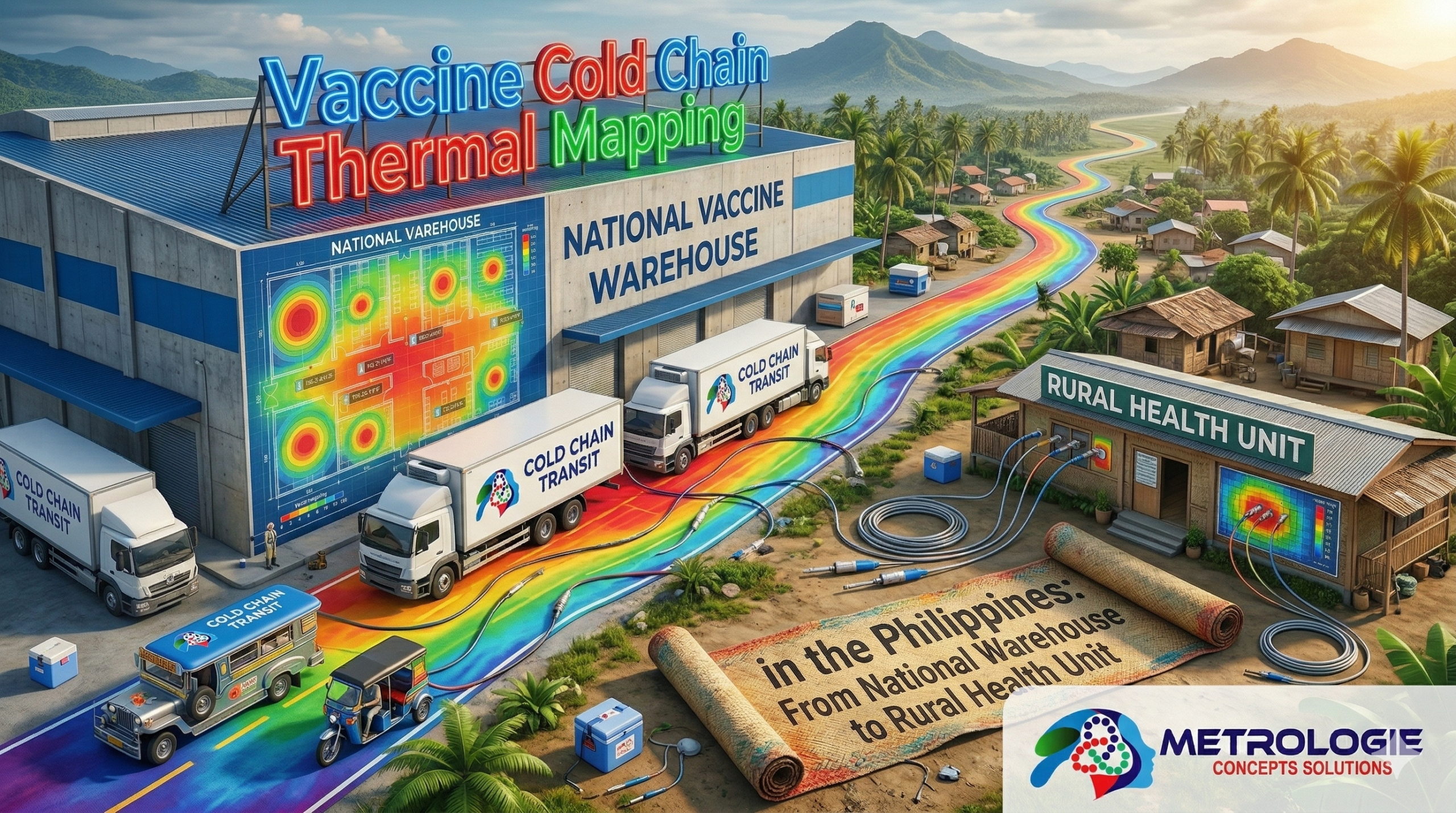
2. The Philippine Vaccine Cold Chain: Structure and Thermal Mapping at Every Level
The Philippine vaccine cold chain operates through a multi-tiered network that spans from international suppliers through national infrastructure, down to the most remote rural health units in the archipelago. Each level of this chain has specific storage requirements, specific thermal mapping obligations, and specific operational challenges.
Level 1: National Cold Stores
At the apex of the Philippine vaccine cold chain sit the national cold stores — large-scale refrigerated warehouse facilities that receive vaccines from international manufacturers and UNICEF/WHO procurement agencies, and hold them pending distribution to regional and provincial levels.
Key national cold store operators include the Research Institute for Tropical Medicine (RITM) in Muntinlupa City, major pharmaceutical 3PL operators such as Zuellig Pharma in Parañaque, UNILAB facilities in Biñan, Laguna, and other designated national distributors.
At this level, thermal mapping requirements are at their most comprehensive. National cold stores must maintain multiple temperature zones — typically including refrigerated space at +2°C to +8°C for most vaccines, frozen space at -20°C to -25°C for vaccines requiring frozen storage, and in some facilities, ultra-cold storage at -60°C to -80°C for mRNA vaccines and specialty biologics.
Thermal mapping at the national cold store level must demonstrate temperature uniformity throughout large warehouse volumes — often thousands of cubic metres. This requires significant numbers of calibrated data loggers, extended study periods (typically seven days or longer), both empty and loaded condition studies, power failure testing, and comprehensive seasonal studies. The documentation produced must meet WHO TRS 961, FDA Circular 2021-003, and international GDP standards.
Level 2: Regional and Provincial Cold Stores
Below the national level, vaccines move to regional and provincial cold stores operated by Department of Health regional offices and provincial health offices. These facilities serve as intermediate distribution hubs, receiving bulk shipments from national stores and distributing to city and municipal levels.
Regional and provincial cold stores typically operate pharmaceutical-grade cold rooms at +2°C to +8°C, often with frozen storage capacity for vaccines requiring -20°C conditions. These facilities face the full range of Philippine environmental challenges — including seasonal temperature extremes during the dry season, humidity during the wet season, and power supply variability that is often more significant at the regional level than at Metro Manila-based national stores.
Thermal mapping at the regional and provincial level is required under DOH cold chain guidelines and FDA Circular 2021-003 for any facility storing pharmaceutical products in temperature-controlled conditions. Studies must be conducted in both the hot dry season and the wet season, with power failure testing mandatory given the prevalence of power interruptions in many regions.
Level 3: City and Municipal Cold Stores
At the city and municipal level, health offices receive vaccines from provincial stores and distribute them to health centres and rural health units. Storage is typically in smaller cold rooms or dedicated pharmaceutical refrigerators. The challenges at this level increase — smaller facilities are more vulnerable to ambient temperature fluctuations, power interruptions are more frequent, and the technical expertise available for cold chain management is often more limited.
Thermal mapping of city and municipal cold rooms and refrigerators is a gap that affects many Philippine local government units. The formal qualification of storage equipment at this level is critical because it is at this point in the chain that vaccines are closest to the patient — any failure here directly affects vaccine efficacy at the point of administration.
Level 4: Rural Health Units and Barangay Health Centers
The final link in the Philippine vaccine cold chain is the rural health unit (RHU) and barangay health center — the primary point of contact between the national immunisation programme and individual patients. At this level, vaccines are typically stored in ice-lined refrigerators (ILRs) or pharmaceutical-grade vaccine refrigerators, and administered directly to patients or community health workers conducting outreach immunisation.
Research on Philippine cold chain management at the RHU level has documented significant gaps: the majority of PHCs lacking access to backup generators, many without voltage stabilisers, and some without functioning thermometers. These gaps create real risk of temperature failure at the last mile — where the vaccine is closest to the patient and the consequences of failure are most direct.
While comprehensive thermal mapping studies at every individual RHU may be aspirational in a system with thousands of health facilities, the minimum requirements — temperature validation of storage equipment before use, regular temperature monitoring, and contingency procedures for power failures — apply at every level of the chain under the WHO and DOH frameworks that govern the Philippine Expanded Program on Immunization.
| Cold Chain Level | Typical Facility | Temperature Zone(s) | Thermal Mapping Requirement | Key Challenge |
| National | National cold stores, major 3PL distributors | +2 to +8°C; -20 to -25°C; -60 to -80°C (some) | Full IQ/OQ/PQ; seasonal mapping; power failure test; loaded/unloaded studies | Large volume; multiple zones; ultra-cold requirements |
| Regional / Provincial | DOH regional offices; provincial health offices | +2 to +8°C; -20 to -25°C | Cold room qualification; seasonal mapping; power failure test | Regional power variability; remote location logistics |
| City / Municipal | City/municipal health offices | +2 to +8°C | Refrigerator/cold room qualification; power failure test | Smaller equipment; less technical oversight |
| Rural Health Unit | RHUs; barangay health centers | +2 to +8°C | Vaccine refrigerator validation; temperature monitoring | Power interruptions; limited technical capacity; no backup power in many units |
| Private Distributor | Drug distributors; hospital pharmacies | +2 to +8°C; -20°C (some) | Full thermal mapping per FDA Circular 2021-003; WHO TRS 961 | Regulatory compliance; client/principal requirements |
| Transport | Cold chain vehicles; insulated containers | +2 to +8°C | Transport container qualification; duration studies under tropical ambient temps | Philippine archipelago; air and sea transport; tropical ambient conditions |
3. The Regulatory Framework: WHO, DOH, and FDA Requirements for Vaccine Cold Chain Mapping
The thermal mapping obligations for vaccine cold chain operators in the Philippines arise from a layered regulatory framework that combines Philippine domestic requirements with international WHO standards. Understanding this framework — and how the layers interact — is essential for any organisation involved in vaccine storage and distribution.
WHO Requirements: The Global Standard
The World Health Organization provides the foundational international standards for vaccine cold chain management. The key WHO documents applicable to Philippine vaccine cold chain thermal mapping are:
- WHO TRS 961 Annex 9 (Model Guidance for Storage and Transport of Time- and Temperature-Sensitive Pharmaceutical Products): Requires that all new temperature-controlled storage areas be qualified before becoming operational. Qualification must demonstrate the air temperature profile throughout the storage area, define zones unsuitable for vaccine storage, and demonstrate the time taken for temperatures to exceed specified limits when cooling fails.
- WHO TRS 961 Supplement 7 (Qualification of Temperature-Controlled Storage Areas): Provides the detailed IQ/OQ/PQ qualification framework specifically for vaccine cold storage, covering installation qualification, operational qualification (empty space mapping), and performance qualification (loaded space mapping).
- WHO TRS 961 Supplement 8 (Temperature Mapping of Storage Areas): The detailed technical guide for conducting mapping studies — sensor selection, calibration, placement, study duration, data analysis, and report format.
- WHO Prequalification Programme: For facilities storing WHO-prequalified vaccines, the WHO PQS (Performance, Quality and Safety) standards for vaccine refrigerators and cold rooms include performance requirements that are verified through qualification and mapping studies.
- WHO Temperature Monitoring Guidelines: WHO recommends digital data loggers with continuous recording for vaccine cold chain monitoring, with calibrated equipment and complete audit trails for all temperature data.
Philippine DOH Requirements
The Department of Health of the Philippines operates the Expanded Program on Immunization (EPI), which manages the national vaccine supply and distribution system. DOH cold chain guidelines — informed by WHO standards and the Philippine FDA’s regulatory framework — govern temperature management at all levels of the public sector vaccine cold chain.
DOH cold chain requirements specify the types of equipment required at each level of the cold chain (cold rooms, walk-in freezers, ice-lined refrigerators, cold boxes, vaccine carriers), the temperature monitoring requirements at each level, the backup power requirements (generator sets and voltage regulators are mandated), and the documentation that must be maintained for all cold chain operations. DOH also conducts periodic assessments of cold chain capacity across its network of regional, provincial, and local health facilities.
FDA Philippines: Circular 2021-003
FDA Circular No. 2021-003 — which we covered in depth in the previous article in this series — applies to all pharmaceutical establishments handling temperature-sensitive products, including vaccines. Private pharmaceutical companies, drug distributors, hospital pharmacies, and 3PL cold chain operators storing and distributing vaccines in the Philippines are subject to the circular’s requirements for storage area qualification, continuous temperature monitoring, calibrated equipment, and complete documentation.
For private sector vaccine cold chain operators, FDA Circular 2021-003 is the primary enforceable regulatory requirement. The circular aligns with WHO standards, meaning that compliance with WHO TRS 961 thermal mapping methodology produces documentation that simultaneously satisfies FDA Circular 2021-003’s qualification requirements.
Temperature Ranges: What Philippine Vaccine Storage Must Maintain
| Storage Category | Temperature Range | Vaccines Typically Stored | Freeze Risk? |
| Refrigerated (standard vaccine storage) | +2°C to +8°C | DTP, HepA, HepB, HPV, Hib, IPV, PCV, influenza, rabies, cholera, typhoid | YES — many freeze-sensitive; sub-zero temps cause irreversible damage |
| Frozen vaccine storage | -15°C to -25°C | OPV (oral polio), varicella, some MMR preparations | NO — these vaccines must be frozen; heat is the primary risk |
| Ultra-cold storage | -60°C to -80°C | Specific mRNA vaccines; some specialty biologics | NO — require ultra-cold; strict stability windows on thawing |
| Transport (with conditioned cold packs) | +2°C to +8°C (maintained) | Any refrigerated vaccine during transit | YES — freeze risk from insufficiently conditioned ice packs |
| The Freeze Risk Is Underestimated in the PhilippinesWhile heat excursions are the more intuitive risk in a tropical country, freezing is an equally serious — and frequently underestimated — threat to vaccine potency in the Philippines.The most common cause of freeze damage is the use of ice packs that have not been properly conditioned (allowed to partially thaw) before being placed in contact with vaccines. Frozen ice packs applied directly to freeze-sensitive vaccines destroy the aluminium adjuvant in DTP, hepatitis, HPV, and other vaccines — rendering them ineffective while leaving them visually identical to potent vaccines.Thermal mapping of vaccine transport containers under Philippine tropical ambient conditions must include freeze-risk testing — demonstrating that no part of the vaccine carrier reaches sub-zero temperatures even with worst-case ice pack configuration. |
4. How Thermal Mapping Is Conducted at Each Level of the Philippine Vaccine Cold Chain
The methodology of thermal mapping follows the same core principles at every level — calibrated sensors, documented protocol, comprehensive data collection, analysis, and formal report. But the specific application of that methodology differs at each level of the Philippine vaccine cold chain, reflecting the differences in facility size, equipment type, and operational context.
Thermal Mapping of National and Regional Cold Rooms
Large pharmaceutical cold rooms at the national and regional level are mapped using the full WHO TRS 961 IQ/OQ/PQ qualification lifecycle:
- Installation Qualification (IQ): Verifies that the cold room was installed according to specifications — HVAC capacity, insulation specifications, door seals, monitoring connections, and backup power systems are all documented and verified.
- Operational Qualification (OQ) — Empty Mapping: The cold room is mapped in an empty or minimally loaded condition. This reveals the baseline airflow pattern and temperature distribution without the moderating influence of product thermal mass. All 8 corners are instrumented, plus mid-space, door-adjacent zones, cooling coil areas, and any identified risk locations. A minimum of 72 hours of data is collected, extended to 7 days for larger spaces.
- Performance Qualification (PQ) — Loaded Mapping: The study is repeated with the cold room loaded to a representative operational condition. This captures the effect of product thermal mass on temperature distribution and response time.
- Power Failure Test: Cooling is interrupted and the time for temperatures to reach the upper limit (+8°C for vaccine storage) is measured and documented. This defines the maximum safe response window for power outage events.
- Seasonal Studies: Studies are conducted in both the hot dry season (March to May in most of the Philippines) and the wet season (July to September) to capture seasonal variation in temperature distribution.
Thermal Mapping of Pharmaceutical Refrigerators (City, Municipal, Hospital Level)
Individual pharmaceutical vaccine refrigerators — whether large ILRs (ice-lined refrigerators) or dedicated vaccine storage units — are mapped using a scaled-down but equally rigorous methodology:
- A minimum of 8 to 16 calibrated data loggers are placed at all geometric extremes (8 corners of the refrigerator interior), near the door (hot spot), near the cooling coil or freezer plate (cold spot and potential freeze zone), near any permanent monitoring sensor, and at product storage height levels.
- Data is collected continuously for a minimum of 72 hours — long enough to capture diurnal temperature variation, defrost cycles, and multiple door-opening events under normal operational conditions.
- The study must be conducted under Philippine tropical ambient conditions — ideally during the hot season to validate worst-case performance. WHO guidance and metrologiesolutions.com recommend testing at ambient temperatures representative of the local Philippine environment (30°C to 40°C ambient for many Philippine locations during peak season).
- Power failure holdover testing is critical for individual refrigerators in the Philippine context, given the prevalence of power interruptions. The holdover time — how long the refrigerator maintains +2°C to +8°C without power — is measured and documented. This defines the maximum duration of a power outage that can be tolerated without vaccine risk.
- Freeze zone identification: The study explicitly maps the cold distribution within the refrigerator to identify any zones where temperatures may fall below 0°C — critical for establishing which shelf positions must not be used for freeze-sensitive vaccines.
Thermal Mapping of Vaccine Transport Containers and Cold Boxes
The transport link in the Philippine vaccine cold chain — from cold rooms to health facilities, and for outreach immunisation activities — relies on insulated cold boxes and vaccine carriers. These containers must also be thermally characterised to understand their temperature maintenance performance under Philippine field conditions.
Transport container thermal mapping differs from fixed storage mapping in important ways:
- The study simulates a transport mission rather than a static storage period. Sensors are placed throughout the container interior in positions representing the full product load.
- The critical output is the qualified duration — the maximum time the container can maintain the +2°C to +8°C range (or the applicable frozen temperature) under the ambient temperature conditions of the transport route.
- Philippine tropical ambient conditions (35°C to 43°C in peak season) must be used for transport container qualification studies — using temperate-climate data from equipment manufacturers does not adequately characterise performance in the Philippine environment.
- Ice pack conditioning procedures are validated as part of the transport mapping study — demonstrating that the specified conditioning procedure prevents freeze-zone formation within the container while maintaining adequate cold duration.
- Duration validation data directly determines the maximum allowable transport mission length for each container type under specific Philippine ambient conditions — a critical operational parameter for planning outreach immunisation in remote or island communities.
| The Philippine Transport Duration ChallengeThe Philippine archipelago creates transport cold chain challenges that are unique in Southeast Asia. Vaccine distribution from a provincial store in Luzon to a remote barangay health center in an island municipality may involve multiple transport modes — vehicle, ferry, and motorcycle — with total transit times potentially exceeding 24 hours.Transport container qualification studies under Philippine tropical ambient conditions must produce validated duration data that demonstrates the container can maintain the required temperature range for the full realistic transit time of the longest routes it will be used on.This duration data is the operational specification that prevents cold chain failure during extended transport missions — and it can only be established through proper thermal mapping of transport containers under Philippine conditions. |
5. The Philippine Environmental Challenges That Make Vaccine Thermal Mapping Essential
The Philippines presents a combination of environmental, infrastructural, and logistical challenges that are unlike those faced by vaccine cold chain operators in temperate countries. These challenges make thermal mapping not merely a regulatory formality but a genuine operational necessity for protecting vaccine potency.
Challenge 1: The Tropical Climate — Both Heat and Humidity
With average temperatures of 26°C to 32°C and peaks above 40°C in many lowland areas during the dry season, the Philippine climate imposes sustained thermal stress on every element of the vaccine cold chain. A pharmaceutical refrigerator designed for temperate ambient conditions of 25°C may struggle to maintain +2°C to +8°C consistently when the room temperature in a rural health unit reaches 35°C during April and May.
Humidity compounds the challenge. High relative humidity accelerates heat transfer through insulation, compromises door seal effectiveness, and creates condensation that can affect equipment performance. Thermal mapping of vaccine refrigerators and cold rooms must be conducted at peak ambient temperature and humidity conditions — not at comfortable air-conditioned room conditions — to produce data that is representative of actual operating performance.
Challenge 2: Power Interruptions and Voltage Fluctuations
Power interruptions are a significant operational reality across the Philippines. In many provincial and rural areas, brownouts lasting from minutes to hours occur regularly. Voltage fluctuations — too low for refrigerators to maintain compressor performance, or sudden surges that damage electronic monitoring equipment — are common without voltage stabilisers.
The holdover time established by thermal mapping — the number of hours a cold room or refrigerator can maintain the required temperature range without power — is one of the most practically important outputs of a vaccine cold chain thermal mapping study in the Philippines. This number determines whether a two-hour brownout is a manageable event or a vaccine-compromising emergency. It drives the specification for backup generators and the definition of the maximum acceptable brownout duration before emergency protocols must be activated.
Research on Philippine RHU cold chain management has found that the majority of PHCs lack access to backup generators. For these facilities, understanding the holdover characteristics of their vaccine refrigerators through thermal mapping is the minimum scientific basis for making rational cold chain management decisions.
Challenge 3: Archipelago Geography and Transport Routes
Distributing vaccines across 7,641 islands in a tropical climate is one of the most logistically complex cold chain challenges in the world. The transport leg is where the Philippine vaccine cold chain faces its greatest vulnerabilities:
- Sea transport across open water exposes cold boxes to solar radiation and ambient heat that may significantly exceed inland conditions
- Air transport — while faster — involves altitude temperature variation and cargo handling at airports that may not be adequately temperature-controlled
- Remote communities accessible only by boat or on foot require transport containers to maintain temperature integrity for extended periods under physically demanding conditions
- Geographic isolation means that when cold chain failure is discovered at a remote health facility, replacement vaccines may take days to arrive — during which patient immunisation is interrupted
Transport container thermal mapping under Philippine field conditions — specifically, at the ambient temperatures and travel durations representative of the actual distribution routes — is the only scientific basis for determining whether containers are adequate for their intended purpose and what protocols are necessary to protect vaccine potency throughout the journey.
Challenge 4: Seasonal Variation — Dry Season vs. Wet Season
The Philippines experiences two distinct seasons: the dry season (roughly November to May, with peak temperatures from March to May) and the wet season (roughly June to October, with peak rainfall and high humidity). These seasons create significantly different thermal challenges for vaccine cold storage:
- During the dry season: Ambient temperatures are at their highest, placing maximum stress on refrigeration systems. Hot spot temperatures within cold rooms reach their peak. HVAC systems work hardest and are most likely to show inadequate capacity. This is the season where thermal mapping most often reveals compliance failures.
- During the wet season: Humidity is at its highest, creating heat transfer challenges and condensation risks. Some coastal and low-lying areas experience flooding that can compromise cold room integrity or interrupt power supply. Temperature distribution may differ from dry-season patterns as ambient humidity affects equipment performance.
WHO TRS 961 Supplement 8 explicitly requires that thermal mapping studies take seasonal variations into account. For Philippine vaccine cold chain operators, this means conducting separate mapping studies in both the dry season and the wet season to build a complete picture of cold room and refrigerator performance across the full range of operating conditions.
6. The Three-Phase Thermal Mapping Protocol for Philippine Vaccine Storage Units
A WHO-compliant thermal mapping study for a Philippine vaccine storage facility follows a structured three-phase protocol. Here is the complete protocol in the sequence that Metrologie Solutions Philippines follows for vaccine cold chain studies.
Phase 1: Pre-Study Protocol Development and Equipment Preparation
Before any sensor is deployed, a formal written protocol is developed and approved. The protocol for a vaccine cold chain thermal mapping study specifies:
- Study scope: The specific storage unit(s) to be mapped — cold room dimensions, refrigerator model, transport container type
- Acceptance criteria: The temperature range that must be maintained (typically +2°C to +8°C for most vaccine storage; never below 0°C for freeze-sensitive vaccines)
- Sensor selection and calibration: All data loggers used must be calibrated by a PAB-accredited laboratory before deployment, with calibration certificates showing traceability to national and international measurement standards
- Sensor placement plan: A detailed map showing the position of every sensor inside the storage unit, with justification for each position based on risk assessment
- Study conditions: Ambient temperature conditions during the study; whether the unit will be loaded or empty; door operation protocols
- Study duration: Minimum hours of continuous data collection (typically 72 hours for refrigerators; 7 days for cold rooms)
- Power failure test protocol: How and when the power failure simulation will be conducted and what data will be collected
- Approval signatures: The protocol must be approved by a qualified person before the study begins
Phase 2: Data Collection Under Controlled and Stress Conditions
With the protocol approved and sensors calibrated, the data collection phase begins. For vaccine cold chain mapping studies at the refrigerator level, the standard sensor placement positions are:
- All eight geometric corners of the refrigerator interior (top/bottom, front/back, left/right)
- The zone immediately adjacent to the door — the primary hot spot in most vaccine refrigerators
- The zone immediately adjacent to the cooling coil or freezer plate — the primary cold spot and primary freeze-risk zone
- The mid-space position at product storage height — the reference point for overall temperature level
- Adjacent to any existing permanent monitoring sensor — to validate whether the sensor position is representative
Data loggers record temperature at intervals of 1 to 10 minutes throughout the study period. The study captures:
- Baseline temperature distribution under normal operating conditions
- Temperature response during door opening events (simulated to represent normal operational usage)
- Temperature distribution during defrost cycles
- Diurnal variation as ambient temperature rises and falls through the day
- Power failure response: After a minimum of 24 hours of baseline data, the power supply to the unit is interrupted and temperature rise in all zones is monitored until either a defined time limit or the upper acceptance temperature (+8°C) is reached — whichever comes first
Phase 3: Data Analysis, Report, and Recommendations
After the study period, all sensor data is downloaded and analysed to produce:
- Temperature profiles for each sensor location — time-series graphs showing temperature behaviour over the full study period
- Statistical summary for each location: minimum, maximum, mean, and standard deviation
- Hot spot identification: The sensor location with the highest recorded temperatures (typically near the door)
- Cold spot identification: The sensor location with the lowest recorded temperatures (typically near the cooling coil or freezer plate)
- Freeze zone mapping: Any zones where temperatures dropped below 0°C — which must be identified as no-storage zones for freeze-sensitive vaccines
- Power failure curve: A graph showing temperature rise from the point of power interruption to the upper limit, with the time-to-exceedance clearly marked
- Compliance conclusion: Does the unit maintain +2°C to +8°C throughout its full volume, with no zones below 0°C, under the full range of study conditions?
- Permanent sensor placement recommendations: Where to position the monitoring thermometer based on the hot spot and cold spot data
- Operational restrictions: Any zones identified as unsuitable for freeze-sensitive vaccine storage due to cold spot proximity
7. Special Considerations: Thermal Mapping for Ultra-Cold Vaccine Storage
The introduction of mRNA vaccines during the COVID-19 pandemic brought ultra-cold storage requirements into the Philippine cold chain for the first time at scale. Some mRNA vaccines required storage at -60°C to -80°C at the national level, and -20°C at the regional and local level after thawing. This created thermal mapping challenges that the Philippine cold chain had not previously encountered.
Ultra-Cold Thermal Mapping Requirements
Ultra-cold storage mapping follows the same core methodology — calibrated sensors, documented protocol, comprehensive data analysis — but with important technical differences:
- Sensor selection: Data loggers must be rated and calibrated for the target temperature range (-80°C requires specialised sensors different from those used for +2°C to +8°C mapping)
- Calibration traceability: Calibration of ultra-cold sensors must specifically cover the ultra-cold temperature range to the required accuracy
- Stability window studies: Ultra-cold vaccines have specific stability windows when thawed for distribution — thermal mapping must characterise the thermal performance of the storage unit in the context of these stability windows
- Power failure criticality: Temperature recovery in ultra-cold freezers after power interruption is very slow — the power failure holdover test is even more critical for ultra-cold storage than for +2°C to +8°C refrigeration
Transition Temperature Mapping: From Ultra-Cold to Refrigerated
Some vaccines that require ultra-cold storage at the national level transition to refrigerated storage (+2°C to +8°C) at lower levels of the cold chain after initial thawing. Managing this transition — maintaining potency during the thawing process and ensuring correct storage conditions in the refrigerated stage — requires both thermal mapping of the refrigerated storage units and clear operational protocols based on the manufacturer’s stability data.
8. What Happens When the Vaccine Cold Chain Fails — And How Thermal Mapping Prevents It
Cold chain failure in the Philippine vaccine supply chain is not a hypothetical risk. It has been documented at multiple levels of the chain, and its consequences — both for patient health and for programme credibility — are significant. Understanding what cold chain failure looks like, and how thermal mapping prevents it, is essential for every organisation involved in Philippine vaccine distribution.
Real-World Cold Chain Failure Scenarios in the Philippines
The following scenarios represent documented or plausible failure modes in the Philippine vaccine cold chain — each preventable through proper thermal mapping and monitoring:
- The unmapped refrigerator hot spot: A rural health unit vaccine refrigerator that has never been mapped has a well-documented hot spot near the door where temperatures regularly reach 10°C to 12°C when the door is opened during busy immunisation days. Vaccines staged near the door are damaged while the refrigerator’s single thermometer, positioned in the cooler middle section, shows 5°C and appears to be operating correctly.
- The freeze zone near the cooling coil: A provincial cold room has a freeze zone in the rear section, near the cooling coil, where temperatures routinely drop to -2°C to -4°C. Freeze-sensitive DTP, hepatitis B, and HPV vaccines stored on the rear shelves are frozen and damaged while the front of the cold room appears compliant. Neither staff nor supervisors are aware of the zone because the cold room was never mapped.
- The extended transport mission: A cold box used to distribute vaccines to a remote island municipality is trusted for up to 36-hour missions because the manufacturer’s documentation shows a 48-hour holdover time. But that specification was tested at 25°C ambient. Under Philippine conditions of 38°C ambient and direct solar radiation on the ferry, the actual holdover time is 22 hours — and vaccines are arriving at the destination with compromised potency.
- The undetected brownout impact: A city health office cold room operates without backup power. A 4-hour brownout occurs overnight. The monitoring thermometer shows that upon power restoration, temperature returned to 5°C within 30 minutes. But without holdover testing data from a mapping study, nobody knows whether the temperature exceeded 8°C during the outage — or for how long. The vaccines are distributed. The question of their potency is never definitively answered.
How Thermal Mapping Prevents Each Scenario
Thermal mapping directly addresses every one of these failure scenarios:
- Hot spot near the door: Identified and documented in the mapping report. The report specifies a no-storage zone near the door and recommends the permanent monitoring sensor be positioned at this hot spot for maximum early warning. Operational procedures are updated to prevent vaccine staging near the door.
- Freeze zone near the cooling coil: Identified and documented. The rear section is designated as a no-storage zone for freeze-sensitive vaccines. Shelf organisation is redesigned based on the mapping data to ensure freeze-sensitive products are stored only in validated safe zones.
- Extended transport mission: Transport container duration study under Philippine tropical ambient conditions (35°C to 43°C) establishes the actual holdover time for Philippine field conditions. Transport missions are scheduled within this validated duration window, and contingency plans are in place for unexpected delays.
- Brownout impact assessment: Power failure holdover test data from the mapping study specifies exactly how long the cold room maintains +2°C to +8°C without power. This data drives backup power specifications, defines the alarm response time in the excursion SOP, and enables a scientifically-based assessment of whether vaccines were compromised during the brownout.
9. Practical Compliance Guide: Thermal Mapping for Every Organisation in the Philippine Vaccine Chain
The following guidance is organised by organisation type — addressing the specific thermal mapping obligations and priorities for each type of entity in the Philippine vaccine cold chain.
For Private Pharmaceutical Distributors and 3PL Cold Chain Operators
If your organisation distributes vaccines in the Philippines under a commercial distribution arrangement — whether as an authorised distributor, 3PL operator, or cold chain service provider — you are subject to the full requirements of FDA Circular 2021-003 and the WHO Good Distribution Practice guidelines it references.
Your compliance priority list:
- Conduct thermal mapping studies for all cold rooms and refrigerated storage areas used for vaccine storage — before use, and at least once per season (dry season and wet season)
- Conduct power failure holdover testing for all refrigerated storage units
- Qualify transport vehicles and cold boxes under Philippine tropical ambient conditions — not manufacturer specifications for temperate climates
- Ensure all data loggers used in mapping studies are calibrated by PAB-accredited laboratories before deployment
- Position permanent monitoring sensors at the hot spots and cold spots identified by mapping
- Document all mapping studies in GMP-quality reports with all calibration certificates attached
- Maintain temperature records, excursion logs, and investigation reports that demonstrate ongoing compliance
For Hospital Pharmacies and Healthcare Facilities
Hospital pharmacies, clinics, and healthcare facilities storing vaccines and temperature-sensitive biological products are covered by FDA Circular 2021-003 for any storage equipment used for pharmaceutical products. At minimum:
- Every dedicated vaccine refrigerator should be thermally mapped before being used for pharmaceutical products — or as soon as possible if the unit has been in use without prior mapping
- The mapping study must identify the hot spot, the cold spot, and any freeze zones — and operational procedures must reflect these findings
- The permanent thermometer or data logger must be positioned at the hot spot identified by mapping
- A power failure protocol, informed by the holdover test data from the mapping study, must be documented and communicated to all pharmacy staff
For DOH Regional and Provincial Cold Store Operators
DOH regional and provincial cold store operators are part of the public health infrastructure responsible for the integrity of the national vaccine supply at the intermediate distribution level. The thermal mapping obligations at this level align with WHO TRS 961 requirements and DOH cold chain management guidelines.
Key priorities for public sector cold store operators are the same as for private operators — full IQ/OQ/PQ qualification, seasonal mapping, power failure testing — with the additional dimension of DOH reporting and documentation requirements. Working with a qualified external thermal mapping service provider ensures that documentation meets both DOH and international WHO standards.
| Metrologie Solutions Recommendation for the Philippine Vaccine Cold ChainEvery organisation in the Philippine vaccine cold chain — from national cold store to hospital pharmacy refrigerator — should conduct thermal mapping as a matter of urgency if it has not been done, and as a matter of routine maintenance if it has.The minimum programme we recommend for any vaccine cold storage unit in the Philippines: (1) Initial mapping study before first use or as soon as possible if currently operating unmapped; (2) Dry season remapping (March-May) and wet season remapping (July-September) for the first two years; (3) Power failure holdover test; (4) Annual recalibration of all monitoring equipment; (5) Remapping after any equipment change, room modification, or HVAC maintenance. |
10. Frequently Asked Questions: Vaccine Cold Chain Thermal Mapping in the Philippines
Does every vaccine refrigerator in a Philippine rural health unit need to be thermally mapped?
Yes, ideally. WHO and DOH guidelines require that temperature-controlled storage equipment be qualified before use for vaccine storage. While the full formal IQ/OQ/PQ process may be impractical at the individual RHU level across thousands of facilities, the minimum requirement — a documented temperature distribution validation showing the unit maintains +2°C to +8°C throughout, with identification of freeze zones — applies at every level. The DOH’s cold chain assessment programme and external support from service providers like Metrologie Solutions Philippines can help make this achievable even for lower-level facilities.
Can we use the manufacturer’s temperature mapping data instead of conducting our own study?
For WHO-prequalified vaccine refrigerators, manufacturer performance data is available through the WHO PQS catalogue. However, this data is typically produced under controlled laboratory conditions (usually 43°C ambient), which may or may not represent actual Philippine field conditions at your location. More importantly, manufacturer data does not account for the specific installation conditions at your facility — room temperature, ventilation, placement near walls, loading patterns, or the specific voltage quality of your power supply. A site-specific mapping study conducted under your actual operating conditions provides the most meaningful and defensible qualification data.
How long does a vaccine refrigerator thermal mapping study take?
The data collection phase for a standard pharmaceutical vaccine refrigerator typically takes 72 hours (3 days). Including protocol development, equipment preparation and calibration, the study itself, data analysis, and report writing, plan for approximately two weeks from project initiation to receiving your completed mapping report. Seasonal studies for larger cold rooms typically require an extended data collection period of 5 to 7 days.
What should we do if our vaccine refrigerator fails its thermal mapping study?
If a mapping study reveals that your refrigerator does not consistently maintain +2°C to +8°C throughout its volume — due to hot spots, cold spots below 0°C, or temperature excursions during power failure — corrective action is required before the unit can be used for vaccine storage. Corrective actions may include relocation of the refrigerator to reduce ambient thermal load, adjustment of the thermostat setting, servicing or replacement of the cooling system, improvement of room ventilation, or — in some cases — replacement of the unit. After corrective action, a new mapping study must confirm that the corrections were effective.
How do we handle vaccine safety during a power failure if we don’t have holdover data?
Without holdover time data from a thermal mapping study, any power interruption requires conservative assumptions about vaccine safety — which typically means treating all vaccines as potentially compromised after any brownout of more than a few minutes. This is operationally very costly and leads to unnecessary vaccine wastage. With holdover data, you know exactly how long your unit can safely maintain temperature without power, enabling rational, data-driven decisions about vaccine safety during and after power interruptions. This is one of the most immediately practical benefits of conducting a thermal mapping study for any vaccine storage unit.
Does Metrologie Solutions Philippines conduct thermal mapping for DOH and LGU cold chain facilities?
Yes. Metrologie Solutions Philippines provides thermal mapping services for both private sector and public sector vaccine cold chain facilities across the Philippines. Our studies for DOH-affiliated and LGU-operated cold stores and vaccine refrigerators are conducted using the same WHO-compliant methodology and PAB-traceable calibration equipment as our private sector pharmaceutical warehouse studies. Contact us at metrologiesolutions.com to discuss your requirements.
Conclusion: Every Vaccine Dose Deserves a Validated Cold Chain
The vaccine cold chain in the Philippines is one of the most logistically complex and consequentially important supply chains in the country. From the national cold store in Muntinlupa to the ice-lined refrigerator in a rural health unit in Sarangani, every link in that chain must perform within specification — or the doses at the end of it may not protect the patients who receive them.
Thermal mapping is not a technical luxury for sophisticated pharmaceutical operations. It is the foundational scientific process that makes every other element of cold chain management meaningful. Without mapping, you do not know where the hot spots are. Without mapping, you do not know where the freeze zones are. Without mapping, you do not know how long your unit survives a brownout. Without mapping, your monitoring sensor may be reading from the most comfortable zone in the refrigerator while the most vulnerable zone is failing.
The good news is that thermal mapping is achievable at every level of the Philippine vaccine cold chain — from national cold stores to individual vaccine refrigerators in rural health units — with the right service provider, the right methodology, and the right commitment to documentation. And the investment pays for itself many times over in vaccines protected, patient safety assured, and regulatory compliance maintained.
Metrologie Solutions Philippines is committed to helping every organisation in the Philippine vaccine cold chain achieve and demonstrate the temperature assurance that every vaccine dose deserves. Our thermal mapping services are grounded in WHO TRS 961 methodology, calibrated with PAB-accredited equipment, and documented to the standard that satisfies FDA Circular 2021-003, DOH cold chain requirements, and the most demanding international principal audits.
| Partner with Metrologie Solutions Philippines for Your Vaccine Cold ChainWhether you operate a national cold store, a provincial vaccine depot, a hospital pharmacy refrigerator, or a fleet of vaccine distribution vehicles across the Philippine archipelago — our team can design and conduct a thermal mapping programme that fits your operations and meets your regulatory obligations.Contact us at metrologiesolutions.com to schedule a consultation and protect the potency of every vaccine in your care. |
| About Metrologie Solutions PhilippinesMetrologie Solutions Philippines is the country’s leading authority on thermal mapping, calibration, and pharmaceutical cold chain compliance. We provide thermal mapping studies for vaccine cold rooms, national and provincial cold stores, hospital pharmacies, and private pharmaceutical cold chain operators across the Philippines — with calibration traceable to PAB-accredited standards and documentation that meets WHO, FDA Philippines, and DOH requirements.Website: metrologiesolutions.com | Services: Thermal Mapping · Calibration · Training · Vaccine Cold Chain Consulting |
Tags: vaccine cold chain thermal mapping Philippines, vaccine thermal mapping Philippines, cold chain temperature mapping Philippines, vaccine storage validation Philippines, DOH vaccine cold chain Philippines, WHO vaccine storage requirements Philippines, EPI cold chain Philippines, thermal mapping vaccine refrigerator Philippines, cold room qualification vaccine Philippines, FDA Circular 2021-003 vaccine Philippines, pharmaceutical cold chain Philippines, rural health unit cold chain Philippines, Metrologie Solutions Philippines