
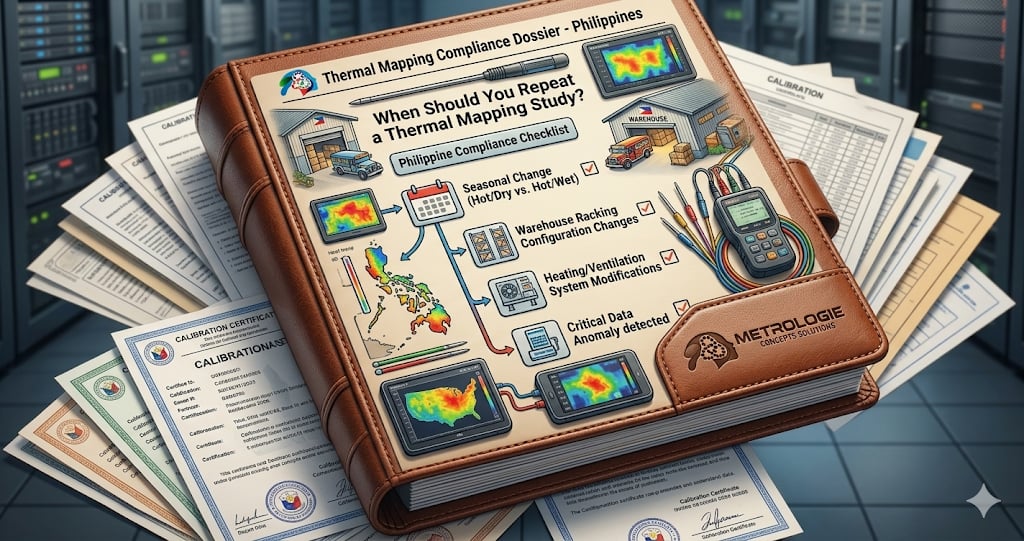
You have done your thermal mapping study. The report is on file. Your monitoring sensors are positioned at the hot spot and cold spot your study identified. Your QA manager has signed off the qualification documentation and filed it with your other compliance records.
Now the question that every Philippine business eventually asks: when do you need to do it again?
This is one of the most commonly asked questions in pharmaceutical and food cold chain compliance — and one of the least clearly answered in practice. Many businesses assume that a thermal mapping study, once done, covers them indefinitely. Others repeat studies mechanically on a fixed annual schedule without understanding which circumstances actually require remapping and which do not. Both approaches create compliance risk: the first by allowing qualification to drift out of validity without anyone noticing, the second by generating unnecessary studies while missing the triggered remapping events that regulators actually care about.
The answer, as with most compliance questions, is: it depends. Thermal mapping requalification is driven by a combination of three independent factors — scheduled periodic requalification, event-triggered requalification when specific changes or circumstances occur, and risk-based requalification driven by data from your ongoing temperature monitoring. Understanding all three, and knowing which applies to your specific facility and product portfolio in the Philippine regulatory context, is the foundation of a compliant, efficient, and defensible thermal mapping programme.
This article provides the definitive Philippine compliance checklist for thermal mapping requalification. It covers every scenario that requires repeating a thermal mapping study — with the specific regulatory basis for each, the Philippine-specific context that makes some triggers more urgent here than elsewhere, and a practical scheduling tool to help you build and maintain a compliant annual mapping programme.
| The Short AnswerYou must repeat your thermal mapping study when: (1) specific changes occur to your facility, equipment, or operations that may have altered the temperature distribution characterised in your previous study; (2) seasonal conditions require a study in a season not covered by your existing documentation; (3) your periodic requalification schedule requires it; or (4) data from your ongoing temperature monitoring suggests that current conditions may no longer match what was documented in your original study.In the Philippines, seasonal remapping — at minimum once in the hot dry season (March to May) and once in the wet season (June to October) — is a WHO requirement that applies to all ambient temperature storage facilities, regardless of whether any other trigger has occurred. |
1. Why Thermal Mapping Studies Have a Shelf Life
A thermal mapping study is a snapshot — a precise, calibrated, documented record of how temperature distributed throughout your storage facility under the specific conditions that existed at the time the study was conducted. It is not a permanent statement about your facility’s performance in all conditions for all time.
The validity of a thermal mapping study depends on the continuing relevance of the conditions under which it was conducted. When those conditions change — because your facility was modified, your equipment was upgraded, your operations changed, or the ambient environment shifted with the seasons — the study may no longer accurately represent your facility’s current thermal behaviour. A study that documented compliance under cool-season ambient conditions tells you nothing about summer performance. A study conducted before you added a new partition wall to your warehouse tells you nothing about the temperature distribution after that wall was built.
Regulatory frameworks acknowledge this reality explicitly. WHO Technical Report Series No. 961, Annex 9 requires qualification exercises to be repeated whenever modifications are made to storage areas that may affect temperature distribution. The ISPE Good Practice Guide recommends periodic performance evaluations to determine whether remapping is necessary. FDA Circular 2021-003 requires that establishments maintain ongoing compliance with cold chain management standards — which means not just having done a mapping study at some point in the past, but having current, valid qualification documentation that reflects the actual present state of the storage facility.
The practical implication is straightforward: your thermal mapping programme is not a one-time activity with a permanent result. It is an ongoing quality programme with defined triggers, scheduled intervals, and the flexibility to respond to data and events that suggest the existing qualification may be outdated.
2. Category 1: Mandatory Event-Triggered Remapping
The first and most important category of remapping triggers consists of specific events or changes that immediately invalidate or cast doubt on your existing thermal mapping qualification. These are not suggestions or best practice recommendations. They are situations where the scientific basis of your existing qualification — the physical conditions it documented — has materially changed. When these events occur, remapping is required before the affected storage areas are used for temperature-sensitive products again.
Trigger 1: Any Modification to the Refrigeration or HVAC System
This is the most common and most consequential change trigger. Any modification to the refrigeration or HVAC system that could alter the temperature distribution within the storage area invalidates the existing thermal mapping qualification for that area. Modifications that trigger immediate remapping include:
- Replacement of the refrigeration unit, compressor, or condenser with a different model or specification
- Refrigerant recharge or refrigerant type change
- Modification of the thermostat setpoint or control system configuration
- Repositioning of the evaporator, supply air diffusers, or return air grilles
- Changes to the ductwork or air distribution configuration
- Addition of supplemental cooling units to address identified hot spots
- HVAC capacity upgrade or system replacement
Why this triggers remapping: The temperature distribution within a storage area is a product of the refrigeration system’s design, capacity, and airflow pattern. Change any of these, and the hot spots and cold spots identified in the previous study may no longer exist — or new ones may have been created that the previous study did not document. A storage area mapped with one evaporator configuration may have an entirely different temperature profile after the evaporator is replaced or repositioned.
Philippine context: In the Philippines, HVAC and refrigeration system modifications are particularly common due to: equipment failure and replacement of aged systems, HVAC upgrades triggered by summer qualification failures, and addition of supplemental cooling to address hot spots identified in initial mapping studies. Each of these is a mandatory remapping trigger.
Trigger 2: Physical Modification of the Storage Area Structure
Any change to the physical structure of the storage area that could affect insulation performance, airflow patterns, or heat ingress invalidates the existing qualification. Structural modifications that trigger remapping include:
- Extension of the cold room or warehouse — additional floor area or increased ceiling height
- Addition of partition walls, mezzanine levels, or internal structures that alter airflow
- Addition or relocation of doors, windows, skylights, or loading dock openings
- Changes to ceiling insulation, roof cladding, or wall panels
- Installation or modification of cold room insulation panels
- Sealing of previously identified insulation gaps or thermal bridges — which may change temperature distribution even when corrective
- Installation of strip curtains, air curtains, or rapid-close doors at loading docks
Even apparently minor structural changes can significantly alter temperature distribution. A new partition wall that restricts airflow in one section of a warehouse may create a dead zone that did not exist before. A new window that adds solar heat gain to a previously shaded wall may create a new hot spot. Remapping after any structural change is the only way to verify whether the distribution has changed and whether the previous qualification remains valid.
Trigger 3: Change in the Racking or Storage Layout
For warehouses with rack storage systems, the configuration of the racking directly affects airflow patterns and temperature distribution. Changes that trigger remapping include:
- Addition of new racking rows or sections that alter the warehouse floor plan
- Changes to rack height that affect the near-ceiling hot spot zone
- Major reconfiguration of the aisle layout
- Addition of dense storage areas that create airflow dead zones not present during the original mapping
Routine product restocking and seasonal inventory level changes do not trigger remapping — these are within the scope of what the PQ study should have characterised. But permanent changes to the physical racking infrastructure that alter the airflow pattern established at the time of qualification are a remapping trigger.
Trigger 4: Relocation of the Storage Facility
If the storage area or cold room is moved to a different physical location — a different building, a different floor, or even a different room within the same building — the new location represents an entirely different thermal environment. Different sun orientation, different ambient heat exposure, different building construction, different HVAC infrastructure. A new qualification study is required before the relocated storage area is used for regulated products.
Trigger 5: Major Equipment Failure and Repair
Significant equipment failures — compressor failure, refrigerant leak requiring major recharge, evaporator replacement — may alter system performance characteristics even after repair. When such failures occur and repairs are made, a post-repair qualification assessment should determine whether the repair was like-for-like (in which case a targeted verification may suffice) or whether the repair changed system specifications in a way that requires full remapping.
In the Philippines, where power surges associated with brownout restoration events can cause equipment damage, post-surge equipment assessment should include evaluation of whether refrigeration system performance has been affected in ways that require requalification.
3. Category 2: Seasonal Remapping — The Philippine-Specific Mandatory Requirement
As discussed in detail in Article 7 of this series on seasonal thermal mapping, the WHO Technical Report Series No. 961, Supplement 8 explicitly requires seasonal mapping for facilities in climates with significant seasonal variation. The Philippines — with its pronounced two-season tropical climate and temperature swings of up to 10°C between the cool dry season and the hot dry season — is precisely the type of climate for which this requirement was written.
The Hot Dry Season Study (March to May)
The hot dry season study is the single most important mapping study in any Philippine thermal mapping programme for ambient temperature storage. It documents performance at peak ambient temperatures — the worst-case condition for maintaining controlled room temperature storage within the 15°C to 30°C limit.
Who must conduct a hot dry season study and when:
- Any ambient temperature pharmaceutical warehouse or CRT storage area — mandatory, at minimum every two years, with annual hot season mapping strongly recommended for facilities in areas prone to exceeding 30°C CRT limit during summer
- Any cold room or refrigerated storage area where the refrigeration system shows signs of capacity stress during hot weather (high compressor run time, temperatures drifting toward the upper limit during summer) — remapping in summer is required to demonstrate continued compliance
- Any facility that has only ever been mapped during the cool dry season (November to February) — the absence of a summer study means the facility has never been qualified under its most demanding ambient conditions
- Any facility that has made operational or structural changes since its last summer study — the new summer study validates performance under the combined effect of the changes and peak summer conditions
The Wet Season Study (June to October)
The wet season study documents performance under high humidity, sustained warmth, and typhoon-season power interruption conditions. It is the required complement to the summer study for a complete seasonal qualification baseline.
Who must conduct a wet season study and when:
- Any ambient temperature storage facility that has only ever been mapped in the dry season — a wet season study is required to complete the two-season baseline
- Any facility in coastal or high-rainfall areas where wet season conditions are particularly pronounced — including Eastern Luzon, Eastern Visayas, and coastal Mindanao
- Any facility that has added new insulation, HVAC modifications, or structural changes since the last wet season study — the new study validates performance under wet season conditions with the changes in place
- Any facility that has experienced unusual humidity-related performance issues (condensation on cooling coils, increased defrost frequency, humidity-related product stability concerns) — an unscheduled wet season study helps diagnose whether the facility temperature profile has changed
The Seasonal Study Schedule for Philippine Facilities
| Storage Type | Minimum Seasonal Mapping Requirement | Recommended Programme | Philippine Context |
| CRT pharmaceutical warehouse | 1× hot dry season + 1× wet season per 2-year cycle minimum | Annual hot dry season; wet season every 2 years or after changes | Peak summer most critical; CRT limit most likely exceeded Apr-May |
| Cold room (+2°C to +8°C) | Hot dry season required if system shows capacity stress; wet season optional unless humidity affects performance | Annual; hot dry season if any capacity concerns; wet season if defrost frequency increases | Seasonal stress highest in summer; power failure test most relevant in typhoon season |
| Freezer room (-20°C or colder) | Seasonal mapping usually not required if fully insulated and refrigerated | Every 2 years; hot season power failure test recommended | Power failure holdover decreases in summer; holdover test most relevant under summer ambient |
| Hospital pharmacy refrigerators | Hot season mapping if room is not air-conditioned; wet season if humidity affects room temperature | Annual mapping in hottest season conditions | Non-AC hospital rooms in tropical climate impose highest stress on refrigerators |
| Food cold storage (HACCP) | 1× hot dry season + 1× wet season per annual cycle | Same as pharma warehouse — both seasons annually for HACCP facilities | Food spoilage and bacterial risk highest in summer; HACCP requires documented validation |
4. Category 3: Periodic Requalification — The Scheduled Remapping Programme
Beyond event-triggered and seasonal remapping, WHO, GMP, and ISPE frameworks all recommend periodic requalification of storage areas — systematic remapping on a defined schedule, even in the absence of specific change triggers, to confirm that the facility continues to perform as originally qualified over time.
Periodic requalification addresses the slow, cumulative changes in facility performance that are invisible in day-to-day monitoring data but that may become significant over a multi-year period: gradual degradation of insulation seals, slow drift in HVAC performance, changes in product loading patterns, minor physical changes that individually fall below the change control threshold but cumulatively alter temperature distribution.
What Periodic Requalification Frequency Applies to Philippine Facilities?
The appropriate requalification interval is not specified as a single universal number in any regulatory framework. WHO TRS 961 recommends that qualification exercises be repeated after any modification that may affect temperature distribution — but does not mandate a fixed periodic interval. ISPE guidance recommends periodic performance evaluations to determine whether remapping is necessary, with the interval driven by risk assessment. Industry experts note that remapping intervals range from six months to five years depending on facility type and product criticality.
For Philippine facilities, the following intervals represent compliant, defensible practices that align with WHO, GMP, FDA Circular 2021-003, and ISPE expectations:
| Facility and Product Type | Recommended Periodic Requalification Interval | Regulatory Basis | Philippine Risk Consideration |
| High-risk cold chain (vaccines, biologics, blood products) | 12 months (annual requalification for high-criticality products) | GMP; WHO TRS 961; FDA Circular 2021-003; AABB blood bank standards | Patient safety consequences of failure; strict regulatory scrutiny; tropical stress on refrigeration |
| Standard pharmaceutical cold rooms (+2°C to +8°C) | 12 to 24 months | WHO TRS 961; GMP; FDA Circular 2021-003 | Summer performance drift; increasing refrigeration age; FDA inspection frequency increasing |
| CRT pharmaceutical warehouses | 12 months — hot dry season study annually; wet season every 2 years | WHO TRS 961 Supplement 8 (seasonal); FDA Circular 2021-003 | Most vulnerable to summer ambient drift; HVAC ageing affects summer performance before winter |
| Food cold storage (HACCP) | 12 months minimum for HACCP critical control points | HACCP; FDA food licensing requirements | Bacterial growth risk highest in summer; regulatory enforcement strengthening |
| Logistics / 3PL pharmaceutical warehouses | 12 months; principal qualification may require more frequent | WHO GDP; FDA Circular 2021-003; principal quality requirements | Principal audits increasingly require current-year mapping; competitive differentiation |
| Ambient temperature storage (non-pharmaceutical) | 24 to 36 months, with annual hot season review | ISPE GPG; HACCP (if applicable); internal quality system SOPs | Philippine summer variability makes annual hot-season review prudent even for lower-risk products |
| The ‘We Passed Last Year’ TrapA common compliance error is treating a mapping study that passed last year as evidence of compliance this year — without conducting the required seasonal studies or periodic requalification.A mapping report dated 14 months ago that was conducted in December (cool dry season) does not demonstrate compliance for the current April (peak summer). It does not tell you whether your facility maintained the required temperature range during last April’s 37°C heat. It does not tell you whether the HVAC system’s performance has drifted since the study was conducted.FDA inspectors who understand thermal mapping compliance will look at both the date and the season of your most recent mapping study. A December 2023 study presented at an August 2025 inspection is two summer seasons without documented compliance for summer conditions. |
5. Category 4: Data-Triggered Remapping — When Your Monitoring System Tells You to Remap
The fourth and most dynamic category of remapping triggers comes from the ongoing temperature monitoring data that your facility generates every day. Your permanent temperature monitoring system is not just a compliance record — it is also an early warning system for changes in facility thermal behaviour that may warrant requalification.
Data-triggered remapping is a risk-based approach: rather than waiting for a fixed calendar interval or a specific change event, it uses patterns in the monitoring data to identify when the thermal behaviour of the facility may have changed since the last mapping study. When these patterns appear, they signal that the existing qualification may no longer accurately represent current conditions — and that a new mapping study is needed to verify and document the current state.
Data Pattern 1: Increasing Frequency of Temperature Alarms at the Hot Spot Sensor
If the hot spot monitoring sensor — positioned at the worst-case location identified by mapping — shows an increasing trend in the frequency or magnitude of temperature alarms over time, this pattern suggests that the thermal conditions at the hot spot are worsening. Possible causes include: HVAC performance degradation, increasing ambient temperatures due to seasonal progression, changes in loading patterns that affect local airflow, or gradual insulation degradation.
A facility that previously experienced zero alarms at the hot spot monitoring sensor and now experiences regular alarms should investigate the root cause — and should consider whether a new mapping study is needed to characterise the current temperature distribution, including whether the hot spot has worsened or whether new hot spots have developed.
Data Pattern 2: Increased Temperature Recovery Time After Door Openings
If trend analysis of the monitoring data shows that temperature recovery time after door openings has increased significantly compared to the baseline established at the time of the original mapping study, this may indicate: HVAC capacity reduction due to system ageing, degraded door seals allowing greater warm air infiltration, increased ambient temperatures due to seasonal progression, or changes in loading bay operations that extend door-open times.
Quantitative comparison of recovery times between the current monitoring data and the recovery times documented in the original mapping study helps distinguish between seasonal variation (expected) and system performance degradation (potentially requiring remapping and corrective action).
Data Pattern 3: Temperature Readings Outside the Range Documented in the Mapping Study
If your ongoing monitoring shows temperatures at the hot spot or cold spot locations that are consistently higher or lower than the range documented in the original mapping study — even if still within the acceptance criteria — this drift may indicate that facility conditions have changed. A cold room mapped with a hot spot of maximum 6.5°C that now consistently shows 7.5°C at the same sensor is approaching the acceptance limit in a way that the original study did not anticipate, and that warrants investigation.
Data Pattern 4: Frequent Power Interruptions with Unknown Temperature Impact
In the Philippines, facilities that experience frequent power interruptions — particularly those without fully validated backup power systems — should trigger a remapping assessment when monitoring records show power interruption events that may have caused temperature excursions at unmonitored locations. The monitoring system shows what happened at the sensor locations. It cannot show what happened between sensors or in zones not covered by permanent monitoring. If power interruption events are occurring at a frequency that suggests regular thermal stress, a fresh mapping study — including updated power failure holdover testing — verifies that the facility’s qualification remains valid.
Implementing a Data-Triggered Remapping Review Process
A practical data-triggered remapping process requires a defined periodic review of monitoring trends — typically quarterly or semi-annually — where a QA manager evaluates the monitoring data against the baseline established in the last mapping study and assesses whether any of the trigger patterns described above are present. This review should be documented as part of the facility’s quality management system records, with the conclusion that either no triggered remapping is required or that a remapping study has been scheduled.
6. The Master Philippine Thermal Mapping Requalification Checklist
The following is the definitive, consolidated checklist for every situation that requires repeating a thermal mapping study in the Philippines. Use this checklist to assess your current compliance status, to evaluate new change proposals, and to build your annual thermal mapping calendar.
| ✓ | Category 1: Mandatory Event-Triggered Remapping — Remap Before Resuming Operations |
| □ | Refrigeration or HVAC unit replaced with a different model or specification |
| □ | Refrigerant recharge, refrigerant type change, or major refrigerant loss and recharge |
| □ | Thermostat setpoint or control system configuration changed |
| □ | Evaporator, condenser, supply air diffusers, or return air grilles repositioned |
| □ | HVAC ductwork or air distribution system modified |
| □ | Supplemental cooling units added to the storage area |
| □ | Cold room or warehouse partition walls, mezzanine levels, or internal structures added |
| □ | Doors, windows, skylights, or loading dock openings added or relocated |
| □ | Cold room insulation panels modified, replaced, or extended |
| □ | Ceiling insulation, roof cladding, or external wall cladding changed |
| □ | Air curtains, strip curtains, or rapid-close dock doors installed or removed |
| □ | Major racking reconfiguration that alters warehouse airflow layout |
| □ | Storage facility relocated to a different physical location |
| □ | Significant equipment failure and repair where post-repair specifications differ from pre-failure |
| □ | Building attached to or surrounding the cold room extended or modified in ways that change thermal environment |
| ✓ | Category 2: Seasonal Remapping — Mandatory for Philippine Ambient Temperature Storage |
| □ | Hot dry season study (March to May) — if last summer study is more than 24 months old for cold rooms |
| □ | Hot dry season study (March to May) — annually for CRT pharmaceutical warehouses and food cold storage |
| □ | Hot dry season study (March to May) — if facility has NEVER been mapped during a Philippine summer |
| □ | Wet season study (June to October) — if last wet season study is more than 24 months old |
| □ | Wet season study (June to October) — if facility has NEVER been mapped during the Philippine wet season |
| □ | Post-typhoon power failure reassessment — if a typhoon-related power interruption caused an unmonitored temperature excursion |
| □ | Seasonal study for any facility in Eastern Luzon or Eastern Visayas — timing per PAGASA data for local rainy season peak |
| ✓ | Category 3: Periodic Requalification — Scheduled in Your Quality System |
| □ | Annual requalification for vaccine, biologic, and blood product cold rooms |
| □ | Annual hot dry season study for all pharmaceutical CRT warehouses |
| □ | 12 to 24 month requalification for standard pharmaceutical cold rooms |
| □ | Annual requalification for HACCP food cold storage at critical control points |
| □ | Annual requalification for 3PL pharmaceutical warehouses to satisfy principal qualification requirements |
| □ | 24 to 36 month requalification for ambient non-pharmaceutical storage (minimum) |
| □ | Requalification before LTO renewal application to ensure current documentation is on file |
| ✓ | Category 4: Data-Triggered Remapping — Based on Monitoring System Review |
| □ | Increasing frequency or magnitude of temperature alarms at the hot spot monitoring sensor |
| □ | Temperature recovery times after door openings significantly longer than baseline in mapping report |
| □ | Consistent monitoring readings drifting toward acceptance limits compared to mapping study baseline |
| □ | Power interruption events causing uncertain temperature impact at unmonitored zones |
| □ | Unexplained temperature excursions at any monitoring sensor that cannot be attributed to a known event |
| □ | Monitoring data showing seasonal performance significantly worse than documented in the last seasonal study |
| □ | Client or principal audit finding that current mapping documentation is outdated |
| □ | FDA inspection finding requesting current seasonal mapping documentation that is not on file |
7. Situations That Do NOT Automatically Require Remapping
Clarity about what does and does not trigger remapping is as important as knowing what does. Requiring a full remapping study for every minor operational event wastes resources and creates unnecessary disruption. The following situations do not automatically require remapping — though they may require a documented impact assessment.
Routine Preventive Maintenance
Scheduled preventive maintenance of the refrigeration or HVAC system — including condenser coil cleaning, air filter replacement, refrigerant pressure check, expansion valve inspection, and lubrication of moving parts — does not require remapping if the maintenance is like-for-like and does not change system performance specifications. Post-maintenance verification that the system is operating within its normal performance parameters (compressor suction and discharge pressure, setpoint maintenance) is appropriate, but a full mapping study is not required for routine maintenance.
Normal Seasonal Fluctuations Already Documented in Seasonal Studies
Temperature variation between seasons — for example, monitoring data showing higher temperatures in April than in December — does not require unscheduled remapping if the seasonal studies already on file documented this variation and confirmed that the facility remained within acceptance criteria during both seasons. Seasonal fluctuation that is within the range already characterised by the seasonal qualification studies is expected behaviour, not a trigger for additional mapping.
Inventory Level Changes Within the Range Covered by PQ
Normal variation in stock levels — from full warehouse at peak season to reduced stock during slow periods — does not require remapping if the PQ study was conducted at a stock level representative of typical operations. The PQ study should have characterised performance at a representative load; normal fluctuation around that representative load level is within the scope of the existing qualification.
Single Isolated Temperature Excursion Events
A single isolated temperature excursion — caused by a door left open, a brief power interruption, or a momentary equipment fault — does not automatically require remapping. The appropriate response is an investigation report documenting the event, its cause, its duration, and the product impact assessment. Remapping is not required unless the investigation reveals that the root cause may have altered the facility’s normal temperature distribution, or unless the excursion reveals a pattern of recurring events suggesting systematic performance degradation.
Minor Cosmetic Changes to the Storage Area
Non-structural cosmetic changes — painting, cleaning, replacement of flooring that does not affect insulation, or repainting of walls — do not affect temperature distribution and do not trigger remapping. The key question for any change is: could this change the temperature distribution documented in the existing mapping study? If the honest answer is no, remapping is not required.
8. Building Your Annual Philippine Thermal Mapping Calendar
An effective, compliant thermal mapping programme is not a series of reactive responses to events — it is a planned, scheduled programme that anticipates mandatory requirements, incorporates triggered remapping when events occur, and documents the rationale for all scheduling decisions.
The Annual Calendar Framework for a Typical Philippine Pharmaceutical Facility
The following framework illustrates a practical annual mapping calendar for a pharmaceutical distribution facility in the Philippines with one CRT warehouse and one cold room:
| Quarter | Planned Mapping Activity | Trigger Category | Key Actions |
| Q1 (January to March) | Annual cold room qualification review; change control assessment for any Q4 modifications; prepare summer mapping protocol | Periodic requalification planning; event-triggered assessment | Review monitoring trend data; assess whether any Q4 changes require immediate remapping; finalise summer study protocol |
| Q2 (April to May) | HOT DRY SEASON MAPPING STUDY — CRT warehouse annual summer study; cold room summer assessment if any capacity concerns identified | Seasonal (mandatory for CRT warehouse) | Deploy calibrated loggers; 72-hour to 7-day study at peak summer ambient; power failure test; analyse and report; update monitoring sensor positions if hot spots have shifted |
| Q3 (June to August) | WET SEASON MAPPING STUDY — CRT warehouse wet season study (every 2 years or if previous wet season study is >24 months old); cold room wet season assessment if humidity concerns | Seasonal; periodic | Wet season protocol; humidity and sustained warmth documentation; typhoon-season power failure holdover test; update seasonal qualification documentation |
| Q4 (September to December) | Annual monitoring equipment calibration; requalification report review; LTO renewal preparation; schedule following year’s mapping programme | Calibration (periodic); LTO preparation | PAB-accredited calibration of all monitoring sensors; review annual mapping documentation; file complete qualification package for LTO renewal if due |
Embedding the Mapping Schedule in Your Quality System SOP
The annual mapping calendar should not exist only in someone’s head or in a spreadsheet. It should be embedded in a formal SOP within your quality management system — specifying the minimum mapping frequency for each storage area, the target months for seasonal studies, the responsible person for scheduling and conducting studies, the acceptance criteria for each storage area, and the escalation procedure when a study fails or when a change trigger occurs.
The SOP should also define the change control process that evaluates proposed facility modifications for their impact on mapping validity — ensuring that the mapping trigger assessment happens before the change is made, not after.
9. Documenting Your Remapping Decision: The Qualification Status Record
Every decision about thermal mapping — whether to remap, when to remap, and what type of study to conduct — should be documented. This documentation creates the audit trail that demonstrates to regulators, clients, and auditors that your mapping programme is rationally managed and continuously maintained, not episodically performed without a systematic framework.
What the Qualification Status Record Contains
A Qualification Status Record for each storage area should be maintained as a living document within your quality management system. It should contain:
- The storage area identifier and description — including physical location, temperature category, and acceptance criteria
- Qualification history — a chronological list of all mapping studies conducted, with dates, seasons, study types (OQ/PQ/seasonal requalification), and outcome (pass/fail)
- Current qualification status — whether the storage area’s qualification is current, due for renewal, or pending a triggered remapping study
- Change control log — a record of all change assessments for the storage area, with the conclusion of each assessment (no mapping required / mapping triggered) and supporting rationale
- Scheduled next study — the target date and type for the next planned mapping study, based on the periodic requalification schedule
- Monitoring trend review records — the periodic monitoring data review assessments, with conclusions on whether data-triggered remapping is indicated
Maintaining this record for each storage area transforms your mapping programme from a series of isolated events into a documented, rational, continuously maintained quality system element — which is exactly what regulators and principal auditors want to see.
10. Frequently Asked Questions: Thermal Mapping Requalification in the Philippines
Our mapping study was conducted 18 months ago. Is it still valid?
It depends. The study is still valid if: no event triggers from Category 1 have occurred since the study; the study covered at least one summer (hot dry season) study and your most recent summer study is less than 24 months old; the study covered the wet season within the past 24 months; your monitoring data shows no concerning trends that suggest conditions have changed since the study. If any of these conditions are not met, a new study or specific seasonal study is needed to maintain current, valid qualification status.
Does replacing a compressor with an identical model require remapping?
If the replacement is truly like-for-like — identical model, identical specifications, no changes to refrigerant charge, no changes to control settings — then a targeted post-replacement verification may be sufficient rather than a full remapping study. However, the replacement should be documented in the change control system with an impact assessment, and the post-replacement verification should demonstrate that operating parameters (setpoint maintenance, compressor performance) are consistent with pre-replacement baseline. If any doubt exists about whether the replacement has altered performance, a targeted remapping of the most sensitive zones is prudent.
We clean our condenser coils quarterly as part of preventive maintenance. Does each cleaning require a mapping study?
No. Routine preventive maintenance that does not change system performance specifications does not require remapping. However, if a quarterly cleaning reveals significant coil fouling — suggesting that the system has been operating below normal efficiency for an extended period — a post-cleaning performance verification and a review of monitoring data for evidence of performance degradation during the fouled period is appropriate. If monitoring data suggests the system underperformed during the fouled period, an investigation and potentially a mapping study may be warranted.
How quickly after a change trigger must we conduct the remapping study?
The remapping study should be completed before temperature-sensitive products are returned to the affected storage area after the triggering change. In practice, for structural or HVAC modifications, this means planning the mapping study as part of the project timeline for the modification — not as an afterthought after the contractor has finished and the facility is ready to resume operations. Build the mapping study into the commissioning plan for any modification that qualifies as a remapping trigger.
Our multinational principal is asking for a mapping study conducted within the last 12 months. Our current study is 15 months old. What should we do?
Schedule a remapping study immediately. Principal qualification requirements vary, but a 12-month currency requirement for mapping documentation is common among multinational pharmaceutical companies auditing their Philippine distribution partners. A 15-month-old study that does not include a current-year summer mapping falls short of this requirement. Contact Metrologie Solutions Philippines to schedule a remapping study as soon as possible — ideally in the next hot dry season period (April to May) to produce a summer-season study that will be current for at least 12 months after completion.
What is the minimum documentation we need to justify why we did NOT remap after a change?
Any change to the facility that could potentially affect temperature distribution should be assessed in the change control system, and the decision not to remap should be documented with a clear rationale. The rationale must demonstrate why the change could not have affected the temperature distribution characterised in the existing mapping study. For example: ‘Addition of a new product labelling station in the ambient temperature zone of the warehouse — this is a non-structural addition with no impact on HVAC airflow patterns, no change to building envelope, and no change to racking configuration. Assessment: no impact on temperature distribution; remapping not required.’ This documented rationale protects the organisation if the decision not to remap is later questioned.
Conclusion: A Living Programme, Not a One-Time Certificate
The most important shift in thinking about thermal mapping requalification is the move from treating a completed mapping study as a permanent certificate to treating it as a current snapshot within a living, continuously managed qualification programme.
A living programme means: knowing exactly which triggers require immediate remapping, having seasonal studies scheduled and on track, reviewing monitoring data quarterly for early warning signals, documenting every change assessment and every scheduling decision, and maintaining a Qualification Status Record for every storage area that shows — at any moment — exactly what has been done, when it was done, and when the next study is due.
For Philippine businesses, the seasonal mapping requirement is the most distinctive and most commonly neglected element of this living programme. Every ambient temperature storage facility in the Philippines must have a current hot dry season study on file — because every April and May, your facility faces conditions that no December mapping study can certify compliance for. That summer study is the most important single document in your pharmaceutical cold chain qualification package.
Metrologie Solutions Philippines helps organisations across the Philippines build and maintain exactly this kind of living qualification programme — scheduled, triggered, data-driven, and documented to the standard that satisfies FDA Circular 2021-003, WHO GDP requirements, and the most demanding multinational principal audits.
| Build Your Compliant Remapping Schedule TodayContact Metrologie Solutions Philippines to review your current mapping documentation, assess whether any triggered or scheduled remapping is due, and design a forward-looking annual thermal mapping programme for your facility.We will tell you honestly what is needed, what is not needed, and how to maintain current qualification status efficiently — without unnecessary studies or compliance gaps.Website: metrologiesolutions.com | Services: Thermal Mapping · Requalification · Calibration · Training · Cold Chain Compliance Consulting |
| About Metrologie Solutions PhilippinesMetrologie Solutions Philippines is the country’s leading provider of thermal mapping and requalification services for pharmaceutical companies, food businesses, logistics operators, hospitals, and cold chain facilities across the Philippines. We help organisations build and maintain compliant, documented thermal mapping programmes — from initial qualification through every requalification trigger over the operating life of their facilities.Website: metrologiesolutions.com | Services: Thermal Mapping · Requalification · Calibration · Training · Cold Chain Compliance |