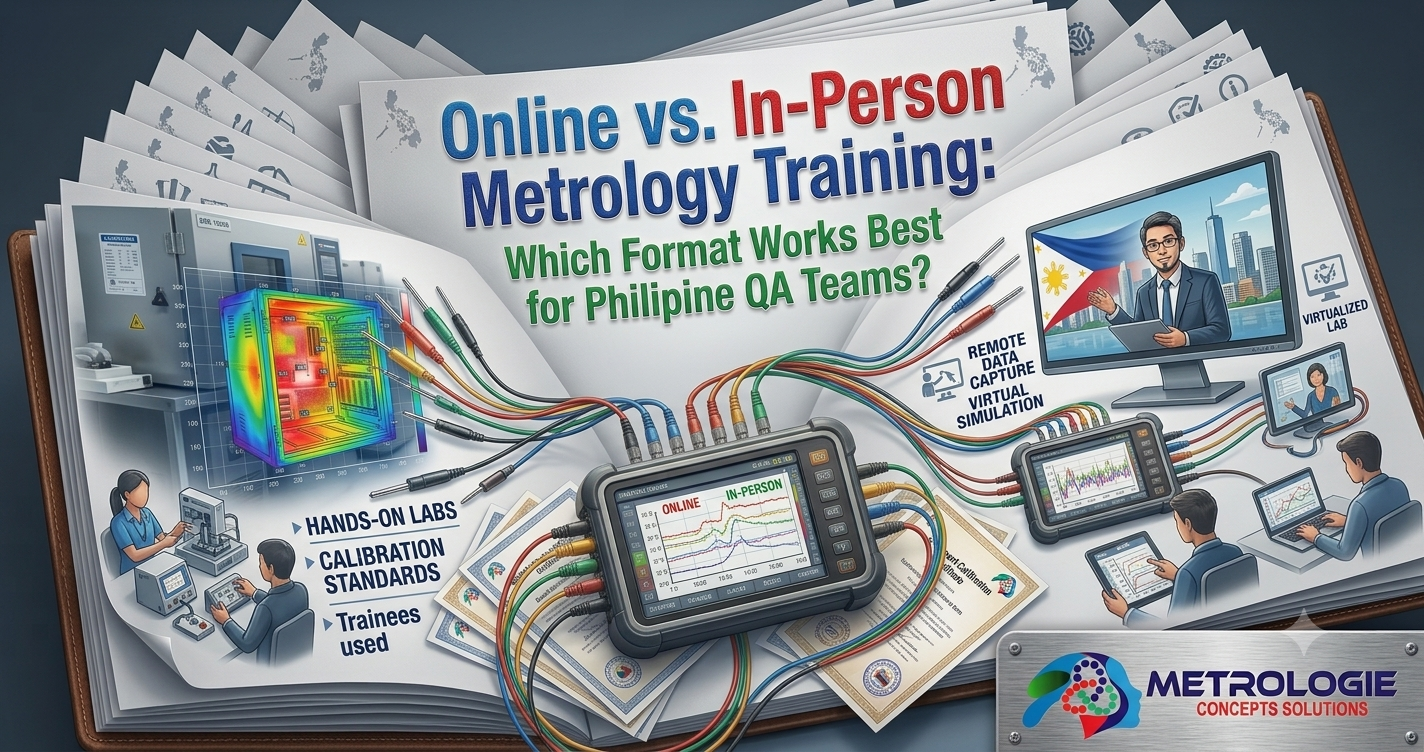
When a QA manager at a pharmaceutical distributor in CALABARZON needs thermal mapping training for her team of six, she faces a decision that training managers across the Philippines now confront regularly: do we send the team to a public classroom course in Metro Manila, bring a trainer in to conduct the programme on-site at our facility, run everyone through an online self-paced course, or do some blended combination of all of these?
This is not a trivial decision. Each format has real differences in cost, convenience, learning effectiveness, and suitability for different types of metrology content. And for technical training — where hands-on calibration practice, real-world equipment handling, and the ability to ask detailed questions about specific regulatory scenarios matter enormously — the format choice has a direct impact on how much the training actually changes what participants can do after it ends.
Post-pandemic, the Philippines has seen significant growth in online professional development — driven by improved internet connectivity, greater familiarity with video conferencing tools, and a genuine recognition that many types of knowledge transfer work well in digital formats. The metrology training market has followed this trend. Online calibration awareness courses, virtual ISO/IEC 17025 modules, and self-paced measurement uncertainty tutorials are now available and increasingly used by Philippine QA professionals.
But the growth of online training has also created a tendency to default to digital formats for practical and technical training that fundamentally requires hands-on learning — with predictable consequences for training effectiveness. A calibration technician who has completed an online course on temperature calibration without ever calibrating a data logger against a calibration bath under expert guidance has learned about calibration, not how to do it.
This guide cuts through the format confusion with a clear, evidence-based framework for choosing the right metrology training format in the Philippine context — covering which content types work in each format, which factors should drive the decision, how the cost calculation actually works, and what the blended approach looks like when it is done well.
| The Quick AnswerConceptual and regulatory content (What is thermal mapping? What does ISO/IEC 17025 require? What is measurement uncertainty?) transfers effectively online. Practical and procedural content (How do I calibrate a data logger? How do I conduct a mapping study? How do I prepare an uncertainty budget?) requires hands-on instruction with a skilled trainer and real equipment.The best metrology training for most Philippine organisations is not fully online or fully in-person — it is a structured blend that uses each format for what it does best. |
1. The Three Formats: What They Are and How They Actually Work
Before comparing formats, it is important to understand precisely what each format involves in the context of Philippine metrology training — because the terms ‘online’ and ‘in-person’ each cover a wide range of delivery approaches with very different learning characteristics.
Format A: Public Classroom Training (Scheduled, In-Person)
Public classroom training brings together participants from multiple organisations at a shared venue — typically a training centre, hotel meeting room, or university classroom in Metro Manila or a major regional city. A professional trainer delivers the programme live, with participants engaging through questions, discussions, exercises, and (for technical courses) hands-on practical demonstrations and practice.
In the Philippine metrology context, public classroom training has historically been the primary format for professional development courses — ISO/IEC 17025 awareness, measurement uncertainty, thermal mapping practitioner courses, and calibration technician development programmes are all commonly delivered in this format.
Key characteristics of Philippine public classroom training:
- Fixed schedule — participants must attend on the specified date(s), which requires advance planning and potential travel
- Group learning environment — participants benefit from discussion with peers from different industries and organisations
- Standardised content — the course covers the standard curriculum rather than being tailored to any individual organisation’s specific context
- Metro Manila concentration — most public metrology training in the Philippines is delivered in Metro Manila, requiring provincial participants to travel or find accommodation
- Typical duration — one to three days for most professional development metrology courses
Format B: On-Site Corporate Training (Customised, In-Person)
On-site corporate training is delivered at the client organisation’s own premises — the pharmaceutical warehouse, the calibration laboratory, the food processing plant — by a trainer who travels to the client’s location. The training content is customised to the client’s specific instruments, regulatory context, industry sector, and learning objectives.
For metrology training in the Philippines, on-site delivery has the significant advantage of allowing training to be conducted with the client’s own instruments, in the client’s own storage areas, and directly referenced to the client’s own calibration certificates, thermal mapping reports, and compliance documentation. This contextualisation dramatically increases the transfer of training to actual job performance.
Key characteristics of on-site corporate training:
- Customised content — the programme is tailored to the client’s specific needs, instruments, regulatory requirements, and training objectives
- Delivered at the client’s facility — no travel required for participants; the trainer travels to the client
- Group efficiency — a single trainer day serves multiple participants simultaneously, reducing per-head cost when groups are large enough
- Contextualised learning — training references the client’s own equipment, documentation, and compliance situation
- Flexible scheduling — timing is agreed between client and trainer rather than fixed by a public calendar
Format C: Online and Blended Training
Online training in the metrology context encompasses several distinct sub-formats, which are often confused but have different learning characteristics:
- Self-paced e-learning: Pre-recorded video modules, interactive exercises, and assessments that participants complete at their own pace, at any time, from any device. The global leader in online calibration and metrology training is A2LA WorkPlace Training (AWPT), which offers comprehensive self-paced courses in calibration, measurement uncertainty, and ISO/IEC 17025.
- Synchronous online (live virtual): Scheduled training delivered via video conferencing (Zoom, Teams, Google Meet) with a live trainer presenting to participants who attend at a defined time. This format preserves the live interaction of classroom training while eliminating travel requirements.
- Blended learning: A hybrid approach that combines online content (self-paced modules, pre-reading, recorded lectures) with in-person practical sessions, on-site workshops, or live virtual interactive sessions. This is increasingly the most effective format for technical training that has both conceptual and practical components.
2. What the Research and Philippine Experience Say About Format Effectiveness
The question of whether online training is as effective as in-person training for technical subjects has been the subject of significant research globally — and the evidence, combined with the specific realities of the Philippine learning context, points to some clear conclusions.
What Online Training Does Well
Research on online learning effectiveness consistently shows that online formats are highly effective for knowledge acquisition — learning and retaining factual information, understanding concepts and principles, and building regulatory awareness. For metrology training content that is primarily conceptual:
- What is measurement uncertainty and why does it matter? — transfers effectively online
- What does ISO/IEC 17025 require of calibration laboratories? — transfers effectively online
- What is metrological traceability and how does the Philippine national measurement system work? — transfers effectively online
- What regulatory frameworks require thermal mapping for Philippine businesses? — transfers effectively online
- What are the warning signs of a non-compliant calibration certificate? — transfers effectively online
For these knowledge-based objectives, self-paced online modules or live virtual sessions can achieve learning outcomes comparable to classroom delivery — at lower cost and without travel requirements.
What Online Training Does Poorly
The evidence is equally clear about where online training underperforms, and it centres on skill acquisition — the ability to actually do something technical, not just understand it conceptually.
Calibration is fundamentally a practical skill. The ability to calibrate a temperature data logger involves: physically setting up a calibration bath or dry-block calibrator, correctly placing the data logger and reference thermometer in the bath, reading and recording results correctly, recognising the signs of equipment malfunction or poor bath stability, calculating and documenting measurement uncertainty from the actual data collected, and making the practical judgment calls that real calibration involves. These skills cannot be adequately developed through video watching or online exercises — they require supervised practice with real equipment.
Similarly, thermal mapping is a practical process. Understanding the principles of sensor placement from a lecture or module is very different from physically positioning 20 sensors throughout a pharmaceutical cold room, verifying each one is properly secured and recording correctly, and managing the study over a 72-hour period. The practical judgment that an experienced thermal mapping practitioner develops through doing cannot be transferred through screen time alone.
The Philippine-Specific Factors
Beyond the general research on online vs. in-person learning effectiveness, several factors specific to the Philippine context affect how well different formats work:
- Internet connectivity reliability: While Metro Manila and major urban centres have adequate internet for synchronous online training, many provincial locations experience connection instability that disrupts live virtual sessions. Self-paced formats that can be downloaded or buffered are more reliable in these locations.
- Equipment access for practical training: For calibration and thermal mapping training to develop practical skills, participants need access to actual calibration equipment — calibration baths, data loggers, reference thermometers. Most participants doing online training at home or at their desk do not have this access. On-site training at the client facility can use the client’s own equipment, making practical skill development possible outside Metro Manila.
- Group learning culture: Filipino learning culture generally values collaborative, discussion-based learning and direct trainer interaction. Filipino technical professionals tend to ask more questions, seek clarification more actively, and learn better in responsive social environments than in self-directed solo learning. This cultural factor supports in-person and live virtual formats over self-paced online for technical metrology content.
- Geographic dispersion: The Philippines’ archipelago geography creates genuine barriers to public classroom attendance for organisations outside Metro Manila. A QA team in Davao who needs thermal mapping training faces a real choice between paying for Manila travel and accommodation or finding an alternative delivery format. On-site training (where the trainer travels to Davao) or live virtual sessions are both significantly more accessible than public Manila classroom courses.
3. A Course-by-Course Format Recommendation for Philippine Metrology Training
Rather than making a single blanket recommendation, the most useful guidance is course-by-course — matching the learning objectives and content type of each metrology training topic to the format that best serves those objectives in the Philippine context.
| Metrology Training Topic | Best Primary Format | Online Component Suitable? | In-Person Component Essential? | Rationale |
| Introduction to Metrology (MET-101) — concepts, traceability, SI units | Online (self-paced or live virtual) | YES — fully suitable | Optional but valuable for Q&A | Primarily conceptual content; no practical skills to develop; high accessibility value for provincial participants |
| Measurement Uncertainty (MET-102) — GUM method, uncertainty budgets | Blended: online concepts + in-person exercises | YES for concepts and framework | YES for uncertainty calculation exercises | Conceptual framework transfers online; uncertainty budget preparation requires supervised practice with real calculation exercises |
| ISO/IEC 17025:2017 Requirements (MET-103) | Live virtual or classroom | YES — live virtual effective | Preferred for interactive Q&A | Regulatory knowledge transfers online; interaction essential for addressing specific laboratory situations |
| Temperature Calibration (MET-104) — practical data logger calibration | On-site corporate (using client equipment) | Online for theory only | YES — essential for skill development | Practical calibration skills cannot be developed online; client equipment use maximises relevance |
| Thermal Mapping (MET-105) — study design, sensor placement, site practice | On-site corporate (at actual facility) | Online for regulatory framework only | YES — sensor placement must be practised | Thermal mapping is a site-specific practical skill; training at the actual facility being mapped is most effective |
| Dimensional Calibration (MET-106) — calipers, micrometers | On-site or classroom with equipment | Online for instrument identification only | YES — hands-on with actual instruments | Cannot develop calibration technique without handling actual instruments |
| ISO/IEC 17025 Internal Auditor (MET-108) — audit practice | Classroom or live virtual (with exercises) | YES for audit principles | YES for role-play audit exercises | Audit skills require interactive role-play and case study work; pure self-paced not recommended |
| Cold Chain Compliance Overview (MET-109) — regulatory awareness | Online (self-paced or live virtual) | YES — fully suitable | Optional | Primarily awareness and regulatory knowledge; high value as asynchronous pre-reading before more advanced courses |
| TESDA NC II Assessment Preparation (MET-110) | Blended: online theory + in-person practical | YES for theory components | YES for practical assessment preparation | TESDA assessment includes practical demonstration; preparation must include hands-on practice |
| The Practical Rule for Philippine Metrology Training Format SelectionAsk one question: does this training need to develop practical skills (the ability to do something with instruments or in a facility), or does it need to build knowledge and awareness (understanding concepts, regulations, and principles)?Practical skills: On-site or classroom with equipment. Knowledge and awareness: Online or live virtual works well.When a course has both components — like measurement uncertainty or ISO/IEC 17025 internal auditing — a blended approach delivers both effectively. |
4. The Real Cost Comparison: Online vs. In-Person in the Philippines
Cost is often the primary driver of format decisions in Philippine organisations — particularly SMEs and public sector establishments with limited training budgets. But the true cost comparison between formats is more nuanced than the headline registration fee, and understanding the full cost picture leads to better decisions.
The True Cost of Public Classroom Training
When a Manila-based pharmaceutical company sends three QA staff to a two-day public classroom course:
- Course registration fee: ₱8,000 to ₱15,000 per participant (typical range for professional metrology development courses in Metro Manila)
- Three participants × ₱10,000 average: ₱30,000
- Opportunity cost — two days away from work per participant: productivity impact
- Total: ₱30,000 for three participants, plus indirect opportunity cost
When a Cebu-based food company sends three QA staff to the same Manila course:
- Course registration: ₱30,000 (same as above)
- Return flights Manila: ₱4,000 to ₱8,000 per person × 3 = ₱12,000 to ₱24,000
- Hotel accommodation (2 nights): ₱3,000 to ₱5,000 per night × 3 participants = ₱18,000 to ₱30,000
- Per diem and incidentals: ₱3,000 to ₱5,000 per person × 3 = ₱9,000 to ₱15,000
- Total: ₱69,000 to ₱99,000 for the same three participants — two to three times the Metro Manila cost
The True Cost of On-Site Corporate Training
When the same three participants receive on-site training at their own Cebu facility:
- Trainer fee and travel: ₱20,000 to ₱45,000 for a day programme (varies by trainer, location, and scope)
- No travel, hotel, or per diem costs for participants
- Content is customised to their facility — increasing training relevance and transfer
- Training can be scheduled at a time convenient to operations — minimising disruption
- Six participants can attend for the same trainer day cost as three — halving the per-head cost
For the Cebu food company, on-site training is likely the more cost-effective option even at similar day rates — because the participant travel and accommodation costs are eliminated entirely. The break-even analysis typically shows that on-site training becomes cost-competitive at three or more participants from the same organisation.
The True Cost of Online Training
Online training appears cheapest on a headline basis — self-paced courses from international providers like A2LA WorkPlace Training (AWPT) are available for USD 50 to USD 300 per module, and many are available in English suitable for Filipino professionals. For pure knowledge content (What is thermal mapping? What does ISO/IEC 17025 require?), online modules from international providers may represent the most cost-efficient knowledge acquisition option.
However, online training has hidden costs that are often not accounted for in the initial decision:
- The learning transfer gap: If online-only training does not develop practical skills because it cannot include hands-on equipment work, the organisation will still need to provide supervised practical experience — which has its own cost in trainer time, equipment access, and reduced productivity during the learning-by-doing phase.
- The accountability gap: Self-paced online learning has significantly lower completion rates than scheduled classroom or on-site training. Participants who enrol in self-paced courses often complete them partially or not at all, particularly when work pressures compete for their attention.
- The relevance gap: International online courses (even excellent ones like AWPT offerings) do not address Philippine-specific regulatory requirements — FDA Circular 2021-003, PAB accreditation, TESDA NC II — that Philippine QA professionals need to understand.
| Cost Factor | Public Classroom (Manila) | On-Site Corporate | Online Self-Paced | Live Virtual |
| Registration / trainer fee | ₱8,000–₱15,000 per person | ₱20,000–₱45,000 per day (whole group) | ₱3,000–₱15,000 per person | ₱5,000–₱12,000 per person |
| Travel (provincial teams) | HIGH — flights + hotel per person | LOW — trainer travels only | NONE | NONE |
| Per-head cost (10 participants) | ₱80,000–₱150,000 + travel | ₱2,000–₱4,500 per person (shared) | ₱30,000–₱150,000 total | ₱50,000–₱120,000 total |
| Content customisation | NONE — standard curriculum | HIGH — tailored to client context | NONE — generic | PARTIAL — some customisation possible |
| Practical skill development | MODERATE — depends on venue setup | HIGH — uses client’s own equipment | LOW — no hands-on component | LOW to MODERATE — limited equipment access |
| Completion rate | HIGH — committed to attend | HIGH — scheduled, supervised | LOW to MODERATE — self-directed | MODERATE to HIGH — scheduled commitment |
| Philippine regulatory content | YES — if Philippine provider | YES — customised to Philippine regs | LOW — mostly international content | MODERATE — depends on provider |
| Best value for groups of 5+ | Moderate value | HIGHEST value | Moderate value (knowledge only) | Good value |
5. The Blended Approach: How to Design It Effectively
For most technical metrology training in the Philippines, the optimal solution is neither fully online nor fully in-person — it is a carefully structured blended programme that uses each format for the content it serves best. Here is how to design an effective blended metrology training programme for a Philippine QA team.
Phase 1: Online Pre-Learning (1 to 2 Weeks Before the Practical Session)
Deliver conceptual and regulatory content online — either through self-paced modules or a live virtual session — before the hands-on training day. This pre-learning serves two purposes:
- It ensures all participants arrive at the practical session with a shared baseline of foundational knowledge — so the trainer does not need to spend half the practical day covering basic concepts that could have been learned online
- It allows the practical session to focus entirely on application — doing calibrations, conducting mapping sensor placement exercises, preparing uncertainty budgets from real data — which is the highest-value activity that requires in-person presence
For a thermal mapping training programme, the pre-learning phase might include: a self-paced online module covering what thermal mapping is, the IQ/OQ/PQ framework, WHO TRS 961 Supplement 8 requirements, Philippine FDA Circular 2021-003 cold chain obligations, and how to read a thermal mapping report. Participants complete this independently, at their own pace, in approximately three to four hours.
Phase 2: In-Person or On-Site Practical Workshop (1 to 2 Days)
The in-person component focuses exclusively on practical skill development — the activities that cannot be adequately conducted online. For thermal mapping training, this might include:
- Sensor placement exercise: Participants physically position sensors throughout a cold room or warehouse area, justify their placement choices, and compare their decisions with the trainer’s analysis
- Protocol development workshop: Participants draft a thermal mapping protocol for their own facility, with trainer review and feedback
- Data logger review: Participants examine actual calibration certificates for data loggers, assess their compliance with ISO/IEC 17025 requirements, and identify deficiencies
- Report review and critique: Participants review real (anonymised) thermal mapping reports, identify what is present and what is missing, and discuss how to improve them
- Q&A on Philippine-specific regulatory scenarios: The trainer addresses specific questions about how requirements apply to participants’ own facilities and compliance situations
Phase 3: Post-Training Online Support and Assessment
After the in-person practical component, online support tools can extend the training’s value:
- A post-training knowledge assessment (online quiz) that confirms participants have retained the key concepts and regulatory knowledge from the programme
- Access to recorded video content from the practical session for review
- An online resource library — protocol templates, calibration certificate review checklists, regulatory reference documents — that participants can access as they apply their training
- A follow-up live virtual Q&A session two to four weeks after the practical training, where participants can ask questions that have arisen as they begin applying the training to their actual work
| Metrologie Solutions Philippines Blended Training ApproachOur metrology training programmes are designed around this blended framework — pre-learning delivered through online materials or a virtual preparatory session, followed by an in-person practical workshop (either at our Metro Manila training facility or at the client’s own site nationwide), with post-training online support.This approach delivers the engagement and practical skill development of in-person training with the accessibility and flexibility of online content — at a cost that is competitive with pure classroom delivery while offering significantly better practical skill outcomes.Contact us at metrologiesolutions.com to discuss a blended training programme for your team. |
6. Choosing the Right Format for Your Specific Situation
The decision matrix for choosing between online, on-site, classroom, and blended formats depends on several factors that are specific to your organisation’s situation. Here is a practical decision framework.
Choose Online (Self-Paced or Live Virtual) When:
- The training content is primarily conceptual — regulatory awareness, standard requirements, conceptual frameworks — rather than practical skill development
- Participants are geographically dispersed and bringing them together for in-person training is logistically impractical
- The training is needed as preparation for a more intensive in-person practical programme — online pre-learning before on-site workshop
- Individual learners need flexible scheduling that cannot be coordinated with a fixed-date classroom or on-site programme
- Budget is very constrained and conceptual knowledge transfer is the primary objective
Choose Public Classroom (In-Person, Metro Manila) When:
- Your team is Manila-based and travel costs are not a factor
- You want your staff to interact with peers from other organisations and industries — the networking and cross-industry learning value of public classroom is a genuine benefit
- You need a fixed-date training event that can be planned and budgeted around a scheduled public calendar
- The training content has enough practical component that a well-equipped training venue adds value, but is not so facility-specific that on-site delivery at your own premises is necessary
Choose On-Site Corporate Training When:
- You have five or more participants from the same organisation who need the same training — on-site becomes cost-competitive at this group size
- Your team is outside Metro Manila and travel costs would make public classroom attendance expensive
- The training involves practical application to your specific facility, equipment, or compliance situation — thermal mapping of your own cold room, calibration of your own instruments, review of your own documentation
- You need training to be scheduled at a time that minimises operational disruption — on-site scheduling is flexible
- You want training content customised to your regulatory obligations, industry sector, and specific QA challenges
Choose Blended When:
- The training content includes both conceptual/regulatory knowledge and practical skill components — the most common situation for substantive metrology training
- You want to maximise the efficiency of the in-person time by front-loading knowledge content online
- Your team is geographically dispersed but can be brought together for a focused practical workshop after completing online pre-learning independently
- You want to provide ongoing access to training resources after the primary delivery event
7. Special Considerations for the Philippine Context
Several factors specific to the Philippines create considerations that do not appear in generic online-vs-in-person training guidance from international sources.
The Regional Access Problem
The Philippines’ archipelago geography creates real training access inequality. A pharmaceutical distributor in Davao, a food manufacturer in Iloilo, or a logistics operator in Cagayan de Oro faces significantly higher barriers to Metro Manila public classroom training than any Metro Manila-based counterpart. For these organisations, the choice between formats is not simply about learning effectiveness — it is about whether training is practically accessible at all.
On-site corporate training eliminates this geographic barrier by bringing the trainer to the client’s location. Live virtual training eliminates it in a different way. For the majority of Philippine organisations outside Metro Manila, on-site or virtual formats are not alternatives to public classroom — they are the primary accessible options.
The Power and Connectivity Challenge
Live virtual training depends on stable internet connectivity and reliable power supply — both of which are more variable outside Metro Manila than inside it. For provincial teams participating in live virtual sessions, the risk of connection drops and power interruptions during the training session is a real factor that can significantly disrupt the learning experience.
Self-paced online content that can be downloaded and accessed offline (or that loads reliably on mobile data) is more resilient to connectivity challenges than live virtual sessions. And on-site training is entirely independent of internet connectivity.
The Language and Communication Factor
Most high-quality international online metrology training — including AWPT courses, ISO standard guidance, and GUM-based measurement uncertainty materials — is available only in English. While Filipino QA professionals typically have strong English reading skills, technical concepts are often more effectively learned when explanations and discussion are available in Filipino or Taglish, particularly for complex mathematical content like measurement uncertainty calculation.
Filipino trainers conducting in-person or live virtual training can switch between English and Filipino as needed — explaining a concept in English, illustrating it with a Tagalog analogy, and answering questions in whichever language is clearest. This linguistic flexibility is a significant advantage of locally delivered training over international online content for complex technical subjects.
8. Frequently Asked Questions: Online vs In-Person Metrology Training
Is online metrology training recognised for ISO/IEC 17025 personnel competence requirements?
ISO/IEC 17025 Section 6.2 requires that laboratory personnel be competent — with appropriate education, training, technical knowledge, and skills — and that this competence be documented. The standard does not specify that training must be in-person. Online training that covers relevant content and is followed by a competence assessment (demonstrating that the learning was effective) can contribute to the documented competence record. However, for practical skills (actual calibration performance, uncertainty budget preparation), online awareness training is not a substitute for demonstrated practical competence — which typically requires supervised hands-on practice, whether in a classroom, on-site, or in the laboratory itself.
How do we handle TESDA NC II preparation for teams outside Metro Manila?
TESDA NC II competency assessment for Laboratory and Metrology/Calibration Services can be conducted at TESDA assessment centres in the provinces — it is not limited to Metro Manila. Check the TESDA website for assessment centres in your region. For preparation training, a blended approach works well for provincial teams: online self-paced theory modules completed independently, followed by a focused in-person practical preparation workshop either at a local training centre or arranged on-site at the company’s own facility. Metrologie Solutions Philippines offers TESDA NC II preparation programmes that can be delivered on-site at client facilities nationwide.
We have a team of twelve QA staff across four cities. What is the most practical training approach?
For geographically dispersed teams, a blended approach typically works best: start with a live virtual kick-off session that covers conceptual content and introduces the training programme to all twelve participants simultaneously — regardless of their location. Follow this with city-specific on-site practical workshops (one session per city, or combining two cities where team sizes are small). This approach provides consistent knowledge content across the full team while allowing practical skill development to happen in the specific local context of each team’s facility and equipment.
Can thermal mapping training be fully delivered online?
No — not effectively for developing practical thermal mapping competence. The conceptual and regulatory aspects of thermal mapping (what it is, why it is required, what WHO and FDA regulations say, how to read a protocol and report) can be delivered online and represent perhaps 40% to 50% of the total training content. But the practical skills — sensor placement decision-making, protocol development, data analysis, report writing — require either: supervised practice in an actual storage area (best), or closely facilitated practical exercises with detailed worked examples and trainer feedback (acceptable as an approximation). Pure self-paced online delivery without any practical component produces graduates who know about thermal mapping but cannot confidently conduct or manage a study.
What is the minimum group size where on-site corporate training becomes cost-competitive?
For Metro Manila-based companies, the break-even between public classroom and on-site corporate training typically occurs at three to four participants from the same organisation. For provincial companies whose staff would need to travel to Manila for public classroom training, on-site becomes cost-competitive at two participants — because the travel and accommodation costs for even two participants to attend a Manila course often exceed the on-site trainer travel and delivery fee.
Conclusion: The Format Question Is Really a Learning Objectives Question
The most useful reframe for the online vs. in-person metrology training decision is this: stop thinking about formats and start thinking about learning objectives. What specifically do you need your people to be able to do after this training — and what format best supports development of that capability?
If you need QA managers to understand what thermal mapping is, why it is required by Philippine FDA regulations, and how to review a mapping report — online or live virtual delivery can achieve this efficiently and cost-effectively. If you need validation engineers to actually design a mapping protocol, place sensors correctly, and interpret mapping data — in-person practical training at your own facility, with your own equipment, under a skilled trainer, is the only format that will genuinely deliver that capability.
For most substantive metrology training — the training that actually changes what QA professionals can do — the answer is a structured blended programme that uses online formats for what they do well (knowledge transfer, regulatory awareness, conceptual frameworks) and in-person formats for what they do best (practical skill development, hands-on equipment work, contextualised application to specific facilities and compliance situations).
Metrologie Solutions Philippines designs and delivers training programmes in all formats — online awareness modules, live virtual regulatory sessions, public classroom courses in Metro Manila, and on-site customised programmes at client facilities throughout the Philippines. We help organisations find the format combination that delivers the best learning outcomes for their specific situation, team, and budget.
| Discuss Your Training Format OptionsContact Metrologie Solutions Philippines to talk through the best training format for your team’s specific needs — whether online, classroom, on-site, or blended.We serve organisations throughout the Philippines, from Metro Manila pharmaceutical companies to provincial food manufacturers to island-based cold chain operators. We design training that works where your team is and builds the skills your compliance programme actually needs.Website: metrologiesolutions.com | Services: Online + On-site Metrology Training · Thermal Mapping · Calibration |
| About Metrologie Solutions PhilippinesMetrologie Solutions Philippines delivers professional metrology training in multiple formats — public classroom courses in Metro Manila, customised on-site programmes at client facilities nationwide, and blended online-plus-practical workshops. Our training covers thermal mapping, temperature calibration, measurement uncertainty, ISO/IEC 17025, and cold chain compliance — tailored to the needs of the Philippine pharmaceutical, food, logistics, and healthcare sectors.Website: metrologiesolutions.com | Services: Metrology Training (Online + On-site) · Thermal Mapping · Calibration |