The science of measurement underpins almost every regulated industry in the Philippines. Pharmaceutical companies depend on calibrated instruments to validate that their storage conditions protect drug potency. Food manufacturers rely on accurate temperature measurement for HACCP compliance. Logistics operators need qualified personnel to manage cold chain validation. Hospital laboratories require trained staff to calibrate diagnostic equipment. Manufacturing companies need metrology-competent engineers to maintain the measurement systems that control product quality.
Yet metrology — the science of measurement — remains one of the most underinvested areas of professional development in the Philippine quality and compliance landscape. Many QA teams manage calibration programmes, thermal mapping studies, and measurement control systems based on on-the-job learning rather than formal training. Many calibration technicians were trained informally by experienced colleagues rather than through recognised curricula. And many compliance officers who review calibration certificates and mapping reports do so without the foundational metrology knowledge to assess whether what they are reviewing is adequate.
This gap has real consequences. Calibration programmes managed by undertrained personnel are more likely to select inadequate service providers, accept non-compliant certificates, miss the signs of equipment drift, and build compliance documentation that will not survive regulatory scrutiny. Thermal mapping studies overseen by QA managers who do not understand measurement uncertainty cannot assess whether the data loggers used in the study were adequate for their application.
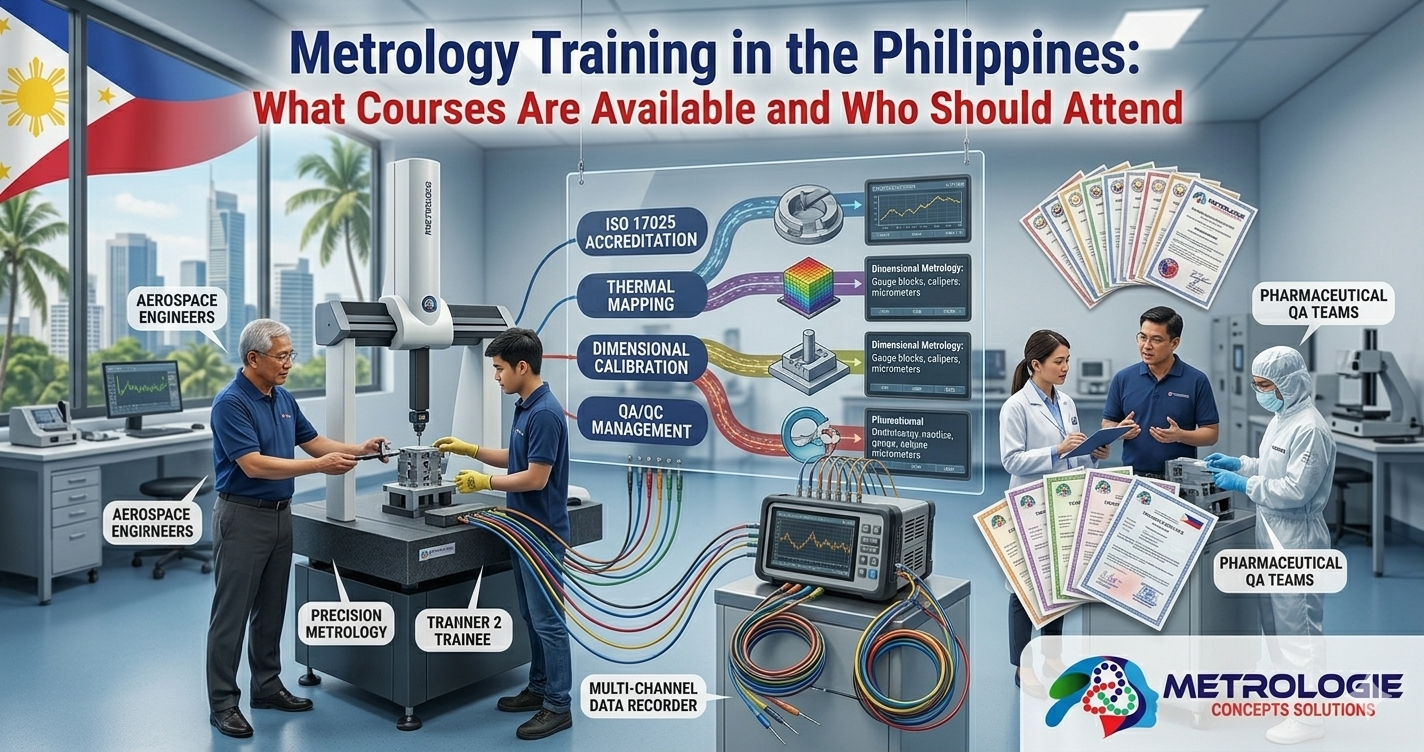
Closing this gap is what metrology training is for. This guide is the most comprehensive overview of metrology training available for Philippine businesses and professionals — covering the full landscape from TESDA vocational qualifications through specialist professional development courses, explaining who should attend each type of training, and providing practical guidance on how to build a metrology training programme appropriate for your organisation.
| What This Guide CoversThe full landscape of metrology training available in the Philippines — from TESDA NC II to ISO/IEC 17025 specialist coursesA course-by-course breakdown of the most important metrology training modules for Philippine QA and compliance professionalsWho should attend each type of training — specific role and industry recommendationsThe difference between formal qualifications and professional development trainingHow to build a structured metrology training programme for your organisationFrequently asked questions about metrology training in the Philippines |
1. Why Metrology Training Matters for Philippine Industry
Before cataloguing the training options available, it is worth understanding precisely why metrology training produces measurable value for Philippine businesses — beyond the general principle that training improves skills.
Regulatory Compliance Depends on Competent Personnel
FDA Circular 2021-003, WHO Good Distribution Practice guidelines, GMP standards, HACCP requirements, and ISO/IEC 17025 all explicitly require that personnel performing calibration, measurement validation, and quality system activities be competent for those activities. ISO/IEC 17025 Section 6.2 dedicates an entire clause to personnel competence — requiring documented education, training, technical knowledge, and skills for all staff performing calibrations.
A calibration programme managed by someone without formal metrology training may be producing certificates that look correct but contain measurement uncertainty values that are not properly calculated, traceability statements that are incomplete, or calibration intervals that are not justified by the instrument’s stability characteristics. These deficiencies are invisible to the untrained eye but immediately apparent to an experienced regulatory auditor.
The Philippine Metrology Skills Gap Is Real and Widening
The Philippines’ rapidly growing pharmaceutical distribution, cold chain logistics, food manufacturing, and healthcare sectors are creating an expanding demand for metrology-competent personnel — at a rate that the existing pool of formally trained metrologists cannot meet. The Cold Chain Association of the Philippines (CCAP) has documented significant growth in cold storage capacity, driven by pharmaceutical and food supply chain expansion. Each new cold room, warehouse, and hospital pharmacy added to the Philippine cold chain creates new demand for personnel who can conduct thermal mapping studies, manage calibration programmes, and maintain ISO/IEC 17025-compliant documentation.
Organisations that invest in metrology training for their QA teams build a competitive advantage over those that do not — attracting calibration contracts, passing quality audits more successfully, and defending their compliance documentation more confidently.
Training Reduces the Cost of Compliance Errors
The most compelling business case for metrology training is the cost of not having it. A thermal mapping study conducted by an undertrained team using non-PAB-accredited calibration, inadequate sensor coverage, and a post-dated protocol may need to be repeated entirely — costing more than five to ten times what the original study should have cost. An out-of-tolerance monitoring sensor that goes undetected because the QA team does not know what to look for in a calibration certificate may result in months of non-compliant product storage. These are not hypothetical risks. They are the recurring costs of metrology-undertrained quality teams in Philippine industry.
2. The Philippine Metrology Training Landscape
Metrology training in the Philippines is available through several distinct channels, each serving different audiences, career stages, and learning objectives. Understanding the landscape helps individuals and organisations choose the training pathway most appropriate for their needs.
TESDA Technical-Vocational Qualifications
The Technical Education and Skills Development Authority (TESDA) is the Philippine government body responsible for technical-vocational education and training (TVET). TESDA administers a National Qualification framework that includes metrology and calibration as a recognised technical-vocational competency area.
The primary TESDA qualification in this area is the Laboratory and Metrology/Calibration Services NC II — a National Certificate Level II qualification that covers dimensional measurement, calibration principles, measurement system management, and laboratory procedures. This qualification is primarily targeted at technicians entering calibration laboratory roles in manufacturing, industrial, and laboratory environments.
TESDA qualifications are delivered through TESDA-accredited training providers, private technical schools, and some company-based training programmes. Assessment is conducted through TESDA’s competency assessment system, with successful candidates receiving a National Certificate (NC II) recognized throughout the Philippines.
Academic Programmes
Several Philippine universities and colleges offer programmes with significant metrology content — primarily within engineering, physics, and quality management curricula. The University of the Philippines system, De La Salle University, and various state universities with engineering programmes include measurement science, calibration, and quality systems content in their engineering and physics degrees.
For professionals seeking academic credentials in metrology, these programmes provide the theoretical depth that complements practical calibration skills. However, academic programmes typically address metrology as one component within broader engineering or science curricula rather than as a dedicated specialty.
Professional Development and Specialist Training
The most immediately practical and widely relevant category of metrology training for working professionals in the Philippine quality, compliance, and calibration sectors is professional development training — typically delivered as short courses, seminars, or workshop programmes ranging from one to five days.
In the Philippines, professional development metrology training is available from: PAB-accredited calibration laboratories that offer training programmes alongside their calibration services (including Acculab Calibration Laboratory and Metrologie Solutions Philippines); international training organisations such as TÜV Rheinland Philippines, which offers dimensional metrology and calibration awareness programmes; industry associations and the Quality and Metrology Society (Qualimets), which provides metrology professional development and examination preparation; and specialist training providers serving the pharmaceutical, food, and industrial sectors.
In-House and On-Site Corporate Training
For organisations with multiple staff who need metrology training, in-house or on-site training delivered by a specialist provider at the company’s own premises is often the most practical and cost-effective option. On-site training can be tailored to the specific instruments, procedures, and regulatory requirements of the host organisation — making it immediately applicable to the participants’ daily work.
Metrologie Solutions Philippines delivers on-site metrology training programmes customised to client requirements — whether a pharmaceutical distributor whose QA team needs training on thermal mapping protocol development, a hospital whose laboratory staff need temperature calibration training, or a 3PL operator whose operations team needs cold chain compliance awareness.
3. The Core Metrology Training Courses Available in the Philippines
The following section presents the most important metrology training courses available in the Philippines — organised by topic, with clear guidance on who should attend each course and what it delivers.
| MET-101 | Introduction to Metrology: Principles of Measurement Science |
| Duration: 1 to 2 days (classroom or online) | Who Should Attend: Anyone new to metrology; QA assistants; laboratory technicians; production supervisors; non-technical managers who oversee calibration programmes |
| What You Will Learn:What metrology is and why it matters; the International System of Units (SI) and its relevance to Philippine industry; the difference between accuracy, precision, resolution, and uncertainty; the concept of measurement traceability and the Philippine national measurement infrastructure (DOST-ITDI NML, BIPM); types of measurement errors and how they affect results; basic calibration principles; the role of PAB and ISO/IEC 17025 in Philippine measurement assuranceKey Outcome: Participants gain a foundational understanding of measurement science that enables them to engage meaningfully with calibration documentation, thermal mapping reports, and quality system calibration requirements. |
| MET-102 | Measurement Uncertainty: Calculating and Reporting GUM-Compliant Uncertainty |
| Duration: 2 to 3 days (classroom with exercises) | Who Should Attend: Calibration engineers and technicians; laboratory QA staff; metrology specialists; anyone who reviews or prepares calibration certificates |
| What You Will Learn:The Guide to the Expression of Uncertainty in Measurement (GUM) — the international standard for uncertainty calculation; sources of measurement uncertainty (Type A and Type B); how to identify and quantify each uncertainty component; combining uncertainty components using the law of propagation of uncertainty; calculating expanded uncertainty with coverage factors; preparing uncertainty budgets; how to state uncertainty on calibration certificates in accordance with ISO/IEC 17025 and regulatory requirementsKey Outcome: Participants can calculate and document measurement uncertainty for calibration results in accordance with GUM and ISO/IEC 17025 requirements — a skill essential for any calibration laboratory seeking or maintaining PAB accreditation. |
| MET-103 | Understanding and Applying ISO/IEC 17025:2017 in Philippine Calibration Laboratories |
| Duration: 2 days (classroom) | Who Should Attend: Quality managers of calibration laboratories; laboratory managers; internal auditors; anyone preparing for or maintaining PAB accreditation |
| What You Will Learn:The structure and requirements of PNS ISO/IEC 17025:2017 — all five sections (General, Structural, Resource, Process, Management); PAB accreditation requirements and the Philippine accreditation process; document control and record-keeping under ISO/IEC 17025; competence management for laboratory personnel; impartiality and confidentiality requirements; data integrity and the ALCOA+ principles for laboratory records; internal auditing to ISO/IEC 17025Key Outcome: Participants understand the full requirements of ISO/IEC 17025 as implemented in the Philippine PAB accreditation context, enabling them to build, maintain, or audit a compliant laboratory quality management system. |
| MET-104 | Temperature Measurement and Calibration: From Thermometers to Data Loggers |
| Duration: 2 to 3 days (classroom and laboratory practical) | Who Should Attend: Calibration technicians; QA personnel responsible for temperature monitoring systems; laboratory staff calibrating thermal instruments; thermal mapping practitioners |
| What You Will Learn:Principles of temperature measurement and the International Temperature Scale (ITS-90); types of temperature sensors — platinum resistance thermometers (PRTs), thermocouples, thermistors, NTC sensors, infrared sensors; how data loggers record and store temperature data; calibration methods for temperature instruments — comparison calibration in controlled baths; calibration at multiple temperature points; calculating temperature calibration uncertainty; reading and assessing temperature calibration certificates; calibration of temperature monitoring systems for pharmaceutical and cold chain applicationsKey Outcome: Participants can perform or oversee temperature calibration at a professional level, assess the adequacy of calibration certificates from service providers, and specify appropriate calibration requirements for thermal mapping data loggers and permanent monitoring sensors. |
| MET-105 | Thermal Mapping: Conducting, Reviewing, and Documenting Temperature Distribution Studies |
| Duration: 2 to 3 days (classroom and site practical) | Who Should Attend: QA managers, validation officers, and compliance officers responsible for cold room and warehouse qualification; thermal mapping practitioners; warehouse managers and facility engineers; anyone who reviews thermal mapping reports |
| What You Will Learn:What thermal mapping is and why it is required by WHO, FDA Circular 2021-003, and GMP; the IQ/OQ/PQ qualification lifecycle and where thermal mapping fits; protocol development — all required sections and common deficiencies; sensor placement strategy based on risk assessment; the specific requirements of WHO TRS 961 Supplement 8; conducting OQ and PQ mapping studies — step-by-step methodology; power failure holdover testing — procedure and interpretation; seasonal mapping requirements for the Philippine climate; data analysis and hot/cold spot identification; writing a compliant thermal mapping report; review of sample mapping reports from Philippine facilitiesKey Outcome: Participants can design, conduct, review, and approve thermal mapping studies and their documentation to the standard required by WHO, FDA Philippines, and GMP — enabling their organisation to produce, manage, and defend its own thermal mapping qualification programme. |
| MET-106 | Dimensional Calibration: Calipers, Micrometers, and Gauge Calibration |
| Duration: 2 days (classroom and laboratory practical) | Who Should Attend: Calibration technicians in manufacturing; QA personnel overseeing dimensional measurement; production engineers; anyone responsible for calibrating linear measurement tools |
| What You Will Learn:Principles of dimensional measurement; calibration of vernier calipers, digital calipers, micrometers, dial gauges, and feeler gauges; reference standards for dimensional calibration — gauge blocks, reference bars; environmental conditions for dimensional calibration — temperature, humidity, and vibration effects; calculating dimensional calibration uncertainty; managing a dimensional calibration programme in a Philippine manufacturing environmentKey Outcome: Participants can calibrate common dimensional measurement instruments and document dimensional calibration results in accordance with ISO/IEC 17025 and GMP requirements. |
| MET-107 | Pressure and Force Calibration for Philippine Industry |
| Duration: 2 days (classroom and practical) | Who Should Attend: Calibration technicians; QA personnel in manufacturing; engineers in pharmaceutical, food, petrochemical, and industrial sectors |
| What You Will Learn:Principles of pressure measurement; types of pressure gauges and pressure calibrators; calibration of analogue and digital pressure gauges using dead-weight testers and reference standards; force measurement principles; calibration of torque wrenches and force gauges; pressure calibration uncertainty calculation; managing pressure calibration in a Philippine industrial calibration programmeKey Outcome: Participants can conduct or oversee pressure and force calibration, assess pressure calibration certificates, and manage pressure instrument calibration programmes. |
| MET-108 | ISO/IEC 17025 Internal Auditor Training for Philippine Calibration and Testing Laboratories |
| Duration: 2 days (classroom with audit exercises) | Who Should Attend: Internal auditors of calibration laboratories; quality managers seeking PAB accreditation or reaccreditation; QA personnel who need to audit external calibration service providers |
| What You Will Learn:Internal audit principles and the audit cycle; how to plan, conduct, document, and follow up a ISO/IEC 17025 internal audit; clause-by-clause audit checklist for PNS ISO/IEC 17025:2017; common non-conformances found in Philippine calibration laboratory audits; audit report writing; corrective action verification; preparing a laboratory for PAB surveillance assessmentKey Outcome: Participants can conduct effective internal audits of calibration laboratories to ISO/IEC 17025 requirements, identify non-conformances, and prepare corrective action plans for PAB surveillance assessments. |
| MET-109 | Cold Chain Compliance for Philippine QA Teams: From Calibration to Thermal Mapping to Monitoring |
| Duration: 1 day (classroom) | Who Should Attend: QA managers, compliance officers, and warehouse supervisors in pharmaceutical distribution, food logistics, hospital pharmacies, and cold chain 3PL operations — people who oversee but do not personally conduct thermal mapping and calibration activities |
| What You Will Learn:The cold chain compliance framework in the Philippines — FDA Circular 2021-003, WHO GDP, GMP, HACCP; what thermal mapping is and when it is required; what ISO/IEC 17025 calibration is and why it matters; how to read a calibration certificate; how to review a thermal mapping report; what to look for during an FDA cold chain inspection; building a compliant annual thermal mapping and calibration calendarKey Outcome: Participants understand the full cold chain compliance landscape and can manage, review, and defend their organisation’s thermal mapping and calibration documentation — without needing to perform the technical work themselves. |
| MET-110 | TESDA Laboratory and Metrology/Calibration Services NC II Competency Assessment Preparation |
| Duration: 3 to 5 days (review programme) | Who Should Attend: Experienced calibration technicians preparing for TESDA NC II assessment; technical-vocational students completing metrology programmes; calibration laboratory staff seeking formal TESDA qualification |
| What You Will Learn:Review of TESDA NC II competency standards for Laboratory and Metrology/Calibration Services; dimensional measurement techniques and instrument operation; calibration documentation and records management; laboratory safety and housekeeping; practice assessments aligned with TESDA competency assessment format; identification of individual competency gaps and targeted practiceKey Outcome: Participants are prepared to successfully complete the TESDA Laboratory and Metrology/Calibration Services NC II competency assessment, earning a nationally recognised qualification in calibration and metrology. |
4. Who Should Attend Which Training: A Role-by-Role Guide
One of the most common questions from Philippine HR managers, QA directors, and training coordinators is: which of our staff need which metrology training? Here is a practical, role-by-role guide.
| Role | Essential Training | Recommended Additional Training | Why These Courses |
| Calibration Technician (entry level) | MET-101, MET-104 (temperature) or MET-106 (dimensional), MET-102 (uncertainty) | TESDA NC II assessment prep (MET-110); MET-107 (pressure if applicable) | Foundation knowledge plus hands-on calibration skills for their specific measurement type; uncertainty calculation is non-negotiable for ISO/IEC 17025 work |
| Calibration Laboratory Manager / QA Manager of Calibration Lab | MET-103 (ISO 17025), MET-102 (uncertainty), MET-108 (internal auditing) | MET-101 (foundation refresh), MET-104 or MET-106 (technical depth) | Must understand the full quality system requirements and be able to audit compliance; uncertainty is a leadership responsibility in ISO/IEC 17025 labs |
| Pharmaceutical QA Manager (cold chain focus) | MET-109 (cold chain compliance overview), MET-105 (thermal mapping) | MET-101 (foundation), MET-104 (temperature calibration understanding) | Needs to design, review, and approve thermal mapping programmes and calibration schedules without necessarily performing the technical work |
| Validation Officer / Qualification Engineer | MET-105 (thermal mapping), MET-102 (uncertainty), MET-103 (ISO 17025) | MET-104 (temperature calibration), MET-108 (auditing) | Primary responsibility for OQ/PQ protocol development, mapping study execution, and documentation — needs technical depth across all relevant topics |
| Warehouse Manager / Operations Manager | MET-109 (cold chain compliance overview) | MET-105 (thermal mapping overview) | Needs to understand compliance obligations, respond to temperature alarms, and manage the operational aspects of the thermal mapping programme |
| Hospital Pharmacy / Blood Bank QA Staff | MET-109 (cold chain compliance), MET-104 (temperature calibration), MET-105 (thermal mapping) | MET-101 (foundation) | Responsible for ensuring pharmaceutical and blood product storage meets regulatory requirements — needs competence in calibration, thermal mapping, and cold chain compliance |
| HACCP Team Member (food industry) | MET-109 (cold chain compliance), MET-104 (temperature calibration) | MET-101 (foundation), MET-105 (thermal mapping basics) | Needs to understand temperature measurement, calibration requirements at food CCPs, and basic thermal mapping concepts |
| ISO 9001 QMS Internal Auditor | MET-101 (foundation), MET-109 (cold chain compliance if applicable) | MET-103 (ISO 17025 awareness), MET-102 (uncertainty awareness) | Needs foundation metrology knowledge to audit measurement control clauses of ISO 9001 effectively |
5. Building a Metrology Training Programme for Your Organisation
Individual course selection is important, but the most effective metrology competence development happens through a structured training programme — one that builds knowledge systematically, tracks competence development over time, and aligns training investment with the specific regulatory and quality requirements of the organisation.
Step 1: Assess Your Current Competence Gaps
Before selecting training, assess where the gaps are. A competence gap assessment for a Philippine pharmaceutical QA team might involve: reviewing calibration certificates currently on file and assessing whether they meet ISO/IEC 17025 requirements; reviewing thermal mapping reports and assessing whether protocols are pre-approved, sensor placement is justified, and acceptance criteria are documented; reviewing the qualifications of personnel responsible for calibration programme management; and identifying which regulatory requirements (FDA Circular 2021-003, WHO GDP, GMP) the organisation is subject to and which training courses align with those requirements.
This gap assessment produces a prioritised training needs list that guides course selection and scheduling.
Step 2: Prioritise Training by Regulatory Criticality
Not all training needs are equally urgent. For a pharmaceutical distributor subject to FDA inspection, the most critically needed training is that which directly supports the regulatory requirements most likely to be scrutinised: ISO/IEC 17025 awareness (so the QA team can assess calibration certificates), thermal mapping (so the QA team can design and review qualification studies), and cold chain compliance (so management understands their obligations). These are higher priority than TESDA NC II preparation or dimensional calibration for roles that do not involve dimensional measurement.
Step 3: Choose the Right Training Format
Philippine metrology training is available in several formats, each with different advantages:
- Public classroom courses: Scheduled training events at a venue, typically attended by participants from multiple organisations. Good for networking, exposure to different industry perspectives, and access to specialist trainers not available internally. Available from Acculab, TÜV Rheinland Philippines, Quality and Metrology Society, and Metrologie Solutions Philippines.
- On-site corporate training: Training delivered at the client’s premises, tailored to the client’s specific instruments, procedures, and regulatory context. Highly practical and immediately applicable. More efficient for organisations with multiple staff who need the same training. Available from Metrologie Solutions Philippines and other specialist providers.
- Online and blended learning: Self-paced online modules supplemented by live webinar sessions or in-person practicals. Suitable for foundation courses (MET-101, MET-109) and for organisations with geographically distributed teams. Growing availability in the Philippine metrology training market.
- TESDA-accredited programmes: For technician-level staff seeking formal TESDA NC II qualifications, TESDA-accredited providers offer structured programmes leading to formal assessment. Search TESDA-registered training providers for Laboratory and Metrology/Calibration Services NC II.
Step 4: Document Training and Competence
For ISO/IEC 17025-accredited laboratories and GMP-regulated pharmaceutical facilities, training records are a regulatory requirement. Every training activity must be documented: who attended, what course, when, who delivered it, and — critically — whether the training was effective (demonstrated through post-training assessment or observed competence verification).
Maintain a training record for each staff member involved in calibration, thermal mapping, or measurement activities. This record should include: the training received (course title, date, provider), any certificates or qualifications earned, the post-training competence assessment result, and the next scheduled training or competence review date.
This documentation is reviewable by FDA inspectors, ISO/IEC 17025 accreditation assessors, and principal auditors — all of whom look at personnel competence records as part of their compliance evaluation.
6. The Metrologie Solutions Philippines Training Programme
Metrologie Solutions Philippines delivers professional metrology training specifically designed for the Philippine regulatory environment, the Philippine climate, and the specific compliance requirements of Philippine pharmaceutical, food, healthcare, and logistics sectors. Our training programmes are grounded in deep practical experience with thermal mapping, calibration, and metrology across the Philippines.
What Sets Our Training Apart
- Philippine regulatory context: Every course is grounded in the specific requirements of FDA Circular 2021-003, WHO TRS 961, GMP/PIC/S, HACCP, and ISO/IEC 17025 as applied in the Philippine regulatory environment — not generic international content adapted without local context.
- Practical case studies from Philippine facilities: Our training uses real scenarios from Philippine pharmaceutical warehouses, cold rooms, hospital pharmacies, food cold chains, and calibration laboratories — making the content immediately recognisable and directly applicable to participants’ daily work.
- Delivered by practitioners: Our trainers are working metrology professionals who conduct thermal mapping studies, perform temperature calibrations, and advise on compliance programmes for Philippine businesses. They teach from current, direct experience.
- On-site and public formats: We deliver both scheduled public training events and customised on-site programmes at client facilities across the Philippines, from Metro Manila and CALABARZON to Cebu and Davao.
Our Core Training Courses
- Thermal Mapping for Philippine QA Teams (MET-105 level) — 2 days
- Temperature Calibration and ISO/IEC 17025 Awareness (MET-104 and MET-103 combined) — 2 days
- Cold Chain Compliance for Philippine Managers (MET-109 level) — 1 day
- Measurement Uncertainty Calculation and Documentation (MET-102 level) — 2 days
- Thermal Mapping Protocol Development Workshop (advanced, MET-105 level) — 1 day
- On-site customised programmes for pharmaceutical companies, 3PL operators, hospital QA teams, and food manufacturers
| Enrol Your Team in Metrologie Solutions Philippines TrainingContact us at metrologiesolutions.com to discuss your team’s training needs, request a training programme schedule, or arrange a customised on-site training programme for your organisation.All our training programmes can be tailored to your specific regulatory obligations, instruments, and compliance programme requirements. Group enrolment discounts are available for organisations sending three or more participants. |
7. The Connection Between Training and Certification: TESDA NC II Explained
The TESDA Laboratory and Metrology/Calibration Services NC II is the only nationally recognised formal qualification specifically for calibration technicians in the Philippines. Understanding what it covers, who it is for, and how it fits into a career development pathway helps both individuals and employers make informed decisions about TESDA NC II investment.
What TESDA NC II Covers
The TESDA NC II for Laboratory and Metrology/Calibration Services covers competencies across four main units: receiving and handling laboratory specimens and samples; performing dimensional measurement and calibration; performing calibration of temperature, pressure, and other measurement parameters; and maintaining laboratory equipment and documentation.
The qualification is designed to produce technicians who can perform calibration work across multiple measurement types at a foundational level — not deep specialists in any single measurement discipline, but broadly competent calibration support personnel who can work in a calibration laboratory or quality management role.
Who It Is For
The TESDA NC II is primarily appropriate for: entry-level calibration technicians who are new to the field and want a formal qualification that documents their basic competence; experienced calibration staff who have been working without formal qualification and want to formalise their credentials; and students completing technical-vocational education programmes who intend to enter calibration or laboratory support roles.
It is not typically the primary qualification needed by QA managers, validation engineers, or calibration laboratory managers — who need deeper knowledge of ISO/IEC 17025, measurement uncertainty, and regulatory compliance than the NC II curriculum covers.
Assessment Process
TESDA NC II competency assessment is conducted by TESDA-accredited assessment centres. Candidates demonstrate competence through a combination of written knowledge assessment and practical demonstration of calibration skills. Successful candidates receive a National Certificate that is recognised by employers throughout the Philippines and by TESDA as part of the Philippine Qualifications Framework (PQF).
8. Frequently Asked Questions: Metrology Training in the Philippines
Do QA managers in pharmaceutical companies need formal metrology training, or is it only for calibration technicians?
QA managers in Philippine pharmaceutical companies benefit significantly from metrology training — particularly training in thermal mapping, temperature calibration, and ISO/IEC 17025 awareness. While QA managers may not personally perform calibrations or deploy sensors, they are responsible for reviewing, approving, and defending calibration certificates, thermal mapping protocols, and qualification reports to FDA inspectors, WHO auditors, and multinational principals. Without foundational metrology knowledge, this review and approval function cannot be performed competently. A QA manager who cannot assess whether a calibration certificate meets ISO/IEC 17025 requirements is signing off on documentation they cannot evaluate.
Is online metrology training as effective as classroom training?
It depends on the training content. Foundational conceptual courses — such as Introduction to Metrology (MET-101), Cold Chain Compliance Overview (MET-109), and ISO/IEC 17025 awareness — are well-suited to online delivery because they are primarily knowledge-based. Technical practical courses — such as temperature calibration (MET-104), uncertainty calculation (MET-102), and thermal mapping (MET-105) — benefit significantly from classroom and laboratory components where participants practice calculations, work with actual instruments, and interact with trainers on specific technical questions. A blended approach — online foundational content plus in-person or on-site practical workshops — typically produces the best outcomes for technical metrology training.
How long does it take to develop a competent QA team in metrology?
A QA team with no formal metrology background can develop practical working competence in thermal mapping and calibration management through: a two-day thermal mapping course plus a one-day cold chain compliance overview in the first month; a two-day temperature calibration and ISO/IEC 17025 awareness course in the second or third month; followed by supervised practical application of the training — conducting or reviewing a thermal mapping study, reviewing calibration certificates, and building a compliant calibration schedule. Full confidence and independence in managing a pharmaceutical cold chain compliance programme typically develops over six to twelve months of trained, supervised practice.
Are there metrology training courses available outside Metro Manila?
Yes. Metrologie Solutions Philippines delivers on-site training at client facilities throughout the Philippines — including CALABARZON, Central Luzon, Cebu, Davao, and other regions. On-site training eliminates the travel burden for organisations with teams outside Metro Manila and can be tailored to the specific facility, instruments, and regulatory requirements of the client. Public scheduled training events are primarily held in Metro Manila, but we accommodate provincial participants and can arrange regional events for sufficient group sizes. Contact us at metrologiesolutions.com to discuss training delivery options for your location.
What is the difference between metrology training and calibration service?
Metrology training is the education of your personnel — building the knowledge and skills they need to understand, manage, and evaluate measurement and calibration activities. Calibration service is the actual technical process of verifying instrument accuracy against traceable standards. The two are complementary: calibration service without trained personnel to specify, review, and apply the results correctly produces certificates that may not be used effectively. Trained personnel without access to quality calibration services cannot produce the measurement traceability their compliance programmes require. Most organisations need both — and Metrologie Solutions Philippines provides both, enabling us to offer an integrated training and calibration service for Philippine businesses.
Conclusion: Invest in Metrology Knowledge and Your Compliance Programme Becomes Defensible
The Philippine quality and compliance landscape is becoming more demanding. FDA enforcement is strengthening. WHO requirements are being applied with greater rigour. Multinational pharmaceutical principals are conducting more thorough distributor qualification audits. And the consequences of compliance failures — product losses, regulatory sanctions, client terminations — are more significant than at any previous point in the Philippine pharmaceutical and food supply chain’s history.
In this environment, organisations that have invested in metrology training for their QA teams have a meaningful advantage. Their calibration programmes are managed by personnel who can assess the adequacy of calibration certificates, not just file them. Their thermal mapping programmes are designed by people who understand sensor placement rationale, protocol requirements, and seasonal mapping obligations. Their compliance documentation can be explained and defended to any regulatory inspector or client auditor because the people responsible for it genuinely understand what they are doing.
This knowledge does not come from on-the-job experience alone. It comes from structured training that provides the theoretical foundation, practical skills, and regulatory context that metrology competence requires. In the Philippines today, that training is available — through TESDA, through professional development providers, and through specialist organisations like Metrologie Solutions Philippines.
The question is not whether metrology training is worth the investment. It is whether your organisation can afford to continue managing its measurement and compliance obligations without it.
| Start Building Your Team’s Metrology CompetenceContact Metrologie Solutions Philippines to discuss training options for your QA team — whether a public short course, an on-site corporate programme, or a customised training curriculum designed around your specific regulatory obligations and industry context.We also provide complementary calibration services and thermal mapping studies — so that your newly trained team has an expert partner to work with as they build their competence.Website: metrologiesolutions.com | Services: Metrology Training · Thermal Mapping · Calibration · Cold Chain Compliance |
| About Metrologie Solutions PhilippinesMetrologie Solutions Philippines delivers professional metrology training programmes for QA teams, calibration technicians, laboratory personnel, and compliance officers across the Philippines. Our training courses cover thermal mapping, measurement uncertainty, ISO/IEC 17025, temperature calibration, and cold chain compliance — delivered in-person, on-site, and in online formats tailored to the Philippine pharmaceutical, food, logistics, and healthcare sectors.Website: metrologiesolutions.com | Services: Metrology Training · Thermal Mapping · Calibration · Cold Chain Compliance |