Every thermal mapping study begins with the same foundational question: can we trust the temperature readings from our data loggers?
For a Philippine pharmaceutical company mapping its cold room, a food manufacturer validating its HACCP cold storage, or a 3PL operator qualifying its pharmaceutical warehouse, the answer to this question determines whether the entire mapping study is scientifically valid and regulatory defensible — or whether it is simply a collection of numbers with no documented basis for confidence.
The answer comes from calibration. Specifically, from ISO/IEC 17025-accredited calibration.
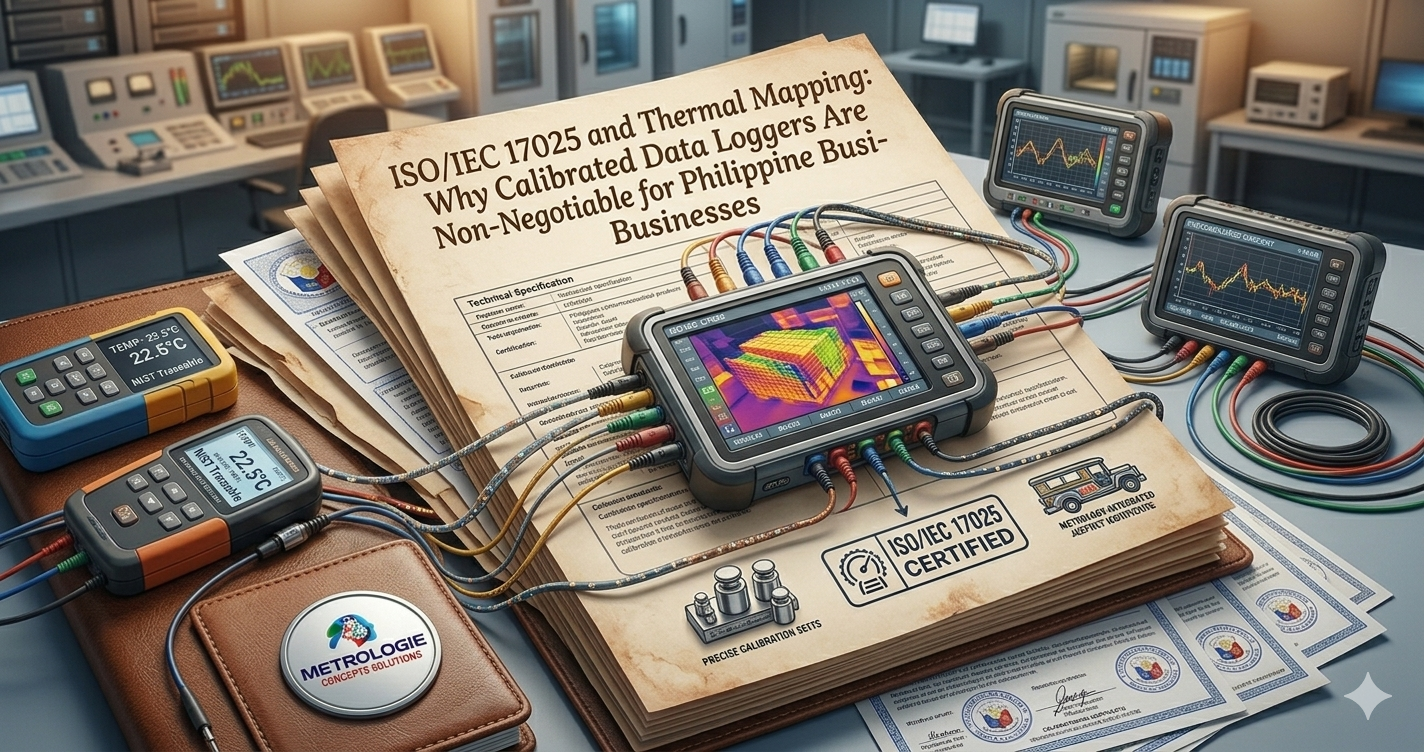
ISO/IEC 17025 is the international standard that defines what it means for a calibration laboratory to be technically competent. It is the standard against which the Philippine Accreditation Bureau (PAB) assesses calibration laboratories before granting accreditation. And it is the standard that WHO, the FDA Philippines, GMP guidelines, and multinational pharmaceutical principals all reference when they require that calibration be traceable to recognised standards.
Yet for many Philippine QA managers and compliance officers, ISO/IEC 17025 remains an abstract label — something that appears on calibration certificates and compliance requirements lists without a clear understanding of what it actually means, why it matters specifically for thermal mapping, and what happens when a mapping study is conducted with data loggers that have not been calibrated to this standard.
This article provides the clearest, most practical explanation of ISO/IEC 17025 available for Philippine businesses. It explains what the standard requires, why it is specifically critical for thermal mapping data loggers, what the consequences of non-compliant calibration are, and how Philippine businesses can verify that their calibration providers meet the standard their compliance programmes depend on.
| The One-Sentence AnswerISO/IEC 17025 accreditation means that a calibration laboratory has been independently assessed and found technically competent to perform calibrations with documented measurement traceability, stated measurement uncertainty, and a quality management system that ensures consistent, reliable results.For thermal mapping in the Philippines: if your data loggers are not calibrated by a PAB-accredited ISO/IEC 17025 laboratory, your mapping study does not meet the calibration requirements of WHO TRS 961 Supplement 8, FDA Circular 2021-003, or GMP standards — regardless of how well everything else was done. |
1. What ISO/IEC 17025 Is — and What It Is Not
ISO/IEC 17025, formally titled ‘General Requirements for the Competence of Testing and Calibration Laboratories,’ is an international standard jointly published by the International Organization for Standardization (ISO) and the International Electrotechnical Commission (IEC). The current version — PNS ISO/IEC 17025:2017 in the Philippine context — was published in 2017 and replaced the previous 2005 edition.
The standard specifies what a calibration laboratory must demonstrate to be considered technically competent. It covers five main areas: general requirements (impartiality and confidentiality), structural requirements (legal status, organisation, and responsibilities), resource requirements (personnel, equipment, and environmental conditions), process requirements (how calibrations are planned, performed, and documented), and management system requirements (quality management, document control, audits, and improvement).
Understanding what ISO/IEC 17025 is — and is not — prevents the common confusion between related but distinct credentials:
| Credential | What It Means | Who Issues It | Is It Adequate for Philippine Thermal Mapping? |
| ISO/IEC 17025 Accreditation (PAB) | Laboratory independently assessed by national accreditation body (PAB) and found technically competent for its specific scope; measurements internationally recognised through ILAC MRA | Philippine Accreditation Bureau (PAB) | YES — this is the required standard |
| ISO/IEC 17025 Certification | Laboratory has implemented a quality management system consistent with ISO 17025; assessed by a certification body (not an accreditation body); NOT internationally recognised through ILAC MRA | Certification bodies (various) | NO — does not provide the measurement traceability or international recognition of accreditation |
| ISO 9001 Certification | Organisation’s quality management system meets ISO 9001 requirements; does not assess technical competence for measurement or calibration | Certification bodies (various) | NO — ISO 9001 is a quality management standard, not a measurement competence standard |
| In-house calibration (no accreditation) | Calibration performed internally without independent assessment of technical competence | Internal laboratory | Only if the internal laboratory is itself PAB-accredited to ISO/IEC 17025 |
| Manufacturer factory calibration | Calibration performed by instrument manufacturer; may or may not be accredited; typically single-point | Instrument manufacturer | Only if performed by manufacturer’s PAB-accredited laboratory and meets multi-point requirements |
The Key Distinction: Accreditation vs. Certification
The most important distinction in this table is between ISO/IEC 17025 accreditation and ISO/IEC 17025 certification. This distinction is frequently misunderstood — and exploited by calibration providers who claim ISO 17025 compliance without holding actual PAB accreditation.
Accreditation is granted by a national accreditation body (in the Philippines, the PAB) after a rigorous technical assessment of the laboratory’s competence, equipment, traceability, and procedures. It requires documented measurement traceability through an unbroken chain to national standards, and confers international recognition through the ILAC Mutual Recognition Arrangement.
Certification is granted by a certification body (which may or may not be accredited itself) after reviewing whether the laboratory has documented a quality management system consistent with ISO 17025 principles. It does not necessarily involve assessment of actual measurement competence, equipment accuracy, or measurement traceability. A certified laboratory may have excellent documentation of its procedures while producing systematically incorrect measurements.
For WHO, FDA Circular 2021-003, and GMP compliance, accreditation is the required credential. In the Philippines, that means PAB accreditation. Certification alone is not acceptable.
2. What ISO/IEC 17025 Requires That Makes It Critical for Thermal Mapping
To understand why ISO/IEC 17025 accreditation is non-negotiable for thermal mapping data logger calibration, it is necessary to understand what the standard actually requires of calibration laboratories — and what those requirements mean for the quality and reliability of calibration results.
Requirement 1: Measurement Traceability
ISO/IEC 17025 Section 6.5 requires that all calibration results be metrologically traceable — connected through an unbroken chain of calibrations to the international definition of the unit being measured, with each link in the chain documented and contributing a quantified measurement uncertainty.
In practice for Philippine temperature calibration, this means: the laboratory’s reference thermometer must be calibrated against a standard that is calibrated against the National Metrology Laboratory (NML) operated by the Department of Science and Technology’s Industrial Technology Development Institute (DOST-ITDI), which in turn is traceable to the International Bureau of Weights and Measures (BIPM) definition of the kelvin. This chain must be documented with calibration certificates at each link.
This traceability requirement is exactly what WHO TRS 961 Supplement 8 references when it requires that data loggers used for thermal mapping be calibrated against certified traceable reference standards. A data logger calibrated by a non-accredited laboratory — where the reference thermometer itself has no documented traceability chain — has no documented basis for its accuracy claims. The calibration certificate may look similar to an accredited certificate, but the measurement foundation is entirely different.
Requirement 2: Measurement Uncertainty Quantification
ISO/IEC 17025 Section 7.6 requires that calibration laboratories evaluate and report measurement uncertainty for all calibration results. Measurement uncertainty is the quantification of doubt about a calibration result — the range within which the true value of the measured quantity is expected to lie, with a stated confidence level.
This requirement is what makes ISO/IEC 17025 calibration certificates fundamentally different from non-accredited calibration documents. A non-accredited calibration may show that an instrument reads 5°C when the reference shows 5°C — but without a stated measurement uncertainty, you cannot know how confident to be in that comparison. If the measurement uncertainty is ±2°C, the calibration tells you almost nothing useful. If it is ±0.1°C, you have a precise, trustworthy calibration result.
For pharmaceutical thermal mapping, the combined measurement uncertainty of the data logger calibration — the uncertainty of the reference standard, the uncertainty of the comparison method, and any environmental contributions — should be no greater than ±0.25°C to ±0.5°C at 95% confidence (k=2). This level of uncertainty is only achievable and documentable by a laboratory operating under ISO/IEC 17025 requirements.
Requirement 3: Personnel Competence
ISO/IEC 17025 Section 6.2 requires that laboratory personnel performing calibrations be competent — having appropriate education, training, technical knowledge, and skills for the measurements they perform. Competence must be demonstrated and documented, not merely assumed.
This competence requirement ensures that the person performing your data logger calibration understands not only how to operate the calibration equipment but also the principles of temperature measurement, the sources of measurement uncertainty, and the documentation requirements for GMP-compliant calibration records. Non-accredited providers may employ technicians without this documented competence framework.
Requirement 4: Equipment Qualification and Maintenance
ISO/IEC 17025 Sections 6.4 and 6.5 require that all equipment used for calibration be fit for purpose, maintained, calibrated itself against traceable references, and subjected to documented performance checks. Reference thermometers, calibration baths, and comparison equipment must be calibrated on defined schedules and their performance verified before use.
This equipment requirement ensures that the tools used to calibrate your data loggers are themselves of verified accuracy. A calibration bath whose temperature uniformity has never been characterised, or a reference thermometer whose calibration has expired, cannot produce reliable calibration results — regardless of how carefully the calibration process is followed.
Requirement 5: Documented Procedures and Quality System
ISO/IEC 17025 Sections 7 and 8 require that calibration procedures be documented, validated, and consistently followed; that calibration records be complete, retrievable, and protected from alteration; that deviations from normal procedure be handled systematically; and that the quality management system be subject to internal audit and management review.
These documentation and quality system requirements ensure that a calibration performed today will be performed in the same way tomorrow — and that the documentation of both calibrations will be complete, correct, and retrievable when needed for regulatory inspection. This consistency and retrievability is essential for the long-term maintenance of a pharmaceutical compliance programme.
3. The Specific Consequences of Using Non-ISO/IEC 17025 Calibrated Data Loggers for Thermal Mapping
Understanding why ISO/IEC 17025 calibration is required is incomplete without a clear picture of what can go wrong when it is not used. The following scenarios illustrate the specific, practical consequences of conducting thermal mapping studies with data loggers calibrated by non-accredited laboratories.
Scenario 1: The Systematic Offset That Creates False Compliance
A Philippine pharmaceutical distributor conducts a thermal mapping study of its cold room using data loggers calibrated by a non-accredited local service provider. The service provider uses a reference thermometer that has not been calibrated against a traceable standard for three years, and whose actual temperature measurement has drifted 1.8°C above the displayed value.
As a result, every data logger calibrated against this reference is corrected with an offset that introduces a systematic error of approximately 1.8°C — and the entire calibration batch of data loggers deployed in the cold room shows readings that are systematically 1.8°C lower than the actual temperature.
The thermal mapping study shows that the cold room maintains temperatures between 2.1°C and 7.6°C throughout the study period — comfortably within the +2°C to +8°C acceptance criteria. The qualification report is signed off. Products are stored in the cold room.
In reality, the cold room temperature ranges from 3.9°C to 9.4°C. The hot spot near the door regularly exceeds the 8°C upper limit. Biologics stored in the door-adjacent zone are chronically exposed to temperatures above their maximum storage limit. The qualification study that should have identified this problem instead certified that no problem exists — because the calibration that should have ensured measurement accuracy was itself compromised.
Scenario 2: The Regulatory Finding That Invalidates the Entire Qualification
A pharmaceutical 3PL operator in CALABARZON conducts a comprehensive IQ/OQ/PQ qualification programme for its new pharmaceutical cold room. The qualification is well-documented, the protocol was pre-approved, the sensors were deployed according to the approved plan, and the data analysis is thorough. The qualification report is filed with complete documentation.
During a routine FDA inspection, the inspector reviews the thermal mapping report and asks for the calibration certificates for the data loggers used in the study. The certificates show the company name of the calibration provider — but when the inspector checks the PAB directory, the provider is not listed as an accredited calibration laboratory.
The inspector issues a deficiency finding: the calibration of the data loggers used in the thermal mapping study cannot be verified as traceable to national or international measurement standards, as required by WHO Good Distribution Practice guidelines referenced in FDA Circular 2021-003. The entire thermal mapping qualification is challenged as non-compliant. The 3PL is required to repeat the qualification study with properly accredited calibration.
The cost of the remediation — repeat mapping study, regulatory correspondence, potential temporary restriction on pharmaceutical storage activities — far exceeds what the original PAB-accredited calibration would have cost. And the reputational impact with the pharmaceutical principals whose products are stored in the facility is significant.
Scenario 3: The Principal Audit That Terminates the Distribution Agreement
A Philippine pharmaceutical distributor passes an FDA inspection. But three months later, the multinational pharmaceutical principal whose products constitute 40% of its business conducts its own annual distributor qualification audit. The auditor reviews the thermal mapping documentation and finds that the data logger calibration certificates, while adequately formatted, do not bear the PAB accreditation number required by the principal’s quality standards.
The principal issues a Critical finding: ‘Temperature data logger calibration cannot be verified as ISO/IEC 17025 accredited. Calibration traceability to national/international standards is not demonstrated.’ The finding requires corrective action within 90 days. The distributor must repeat the thermal mapping study with PAB-accredited data loggers and resubmit the qualification documentation for review.
During the 90-day corrective action period, the principal suspends new product releases to the distributor. The financial impact — lost sales during the suspension period, plus the cost of repeat qualification — creates a business crisis that could have been entirely prevented by using a PAB-accredited calibration laboratory for the original study.
4. How ISO/IEC 17025 Connects to Every Philippine Regulatory Framework That Requires Thermal Mapping
ISO/IEC 17025-accredited calibration is not a standalone requirement invented by the metrology community. It is embedded in every major regulatory framework that Philippine businesses must comply with when conducting thermal mapping. Here is how the connection works for each framework.
WHO Technical Report Series No. 961, Supplement 8
WHO TRS 961 Supplement 8 — the global reference standard for pharmaceutical warehouse temperature mapping — states that calibration devices must be verified against certified reference standards and that calibration must be traceable to national or international standards. The concept of traceability to national or international standards is the defining characteristic of ISO/IEC 17025 accredited calibration. An accredited calibration is one that has been independently verified to meet this traceability requirement. A non-accredited calibration has no such independent verification.
WHO Supplement 8 also requires that calibration uncertainty be documented and stated in calibration certificates — a requirement that directly reflects ISO/IEC 17025 Section 7.6’s uncertainty quantification requirement. Only laboratories operating under ISO/IEC 17025 requirements are consistently expected to calculate and report measurement uncertainty as part of every calibration.
FDA Circular No. 2021-003
FDA Circular 2021-003 requires that Philippine pharmaceutical establishments implementing cold chain management systems comply with WHO Good Distribution Practice guidelines. The calibration requirements embedded in WHO GDP — traceability to national or international standards, calibrated monitoring equipment, current calibration certificates available for inspection — are the same requirements that ISO/IEC 17025 accredited calibration is designed to meet.
An FDA inspector applying FDA Circular 2021-003 to evaluate a pharmaceutical cold chain facility’s temperature monitoring compliance will expect to see calibration certificates from laboratories that can demonstrate measurement traceability. In the Philippine context, this means PAB-accredited laboratories. Non-accredited certificates may meet the format requirements but will not satisfy the traceability substance requirement.
GMP and PIC/S Guidelines
Good Manufacturing Practice guidelines — including the PIC/S GMP guidelines followed by Philippine pharmaceutical manufacturers and increasingly applied to pharmaceutical distributors — require measurement control throughout the manufacturing and storage process. GMP Annex 15 on Qualification and Validation requires that instruments used in qualification studies be calibrated with documented traceability. The ISO/IEC 17025 framework provides exactly the documented traceability and competence assurance that GMP calibration requirements describe.
ISPE Good Practice Guide: Controlled Temperature Chambers
The ISPE Good Practice Guide (2021) — the industry technical reference for pharmaceutical controlled temperature storage qualification — provides detailed guidance on data logger selection and calibration for thermal mapping studies. The guide requires that data loggers be calibrated by an accredited laboratory with documented traceability. ISO/IEC 17025 accreditation is the internationally recognised framework for accredited calibration laboratory status.
HACCP — Food Industry
For food businesses in the Philippines, HACCP requires documented control of critical control points — including temperature management at cold storage CCPs. The temperature monitoring and validation at these CCPs must use calibrated measurement equipment. ISO/IEC 17025-accredited calibration provides the documented measurement traceability that HACCP programme documentation requires for temperature-critical food safety management.
5. Reading an ISO/IEC 17025 Calibration Certificate: What Every QA Manager Must Know
A calibration certificate from a PAB-accredited ISO/IEC 17025 laboratory contains specific information that is required by the standard. Every QA manager responsible for reviewing calibration certificates should be able to read and assess this information quickly and accurately. Here is a guided walkthrough of the key elements.
The PAB Accreditation Mark and Accreditation Number
The most visible indicator of ISO/IEC 17025 accredited calibration is the PAB logo and accreditation number on the certificate. The PAB logo (the Philippine Accreditation Bureau seal) combined with the PAB ILAC MRA mark (the ILAC globe symbol alongside the PAB mark) confirms that the calibration was performed by an accredited laboratory whose work is internationally recognised. The accreditation number (format: LA-YYYY-XXXN) is the unique identifier that can be verified in the PAB online directory.
Calibration Results Table
The body of the certificate presents the calibration results in a table format. For a temperature data logger calibrated at multiple points, the results table shows for each calibration point: the nominal temperature (the target temperature at which the calibration was performed); the reference value (what the calibration laboratory’s reference thermometer showed at that point); the instrument reading (what the data logger being calibrated showed at that point); and the deviation or correction (the difference between the reference value and the instrument reading, which may be applied as a correction to the data logger’s readings in analysis).
For a well-calibrated data logger at +5°C: Nominal = +5.00°C; Reference = +5.02°C; Instrument reading = +5.04°C; Deviation = +0.02°C. This deviation is within the typical ±0.5°C tolerance for pharmaceutical mapping applications and would not require a correction to be applied.
Measurement Uncertainty Statement
The measurement uncertainty — the range within which the true value is expected to lie at a specified confidence level — must appear on every ISO/IEC 17025 calibration certificate. The statement typically reads: ‘Expanded measurement uncertainty: ±0.25°C at k=2 (approximately 95% confidence level).’ This means the true temperature deviation is expected to lie within ±0.25°C of the reported value 95% of the time.
The practical implication for thermal mapping: if a data logger shows a deviation of +0.02°C at the calibration point, and the measurement uncertainty is ±0.25°C, the true deviation is within the range -0.23°C to +0.27°C with 95% confidence. This combined information — reported deviation plus measurement uncertainty — gives the QA manager the full picture of the data logger’s measurement confidence.
Traceability Statement
The certificate must include a traceability statement that identifies the reference standards used and declares that the measurements are traceable to national or international standards. A typical traceability statement: ‘This calibration is traceable to the national measurement standards maintained by the Industrial Technology Development Institute (ITDI) of the Department of Science and Technology (DOST), Philippines, which are traceable to the International Bureau of Weights and Measures (BIPM).’
Environmental Conditions
ISO/IEC 17025 certificates for temperature calibration should state the environmental conditions in the calibration laboratory at the time of calibration — specifically the laboratory temperature and relative humidity. This information is relevant because the calibration was performed under specific environmental conditions, and any significant deviation from those conditions in the field application should be considered when using the calibration results.
Recommended Recalibration Interval
Many ISO/IEC 17025 calibration certificates include a recommended recalibration interval — the laboratory’s recommendation for how long the calibration remains valid before re-verification is needed. This recommendation is typically based on the laboratory’s experience with the instrument type and the measurement uncertainty requirements. For pharmaceutical data loggers, a 12-month recalibration interval is standard.
6. ISO/IEC 17025 in Practice: Data Logger Calibration for Philippine Thermal Mapping Studies
Understanding the theory of ISO/IEC 17025 is useful. Understanding how it applies specifically to the data loggers used in your Philippine thermal mapping studies is essential. Here is the practical guidance.
Before the Study: Pre-Deployment Calibration Requirements
Every data logger must be calibrated by a PAB-accredited laboratory before deployment in a thermal mapping study. The pre-deployment calibration must:
- Be performed within a timeframe that ensures the calibration is current at the time of the study — typically not more than 12 months for routine monitoring applications, and as recently as possible (ideally within 30 days) for mapping study applications where the highest confidence in measurement accuracy is required
- Cover the full temperature range expected during the study at multiple calibration points — for a +2°C to +8°C cold room study, minimum calibration points at 0°C, +5°C, and +10°C; for a CRT warehouse study in Philippine summer conditions (15°C to 35°C), calibration points covering 15°C to 40°C
- Produce a certificate meeting all ISO/IEC 17025 requirements — PAB accreditation number, multi-point results table, measurement uncertainty, traceability statement, and authorised signature
- Be retained and attached to the thermal mapping report as documentary evidence of the measurement basis for all study data
After the Study: Post-Deployment Calibration Best Practice
Best practice in pharmaceutical GMP environments — and an increasingly common requirement from international principals and sophisticated FDA inspectors — is to calibrate data loggers again after the mapping study is completed. Post-study calibration serves two purposes:
- It confirms that the data loggers maintained their calibrated accuracy throughout the study period — that no drift or damage occurred that might have affected the study data
- If post-study calibration reveals drift from the pre-study calibration (exceeding ±0.5°C for any calibration point), it provides the data needed to assess whether the drift might have affected the study results and whether a correction should be applied to the affected data
When post-study calibration reveals that a data logger’s accuracy drifted during the study: document the finding formally, determine whether the drift was gradual (suggesting instrument ageing) or sudden (suggesting damage or malfunction), assess the impact on the study data by applying a conservative correction based on the assumed drift, and determine whether the study conclusions remain valid after the correction. If the drift is large enough to affect the compliance conclusion, the affected study phase may need to be repeated.
For Ongoing Monitoring Sensors: Annual Calibration Programme
Permanent temperature monitoring sensors installed in cold rooms, warehouses, hospital pharmacies, and blood banks must be recalibrated on a defined schedule — at minimum annually, and more frequently (every 6 months) for high-risk applications including vaccines, biologics, and blood products. The annual calibration programme for monitoring equipment should be:
- Scheduled and tracked in the quality management system — with reminders generated before calibration due dates
- Performed by a PAB-accredited calibration laboratory with temperature calibration in its accredited scope and an accredited range covering your monitoring application
- Documented with complete calibration certificates retained for each sensor for the full operational life of the facility plus a minimum of five years
- Reviewed at each calibration event for any evidence of drift — comparing current calibration results against previous results to identify any trend toward increasing deviation that might require more frequent calibration
7. The Traceability Chain in the Philippines: From Your Data Logger to the BIPM
Metrological traceability is one of the most important — and least understood — concepts in calibration. For Philippine businesses, understanding how the traceability chain works in the Philippine national measurement system clarifies exactly what ISO/IEC 17025 accredited calibration provides and why it matters.
The Philippine National Measurement System
The Philippines’ national measurement infrastructure is administered by the Department of Science and Technology (DOST) through several key institutions:
- The Industrial Technology Development Institute (DOST-ITDI): Operates the National Metrology Laboratory (NML), which maintains the Philippine national measurement standards — the primary reference standards for temperature, mass, length, electrical, and other physical quantities. The NML’s standards are calibrated against international references maintained at the BIPM.
- The Philippine Accreditation Bureau (PAB — under DTI): Accredits calibration laboratories to ISO/IEC 17025, ensuring they maintain traceability through the NML and operate with demonstrated technical competence.
- DOST-ITDI Calibration Services: Provides calibration services that serve as the primary reference calibration for many Philippine industries, with direct traceability to the NML.
The Complete Traceability Chain for a Philippine Thermal Mapping Data Logger
Here is the step-by-step traceability chain that makes your data logger’s calibration internationally recognised:
- International Bureau of Weights and Measures (BIPM, France): The global authority for the International Temperature Scale (ITS-90), which defines the kelvin and the practical temperature measurement scale. This is the ultimate reference.
- DOST-ITDI National Metrology Laboratory (NML): Maintains the Philippine national temperature standards — primary platinum resistance thermometers (PRTs) calibrated against BIPM-traceable international temperature references. The NML’s traceability to BIPM is verified through international comparison exercises.
- PAB-accredited calibration laboratory’s reference standards: The calibration laboratory’s reference thermometers and calibration baths are calibrated against DOST-ITDI NML standards, establishing a traceable link to the national temperature scale.
- Your data logger: The data logger is calibrated against the calibration laboratory’s reference thermometer, establishing a traceable link through the laboratory to the NML and ultimately to the BIPM.
Each link in this chain is documented with a calibration certificate showing the traceability reference, the calibration results, and the measurement uncertainty contribution. When a WHO auditor or FDA inspector asks for measurement traceability documentation, you present this chain — from your data logger certificate, through the laboratory’s reference standard certificate, to the NML, to the BIPM. The ISO/IEC 17025 accreditation of the calibration laboratory is the proof that this chain is intact and credible.
| Why This Chain Matters for Philippine BusinessesWhen WHO says ‘calibration must be traceable to national or international standards,’ they are referring to this chain. When FDA Circular 2021-003 references WHO GDP calibration requirements, they are referring to this chain. When a multinational pharmaceutical principal requires ‘ISO/IEC 17025 accredited calibration,’ they are verifying that this chain exists and is documented.A calibration certificate from a non-accredited Philippine laboratory may look similar to one from a PAB-accredited laboratory. But without the PAB accreditation that verifies the laboratory’s reference standards are traceable to the NML, the chain is broken — and the certificate is not evidence of measurement traceability. |
8. Common Misconceptions About ISO/IEC 17025 Calibration in the Philippines
Several persistent misconceptions about ISO/IEC 17025 calibration affect how Philippine QA managers assess and manage their calibration programmes. Correcting these misconceptions protects compliance programmes from the gaps they create.
Misconception 1: ‘Any Calibration Certificate Is Good Enough’
This is the most common and most costly misconception. A calibration certificate from a non-accredited provider may resemble an ISO/IEC 17025 certificate in format — it may have the same fields, similar language, and an official-looking layout. But it does not have the PAB accreditation number, the ILAC MRA mark, the independently verified traceability chain, or the competence assurance that ISO/IEC 17025 accreditation provides. For pharmaceutical GMP, thermal mapping, and FDA Circular 2021-003 compliance, the form of a certificate is not sufficient — the substance matters.
Misconception 2: ‘Our Data Loggers Come with Factory Calibration — That’s Enough’
Factory calibration from the instrument manufacturer is not equivalent to ISO/IEC 17025 accredited calibration from a PAB-accredited laboratory for three reasons: the manufacturer’s calibration laboratory may not be PAB-accredited or ILAC MRA recognised; factory calibration is typically performed at a single temperature point, not at multiple points across the full study range; and factory calibration dates from the date of manufacture or shipping, not from the date of study deployment — a data logger shipped six months before its use in a thermal mapping study may have aged out of its calibration validity.
Factory calibration can be used to verify that an instrument was accurate when it left the factory. For thermal mapping study purposes, it does not replace a current, multi-point, PAB-accredited calibration performed close to the study date.
Misconception 3: ‘We Only Need Calibration for FDA Inspections — Not for Day-to-Day Monitoring’
Calibration is not a compliance exercise — it is a measurement quality requirement. The permanent monitoring sensors that watch over your cold room temperature every day are only providing meaningful protection if they are accurately calibrated. A monitoring sensor that drifts 1°C over time, and is not recalibrated to detect that drift, is silently degrading the quality of its protection. The annual calibration programme for monitoring equipment is not primarily about preparing for FDA inspections — it is about ensuring that the real-time protection of your stored products is actually working.
Misconception 4: ‘ISO 17025 Certification Is the Same as ISO 17025 Accreditation’
As discussed in Section 1, these are entirely different credentials. A laboratory that holds ‘ISO 17025 certification’ from a certification body has documented a quality management system but has not been independently assessed for technical measurement competence by a national accreditation body. For pharmaceutical GMP, WHO GDP, and FDA Circular 2021-003 compliance in the Philippines, PAB accreditation is the required credential. ISO 17025 certification without PAB accreditation is not an acceptable substitute.
9. Frequently Asked Questions: ISO/IEC 17025 and Thermal Mapping
How do I know if my calibration provider is truly PAB-accredited for temperature calibration?
Verify directly on the PAB website at pabaccreditation.dti.gov.ph. Access the Directory of Accredited Calibration Laboratories and search for the provider by name. Confirm that: (1) the laboratory is listed, (2) the accreditation is currently valid (check the validity date), and (3) temperature calibration is listed in the Scope of Accreditation document, covering the temperature range relevant to your application. Any discrepancy between what the provider claims and what the PAB directory shows should be resolved before engaging the provider.
Our thermal mapping study was conducted last year with non-accredited calibration. What should we do?
First, assess the risk: was the deviation between the data loggers and a traceable reference standard likely significant enough to have affected the compliance conclusion? If the non-accredited calibration used reference standards that were themselves traceable (for example, calibrated against a PAB-accredited laboratory’s reference), the practical accuracy may have been adequate even without formal accreditation. If the traceability of the reference standards is entirely unknown, the calibration provides no meaningful basis for confidence in measurement accuracy.
In either case, the thermal mapping documentation does not meet WHO, GMP, or FDA Circular 2021-003 requirements as stated. The appropriate action is to conduct a new thermal mapping study with PAB-accredited calibration, to replace the non-compliant documentation in your qualification file. The urgency depends on your regulatory inspection schedule and the criticality of the products stored.
Does the ISO/IEC 17025 accreditation have to be for temperature, or is general laboratory accreditation sufficient?
The accreditation must specifically include temperature calibration within its scope — and within the relevant temperature range for your application. A laboratory accredited for pressure calibration or dimensional calibration but not for temperature calibration is not accredited for the work you need. Always verify the Scope of Accreditation document to confirm that temperature calibration, at the range relevant to your study (for example, 0°C to +10°C for pharmaceutical cold room mapping), is included.
What measurement uncertainty is adequate for pharmaceutical cold room thermal mapping data loggers?
For pharmaceutical thermal mapping of cold rooms at +2°C to +8°C, a combined measurement uncertainty of ±0.25°C to ±0.5°C at k=2 (95% confidence) is the standard range. The ±0.5°C value is the commonly cited WHO requirement for data logger accuracy in thermal mapping applications. For the most demanding applications — blood bank cold rooms with the narrow +1°C to +6°C acceptance range, or vaccine cold rooms where freeze-damage risk requires confident identification of sub-zero zones — ±0.25°C uncertainty is preferred to provide adequate measurement confidence at range boundaries.
Conclusion: ISO/IEC 17025 Is the Scientific Foundation of Your Temperature Compliance
Thermal mapping without ISO/IEC 17025-accredited calibration is data collection without scientific foundation. The numbers may appear on graphs, the charts may look compliant, and the report may be professionally formatted — but without the documented measurement traceability, stated measurement uncertainty, and independently verified competence that ISO/IEC 17025 accreditation provides, the entire study rests on an unverified assumption that the instruments measuring your temperatures were actually accurate.
For Philippine businesses operating in pharmaceutical distribution, food cold chain, hospital pharmacy, blood banking, or any regulated cold storage environment, this is not an acceptable foundation. The products stored in your cold rooms depend on accurate measurement for their safety and efficacy. The patients and consumers who ultimately receive those products depend on it. The regulatory frameworks that govern your industry demand it.
ISO/IEC 17025 calibration is not a bureaucratic requirement invented by regulators to create paperwork. It is the international framework that the measurement science community has built over decades to ensure that when a thermometer shows 5°C, the confidence that it is actually 5°C — and not 5°C plus or minus 3°C of undocumented error — is scientifically grounded, independently verified, and internationally recognised.
Metrologie Solutions Philippines provides PAB-accredited ISO/IEC 17025 temperature calibration for thermal mapping data loggers, permanent monitoring sensors, and pharmaceutical measurement instruments throughout the Philippines. Every certificate we issue meets WHO, FDA Circular 2021-003, GMP, and ISPE requirements — with full traceability to the DOST-ITDI National Metrology Laboratory and the BIPM.
| Ensure Your Thermal Mapping Data Is Built on Solid CalibrationContact Metrologie Solutions Philippines to calibrate your thermal mapping data loggers before your next study, or to review the calibration documentation in your existing thermal mapping qualification package.We provide pre-study and post-study calibration for mapping studies, annual recalibration programmes for permanent monitoring systems, and calibration documentation review for FDA inspection readiness.Website: metrologiesolutions.com | Services: ISO/IEC 17025 Temperature Calibration · Thermal Mapping · Training |
| About Metrologie Solutions PhilippinesMetrologie Solutions Philippines is a PAB-accredited calibration laboratory and the Philippines’ leading provider of ISO/IEC 17025-traceable temperature calibration for thermal mapping data loggers, monitoring sensors, and pharmaceutical measurement instruments. Every calibration certificate we issue meets the requirements of WHO TRS 961 Supplement 8, FDA Circular 2021-003, GMP, and ISPE standards. Our calibration services support thermal mapping studies, pharmaceutical cold chain compliance, food safety programmes, and industrial quality systems throughout the Philippines.Website: metrologiesolutions.com | Services: Calibration · Thermal Mapping · Training · Cold Chain Compliance |