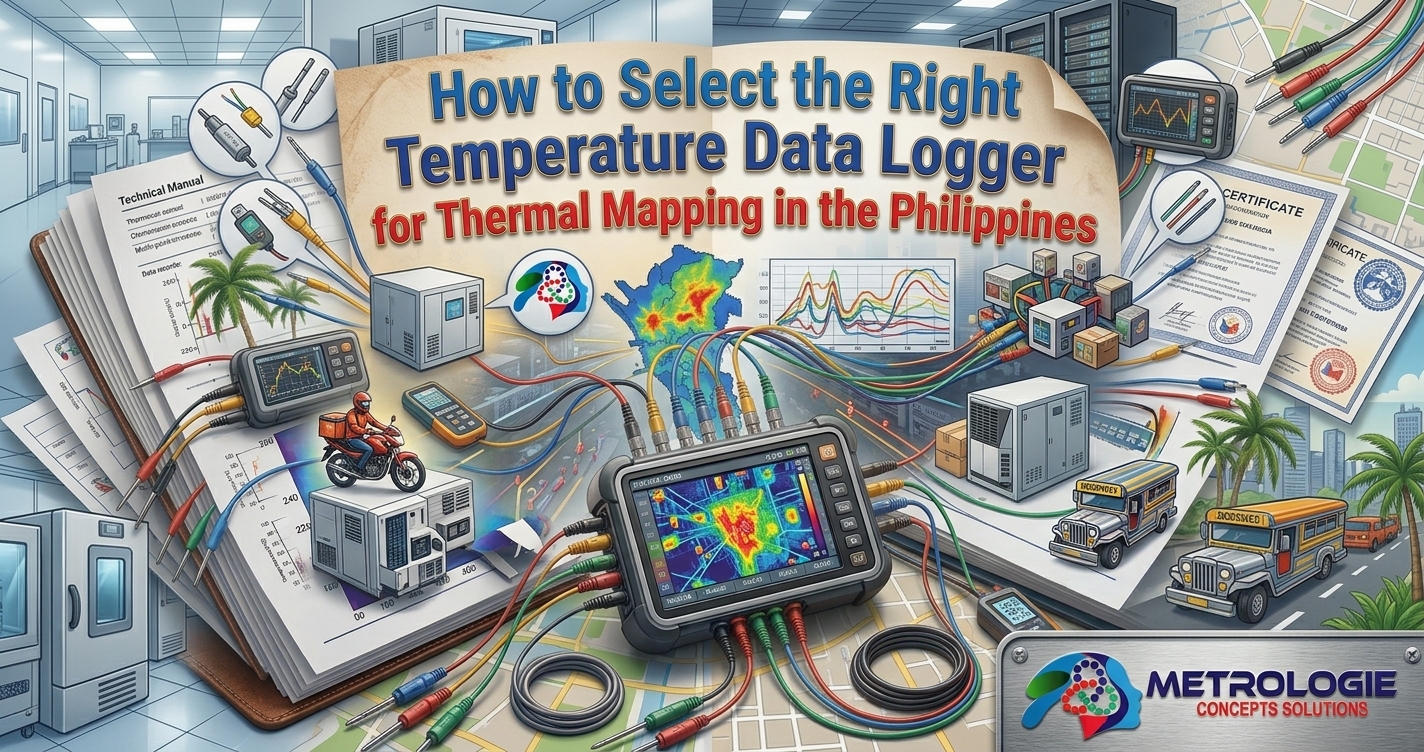
The temperature data logger is the most important instrument in any thermal mapping study. Everything else — the protocol, the sensor positions, the study duration, the data analysis, the final report — depends entirely on the quality and appropriateness of the loggers deployed. Use the wrong logger, and the most carefully designed mapping study produces data that cannot be trusted and documentation that will not satisfy a regulatory inspector or principal auditor.
Yet data logger selection is one of the least-discussed aspects of thermal mapping practice in the Philippines. QA managers who understand the protocol requirements deeply — who know that the protocol must be pre-approved, that seasonal studies are mandatory, that the power failure test is essential — often make data logger selection decisions based on price alone, or based on whatever the mapping service provider happens to have in stock.
This approach creates real compliance risk. A data logger with ±1.0°C accuracy used in a pharmaceutical cold room study — where the acceptance criterion is +2°C to +8°C (a 6°C window) — introduces measurement error equivalent to 17% of the entire acceptable temperature range. <cite index=’25-1′>Most disposable loggers offer around ±0.5°C accuracy. While this may satisfy WHO requirements, it’s often not precise enough for pharmaceutical environments with tighter specs — like refrigerators or incubators.</cite> For fresh seafood cold rooms with a 3°C acceptance window, ±0.5°C accuracy is genuinely marginal. For fresh dairy with a dual freeze-and-heat risk in a 3°C window, inadequate accuracy can make the difference between a study that correctly identifies a compliance failure and one that masks it.
This guide provides the most complete, Philippines-specific explanation of temperature data logger selection for thermal mapping studies available. It covers every technical parameter that matters — accuracy, resolution, measurement range, recording interval, battery life, memory capacity, physical form factor, and data integrity features — explains what each parameter means for study quality, and provides application-specific selection guidance for the major Philippine thermal mapping scenarios. It also addresses the critical compliance distinction between reusable calibrated loggers, disposable loggers, and wireless logger systems — and what each means for WHO, GMP, and FDA Circular 2021-003 compliance.
| The Guiding Principle for Data Logger SelectionSelect the data logger based on the requirements of the application — the temperature range, the acceptance criterion window, the calibration standards required, and the physical deployment environment — not based on price or availability alone.In the Philippines, the most common data logger selection mistake is choosing a logger whose accuracy is inadequate for the application’s acceptance criterion. In a 6°C pharmaceutical CRT window, ±0.5°C is adequate. In a 3°C fresh seafood or fresh dairy window, ±0.25°C or better is required. In an ultra-cold -80°C application, specialised sensors are needed. The logger must fit the application. |
1. The Seven Technical Parameters That Determine Data Logger Suitability
Every temperature data logger is defined by a set of technical parameters that determine whether it is suitable for a given thermal mapping application. Understanding what each parameter means — and what values are required for Philippine pharmaceutical, food, and cold chain applications — is the foundation of informed data logger selection.
Parameter 1: Accuracy
Accuracy is the most important parameter for thermal mapping applications. It is the maximum difference between the logger’s reported temperature and the true temperature, expressed as ±°C. For example, a logger with ±0.5°C accuracy means its readings may be up to 0.5°C higher or 0.5°C lower than the true temperature at any measured point.
Accuracy determines whether the study can reliably detect compliance failures within the application’s acceptance criterion window. The rule of thumb: the logger’s accuracy should be no greater than 1/4 of the acceptance criterion window. For a ±3°C window (6°C total), ±0.5°C accuracy provides adequate resolution for detecting compliance failures with meaningful confidence. For a ±1.5°C window (3°C total), ±0.25°C is needed.
WHO TRS 961 Supplement 8 specifies that data loggers for pharmaceutical thermal mapping should have accuracy of ±0.5°C or better. This is a minimum standard — not a universal specification for all applications. Tighter-tolerance applications require better accuracy.
Parameter 2: Resolution
Resolution is the smallest temperature increment the logger can display or record — typically 0.1°C, 0.01°C, or finer. Resolution is distinct from accuracy: a logger can display temperature to 0.01°C (high resolution) while having accuracy of only ±0.5°C.
For thermal mapping, resolution affects two things: the smoothness of the time-temperature graph (high resolution gives smooth curves, low resolution gives stepped curves), and the uncertainty contribution from digitisation (rounding error). A logger with 0.1°C resolution contributes a ±0.05°C digitisation uncertainty component; a logger with 0.01°C resolution contributes only ±0.005°C. For applications where measurement uncertainty calculation is required under ISO/IEC 17025, higher resolution reduces the uncertainty budget.
For most Philippine pharmaceutical and food thermal mapping applications, 0.1°C resolution is adequate. For pharmaceutical cold rooms and fresh dairy applications where the acceptance window is tight, 0.01°C resolution is preferred.
Parameter 3: Measurement Range
The measurement range is the minimum and maximum temperature the logger can measure reliably. Loggers must be selected with a range that covers the full temperature expected during the study — including temperatures that may be encountered during power failure tests (which may be significantly warmer than the normal operating range) and any ambient temperature recording that the logger will perform.
For Philippine thermal mapping applications:
- Pharmaceutical CRT warehouse mapping (15°C to 30°C target; up to 40°C ambient): Range of -10°C to +60°C is adequate for most warehouse mapping with standard USB loggers
- Pharmaceutical cold room mapping (+2°C to +8°C target; power failure test up to +20°C): Range of -10°C to +60°C adequate
- Pharmaceutical freezer mapping (-20°C to -18°C target): Range of -40°C to +30°C minimum; use loggers rated for extended sub-zero temperatures
- Ultra-cold storage mapping (-80°C target): Specialised thermocouple or platinum resistance thermometer sensors rated for -196°C to +50°C — standard NTC thermistor loggers are NOT suitable for ultra-cold applications
- Transport mapping (Philippine summer ambient; range from product temperature to ambient): Range of -10°C to +60°C adequate for most chilled transport; -30°C to +60°C for frozen product transport
Parameter 4: Recording Interval
The recording interval (or logging rate) is how frequently the logger records a temperature reading — typically expressed in seconds or minutes. The recording interval determines the temporal resolution of the temperature profile: how quickly temperature events (door openings, defrost cycles, power failure recovery) are captured.
WHO TRS 961 Supplement 8 does not specify a minimum recording interval, but industry practice for pharmaceutical thermal mapping is 5 to 15 minutes. A 5-minute interval captures most temperature events with adequate resolution; a 15-minute interval may miss brief excursions during defrost cycles or rapid door-opening events. A 1-minute interval provides the best event resolution but generates very large data files for long studies.
For Philippine thermal mapping studies, the recommended recording intervals are:
- Pharmaceutical warehouse (72-hour to 7-day study): 10 to 15 minutes — adequate for capturing diurnal variation and HVAC behaviour
- Pharmaceutical cold room (72-hour study): 5 to 10 minutes — captures defrost cycles and door-opening events
- Power failure test: 1 to 5 minutes — required to capture the rapid temperature rise during power interruption
- Transport mapping (4 to 24-hour mission): 1 to 5 minutes — captures door-opening events and traffic stop temperature behaviour
- Insulated delivery container validation (2 to 4-hour study): 1 minute — captures the rapid temperature changes at each delivery stop
Parameter 5: Battery Life and Memory Capacity
Battery life determines how long the logger can operate without replacement or recharging. For thermal mapping studies, the logger must survive the full study duration — including any pre-deployment programming and post-study data retention period — without battery failure. Battery failure mid-study creates a data gap that may require the affected study period to be repeated.
For Philippine thermal mapping applications, select loggers with battery life of at least 2× the study duration. A 72-hour pharmaceutical cold room study requires loggers with at least 144 hours (6 days) of battery life at the selected recording interval. A 7-day warehouse study requires loggers with at least 14 days of battery life.
Memory capacity determines how many readings the logger can store before its memory is full. At a 10-minute recording interval over 72 hours, a logger records 432 data points. At 5 minutes over 7 days, it records 2,016 data points. Most modern thermal mapping data loggers have adequate memory for these study durations — but for longer studies at shorter intervals, verify that the logger’s memory capacity is sufficient before deployment.
Parameter 6: Physical Form Factor and Mounting
The logger’s physical size, shape, and mounting mechanism determine where it can be placed and how securely it stays in position during the study. For pharmaceutical and food cold room mapping, the logger must be small enough to be placed at the required measurement positions without significantly disturbing airflow, and secure enough to remain in position throughout the study period without being accidentally displaced by staff accessing the storage area.
Key form factor considerations for Philippine thermal mapping:
- Small USB button loggers (15 to 30mm diameter): Ideal for pharmaceutical cold rooms and refrigerators — can be placed on shelves, hung from racking, or attached to walls with cable ties without disturbing product access
- Loggers with remote probe options: Essential for applications where the logger body must be positioned outside the measurement zone (for example, a logger mounted on the exterior of a cold room with a probe inserted through an access port to measure internal temperatures without opening the door)
- Weatherproof or splash-resistant loggers: Required for outdoor transport studies and for food production environments where the logger may be exposed to moisture or cleaning chemicals
- High-visibility coloured loggers: Useful for large warehouse studies where loggers must be located quickly at the end of the study — bright orange or yellow loggers are easier to find in racking than small silver button loggers
Parameter 7: Data Integrity and Download Features
For GMP and pharmaceutical compliance applications, the data logger must support data integrity requirements — protecting recorded data from tampering, loss, or unauthorised modification. Key data integrity features:
- Tamper-evident data storage: The logger’s raw data must be stored in a non-editable format, with any post-download data manipulation documented and auditable
- Password protection: Access to logger programming and data download should be password-protected to prevent unauthorised modification of settings or data
- Time-stamp accuracy: The logger’s internal clock must be accurate to within a few minutes over the study duration — significant time drift can make event correlation difficult in the final report
- Data format compatibility: The logger must be able to export data in a format compatible with the analysis software used by the mapping team — CSV, Excel, or proprietary format depending on the analysis workflow
2. Logger Types: USB, Wireless, Multi-Channel, and Disposable
Temperature data loggers for thermal mapping are available in four main configurations. Each has specific advantages and limitations for Philippine thermal mapping applications.
Type 1: USB Button Loggers — The Philippine Thermal Mapping Workhorse
Small, battery-powered loggers that are deployed at sensor positions, record temperature continuously for the study duration, and are collected and connected to a computer via USB at the end of the study for data download. USB loggers are the most widely used data logger type for pharmaceutical and food thermal mapping in the Philippines for several reasons:
- Robust and reliable: No active radio transmission means no interference, no connectivity issues, and no power drain from wireless communication — USB loggers simply log temperature reliably for the full study duration
- No infrastructure requirement: Do not require Wi-Fi, Bluetooth network coverage, or any infrastructure at the mapping site — they work equally well in a Metro Manila cold room, a provincial warehouse, or a remote island food cold store
- Low cost per unit: USB button loggers are relatively inexpensive, making it practical to deploy the sensor density required for compliant thermal mapping without excessive instrument cost
- Straightforward calibration: The sensor is integral to the logger body — calibration covers both the sensing element and the recording electronics in a single certificate
- Limitation: No real-time data access — data is only available after download at the end of the study. This means that a sensor failure mid-study may not be detected until data download.
Type 2: Wireless Temperature Loggers — Real-Time Monitoring with Infrastructure Requirements
Wireless loggers transmit temperature data in real time to a central gateway or cloud system — providing immediate visibility of all sensor readings throughout the study period. This real-time visibility is a significant advantage: sensor failures, unexpected temperature events, and power interruptions can be detected and responded to immediately rather than discovered at data download. <cite index=’24-1′>Solutions such as wireless temperature data loggers allow precise placement at true product locations, supporting accurate thermal validation in cold rooms, stability chambers, warehouses, and transport systems.</cite>
The primary limitation of wireless loggers for Philippine thermal mapping is infrastructure dependence:
- Wi-Fi or cellular coverage required: Wireless loggers require adequate signal coverage throughout the mapped space. In large pharmaceutical warehouses with metal racking, thick-walled cold rooms, or remote locations with limited cellular infrastructure, maintaining consistent wireless connectivity throughout the study is challenging
- Battery life reduction: Radio transmission consumes significantly more power than local logging — wireless loggers typically have shorter battery life than equivalent USB loggers at the same recording interval
- Higher cost: Wireless logger systems — including the gateway infrastructure — represent a significantly higher capital investment than USB logger systems
- Best application: Ongoing temperature monitoring programmes (where real-time alarm capability is the primary requirement) rather than time-limited mapping studies (where data is needed only after the study)
Type 3: Multi-Channel Data Loggers — Hub-and-Spoke for Complex Studies
Multi-channel loggers connect multiple temperature probes to a single recording unit, storing all channels’ data in a centralised logger. This configuration is useful for applications where sensors must be placed in locations that are difficult to access for individual logger deployment — for example, penetrations through cold room walls or connections to permanently installed sensors.
Multi-channel loggers are less common in Philippine thermal mapping practice than USB button loggers, but they offer advantages for specific applications: pharmaceutical freezer validation (where cold room penetrations are minimal and all sensors can be wired to a single logger outside the freezer), transport container validation (where sensors can be wired to a single logger mounted in an accessible location while probes are positioned throughout the container), and blast chiller validation (where simultaneous core temperature and air temperature measurements are needed with precise time synchronisation between channels).
Type 4: Disposable Data Loggers — Compliance Caution Required
Disposable loggers are single-use devices designed for one mapping study or transport mission — they are pre-programmed, deployed for a single use, and discarded after data download. They are widely used in international pharmaceutical supply chains for transport monitoring because they eliminate the need to return loggers to the sender after an international shipment.
For Philippine pharmaceutical thermal mapping studies used for GMP and FDA Circular 2021-003 compliance, disposable loggers require specific caution:
| The Disposable Logger Compliance ProblemDisposable loggers typically come with a ‘Certificate of Validation’ or ‘Certificate of Conformance’ rather than a calibration certificate. As noted by Vaisala: ‘This might not satisfy GMP requirements or auditor expectations. Because under GMP, it’s not enough to know a device probably works — you need documented evidence that it meets performance requirements, including calibration traceability.’A validation certificate is a manufacturer’s statement that the batch of loggers from which this unit came met specifications during production testing. It is NOT a calibration certificate showing that this specific logger was calibrated against a traceable reference standard, with a stated measurement uncertainty, before deployment in your study.For Philippine pharmaceutical mapping studies submitted as FDA Circular 2021-003 compliance evidence, mapping studies conducted with principal auditors who expect ISO/IEC 17025-traceable calibration, and WHO TRS 961 Supplement 8-compliant studies, individual PAB-accredited calibration certificates are required for each logger. This requirement effectively limits the use of disposable loggers to transport monitoring and non-GMP applications unless the specific disposable logger model can be individually calibrated and certified. |
3. Application-Specific Data Logger Selection Guide
Different Philippine thermal mapping applications have different data logger requirements. The following section provides application-specific selection guidance for the major thermal mapping scenarios covered in this article series.
| Application | Required Accuracy | Recommended Range | Recommended Interval | Logger Type | Key Selection Consideration |
| Pharmaceutical CRT warehouse (15°C to 30°C) | ±0.5°C | -10°C to +60°C | 10 to 15 minutes | USB button logger | Battery life ≥14 days for 7-day study; large enough memory for 7-day × 15-min intervals |
| Pharmaceutical cold room (+2°C to +8°C) | ±0.5°C | -10°C to +30°C | 5 to 10 minutes | USB button logger | Freeze-tolerant housing; small form factor for positioning at geometric corners |
| Pharmaceutical freezer (-20°C) | ±0.5°C | -40°C to +30°C | 5 to 10 minutes | USB logger rated for sub-zero | Must be rated for continuous operation at -20°C — verify low-temperature specification |
| Ultra-cold storage (-80°C) | ±1.0°C or better | −196°C to +50°C | 5 minutes | Thermocouple or specialised RTD system | Standard NTC thermistors NOT suitable; specialised equipment required |
| Fresh seafood cold room (0°C to 2°C) | ±0.25°C or better | -5°C to +20°C | 5 minutes | High-accuracy USB logger | Tightest accuracy requirement; narrow window demands best available instrument |
| Fresh dairy cold room (1°C to 4°C) | ±0.25°C or better | -5°C to +15°C | 5 minutes | High-accuracy USB logger | Dual freeze/heat risk requires high accuracy to detect both extremes reliably |
| Hospital pharmacy refrigerator | ±0.5°C | -5°C to +20°C | 5 minutes | Small USB button logger | Must fit in refrigerator interior without disturbing product; splash-resistant preferred |
| Blood bank refrigerator (1°C to 6°C) | ±0.25°C | -5°C to +20°C | 5 minutes | High-accuracy USB logger | Narrow AABB-standard window (1°C to 6°C) demands high accuracy |
| CRT warehouse — summer study | ±0.5°C | -10°C to +60°C | 10 minutes | USB logger rated to 60°C+ | Confirm upper temperature rating adequate for Philippine summer ceiling hot spot temperatures (potentially 50°C+) |
| Reefer truck transport (chilled) | ±0.5°C | -10°C to +60°C | 1 to 5 minutes | Compact USB logger; shock-resistant | Vehicle vibration resistance required; short interval to capture door-opening events |
| Insulated delivery container (e-commerce) | ±0.5°C | -5°C to +50°C | 1 minute | Miniature USB logger | Small enough to fit inside insulated bag without displacing gel packs; high recording frequency |
| Blast freezer product core temperature | ±0.5°C | -30°C to +80°C | 1 minute | Thermocouple probe logger | Probe must penetrate product to measure core temperature; fast response time required |
4. The Calibration Requirement: What Philippine QA Managers Must Demand
Every data logger used in a pharmaceutical, food, or cold chain thermal mapping study in the Philippines that will be submitted as compliance evidence must be individually calibrated by a PAB-accredited calibration laboratory before deployment. This is the non-negotiable calibration requirement that applies under WHO TRS 961 Supplement 8, FDA Circular 2021-003, GMP, and ISO/IEC 17025.
What the Calibration Certificate Must Show
The calibration certificate for a thermal mapping data logger must contain:
- The laboratory’s PAB accreditation number and the PAB-ILAC MRA mark
- The unique serial number of the specific logger calibrated — not just the model number
- Multiple calibration points covering the full temperature range relevant to the study (e.g., 0°C, +5°C, and +10°C for a pharmaceutical cold room logger)
- The measured deviation at each calibration point (the logger’s reading vs. the reference standard’s reading)
- The expanded measurement uncertainty at each calibration point (e.g., ±0.25°C at k=2)
- A traceability statement linking the calibration to national standards through the DOST-ITDI National Metrology Laboratory
- A recommended recalibration interval
Pre-Study vs Post-Study Calibration
Best practice for GMP-compliant thermal mapping is to calibrate data loggers both before the study (pre-study calibration) and after the study (post-study calibration):
- Pre-study calibration confirms that the logger was accurate at the start of the study — establishing the measurement foundation for all data collected
- Post-study calibration confirms that the logger maintained its accuracy throughout the study — detecting any drift that might have affected the study results
If post-study calibration reveals that a logger drifted more than 0.5°C from its pre-study values, the data from that logger must be reviewed and potentially adjusted or excluded from the compliance analysis. This post-study calibration check is increasingly expected by multinational pharmaceutical principals auditing Philippine distributors’ thermal mapping programmes.
Calibration Interval for Thermal Mapping Loggers
For ongoing temperature monitoring sensors (permanently installed in cold rooms, warehouses, and hospital pharmacies), annual calibration is the WHO-recommended minimum interval. For data loggers used specifically for thermal mapping studies (deployed for a single study and then stored), the calibration should be performed within 30 days before study deployment — ensuring the calibration is current and relevant to the actual study date.
Some organisations calibrate their entire logger fleet annually regardless of whether loggers are used for mapping studies or monitoring — simplifying the calibration schedule at the cost of some calibration resource. This approach is defensible and provides a conservative calibration currency that satisfies the most rigorous auditor expectations.
5. Practical Guidance: How Many Loggers Do You Need?
One of the most common questions from Philippine QA managers planning thermal mapping studies is: how many data loggers do we need? The answer depends on the size and complexity of the space being mapped, the risk profile identified in the site assessment, and the WHO/ISPE guidance on minimum sensor density.
The WHO Guidance on Sensor Density
WHO TRS 961 Supplement 8 does not specify a universal minimum number of sensors but states that sensors should be placed to cover the full volume of the storage area, with emphasis on identified risk locations. ISPE guidance provides more specific recommendations, suggesting a minimum of one sensor per defined zone of the storage volume plus additional sensors at all identified risk locations.
In practice, the industry-accepted minimum sensor counts for Philippine thermal mapping studies are:
- Pharmaceutical refrigerator (single unit): 8 to 16 sensors — covering all 8 geometric corners plus door-adjacent zone, evaporator zone, and each shelf level
- Small pharmaceutical cold room (up to 20 cubic metres): 12 to 20 sensors
- Medium pharmaceutical cold room (20 to 100 cubic metres): 20 to 35 sensors
- Large pharmaceutical warehouse (over 1,000 square metres): 25 to 60 sensors — proportional to warehouse size and racking complexity
- Reefer truck cargo hold: 10 to 16 sensors
- Insulated delivery container: 6 to 10 sensors
| The Too-Few-Sensors TrapThe most common thermal mapping quality compromise in the Philippines is deploying too few sensors to save cost. A warehouse mapping study with 8 loggers covering 2,000 square metres has sensors 15 to 20 metres apart — a spatial resolution that will miss hot spots between sensor positions entirely.When a reviewer — an FDA inspector, a WHO auditor, or a multinational principal quality auditor — looks at your mapping report and sees sensor positions 20 metres apart in a 2,000 square metre warehouse, they will immediately recognise that the study cannot credibly characterise temperature distribution throughout the space. The study will be questioned, and the qualification status of the facility will be challenged.Deploy adequate sensors. The cost of additional loggers — which are inexpensive — is trivial compared to the cost of a mapping study that does not satisfy the reviewer and must be repeated. |
6. Building and Maintaining a Logger Fleet for Ongoing Philippine Operations
For Philippine organisations that conduct multiple thermal mapping studies per year — pharmaceutical distributors mapping seasonal studies, hospitals mapping multiple refrigerators, 3PL operators qualifying multiple cold rooms — building and maintaining a calibrated logger fleet is more cost-effective and operationally reliable than renting loggers for each study.
Fleet Size Planning
The right fleet size depends on the maximum number of loggers needed for the largest single study, plus a buffer to account for loggers out for calibration and any loggers that are damaged or fail quality checks. A practical rule: maintain a fleet of 125% to 150% of the maximum study sensor count. If the largest study you conduct requires 30 loggers, maintain a fleet of 38 to 45 loggers.
Calibration Rotation Management
With a logger fleet, calibration management becomes an ongoing programme rather than a one-time exercise. Track each logger’s calibration due date in a master calibration schedule, and rotate loggers through the PAB-accredited calibration laboratory on a defined annual cycle. Ensure that no logger is deployed in a study with an expired or near-expiry calibration — a 30-day pre-study calibration currency requirement is good practice.
Logger Identification and Tracking
Each logger in the fleet must have a unique identifier — the serial number provided by the manufacturer, supplemented with an internal asset tag if the manufacturer serial number is difficult to read. This identifier must appear on: the PAB-accredited calibration certificate; the mapping protocol’s sensor list; the sensor placement map; the data download files; and the final mapping report. Maintaining this chain of identification ensures that any reviewer can verify that the loggers listed in the protocol are the same loggers whose calibration certificates are attached.
Logger Maintenance and Retirement
Temperature data loggers are precision instruments that can be damaged by: physical impact (dropping), exposure to temperatures outside their rated range (e.g., leaving a pharmaceutical cold room logger in a vehicle during Philippine summer), chemical exposure (cleaning agents), and battery exhaustion followed by failed restart. Loggers that have been dropped, exposed to out-of-range conditions, or found to have drifted beyond acceptable limits on calibration should be removed from service and replaced. Maintain a logger maintenance log that records any unusual events affecting individual loggers — including any post-study calibration findings of drift.
7. Frequently Asked Questions: Data Logger Selection for Philippine Thermal Mapping
Can we use data loggers that come with the mapping service provider’s equipment, or do we need to purchase our own?
Either approach is acceptable — what matters is that the loggers used in the study are individually calibrated with current PAB-accredited certificates, that the calibration certificates are attached to the mapping report, and that the loggers used are appropriate for the application’s temperature range and accuracy requirements. Many Philippine organisations use their mapping service provider’s loggers for initial qualification studies, then invest in their own fleet for ongoing monitoring and repeat seasonal studies. The key is ensuring that any loggers used — whether owned or provided by the service provider — meet the calibration and accuracy requirements of the study.
Is there a specific brand of data logger that is recommended for Philippine pharmaceutical thermal mapping?
WHO, FDA, and GMP standards do not mandate specific brands — they specify performance requirements (accuracy, calibration standard, data integrity features). Many reputable brands are used in Philippine pharmaceutical thermal mapping: Testo, Vaisala, Onset HOBO, Rotronic, MadgeTech, LogTag, and others. The brand matters less than: verifying that the specific model meets the accuracy and range requirements for your application, confirming that the model can be individually calibrated with PAB-accredited certificates (not just provided with a validation certificate), and ensuring that the data output format is compatible with your analysis workflow.
Our mapping service provider uses loggers with a Certificate of Conformance rather than a calibration certificate. Is this acceptable?
For GMP and FDA Circular 2021-003 pharmaceutical compliance, a Certificate of Conformance (CofC) or Certificate of Validation (CoV) is not equivalent to an individual PAB-accredited calibration certificate. As discussed in Section 2, a CofC is a manufacturer’s statement about batch conformance during production — it is not a measurement traceability document showing that this specific logger was calibrated against a traceable reference standard with a stated measurement uncertainty. WHO TRS 961 and GMP require traceable calibration. An FDA inspector or WHO auditor who reviews a thermal mapping report and finds CofC documents rather than individual PAB-accredited calibration certificates may raise this as a compliance finding. Insist on PAB-accredited individual calibration certificates for each logger used in any compliance-relevant pharmaceutical mapping study.
How do we handle a data logger that fails mid-study?
A logger failure mid-study — whether from battery exhaustion, physical damage, or electronics failure — creates a gap in the data from that sensor position. The gap must be documented formally in the mapping report as a deviation, with an explanation of the cause and an assessment of the impact on the study’s compliance conclusion. If the gap occurred during a critical phase of the study (during the power failure test, during a door-opening simulation event, or during a period of high ambient temperature), the impact on the compliance conclusion must be assessed carefully. If the gap affects a sensor position that was identified as a high-risk location (door zone, ceiling zone, evaporator zone), the study may need to be extended or the affected phase repeated with functioning loggers at all required positions.
Can we use the same data loggers for both thermal mapping studies and for permanent temperature monitoring?
Yes — the same logger can serve both functions, but with different management requirements. For permanent temperature monitoring, loggers are deployed continuously and calibrated annually. For thermal mapping studies, loggers are deployed for the study duration, retrieved, and then stored (or redeployed) until the next study. If the same loggers are used for both purposes, the calibration management must ensure that loggers are calibrated before each mapping study deployment (not just on the annual schedule) — particularly if a mapping study is conducted significantly before or after the annual calibration date. The logger’s condition (battery level, data memory available, absence of physical damage) must be verified before each mapping study deployment regardless of the annual calibration status.
Conclusion: The Data Logger Is the Foundation of Every Thermal Mapping Study
A thermal mapping study is only as good as its instruments. The protocol can be perfectly designed, the sensor positions can be scientifically justified, the study duration can be adequate — and none of it matters if the loggers recording the temperature data are not accurate enough for the application, not properly calibrated before deployment, or not appropriate for the temperature range and physical environment of the study.
For Philippine QA managers, validation engineers, and procurement officers making data logger selection decisions, the guidance in this article provides the framework for making those decisions based on technical requirements rather than price alone. Select for accuracy first — the application’s acceptance criterion window determines the minimum accuracy needed. Verify calibration requirements second — PAB-accredited individual calibration certificates for compliance applications, not validation certificates or batch certifications. Then consider form factor, battery life, memory, and data integrity features for the specific deployment environment.
The investment in appropriate, properly calibrated data loggers is the investment that makes every other element of the thermal mapping programme meaningful. Metrologie Solutions Philippines provides PAB-accredited calibration for temperature data loggers of all types — from small USB button loggers to multi-channel systems — with certificates that meet the full requirements of WHO TRS 961 Supplement 8, FDA Circular 2021-003, GMP, and ISO/IEC 17025.
| Calibrate Your Data Loggers with Metrologie Solutions PhilippinesBefore your next thermal mapping study, ensure every data logger has a current PAB-accredited calibration certificate from our laboratory. We calibrate USB loggers, wireless loggers, multi-channel systems, and thermocouple probes across the full temperature range from ultra-cold to high ambient — with multi-point calibration, stated measurement uncertainty, and full traceability to DOST-ITDI NML.Website: metrologiesolutions.com | Services: Data Logger Calibration · Thermal Mapping · Training |
| About Metrologie Solutions PhilippinesMetrologie Solutions Philippines is a PAB-accredited calibration laboratory and thermal mapping specialist. We calibrate and deploy temperature data loggers for mapping studies across pharmaceutical warehouses, cold rooms, food facilities, hospital pharmacies, transport containers, and e-commerce cold chain operations throughout the Philippines. Our PAB-accredited calibration services cover the full range of data logger types — USB loggers, wireless loggers, and multi-channel systems — with certificates meeting WHO TRS 961, FDA Circular 2021-003, GMP, and ISO/IEC 17025 requirements.Website: metrologiesolutions.com | Services: Calibration · Thermal Mapping · Training · Cold Chain Compliance |