| Urgent Regulatory Update — October 2025The Animal Industry Development and Competitiveness Act (RA 12308) took effect on October 28, 2025, transferring exclusive jurisdiction over veterinary drugs, biologics, and animal vaccines from the Food and Drug Administration (FDA) to the Bureau of Animal Industry (BAI) under the Department of Agriculture.All veterinary pharmaceutical distributors, animal vaccine importers, veterinary drug retailers, and cold chain operators handling veterinary biologics must now comply with BAI regulations — including BAI-specific Good Storage Practice (GSP) and cold chain requirements. The 180-day transition deadline for full compliance is April 26, 2026.This article provides the most current and complete guidance available on cold chain compliance for the Philippine veterinary biologics sector under the new BAI regulatory framework. |
The Philippine animal health sector is navigating one of the most significant regulatory transitions in its history. For years, veterinary pharmaceutical companies, vaccine distributors, and cold chain operators in the poultry, livestock, and companion animal sectors managed compliance through an uneasy dual-agency framework — the Food and Drug Administration regulated veterinary drugs as pharmaceutical products while the Bureau of Animal Industry maintained parallel oversight of veterinary biologics.
That complexity has now been resolved — but replaced with new compliance obligations that require immediate attention from every business in the veterinary cold chain. <cite index=’4-1′>Regulatory oversight over animal health and local dairy products in the Philippines has shifted to the Department of Agriculture (DA) after the Animal Industry Development and Competitiveness Act took effect on October 28, 2025. The BAI now holds exclusive jurisdiction over veterinary drugs, biologics, vaccines, and related animal health products — managing licensing, product registration, inspections, surveillance, enforcement, and post-market monitoring.</cite>
For the veterinary biologics cold chain — the network of distributors, importers, retailers, and veterinary clinics that store and handle animal vaccines, antisera, bacterins, and biological products requiring refrigeration or freezing — this transition means a new regulatory authority with new inspection standards, new licensing requirements, and new cold chain documentation obligations.
This article provides the most current available guidance on cold chain compliance for Philippine veterinary biologics businesses under the new BAI framework — covering the regulatory transition, BAI Good Storage Practice requirements for cold chain, the specific temperature requirements for major veterinary biologic categories, the thermal mapping and calibration programme these requirements imply, and the practical steps businesses must take before the April 2026 transition deadline.
| Who This Article Is ForVeterinary pharmaceutical distributors holding temperature-sensitive animal vaccines, antisera, and biologicsAnimal vaccine importers whose cold chain storage must meet BAI inspection standardsPoultry integrators and livestock farm operators with on-farm veterinary biologic cold storageFarm supply and veterinary retail businesses with pharmaceutical refrigerators for animal health productsVeterinary clinics that store temperature-sensitive biologics for patient treatmentCold chain 3PL operators that handle veterinary pharmaceutical products alongside human pharmaceutical products |
1. The Regulatory Transition: From FDA to BAI — What Changed and What It Means
The Pre-2025 Dual-Agency Framework
Before the Animal Industry Development and Competitiveness Act, veterinary pharmaceutical regulation in the Philippines was split between two agencies:
- The Food and Drug Administration (FDA) regulated veterinary drugs as pharmaceutical products under RA 3720 (the Food and Drug Administration Act) as amended by RA 9711. The FDA issued Licences to Operate (LTO) for veterinary drug establishments and Certificates of Product Registration (CPR) for registered veterinary drug products.
- The Bureau of Animal Industry (BAI) regulated veterinary biologics — vaccines, antisera, bacterins, and similar biological products — under BAI Administrative Order No. 15 and related regulations. BAI issued Veterinary Biologics Establishment Licences and veterinary biologics product licences.
This dual-agency framework created compliance complexity: a veterinary pharmaceutical distributor handling both conventional veterinary drugs (antiparasitics, antibiotics) and veterinary biologics (vaccines, antisera) had to manage two sets of licences, two inspection regimes, and two sets of compliance documentation — with the FDA and BAI applying different standards that were not always consistent with each other.
<cite index=’1-1′>On 24 June 2024, the Bureau of Animal Industry (BAI) issued a Technical Advisory notifying all concerned on the cessation of the processing of application for issuance of LTO as veterinary drug products and veterinary biologics establishments, as per the Memorandum, effective 25 June 2024, all inquiries and applications on veterinary drug products shall now be referred to the FDA.</cite> This was a transitional step — moving veterinary drug regulation to the FDA while veterinary biologics remained under BAI, pending the comprehensive legislation that would ultimately resolve the split.
The 2025 Transition: BAI Takes Exclusive Jurisdiction
<cite index=’4-1′>The Animal Industry Development and Competitiveness Act (RA 12308), enacted in September 2025, has officially transferred jurisdiction over all veterinary drugs, biologics, vaccines, and related animal health products to the Bureau of Animal Industry (BAI). The BAI now manages licensing, product registration, inspections, surveillance, enforcement, and post-market monitoring for all veterinary products. The transfer of veterinary product regulation to DA-BAI must be completed within 180 days — by April 26, 2026.</cite>
This is a comprehensive transfer — not just of regulatory responsibility but of all existing authorisations. <cite index=’4-1′>Revalidation and compliance with post-approval commitments attached to FDA authorizations, such as Certificates of Product Registration, must be submitted directly to the BAI.</cite> Businesses that hold existing FDA CPRs for veterinary products must engage with BAI for revalidation and continuation of those authorisations under the new framework.
What This Means for Cold Chain Operators
For businesses that handle veterinary biologics in temperature-controlled storage, the BAI jurisdiction transfer has four specific implications:
- New licensing authority: Licences to Operate for establishments handling veterinary biologics are now issued by BAI, not FDA. Existing FDA-issued LTOs for veterinary drug establishments must be revalidated with BAI before the April 2026 deadline.
- New inspection standards: BAI inspections of veterinary pharmaceutical establishments apply BAI’s Good Storage Practice (GSP) standards for veterinary biologics — which include cold chain management requirements. The FDA cold chain management framework of FDA Circular 2021-003 no longer applies directly to veterinary-only establishments, though the underlying Good Storage Practice principles remain similar.
- New documentation requirements: Cold chain compliance documentation must be formatted and organised to satisfy BAI inspection requirements, not FDA cold chain inspection formats. Businesses that built their cold chain documentation around FDA Circular 2021-003 need to assess whether their existing documentation meets BAI GSP standards.
- Continued cold chain compliance obligations: The transition does not reduce cold chain requirements — it changes which authority enforces them. Veterinary biologics still require temperature-controlled storage, calibrated monitoring systems, and documented cold chain management. These requirements are now enforced by BAI rather than FDA.
2. BAI Good Storage Practice: The Cold Chain Requirements
BAI Administrative Order No. 15 (1991) — the foundational regulation for veterinary biologics manufacturing and storage in the Philippines — establishes baseline cold chain standards for veterinary biologic establishments. Under the new BAI jurisdiction framework, these standards, supplemented by current WHO and OIE (World Organisation for Animal Health) guidelines for veterinary biologics, define the cold chain compliance requirements that veterinary biologic distributors must meet.
Temperature-Controlled Storage Requirements
<cite index=’3-1′>Biologics shall be stored at controlled temperature environments at all times, within a range which ensures and maintains optimal stability of the veterinary biological product. Additional storage equipment such as -20°C and -70°C freezers, liquid nitrogen tanks and similar equipment essential for specified standards operations of the Veterinary Biological Standards facility should also be available.</cite>
The storage temperature requirements for veterinary biologics are product-specific — established by the product manufacturer and stated on the product label, in the product’s CPR, and in the manufacturer’s technical data sheet. BAI GSP requires that establishments store each biologic product within its specified temperature range at all times, with continuous temperature monitoring to verify compliance.
Key BAI GSP Cold Chain Requirements
Under BAI Good Storage Practice standards applicable to veterinary biologic cold chain operations, the following cold chain management elements are required:
- Temperature-controlled storage areas appropriate for each product category — refrigerators for +2°C to +8°C products, freezers for -20°C products, ultra-cold storage for -70°C or colder products where applicable
- Continuous temperature monitoring with alarm capability — monitoring must be continuous (not manual read-and-log), with alarms that notify designated staff when temperatures fall outside specified ranges
- Calibrated monitoring equipment — temperature monitoring sensors must be calibrated with documented traceability to ensure measurement accuracy
- Temperature records maintained and accessible for BAI inspection — records must cover the full storage period for all product lots held at the facility
- Qualified personnel training in cold chain management — staff responsible for receiving, storing, and dispatching temperature-sensitive biologics must have documented training
- SOPs for temperature-sensitive product handling — documented procedures for receiving, storage, dispatch, and temperature excursion response
Facility Inspection Requirements Under BAI
<cite index=’7-1′>The importer’s warehouse must pass BAI inspection for Good Storage Practices (GSP).</cite> BAI facility inspections for veterinary pharmaceutical establishments assess the physical cold chain infrastructure — refrigeration equipment, monitoring systems, product segregation, and facility conditions — as well as documentation systems and personnel competence. BAI inspectors reviewing cold chain facilities will expect to see:
- Functioning, appropriately sized refrigeration equipment for each temperature category of product stored
- Temperature monitoring system with continuous recording and alarm capability
- Current calibration certificates for temperature monitoring equipment
- Temperature records covering recent storage periods
- Evidence of temperature excursion response procedures
- Staff training records for cold chain-relevant roles
3. Temperature Requirements by Veterinary Biologic Category
Veterinary biologics span a much wider temperature range than human pharmaceuticals — from conventional refrigerated vaccines at +2°C to +8°C through frozen viral vaccines at −20°C, ultra-cold viral antigens at −70°C or colder, and liquid nitrogen preserved cell-based biologics at −196°C. Each category requires different cold chain infrastructure and different qualification approaches.
| Veterinary Biologic Category | Temperature Requirement | Philippine Sector Application | Cold Chain Challenge |
| Modified live virus (MLV) vaccines — poultry (Newcastle, IBD, Marek’s, ILT) | −20°C or colder for storage; +2°C to +8°C after reconstitution, use within hours | Largest veterinary vaccine category in the Philippines — broiler, layer, and breeder farms | Ultra-cold storage on-farm is rare; MLV vaccines typically received at −20°C and moved to refrigerator only after farm schedule confirms near-term use |
| Killed/inactivated virus vaccines — poultry | 2°C to 8°C | Common in commercial poultry operations — AI, ND inactivated, EDS | Standard pharmaceutical cold room range; same requirements as human pharmaceutical cold chain |
| MLV vaccines — swine (FMD, CSF, PRRS) | −20°C for most; some 2°C to 8°C — product-specific | High-value sector — Luzon commercial swine operations | FMD vaccine cold chain is strategically critical for the Philippine hog industry; excursions have national animal health implications |
| Killed bacterins — cattle and small ruminants | 2°C to 8°C | Widespread in commercial dairy, beef, and goat farming | Generally stable refrigerated products; freeze sensitivity varies by adjuvant type |
| Antiserum / immunoglobulin products | 2°C to 8°C | Used in therapeutic and prophylactic applications across species | Similar to human biologic antisera; critical to avoid freezing |
| Marek’s disease vaccine (cell-associated) | −196°C (liquid nitrogen) | Mandatory for commercial broiler and layer production — administered in hatcheries | Liquid nitrogen cold chain is entirely separate from conventional refrigeration; requires liquid nitrogen supply chain, specialised transport dewars, and hatchery LN2 infrastructure |
| Semen and embryo biologics | −196°C (liquid nitrogen) for frozen; 15°C–18°C for chilled (short-term) | Cattle and swine AI programmes; embryo transfer programmes | Highly time-sensitive; chilled semen has 24–72 hour viability window; cold chain failure is immediately and irreversibly damaging |
| Autogenous biologics (custom vaccines) | Product-specific; typically 2°C to 8°C | Poultry and swine operations with specific pathogen situations | Frequently used in Philippine poultry sector; product-specific storage conditions must be confirmed with the BAI-approved manufacturer |
4. The Philippine Veterinary Cold Chain Infrastructure: Unique Challenges
The veterinary biologics cold chain in the Philippines faces several challenges that are specific to the animal health sector and to the Philippine operating environment — distinct from the human pharmaceutical cold chain covered in previous articles in this series.
Challenge 1: Farm-Level Cold Chain — The Last Mile to the Injection Site
Unlike human pharmaceutical cold chain, which ends at a pharmacy or hospital and involves trained healthcare professionals, veterinary biologic cold chain must reach the point of administration — which is often a poultry house in Batangas, a swine farm in Bulacan, or a cattle operation in Bukidnon. The farm-level cold chain typically involves:
- Cold box or insulated cooler transport from the veterinary distributor to the farm
- Farm storage in a dedicated vaccine refrigerator or, for MLV poultry vaccines, a −20°C freezer
- Thawing and reconstitution protocols for MLV vaccines — timing the transition from −20°C storage to +2°C to +8°C reconstituted product to match the vaccination schedule
The farm-level cold chain is where the most temperature excursions occur in the Philippine veterinary biologics cold chain — not in the distributor’s cold room, but in the farm’s vaccine storage and handling practices. Thermal mapping and validated monitoring at the distributor level, while necessary for BAI compliance, must be supplemented by training and cold chain SOPs that extend to the farm level.
Challenge 2: Philippine Summer and Farm Building Temperatures
Philippine broiler and layer houses are typically open-sided, naturally ventilated structures — with interior temperatures that track closely with the ambient environment. During Philippine summer (March to May), interior temperatures in these structures can reach 35°C to 40°C. A vaccine refrigerator in a farm office or medication room adjacent to a poultry house faces the same solar-driven ambient thermal load that pharmaceutical warehouses face — but typically without the infrastructure (insulation, backup power, monitoring systems) of a regulated pharmaceutical storage facility.
Veterinary distributors providing vaccines to farms must consider the farm cold chain as a link in their own quality responsibility — advising farms on proper vaccine storage, providing validated cold box and ice pack protocols for transport from the distributor to the farm, and establishing documentation standards for farm-level temperature management.
Challenge 3: The Frozen Vaccine Cold Chain (−20°C to Farm)
Modified live virus vaccines — the dominant vaccine type in Philippine commercial poultry and swine production — must be maintained at −20°C or colder throughout the storage and transport chain until the moment of thawing for use. This −20°C requirement creates a cold chain infrastructure challenge that is more demanding than the standard +2°C to +8°C pharmaceutical cold chain:
- Distributor warehouses must have −20°C freezer storage with adequate capacity for vaccine inventory and with power backup sufficient for the coldest product category’s sensitivity
- Transport from distributor to farm must use insulated dry ice shippers or validated −20°C transport containers — not standard pharmaceutical cold boxes
- On-farm storage requires a −20°C chest freezer with reliable power — a significant infrastructure requirement for farms in areas with variable power supply
- Thermal mapping of −20°C freezer storage at the distributor level must address the specific risks of frozen vaccine storage: defrost cycle temperature spikes, power failure holdover time at Philippine summer ambient conditions, and door-opening temperature recovery for high-throughput operations during peak vaccination season
Challenge 4: Liquid Nitrogen Cold Chain for Marek’s Disease Vaccine
The liquid nitrogen (LN2) cold chain for Marek’s disease vaccine — used in virtually every Philippine commercial broiler and layer hatchery — is the most technically demanding cold chain in the Philippine animal health sector. LN2 operates at −196°C, far beyond the range of conventional refrigeration systems. The LN2 cold chain requires:
- LN2 supply from a licensed gas supplier — typically with scheduled delivery to hatcheries and distributors
- LN2 transport dewars (vacuum-insulated containers) for moving vials from the LN2 tank to the administration site — with maximum hold time specifications that vary by dewar type
- Vial thawing protocols for use — typically rapid thaw in 35°C–40°C water bath immediately before use, with maximum time from thaw to administration
The LN2 cold chain does not use conventional temperature monitoring in the same way that refrigerated or frozen storage does — LN2 evaporation is the primary temperature control mechanism, and LN2 levels must be checked regularly rather than temperature monitored continuously. However, the distributor’s LN2 storage tank infrastructure requires its own qualification and monitoring programme to ensure that LN2 is available at adequate levels for vaccine storage at all times.
5. Thermal Mapping for Veterinary Biologic Cold Storage
Thermal mapping for veterinary biologic cold storage follows the same fundamental methodology covered throughout this article series — calibrated sensors, pre-approved protocol, data analysis, formal report — adapted for the specific product categories, temperature ranges, and operational patterns of the veterinary sector.
Cold Room Thermal Mapping for Refrigerated Veterinary Biologics (+2°C to +8°C)
For veterinary distributors with dedicated cold rooms storing refrigerated biologics (killed vaccines, antisera, bacterins), the thermal mapping requirements are substantively identical to those for pharmaceutical cold rooms — with the acceptance criterion set at the product’s specified storage range (typically +2°C to +8°C) and the study design accounting for the operational access patterns of the veterinary distribution business.
Key differences from human pharmaceutical cold room mapping:
- Higher door-opening frequency during peak vaccination seasons — Philippine commercial poultry vaccination campaigns can create very high dispatch volumes during specific seasonal windows, with multiple large orders being assembled and dispatched on the same day
- Vaccine order assembly typically involves removing entire boxes from refrigerated storage to a picking area — creating larger thermal mass withdrawals than individual pharmaceutical product picking
- Power supply considerations in provincial locations — many veterinary distributors operate in locations outside Metro Manila with more variable power supply than the CALABARZON pharmaceutical distribution corridor
Freezer Mapping for −20°C MLV Vaccine Storage
Thermal mapping of −20°C freezer storage for modified live virus vaccines addresses the most critical cold chain risk in the Philippine veterinary sector. The key mapping concerns are:
- Power failure holdover time at Philippine summer ambient: A −20°C freezer that loses power at 37°C Philippine summer ambient will warm significantly faster than the same freezer at 25°C. The holdover test conducted during summer conditions establishes the realistic emergency response window — the time from power failure to the product reaching the upper temperature limit of acceptable storage.
- Defrost cycle temperature impact: Most commercial chest freezers and upright freezers cycle through automatic defrost events that temporarily raise freezer compartment temperature. The mapping study must capture defrost cycles and assess whether peak temperatures during defrost remain within acceptable bounds for the product stored.
- Temperature distribution — identifying warm zones: Even in a well-functioning −20°C freezer, there are temperature gradients — typically warmer zones near the door and frost-free zones near the interior. Products stored in these warmer zones experience less severe cold exposure than the thermostat suggests. For MLV vaccines where viral attenuation can occur with warmer storage, warm zones must be identified and products placed in the coldest (most stable) zones.
Documentation for BAI Compliance
Veterinary biologic cold room thermal mapping reports, calibration certificates, and monitoring records must be formatted and organised to meet BAI GSP inspection requirements. Key documentation elements for BAI cold chain compliance:
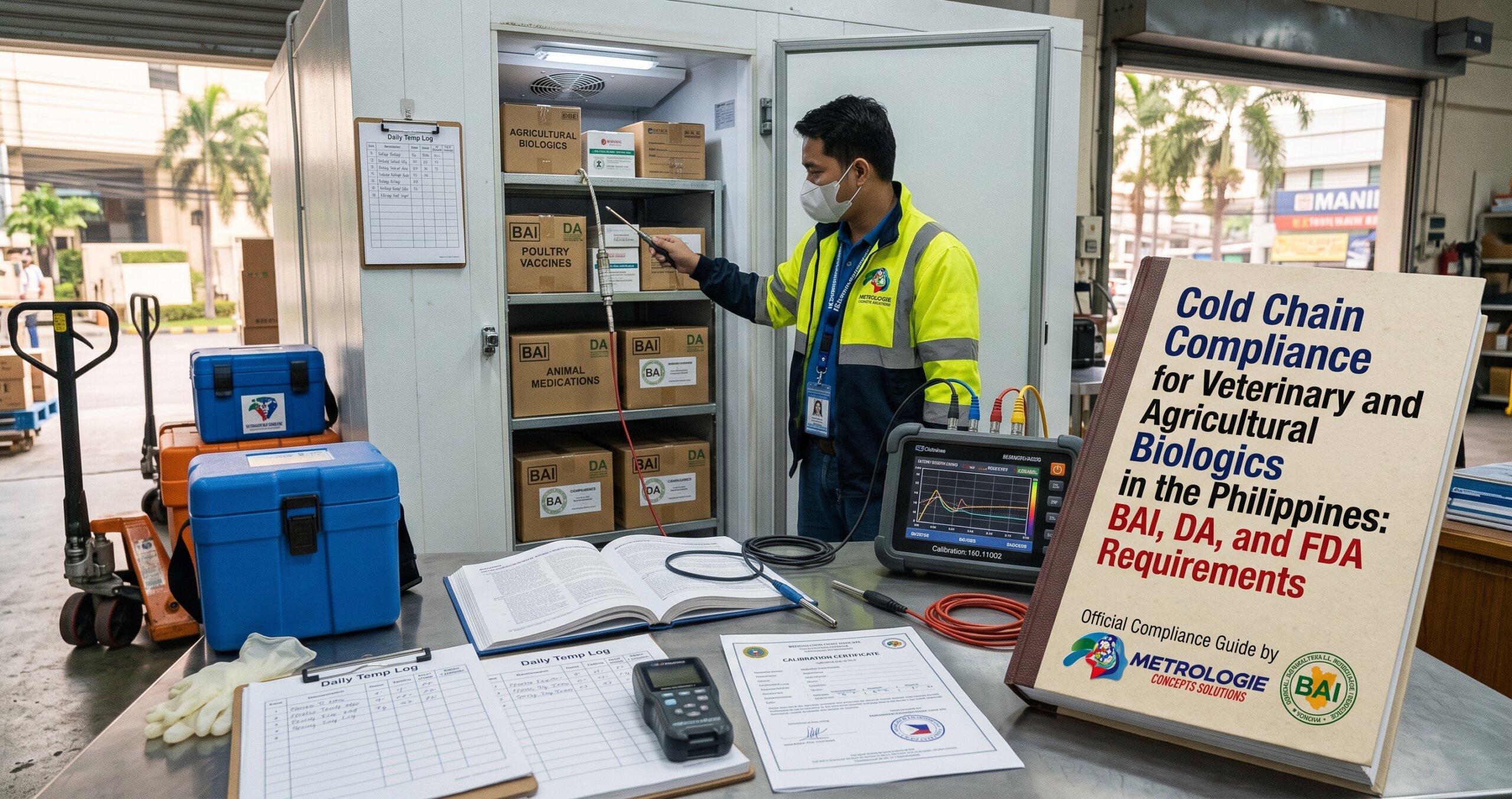
- Thermal mapping report for each cold room or freezer used for veterinary biologic storage — with pre-approved protocol, PAB-accredited data logger calibration certificates, temperature distribution data, hot and cold spot identification, and power failure holdover results
- Continuous temperature monitoring records — electronic records from the monitoring system covering the storage period for all current product lots
- Monitoring sensor calibration certificates — current PAB-accredited calibration certificates for all monitoring sensors
- Cold chain SOPs — receiving, storage, dispatch, excursion response procedures specific to veterinary biologic handling
- Staff training records — documentation that personnel handling veterinary biologics are trained in cold chain management
6. The Transition Timeline: What Veterinary Cold Chain Operators Must Do Before April 2026
The 180-day transition deadline under the Animal Industry Development and Competitiveness Act — April 26, 2026 — requires veterinary pharmaceutical establishments to complete their regulatory transition to BAI. For cold chain operators, this transition has specific tasks that must be completed within this window.
Immediate Actions (Now to December 2025)
- Contact BAI’s Animal Feeds, Veterinary Drugs and Biologics Control Division (AFVDBCD) to understand the specific revalidation process for your existing FDA or BAI licences and CPRs — the transition procedure may vary by establishment type and current licence status
- Inventory all temperature-sensitive veterinary biologic products currently held at your facility — identify which products require refrigeration (+2°C to +8°C), which require freezing (−20°C), and which require ultra-cold storage
- Assess your current cold chain infrastructure against BAI GSP standards — compare your cold room equipment, monitoring systems, calibration status, and documentation against the requirements described in Section 2
- Identify gaps between your current cold chain programme and BAI GSP requirements — particularly gaps in thermal mapping documentation, monitoring sensor calibration, and cold chain SOPs
Short-Term Actions (January to March 2026)
- Commission thermal mapping studies for cold rooms and freezers used for veterinary biologic storage — prioritise any cold room for which no current mapping documentation exists
- Calibrate all temperature monitoring sensors with a PAB-accredited calibration laboratory — obtain current calibration certificates for every sensor
- Develop or update cold chain SOPs to align with BAI GSP standards — particularly the temperature excursion response SOP and the product receiving SOP
- Implement or verify continuous temperature monitoring with alarm capability for all cold chain storage areas
- Conduct cold chain training for all relevant staff and document training records
Compliance Deadline (April 26, 2026)
- Submit revalidation applications to BAI for all existing FDA and BAI licences and CPRs as required by the transition process
- Have the complete cold chain documentation file available for BAI inspection: thermal mapping reports, calibration certificates, monitoring records, SOPs, and training records
- Ensure all cold chain infrastructure meets BAI GSP requirements: functioning calibrated refrigeration, continuous monitoring with alarm, and complete documentation
| Do Not Wait Until the DeadlineThe April 26, 2026 deadline is the final compliance date — not the date to begin preparation. Thermal mapping studies for cold rooms and freezers typically take 4 to 8 weeks from commissioning to final report delivery (study design, protocol approval, data collection, analysis, and report). If you begin commissioning studies in April 2026, you will not have the reports by the deadline.Start your cold chain compliance assessment and thermal mapping programme now. Contact Metrologie Solutions Philippines to discuss your veterinary cold chain compliance needs and to schedule your mapping studies before the transition deadline. |
7. The BAI-FDA Transition and Cold Chain Service Providers
The regulatory transition from FDA to BAI does not change the calibration traceability requirements for monitoring instruments used in veterinary biologic cold chain. Calibration of temperature monitoring sensors must remain traceable to national or international measurement standards — the Philippine Accreditation Bureau (PAB) accreditation of the calibration laboratory remains the appropriate credential for temperature calibration in the Philippine national measurement system.
The transition changes the regulatory authority reviewing compliance, not the technical standards for measurement quality. A PAB-accredited calibration certificate from Metrologie Solutions Philippines for a veterinary cold room monitoring sensor will satisfy BAI inspection requirements for measurement traceability in the same way it would satisfy FDA cold chain inspection requirements — because both authorities require traceable calibration, and PAB accreditation is the Philippines’ national framework for that traceability.
Similarly, thermal mapping studies conducted to WHO/OIE Good Storage Practice methodology — with pre-approved protocols, adequate sensor density, documented ambient conditions, power failure testing, and formal QA-approved reports — will satisfy BAI GSP cold chain qualification requirements regardless of which regulatory authority is reviewing them.
8. Frequently Asked Questions: Veterinary Biologics Cold Chain Compliance
We currently hold an FDA Licence to Operate for our veterinary drug distribution business. What do we need to do before April 2026?
You must engage with BAI’s Animal Feeds, Veterinary Drugs and Biologics Control Division (AFVDBCD) to revalidate your licence under the new BAI framework. The specific revalidation process is being developed by BAI as part of the transition implementation — check the DA/BAI official website and contact AFVDBCD directly for the current revalidation procedure and required documents. In parallel with the licensing revalidation, ensure your cold chain compliance documentation meets BAI GSP standards — thermal mapping reports, calibration certificates, monitoring records, and SOPs should all be current and well-organised for the BAI inspection that may accompany or follow the licence revalidation.
Does BAI GSP require the same level of thermal mapping documentation as FDA Circular 2021-003?
BAI GSP standards, based on BAI Administrative Order No. 15 and consistent with OIE and WHO guidelines for veterinary biologics, require that veterinary biologic establishments demonstrate that storage conditions are maintained within specified temperature ranges at all times. The thermal mapping study, as the standard methodology for demonstrating temperature distribution compliance in cold rooms and freezers, satisfies this requirement in the same way it satisfies the FDA Circular 2021-003 requirement. The specific technical standards for study design (WHO methodology, PAB-accredited calibration, power failure testing, seasonal studies) remain applicable under BAI GSP as good storage practice — even if BAI regulations do not yet describe them with the same prescriptive specificity as FDA Circular 2021-003 references WHO TRS 961.
Our farm stores veterinary vaccines on-site for our own use. Does the BAI transition affect us?
For farms storing veterinary vaccines for their own use (self-use vaccination programmes), the regulatory compliance obligations are generally lighter than for commercial distributors or retailers — farms are typically not required to hold an LTO for storage of products for their own animals. However, the quality of on-farm vaccine cold chain directly affects vaccination efficacy and animal health outcomes. BAI technical advisories and veterinary inspection programmes may increasingly address on-farm cold chain practices as the sector matures. More practically, vaccine manufacturers and distributors may build on-farm cold chain requirements into their supply conditions — and farm cold chain failures result in vaccine failure, disease outbreaks, and economic loss regardless of regulatory enforcement.
We use a cold chain 3PL to store our veterinary biologics. Does the 3PL need its own BAI LTO?
If your 3PL cold chain operator is storing veterinary biologics as a service to your business, they are operating as a veterinary pharmaceutical storage establishment and may need their own BAI LTO for that storage activity under the new BAI framework. This question should be resolved by engaging directly with BAI — the specific licensing requirements for cold storage service providers handling veterinary biologics as a contracted service are part of the broader BAI transition guidance that is being developed. As a principal in this arrangement, you have responsibility for ensuring that the cold chain conditions in your 3PL’s storage meet BAI GSP standards — your own compliance cannot be fully delegated to the 3PL without oversight.
Does thermal mapping conducted for FDA compliance remain valid after the BAI transition?
Existing thermal mapping reports produced under WHO/GDP methodology and FDA cold chain compliance standards remain technically valid — they document the temperature distribution performance of your cold rooms and freezers under defined conditions with calibrated instruments. The BAI transition does not invalidate the science of a properly conducted mapping study. However: if your mapping reports are more than 2 to 3 years old, periodic requalification is appropriate regardless of which regulatory authority is reviewing them; if your mapping reports lack power failure holdover test data, summer-condition testing, or PAB-accredited calibration certificates, these gaps should be addressed; and if your cold chain infrastructure has been modified since the most recent mapping study, remapping after the modifications is required. The BAI transition is a good prompt to review and update your cold chain qualification documentation — treating it as an opportunity to strengthen your cold chain programme rather than merely meeting a filing deadline.
Conclusion: The BAI Transition Is an Opportunity to Build a Stronger Cold Chain
The transition of veterinary pharmaceutical regulation from FDA to BAI — completed through the Animal Industry Development and Competitiveness Act of 2025 — represents a significant regulatory change for the Philippine animal health sector. For veterinary biologic cold chain operators, it means new licensing requirements, new inspection authority, and new documentation obligations to understand and implement.
But it also represents an opportunity. Many Philippine veterinary pharmaceutical distributors, animal vaccine importers, and farm supply businesses have managed cold chain compliance informally — relying on functional refrigeration and manual temperature logs without the formal qualification, monitoring, and documentation infrastructure that the human pharmaceutical sector has long required. The BAI transition, with its explicit GSP requirements and inspection programme, creates the compliance pressure that motivates building the cold chain programme that animal health product quality and effectiveness actually demands.
A veterinary biologic that has been stored at incorrect temperatures may appear physically intact — but its immunogenic activity may be destroyed, its safety profile altered, or its efficacy severely compromised. Animals vaccinated with temperature-compromised biologics are not protected. Disease outbreaks in farms that used temperature-damaged vaccines impose direct financial losses on farming operations and broader animal health consequences for the sector.
The cold chain compliance programme described in this article — with thermal mapping studies that establish qualification, continuous monitoring with calibrated sensors, systematic documentation, and trained staff — is not primarily a regulatory compliance exercise. It is the quality infrastructure that ensures the veterinary biologics distributed, stored, and administered in the Philippines actually do what they are supposed to do: protect animals, support food security, and maintain the health of the Philippine livestock and poultry industry.
| Ready to Build Your Veterinary Cold Chain Compliance Programme?Contact Metrologie Solutions Philippines to discuss thermal mapping studies, PAB-accredited calibration, and cold chain compliance documentation for your veterinary biologic cold rooms and freezers — timed to meet the April 2026 BAI transition deadline.We serve veterinary pharmaceutical distributors, animal vaccine importers, and poultry and livestock cold chain operators throughout the Philippines.Website: metrologiesolutions.com | Services: Veterinary Cold Chain Mapping · Calibration · GSP Compliance Documentation · Training |
| About Metrologie Solutions PhilippinesMetrologie Solutions Philippines provides thermal mapping, PAB-accredited calibration, and cold chain compliance documentation services for veterinary pharmaceutical distributors, animal vaccine importers, poultry and livestock biologics cold chain operators, and veterinary drug retailers throughout the Philippines. Our services meet BAI Good Storage Practice requirements and the cold chain standards applicable under the Animal Industry Development and Competitiveness Act of 2025.Website: metrologiesolutions.com | Services: Veterinary Cold Chain Mapping · Calibration · GSP Compliance · Training |