The FDA inspector has arrived. You have 15 minutes to produce the cold chain documentation file.
This scenario — familiar to any QA manager who has experienced an unannounced FDA inspection or a last-minute notice from a multinational pharmaceutical principal’s audit team — reveals the difference between a cold chain compliance programme and a cold chain compliance documentation programme. A facility may have excellent cold rooms, calibrated monitoring systems, trained staff, and competent procedures — but if the documentation of all of these cannot be produced quickly, completely, and coherently when an inspector asks for it, the compliance programme has failed its most important test.
Documentation is not a bureaucratic overlay on cold chain operations. It is the evidence that the operations happened — and happened correctly. An FDA inspector cannot observe that your cold room was properly qualified three years ago, or that your monitoring sensor was calibrated last March, or that when a temperature excursion occurred in April the right people were notified, the right products were quarantined, and the right corrective actions were implemented. They can only read the documents that record these events.
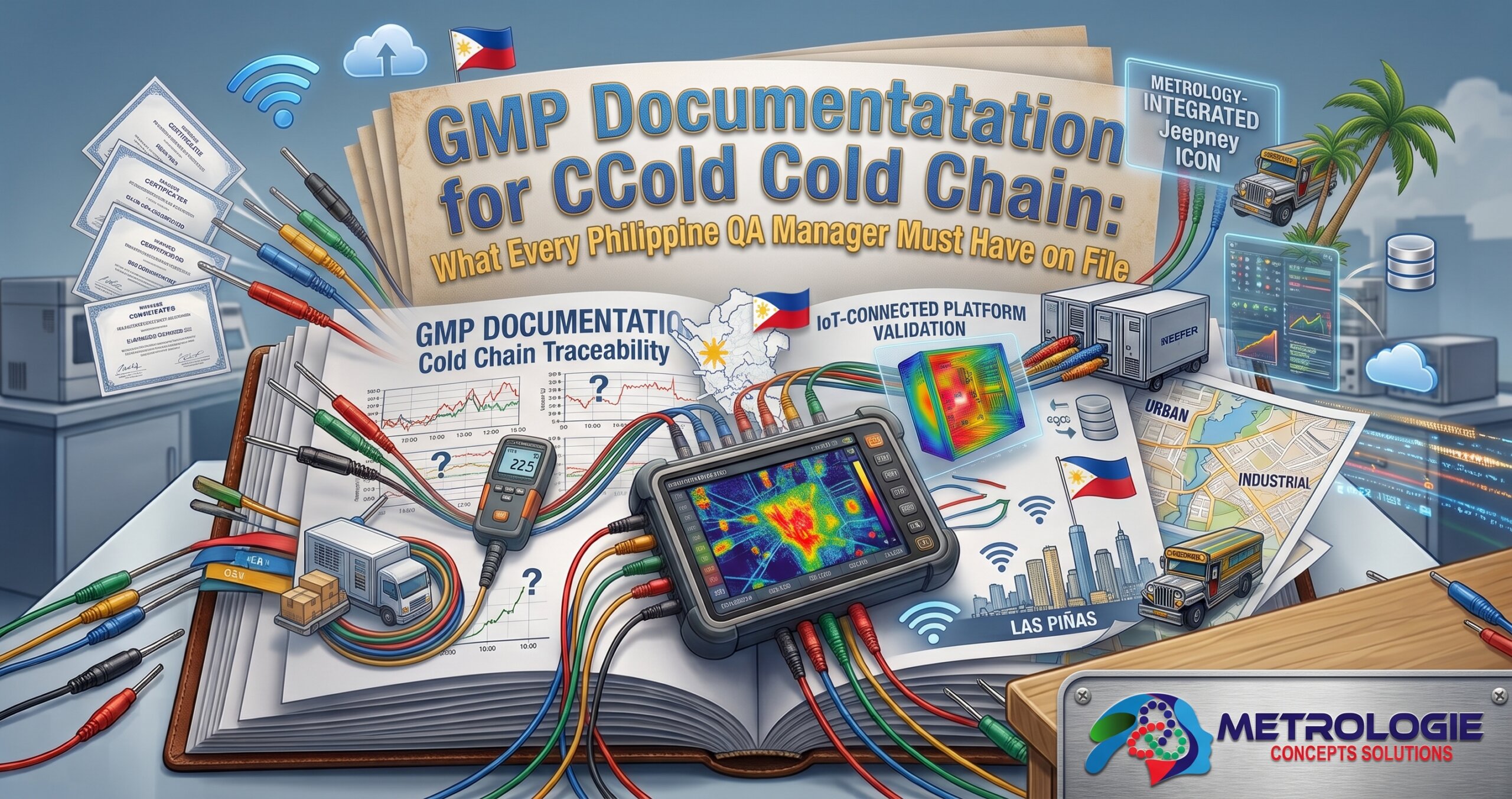
This article provides the definitive guide to cold chain compliance documentation for Philippine pharmaceutical, food, and healthcare organisations. It identifies every document category that FDA inspectors, WHO auditors, and multinational principal quality auditors will ask for during a cold chain compliance review, explains what each document must contain, specifies how long each must be retained, and provides a practical folder structure for organising the complete cold chain documentation file.
It also identifies the ten most common cold chain documentation gaps found in Philippine pharmaceutical facilities during inspections — so QA managers can close these gaps proactively rather than discovering them under inspection pressure.
| How to Use This ArticleRead it once for comprehensive understanding of the complete documentation framework.Then use the document inventory checklists in Section 3 to audit your current documentation file against the complete requirement.Use the gap analysis framework in Section 7 to prioritise remediation of any missing or inadequate documents.Share the folder structure guide with your document control team to organise the documentation for rapid retrieval during inspections. |
1. The Regulatory Frameworks That Define Documentation Requirements
Cold chain documentation requirements in the Philippines are defined by overlapping regulatory frameworks — each adding specific requirements that together constitute the complete documentation obligation for Philippine cold chain operators.
FDA Circular 2021-003
FDA Circular 2021-003 is the primary Philippine regulatory instrument governing pharmaceutical cold chain management. It requires that pharmaceutical establishments: maintain records demonstrating that products were stored and transported under required temperature conditions; document their cold chain management system; maintain calibration records for monitoring equipment; and be able to produce these records for FDA inspection on demand.
The circular does not specify a comprehensive list of required documents — it specifies the outcomes that must be documented. The document list in this article is derived from the outcomes the circular requires, interpreted through the WHO Good Distribution Practice guidelines the circular references.
WHO Technical Report Series No. 1010 Annex 7
WHO TRS 1010 Annex 7 (2021) provides the most detailed documentation requirements for pharmaceutical cold chain management. It specifies: qualification documentation for storage facilities (IQ/OQ/PQ); temperature monitoring records; calibration records for monitoring equipment; standard operating procedures for cold chain management; deviation and CAPA records; and personnel training records. These WHO requirements, incorporated by reference through FDA Circular 2021-003, constitute the substantive documentation standard for Philippine pharmaceutical cold chain operators.
GMP and PIC/S Guidelines
For pharmaceutical manufacturers and their licensed distributors, Good Manufacturing Practice guidelines — including the PIC/S GMP guidelines — add document control requirements to the cold chain documentation obligation: documents must be version-controlled, approved by authorised personnel, reviewed periodically, and managed under a formal document control system. Each document must have a unique identifier, version number, effective date, and approval signature from an authorised quality person.
HACCP (Food Sector)
For food businesses operating temperature-controlled cold chain, HACCP documentation requirements specify: the HACCP plan with identified CCPs and critical limits; monitoring records for each CCP; corrective action records when critical limits are exceeded; verification records (including thermal mapping as the CCP verification method); and HACCP training records for staff.
ISO/IEC 17025 (Calibration Laboratories)
For calibration laboratories — including those that conduct in-house calibration as part of their cold chain management — ISO/IEC 17025 documentation requirements include: calibration procedures, reference standard calibration records, measurement uncertainty evaluations, calibration certificates, and quality management system records.
2. The Architecture of a Complete Cold Chain Documentation File
A complete cold chain compliance documentation file is not a single binder — it is a structured set of document categories, each covering a specific aspect of the cold chain management programme. Understanding the architecture before building the file ensures that no category is missing and that documents are organised for rapid retrieval.
The complete file consists of seven primary document categories:
| Category | What It Covers | Typical Document Volume | Primary Regulatory Reference |
| 1. Policy and Governance | Cold chain management policy; regulatory compliance commitments; organisational responsibilities | 1 to 3 documents | WHO TRS 1010; GMP; FDA Circular 2021-003 |
| 2. Facility Qualification | IQ/OQ/PQ documentation for each cold room and controlled storage area; URS; DQ | 3 to 10 documents per cold room | WHO TRS 961 Supplement 8; PIC/S Annex 15; GMP |
| 3. Calibration Records | Calibration certificates for all monitoring sensors, data loggers, and reference standards | 5 to 50+ certificates depending on instrument count | WHO TRS 961; ISO/IEC 17025; FDA Circular 2021-003 |
| 4. Standard Operating Procedures | SOPs covering all cold chain operations: receiving, storage, dispatch, monitoring, excursion response, etc. | 5 to 15 SOPs depending on operational complexity | WHO GDP; GMP; FDA Circular 2021-003 |
| 5. Temperature Monitoring Records | Continuous temperature records for all cold rooms; alarm logs; excursion reports | Ongoing — retained for minimum 5 years | WHO TRS 1010 Annex 7; GMP; FDA Circular 2021-003 |
| 6. Deviation and CAPA Records | Temperature excursion reports; CAPA records; corrective action effectiveness verification | Per-event records; retain for minimum 5 years | WHO GDP; GMP; PIC/S Annex 15 |
| 7. Training Records | Personnel training records for all staff involved in cold chain operations | Per-person records; retain for employment period plus 2 years | WHO TRS 1010; GMP; ISO/IEC 17025 |
3. The Complete Document Inventory: Category by Category
The following document inventories provide the complete list of documents required in each category of the cold chain compliance file. Use these as review checklists: every item marked with □ should be present in your documentation file. Items that are missing or inadequate are documentation gaps requiring remediation.
| 📁 CATEGORY 1: Cold Chain Policy and Governance |
| □ Cold Chain Management Policy — signed by senior management; references applicable regulatory frameworks (FDA Circular 2021-003, WHO TRS 1010, GMP); defines the organisation’s commitment to cold chain compliance |
| □ Cold Chain Organisational Chart — identifies the roles responsible for cold chain management, monitoring, calibration, and deviation response; names the authorised quality person responsible for cold chain compliance |
| □ Regulatory Framework Reference Document — identifies all applicable regulatory frameworks (Philippine FDA, WHO, GMP, HACCP, DOH, DA/BFAR as applicable); maintained current as regulations are updated |
| 📁 CATEGORY 2: Facility Qualification (Per Cold Room / Controlled Storage Area) |
| □ User Requirements Specification (URS) — defines what the cold room is required to achieve; references applicable regulatory frameworks; signed and dated by QA manager |
| □ Design Qualification (DQ) Report — confirms that the approved design will meet the URS requirements; references key design specifications (refrigeration capacity, insulation R-value, monitoring system design) |
| □ Installation Qualification (IQ) Report — documents that equipment was installed according to approved specifications; includes commissioning records, utility verification, equipment receipt documentation; signed by QA approver with date AFTER installation completion |
| □ IQ Equipment List — complete list of all equipment installed in the cold room with model numbers, serial numbers, and specifications |
| □ Operational Qualification (OQ) Thermal Mapping Report — the OQ thermal mapping study report (see Article 26 for required content); includes PAB-accredited calibration certificates for all data loggers; pre-approved protocol with protocol effective date BEFORE study start date |
| □ OQ Thermal Mapping Protocol — the pre-approved protocol for the OQ thermal mapping study; version-controlled; approval signatures dated before study commencement |
| □ Performance Qualification (PQ) Thermal Mapping Report — PQ mapping study under operational loading conditions; same documentation requirements as OQ |
| □ Seasonal Remapping Reports — summer season mapping report (April-May); wet season mapping report (June-October); stored in chronological order with most recent accessible first |
| □ Re-qualification Reports — all periodic requalification and post-modification requalification reports; stored chronologically |
| □ Monitoring Sensor Placement Memo — document specifying the current monitoring sensor position at the hot spot identified by thermal mapping; signed by QA manager; updated after each thermal mapping study if sensor is repositioned |
| 📁 CATEGORY 3: Calibration Records |
| □ Master Calibration Schedule — complete list of all instruments requiring calibration (monitoring sensors, data loggers, reference thermometers); calibration interval for each; last calibration date; next due date; current calibration status |
| □ Monitoring Sensor Calibration Certificates (current cycle) — PAB-accredited calibration certificates for all currently installed monitoring sensors; filed by sensor ID; accessible for immediate production during inspection |
| □ Monitoring Sensor Calibration Certificates (historical) — all previous calibration certificates for each monitoring sensor for the full operational life of the sensor; filed chronologically per sensor |
| □ Data Logger Calibration Certificates (thermal mapping studies) — pre-study PAB-accredited calibration certificates for all data loggers used in thermal mapping studies; filed with their corresponding mapping study report |
| □ Post-Study Data Logger Calibration Certificates — post-study calibration certificates confirming loggers maintained accuracy throughout each mapping study; filed with corresponding study report |
| □ Reference Standard Calibration Certificates — calibration certificates for all reference thermometers and reference standards used in in-house calibration activities; filed chronologically |
| □ Out-of-Tolerance (OOT) Records — formal records of any OOT calibration finding; the investigation, corrective action, and impact assessment for each OOT event; filed with the calibration certificate that identified the OOT finding |
| □ Calibration Laboratory Accreditation Verification — printed copy of PAB accreditation certificate or verified PAB directory printout for each external calibration laboratory used; updated annually to confirm continuing accreditation |
| 📁 CATEGORY 4: Standard Operating Procedures |
| □ Cold Chain Management Master SOP — overview SOP describing the entire cold chain management system, roles, responsibilities, and cross-references to all sub-SOPs |
| □ Temperature-Sensitive Product Receiving SOP — procedures for receiving temperature-sensitive products; temperature verification at receipt; acceptance/rejection criteria; documentation requirements |
| □ Cold Room Storage SOP — procedures for storing temperature-sensitive products; product placement rules (no-storage zones from thermal mapping); stock rotation; product inspection |
| □ Temperature Monitoring SOP — procedures for operating the monitoring system; alarm threshold settings; alarm response; data download and review procedures |
| □ Temperature Alarm Response SOP — step-by-step procedure for responding to temperature alarms; escalation contacts and timeframes; immediate containment actions; documentation requirements |
| □ Temperature Excursion Investigation SOP — procedures for investigating confirmed temperature excursions; product impact assessment methodology; manufacturer contact procedure; product quarantine and disposition |
| □ Product Dispatch SOP — cold chain maintenance during order picking, packaging, and handover to transport; temperature verification at dispatch; documentation |
| □ Cold Room Cleaning and Maintenance SOP — cleaning schedules; maintenance procedures; temperature management during cleaning activities |
| □ Calibration Management SOP — schedule management; calibration certificate review; OOT response procedure; in-house calibration procedure (if applicable) |
| □ Staff Training SOP — training programme for all cold chain-related roles; training records management; retraining triggers |
| □ Cold Chain Emergency Response SOP — procedures for refrigeration failure, extended power interruption, and other emergency scenarios; emergency contacts; backup cold storage arrangements |
| □ Document Control SOP — version control procedures; document approval and distribution; obsolete document management; document retention and archiving |
| 📁 CATEGORY 5: Temperature Monitoring Records |
| □ Continuous Temperature Records — complete electronic temperature logs for all monitoring sensors in all cold rooms; stored in tamper-evident format; retained for minimum 5 years; accessible for inspection |
| □ Alarm Event Log — log of all temperature alarms generated by the monitoring system; date, time, sensor, alarm type, peak temperature, duration; acknowledgement record; outcome (false alarm, excursion, sensor fault) |
| □ Manual Temperature Check Records (if applicable) — records of any scheduled manual temperature checks supplementing continuous monitoring; date, time, reading, checker’s identity |
| □ Monitoring System Configuration Records — current alarm threshold settings for each sensor; history of any threshold changes with date, reason, and authorisation; recording interval settings |
| □ Monitoring System Downtime Records — records of any monitoring system outages (sensor failures, communication failures, power supply failures); duration of each outage; impact assessment; corrective action |
| □ Ambient Temperature Records (for seasonal context) — records of outdoor ambient temperatures during the period covered by the monitoring records; PAGASA data or facility ambient monitoring data; particularly important for summer season and typhoon season periods |
| 📁 CATEGORY 6: Deviation and CAPA Records |
| □ Temperature Excursion Reports — formal reports for each temperature excursion event (see Article 28 for required content); filed chronologically; each report includes: excursion data, products affected, immediate response actions, root cause, product disposition, CAPA reference |
| □ CAPA Records — formal Corrective and Preventive Action records for each significant deviation; includes root cause analysis, corrective actions implemented, preventive actions planned, effectiveness check criteria, and effectiveness verification evidence |
| □ Product Quarantine and Disposition Records — records of products quarantined pending excursion impact assessment; final disposition decision (released, destroyed) with authorising signature and rationale; lot traceability from excursion event to disposition |
| □ Manufacturer Consultation Records — records of contacts with pharmaceutical manufacturers regarding product impact assessment; date and method of contact, manufacturer representative, guidance received, and manufacturer’s conclusion |
| □ Post-CAPA Remapping Studies — thermal mapping studies conducted after CAPA implementation to verify that corrective actions improved cold room performance; filed with corresponding CAPA record |
| □ Deviation Trend Analysis Reports — periodic (at minimum annual) analysis of deviation frequency, root causes, and CAPA effectiveness; filed with the period’s quality review documentation |
| 📁 CATEGORY 7: Personnel Training Records |
| □ Training Programme Curriculum — documentation of all training topics, training materials, and training schedule for cold chain-related roles |
| □ Individual Training Records — per-person records showing: training topics completed, training dates, trainer identity, assessment results (where applicable), next scheduled training or retraining dates |
| □ Training Effectiveness Assessments — evidence that training was effective: post-training assessment results, observed competence verification records, or documented practical demonstration |
| □ Contractor and Visitor Cold Chain Awareness Records — records of cold chain awareness briefings provided to contractors, temporary workers, and visitors who access cold chain areas |
| □ Metrology Training Certificates — training certificates for calibration-related training (ISO/IEC 17025 awareness, measurement uncertainty, temperature calibration courses) for relevant personnel |
4. The Ten Most Common Cold Chain Documentation Gaps in Philippine Facilities
Based on cold chain documentation review experience across Philippine pharmaceutical distributors, hospital pharmacies, and cold chain operators, the following ten gaps appear most consistently. QA managers should assess their own documentation against each of these gaps before any inspection or audit.
| Gap # | Documentation Gap | Frequency | Impact at Inspection | Remediation |
| 1 | No thermal mapping report for current cold rooms — or reports are more than 3 years old without periodic requalification | Very common | Major finding — no documented proof that cold rooms can maintain required temperatures | Commission OQ thermal mapping study immediately; add periodic requalification to the qualification schedule |
| 2 | Monitoring sensor calibration certificates are expired, missing, or from non-PAB-accredited laboratories | Very common | Major finding — monitoring data cannot be verified as accurate | Annual recalibration programme with PAB-accredited laboratory; review all certificates currently on file |
| 3 | Thermal mapping reports exist but were conducted in December or January only — no summer season study | Common | Significant finding — seasonal mapping requirement not met; qualification not demonstrated for worst-case Philippine conditions | Commission summer (April-May) thermal mapping study; acknowledge seasonal study obligation in qualification plan |
| 4 | Protocol approval signatures are dated after the study start date — protocol was approved retrospectively | Common | Critical finding — study was conducted without a pre-approved protocol; entire qualification is challenged | This cannot be retrospectively corrected — the study must be repeated with a properly pre-approved protocol |
| 5 | No power failure holdover test in thermal mapping reports | Common | Significant finding — cold room’s emergency temperature performance is undemonstrated | Repeat mapping study to include power failure holdover test; or commission a standalone holdover test if full remapping is not yet feasible |
| 6 | No temperature excursion reports — or excursions noted in monitoring records have no corresponding investigation or CAPA | Common | Major finding — excursions are being monitored but not managed; systematic problem not being addressed | Retrospectively document recent excursions; implement excursion reporting SOP; build CAPA programme |
| 7 | Standard Operating Procedures exist but have not been reviewed or updated in more than 2 years | Common | Moderate finding — SOPs may not reflect current practices or regulatory requirements | Annual SOP review programme; update SOPs to current WHO TRS 1010 and FDA Circular 2021-003 requirements |
| 8 | Personnel training records are incomplete — staff responsible for cold chain operations have no documented training | Common | Significant finding — unqualified personnel managing cold chain | Implement training records programme; document retroactive training; implement new-hire and annual retraining schedule |
| 9 | No document control system — documents lack version numbers, approval signatures, or effective dates | Moderate | Moderate finding — inability to demonstrate that controlled documents were in use at specific times | Implement document control SOP; add version numbers, approval signatures, and effective dates to all key documents |
| 10 | Cold chain documentation is not organised for rapid inspection retrieval — documents scattered across multiple systems and locations | Moderate | Logistical problem that creates inspection pressure and may cause key documents to be overlooked | Implement the folder structure described in Section 5; conduct a documentation audit and organise all existing records |
5. Organising the Documentation File: A Practical Folder Structure
The physical or electronic organisation of the cold chain documentation file determines how quickly documents can be retrieved under inspection pressure. A well-organised file enables a QA manager to respond to an inspector’s document request within minutes. A disorganised file — with documents scattered across multiple binders, shared drives, and email folders — creates the impression of inadequate document control regardless of the actual quality of the documents.
The following folder structure reflects the seven-category architecture from Section 2 and is designed for rapid retrieval during inspections. This structure works equally for a physical filing system and for an electronic document management system.
| Recommended Cold Chain Documentation Folder Structure📁 COLD CHAIN COMPLIANCE FILE ├── 01_Policy_and_Governance/ │ ├── Cold_Chain_Management_Policy.pdf │ ├── Organisational_Chart_Cold_Chain_Roles.pdf │ └── Regulatory_Framework_Reference.pdf ├── 02_Facility_Qualification/ │ ├── Cold_Room_A/ │ │ ├── URS_Cold_Room_A.pdf │ │ ├── DQ_Report_Cold_Room_A.pdf │ │ ├── IQ_Report_Cold_Room_A.pdf │ │ ├── OQ_Thermal_Mapping_Protocol_v1.0.pdf │ │ ├── OQ_Thermal_Mapping_Report_[Year].pdf │ │ ├── PQ_Thermal_Mapping_Report_[Year].pdf │ │ ├── Seasonal_Mapping_Summer_[Year].pdf │ │ ├── Seasonal_Mapping_WetSeason_[Year].pdf │ │ └── Sensor_Placement_Memo.pdf │ └── Cold_Room_B/ [same structure] ├── 03_Calibration_Records/ │ ├── Master_Calibration_Schedule.xlsx │ ├── Monitoring_Sensors/ │ │ ├── Sensor_001_[Serial]/ │ │ │ ├── Calib_Certificate_2024.pdf │ │ │ ├── Calib_Certificate_2025.pdf │ │ │ └── OOT_Record_[Date].pdf (if applicable) │ │ └── Sensor_002_[Serial]/ [same structure] │ ├── Data_Loggers_Mapping_Studies/ │ │ └── [Study_Date]_Logger_Calib_Certificates/ │ └── Reference_Standards/ ├── 04_SOPs/ │ ├── SOP-CC-001_Cold_Chain_Management_Master_v2.0.pdf │ ├── SOP-CC-002_Receiving_Temperature_Sensitive_Products_v1.1.pdf │ ├── SOP-CC-003_Cold_Room_Storage_v1.0.pdf │ ├── SOP-CC-004_Temperature_Monitoring_v1.2.pdf │ ├── SOP-CC-005_Alarm_Response_v1.0.pdf │ ├── SOP-CC-006_Excursion_Investigation_v1.1.pdf │ └── [Additional SOPs] ├── 05_Monitoring_Records/ │ ├── Temperature_Logs_[Year]/ │ │ ├── Cold_Room_A_Sensor_001_[Month].csv │ │ └── [Additional sensor files] │ └── Alarm_Event_Log_[Year].xlsx ├── 06_Deviations_and_CAPA/ │ ├── Excursion_Reports/ │ │ ├── EXC-2025-001_[Brief_Description].pdf │ │ └── [Additional excursion reports] │ └── CAPA_Records/ │ └── CAPA-2025-001_[Brief_Description].pdf └── 07_Training_Records/ ├── Training_Programme_Curriculum.pdf └── Individual_Records/ ├── [Staff_Name_1]_Training_Record.pdf └── [Staff_Name_2]_Training_Record.pdf |
6. Document Retention: How Long to Keep Each Category
Document retention requirements for cold chain compliance records in the Philippines vary by document type and regulatory framework. The following retention guide reflects WHO GDP guidelines, Philippine FDA requirements, and GMP standards as applicable.
| Document Category | Minimum Retention Period | Best Practice Recommendation | Regulatory Basis |
| Cold Chain Policy and Governance | Life of organisation, current version plus 2 superseded versions | Retain indefinitely — organisational history | GMP document control |
| Facility Qualification (IQ/OQ/PQ) and Thermal Mapping Reports | Life of the qualified facility plus minimum 5 years | Retain for life of facility plus 10 years for key qualification studies | PIC/S Annex 15; WHO GDP; GMP |
| Calibration Certificates — monitoring sensors | Life of the sensor plus minimum 5 years | Retain for the full operational life of the monitoring system plus 5 years | WHO TRS 961; ISO/IEC 17025; GMP |
| Calibration Certificates — data loggers (mapping studies) | Retain with the corresponding mapping report for the life of the qualified facility plus 5 years | Same as mapping reports | WHO TRS 961 Supplement 8; GMP |
| Standard Operating Procedures | Current version plus 2 superseded versions; superseded versions retained for minimum 5 years | Retain indefinitely — SOPs establish what procedures were in use at specific times | GMP; WHO GDP |
| Temperature Monitoring Records (continuous logs) | Minimum 5 years from date of record | 5 to 10 years depending on product criticality; blood bank records: longer per AABB requirements | WHO TRS 1010 Annex 7; GMP; FDA Circular 2021-003 |
| Temperature Excursion Reports and CAPA Records | Minimum 5 years from CAPA closure | Retain for life of the relevant product batches plus 5 years | WHO GDP; GMP; PIC/S Annex 15 |
| Personnel Training Records | Employment period plus minimum 2 years | Retain for employment period plus 5 years | WHO TRS 1010; GMP; ISO/IEC 17025 |
7. The FDA Inspection Scenario: What the Inspector Will Ask For
Understanding what a Philippine FDA inspector will request during a cold chain compliance inspection — and in what sequence — enables QA managers to organise their documentation for the most efficient possible inspection response.
Based on the FDA Circular 2021-003 framework and WHO GDP guidelines, a Philippine FDA cold chain inspection typically proceeds in this sequence:
Phase 1: Policy and System Overview
The inspector will first request an overview of the cold chain management system — the policy, the organisational structure, and the scope of cold chain operations. The first documents requested are typically: the Cold Chain Management Policy and the regulatory framework reference document. The inspector uses this to understand the scope of what they will inspect and to verify that the organisation has formally committed to the applicable regulatory frameworks.
Phase 2: Facility Qualification Documentation
The qualification documentation for each cold room or controlled storage area is typically the core of the inspection. The inspector will ask for:
- The IQ, OQ, and PQ reports for each cold room — verifying that qualification was conducted before the cold room was placed into service
- The thermal mapping reports — examining the protocol approval dates against the study start dates, the calibration certificates, the sensor placement justification, the hot spot identification, and the power failure test results
- Seasonal remapping reports — confirming that both hot season and wet season qualification studies have been conducted
- The monitoring sensor placement memo — confirming the sensor is positioned at the thermal mapping hot spot
Phase 3: Calibration Records
The inspector will typically then ask for calibration certificates for the current monitoring sensors — verifying that they are from PAB-accredited laboratories, are current (not expired), and have the required content (measurement uncertainty, multi-point coverage, traceability statement).
Phase 4: Monitoring Records
The inspector will review a sample of temperature monitoring records — typically requesting records covering a specific period including any high-risk ambient periods (summer months) and any alarm events visible in the records.
Phase 5: Deviation and CAPA Records
The inspector will review whether temperature excursions visible in the monitoring records have corresponding excursion reports and CAPA records. A mismatch between alarm events in the monitoring log and the deviation file is an immediate red flag.
Phase 6: Training Records
The inspector may request training records for specific staff members — particularly those directly responsible for cold chain monitoring and alarm response.
| The Documents Most Likely to Have Problems at InspectionBased on common inspection outcomes in the Philippines, the five document categories most likely to have problems during an FDA cold chain compliance review are:1. Thermal mapping reports (protocol post-dating; missing power failure test; no summer study)2. Calibration certificates (expired; from non-accredited labs; no measurement uncertainty)3. Deviation records (alarm events in monitoring logs with no corresponding excursion reports)4. SOP currency (SOPs not updated since before FDA Circular 2021-003 was issued in 2021)5. Training records (staff performing cold chain functions with no documented training)Prioritise these five categories in any pre-inspection documentation audit. |
8. Building a Documentation Programme from Scratch
For Philippine QA managers whose cold chain documentation is incomplete or absent — starting from a state of minimal documentation and building toward full compliance — the following prioritised sequence provides a practical implementation roadmap.
Month 1: Inventory and Gap Assessment
- Conduct a documentation audit using the checklists in Section 3 — identify every document that is missing, expired, or inadequate
- Prioritise gaps by inspection risk (use the ten common gaps in Section 4 as a reference)
- Identify the most critical gaps: missing thermal mapping reports, expired calibration certificates, absent power failure test data
- Commission urgent remediation activities: schedule thermal mapping studies, arrange calibration of all monitoring sensors
Months 2 to 3: Critical Documentation
- Commission and complete OQ thermal mapping studies for all cold rooms not previously mapped or with outdated mapping reports
- Calibrate all monitoring sensors with PAB-accredited laboratory — obtain current calibration certificates for every sensor
- Develop or update the six most critical SOPs: cold chain management master, temperature monitoring, alarm response, excursion investigation, product receiving, and calibration management
- Establish the temperature excursion report system — begin documenting all future temperature excursions with the required report format
Months 3 to 6: Complete Documentation Infrastructure
- Develop remaining SOPs and supporting documents
- Implement the training programme — deliver cold chain training to all relevant staff and document training records
- Organise existing documentation in the folder structure from Section 5
- Commission seasonal remapping studies as the appropriate season arrives
- Implement the annual calibration schedule and tracking system
Ongoing: Maintenance and Continuous Improvement
- Annual SOP review and update cycle
- Annual calibration renewal for all monitoring sensors
- Summer season thermal remapping study (April-May)
- Annual cold chain training for all relevant staff
- Annual documentation audit against the full checklist in this article
| Start with the Thermal Mapping StudyIf your cold chain documentation programme is starting from zero, the single most important first step is commissioning a thermal mapping study for each cold room. This study produces the qualification documentation that is the backbone of the entire compliance file, establishes the monitoring sensor position at the hot spot, and provides the power failure holdover data that drives emergency response procedures.Contact Metrologie Solutions Philippines to schedule your thermal mapping studies — we can advise on study prioritisation, conduct the studies under Philippine summer conditions, and provide PAB-accredited calibration for all data loggers. |
9. Frequently Asked Questions: Cold Chain Documentation in the Philippines
How long do we have to produce documentation when an FDA inspector requests it?
The Philippine FDA does not specify a legally mandated response time for producing documentation during an inspection. However, the practical expectation — based on GMP principles and inspection practice — is that documentation should be produced promptly, typically within 15 to 30 minutes for commonly requested documents. Inability to produce documents promptly raises concerns about document control quality. This is why the organised folder structure in Section 5 is important: organised documentation enables rapid retrieval, while disorganised documentation creates the impression of inadequate document management regardless of the actual content of the documents.
Our thermal mapping reports are from a service provider. Who is responsible for the documentation?
The pharmaceutical establishment — the company, hospital, or distributor holding the FDA Licence to Operate — is responsible for the cold chain compliance documentation, regardless of whether the thermal mapping studies were conducted by an external service provider. The service provider produces the mapping report, but the establishment must: review and approve the report (ensuring it meets the requirements described in Article 26), file it in the establishment’s document management system, maintain it for the required retention period, and produce it for regulatory inspection. Outsourcing the thermal mapping study does not transfer the regulatory responsibility for the documentation.
We are a 3PL cold chain operator — we store other companies’ pharmaceutical products. What documentation do we need?
As a 3PL pharmaceutical cold chain operator, you need the full documentation set described in this article for your own cold chain operations — facility qualification, calibration records, monitoring records, SOPs, and training records. You also need to be able to share relevant sections of this documentation with your pharmaceutical principal clients, who may conduct their own qualification audits of your facility as part of their supplier qualification programme. Additionally, you may need to provide temperature records specific to individual client lots as part of the product release documentation chain. Agree the documentation sharing requirements with each pharmaceutical principal client at the start of the storage relationship.
Is a digital copy of calibration certificates acceptable for FDA inspection, or do we need originals?
Regulated companies may maintain calibration certificates and other compliance documents in electronic format — scanned copies or electronically issued certificates — provided the electronic format is controlled, tamper-evident, and accessible. The key requirements are that the electronic copy is identical to the original, that it can be displayed clearly during inspection, and that the document management system provides adequate protection against alteration. Many Philippine pharmaceutical facilities maintain both electronic copies (for rapid inspection access via laptop or tablet) and physical originals (filed in the cold chain compliance binder). For documents issued electronically by the calibration laboratory (PDF with digital signature), the electronic version is the original document.
How do we handle cold chain documentation for products received from suppliers — do we need the supplier’s cold chain documentation?
For temperature-sensitive pharmaceutical products received from suppliers, your documentation should include: the transport condition verification record at receipt (confirming the product arrived within required temperature conditions — temperature log from the transport, cold chain integrity documentation from the supplier), and the chain of custody from the supplier’s storage through transport to your receipt. The depth of supplier cold chain documentation you require depends on your organisation’s supplier qualification programme and the requirements of any pharmaceutical principals whose products you handle. At minimum, temperature records for the transport leg from supplier to your facility should be available for any product lot that is stored in your cold chain facility.
Conclusion: Documentation Is the Proof of Your Cold Chain
In pharmaceutical cold chain management, what is not documented did not happen — at least not in the eyes of a regulatory inspector or a product liability court. The cold room that was properly qualified three years ago, the monitoring sensor that was calibrated last March, the temperature excursion that was correctly managed in April — none of these events exist in a compliance sense unless they are documented, organised, and retrievable.
The documentation framework in this article represents the complete picture of what Philippine pharmaceutical cold chain operators need to have on file — not as a bureaucratic exercise, but as the evidence base for all the operational decisions that cold chain management involves. Every product disposition decision after an excursion, every monitoring sensor position, every alarm threshold setting — all of these decisions should be traceable to documented evidence in the cold chain compliance file.
Building this file is not a one-time project — it is an ongoing programme of maintenance, renewal, and continuous improvement. Annual calibration renewals, seasonal mapping studies, SOP reviews, training records updates, and deviation documentation all require systematic management. But the investment in this documentation programme is the investment that makes the cold chain protection system complete — not just operationally effective but legally and regulatorily defensible.
Metrologie Solutions Philippines is ready to help Philippine cold chain operators build and maintain this documentation — through thermal mapping studies, PAB-accredited calibration, SOP development support, training programmes, and documentation gap assessments for organisations preparing for FDA inspections or principal quality audits.
| Assess Your Cold Chain Documentation File TodayUse the document inventory checklists in Section 3 of this article to audit your current cold chain documentation against the complete requirement. For every gap identified, contact Metrologie Solutions Philippines — we can help you close it with the right documentation, the right studies, and the right training.Website: metrologiesolutions.com | Services: Thermal Mapping · Calibration · Documentation Review · Cold Chain Training |
| About Metrologie Solutions PhilippinesMetrologie Solutions Philippines helps Philippine pharmaceutical, food, and healthcare organisations build and maintain complete cold chain compliance documentation files — through thermal mapping studies, PAB-accredited calibration, SOP development support, and training. Our documentation meets the standards reviewed by FDA Philippines inspectors, WHO auditors, and multinational principal quality teams. We also provide documentation gap assessments for organisations preparing for their first FDA inspection or principal audit.Website: metrologiesolutions.com | Services: Thermal Mapping · Calibration · Documentation Review · Training |