
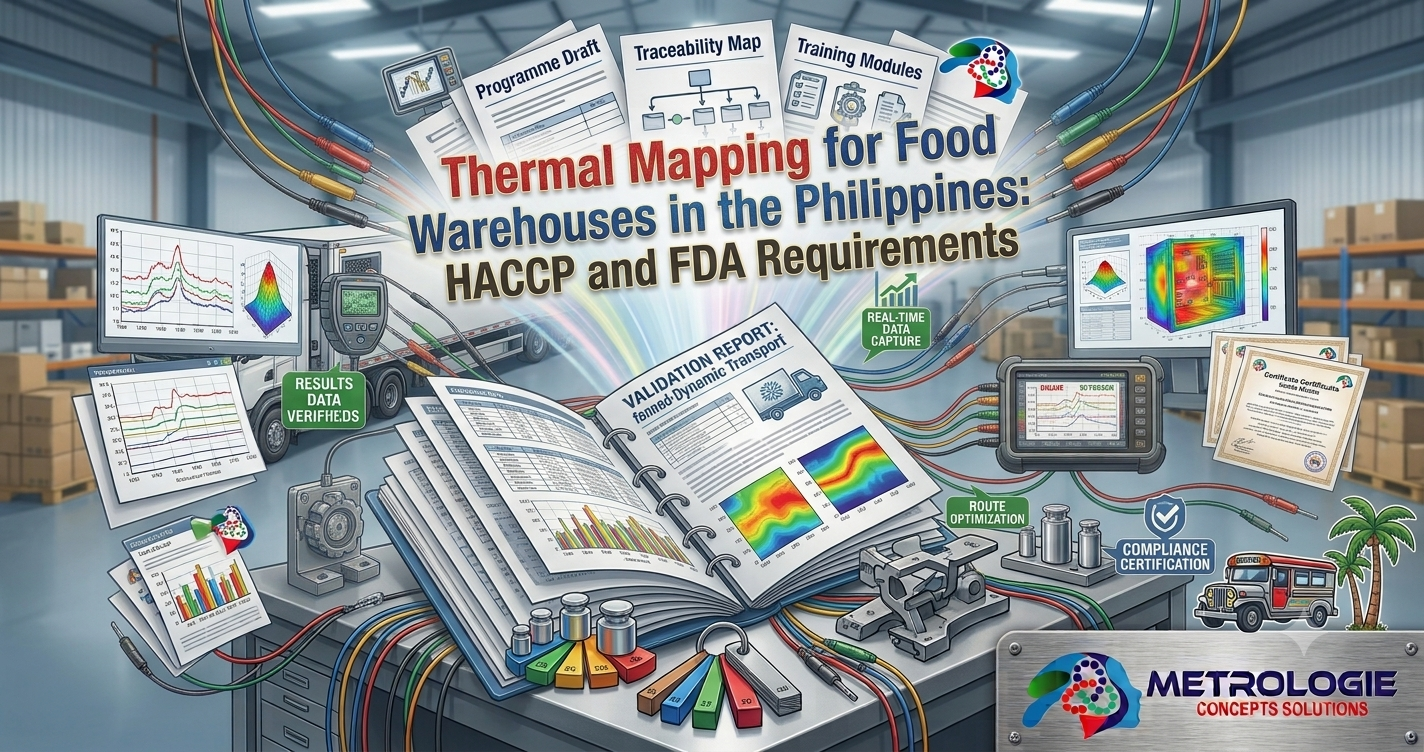
The Philippines is one of Southeast Asia’s most significant food production and export economies — a major producer of seafood, processed meats, tropical fruits, coconut products, and packaged food that reaches markets across Asia, the Middle East, and beyond. The cold chain that supports this industry — from processing plant to distribution centre to export container — is subject to a regulatory and commercial compliance framework that demands documented temperature control validation at every critical point.
At the heart of this framework is the HACCP system: Hazard Analysis and Critical Control Points, the internationally recognised methodology for food safety management that identifies where in a food production or distribution process temperature control is critical, establishes what the critical limits are, and requires documented evidence that those limits are consistently met.
For food businesses operating cold storage warehouses, walk-in chillers, blast freezers, cold rooms for ingredient or finished product storage, and temperature-controlled distribution facilities, HACCP compliance at temperature-related critical control points requires more than a thermometer on the wall and a daily log sheet. It requires proof — documented, scientific, calibrated proof — that the storage environment actually maintains the temperature conditions that protect food safety throughout its entire volume, under real operating conditions, in all seasons.
That proof comes from thermal mapping.
This article is the most comprehensive guide available for Philippine food businesses on food warehouse thermal mapping — covering the HACCP framework and why it requires thermal mapping, the Philippine FDA food licensing temperature requirements, the specific storage temperature needs of the major Philippine food categories, how thermal mapping is conducted for food storage environments, the seasonal mapping obligation that is uniquely critical in the Philippines, and the complete regulatory and commercial compliance picture for food businesses pursuing or maintaining FDA food licenses, HACCP certification, and export market access.
| What This Article CoversThe HACCP framework and why temperature-related CCPs require thermal mapping as the validation methodPhilippine FDA food licensing temperature control requirements and how thermal mapping meets themStorage temperature requirements for the major Philippine food categories — meat, seafood, dairy, poultry, produceHow thermal mapping is conducted for food cold rooms and ambient food warehousesWhy seasonal mapping is especially critical for Philippine food businessesThe export market compliance dimension — how thermal mapping documentation supports international food safety certificationCommon food warehouse mapping failures in the Philippines and how to avoid them |
1. HACCP and Temperature Control: Why Thermal Mapping Is the Required Validation Method
The Hazard Analysis and Critical Control Points (HACCP) system is the foundational food safety management framework adopted by the Philippine FDA, the Codex Alimentarius Commission, and food safety regulatory bodies worldwide. Understanding how HACCP works — and specifically how it requires temperature control to be validated — establishes why thermal mapping is not merely useful for food businesses but is a necessary component of a complete HACCP implementation.
The HACCP Principle: Critical Control Points
HACCP identifies the specific points in a food production or distribution process where control is essential to prevent, eliminate, or reduce food safety hazards to acceptable levels. These are called Critical Control Points (CCPs). For food businesses with temperature-sensitive products, cold storage is almost always identified as a CCP — the point where temperature control prevents bacterial growth and maintains food safety.
The HACCP system requires that for each CCP:
- A critical limit is established — the maximum or minimum temperature that must be maintained to ensure food safety at that CCP. For refrigerated food storage, this is typically an upper temperature limit (for example, 4°C for chilled meat and poultry, 0°C for fresh fish) below which pathogen growth is controlled.
- A monitoring system is established — a method for continuously or periodically verifying that the critical limit is being maintained at the CCP.
- Corrective actions are defined — the procedures to be followed when monitoring indicates that the CCP is out of control (the critical limit has been exceeded).
- Verification activities are conducted — procedures to confirm that the HACCP system is working effectively. For temperature CCPs, verification includes confirming that the temperature monitoring system is accurately measuring the temperature at the most critical location in the storage area.
- Records are maintained — complete documentation of all monitoring data, corrective actions, and verification activities.
Why Thermal Mapping Is the HACCP Verification Method for Cold Storage CCPs
The HACCP verification requirement for cold storage CCPs creates a direct logical need for thermal mapping, for a reason that is precisely analogous to the pharmaceutical cold chain context: a temperature monitor at a single fixed location in a cold room tells you the temperature at that location. It does not tell you the temperature throughout the room — and specifically, it does not tell you whether the monitoring sensor is positioned at the location where food safety risk is highest.
Consider the typical food cold room scenario: a chilled meat cold room with a single thermostat and monitoring sensor located in the centre of the room at eye level. The thermostat reads 2°C — comfortably within the 0°C to 4°C acceptable range for chilled meat. But the hot spot near the loading dock door, where door openings admit warm air at each delivery, may reach 7°C or higher during a busy receiving day in Philippine summer. Meat staged in that zone during receiving is being held at temperatures that support pathogen growth, while the monitoring sensor in the centre of the room records compliance.
This is exactly the scenario that HACCP verification through thermal mapping is designed to prevent. Thermal mapping characterises the full temperature distribution of the cold storage CCP — identifying where the worst-case temperatures occur, how severe they are, and how long they persist. This information enables:
- Informed placement of the monitoring sensor at the worst-case location (the hot spot), ensuring that the monitoring system provides genuine worst-case protection rather than comfortable mid-space readings
- Identification of no-storage zones — areas within the cold room where temperatures exceed critical limits and where food products must not be stored
- Evidence-based corrective action — when a temperature excursion occurs at the monitoring sensor, the thermal mapping data provides context for understanding how the excursion affected the broader storage environment and which product lots may have been affected
A HACCP plan that lists temperature monitoring at the cold storage CCP but has never conducted thermal mapping of that cold room is a HACCP plan built on an unverified assumption — that the monitoring sensor is positioned where temperature risk is highest, and that temperatures throughout the room are acceptable. That assumption may be wrong, and the consequences of a wrong assumption in food safety are product recalls, consumer illness, and regulatory sanctions.
2. The Philippine Regulatory Framework: FDA, DA, and International Certification
Philippine food businesses operating temperature-controlled storage face a layered regulatory framework — domestic requirements from the FDA Philippines and sector-specific agencies, plus international food safety certification requirements for export markets. Understanding each layer and how thermal mapping evidence satisfies them is essential for food quality managers planning their compliance documentation.
FDA Philippines: Food Licensing and CPR Requirements
The Food and Drug Administration of the Philippines licenses food manufacturers, processors, importers, and distributors through its Food Business Registration and Licensing system. Food businesses handling temperature-sensitive products must demonstrate that their storage and processing facilities maintain the required temperature conditions for the products they handle.
FDA food license applications and renewals for businesses handling temperature-sensitive foods require documentation of temperature control capabilities. FDA inspectors evaluating food facility compliance assess whether cold storage facilities maintain required temperatures through a combination of facility inspection and documentation review. While the Philippine FDA’s food licensing requirements do not yet prescribe thermal mapping in the same explicit detail as FDA Circular 2021-003 does for pharmaceutical products, the requirement to demonstrate that storage environments maintain required food safety temperatures creates an equivalent validation need.
For food businesses seeking FDA Food Business Registration or Certificate of Product Registration for temperature-sensitive food products, thermal mapping documentation for cold storage facilities provides the strongest possible evidence of temperature control capability — evidence that goes beyond thermostat specifications to actual calibrated measurement of the storage environment.
Department of Agriculture: DA Administrative Order No. 23 (2013)
The Department of Agriculture’s Administrative Order No. 23, Series of 2013 mandates accreditation of cold storage warehouses for agricultural and fishery products. The order was developed in coordination with the Cold Chain Association of the Philippines and applies to commercial cold storage facilities handling agricultural commodities. Accreditation under DA AO 23 requires that cold storage facilities meet standards for temperature control, hygiene, and sanitation — with compliance demonstrated through inspection and documentation. Thermal mapping evidence of cold room temperature performance is directly relevant to the temperature control demonstration required for DA cold storage accreditation.
BFAR: Bureau of Fisheries and Aquatic Resources
BFAR has specific procedures for certifying cold storage warehouse facilities used for fish and fishery/aquatic products, based on compliance with hygiene and sanitation requirements in support of the HACCP system. For seafood processors and exporters operating cold storage facilities, BFAR certification requires demonstrated compliance with the HACCP framework — including the temperature control verification requirement that thermal mapping addresses.
International Export Market Requirements
For Philippine food businesses exporting to the European Union, Japan, the United States, or other international markets, the food safety certification requirements of those markets apply — in addition to domestic Philippine requirements. The EU’s food hygiene regulations (EC Regulation 852/2004 and 853/2004) require that operators in the food chain implement and maintain HACCP-based procedures with documented verification of critical control point management. GFSI-benchmarked certification schemes — including SQF Edition 9, BRCGS Food Safety Issue 9, and FSSC 22000 — require documented temperature control programmes with defined critical limits, calibration schedules, and verifiable records.
For Philippine food exporters seeking or maintaining these international food safety certifications, thermal mapping of cold storage CCPs is not merely best practice — it is increasingly the specific evidence that certification body auditors request when verifying temperature CCP control. A BRCGS or SQF auditor reviewing a Philippine food company’s temperature CCP verification programme who finds temperature monitoring records but no thermal mapping of the cold rooms behind those monitoring sensors will raise a major non-conformance.
3. Temperature Requirements for Philippine Food Categories
The specific temperature requirements that thermal mapping acceptance criteria must be set against vary by food category. Understanding the temperature requirements for the major Philippine food categories helps QA managers set appropriate acceptance criteria for thermal mapping studies and identify the most critical cold storage CCPs in their operations.
| Food Category | Required Storage Temperature | Thermal Mapping Critical Risk | Philippine Production Context |
| Fresh fish and seafood (chilled) | 0°C to 4°C (ideally near 0°C) | Upper limit exceedance in hot spot zones — accelerates spoilage and bacterial growth; Philippine summer creates severe ambient load on chilled seafood cold rooms | Major export category — tuna, grouper, lapu-lapu; BFAR certification requires HACCP compliance |
| Frozen fish and seafood | -18°C or colder | Temperature rise above -18°C during defrost cycles; hot spots near frozen storage doors during product retrieval | Philippines is Southeast Asia’s largest tuna exporter — frozen tuna destined for Japan and EU markets must meet strict cold chain documentation |
| Fresh poultry (chilled) | 0°C to 4°C | Upper limit exceedance during high-throughput receiving operations; door zone temperature spikes during busy production days | Major domestic consumption category; NMIS accreditation for poultry processors requires cold storage compliance |
| Processed meats (refrigerated) | 0°C to 7°C (varies by product) | Hot spot near walk-in cooler door; ambient temperature infiltration during loading dock operations in Philippine summer | Significant Philippine food processing sector — longganisa, tocino, tapa, ham, bacon |
| Fresh dairy products | +1°C to +4°C | Very tight temperature window; freeze risk at lower limit; bacterial growth risk above 4°C | UHT dominant domestically; fresh dairy cold storage important for premium and imported products |
| Eggs (refrigerated) | +4°C to +7°C | Condensation risk if temperature cycles too wide; upper limit exceedance risks Salmonella growth | Major Philippine food safety concern — Salmonella contamination linked to temperature abuse |
| Fruits and vegetables (chilled) | Varies by commodity (typically 8–15°C for tropical produce) | Chilling injury risk from cold spots below tolerance for tropical produce; condensation from humidity in wet season | Philippine tropical produce (banana, mango, pineapple) has specific chilling injury thresholds |
| Frozen processed foods | -18°C or colder | Partial thaw during extended power outages (Philippine typhoon risk); temperature rise at door zone during high pick frequency | Growing frozen food processing sector — ready meals, frozen vegetables, ice cream |
| Ambient temperature food (controlled) | Below 30°C (ideally 20–25°C) | Exceeding 30°C upper limit during Philippine summer — most challenging food storage category in tropical climate | Dry goods, canned food, packaged snacks, confectionery — all require controlled ambient storage |
4. How Thermal Mapping Is Conducted for Philippine Food Warehouses
Thermal mapping for food cold rooms and food warehouses follows the same core methodology as pharmaceutical mapping — calibrated sensors, pre-approved protocol, formal report — with adaptations for the specific characteristics of food storage environments and the HACCP CCP verification context.
Pre-Study: Understanding the HACCP Context
Before designing a thermal mapping protocol for a food warehouse, the quality team must understand the HACCP context:
- Which storage areas are CCPs in the HACCP plan? Thermal mapping studies must prioritise CCPs — the storage areas where temperature control is most critical for food safety and where a temperature excursion could have direct food safety consequences
- What are the critical limits for each CCP? The acceptance criteria for the thermal mapping study must align with the HACCP critical limits — the temperature range within which the storage area must remain for food safety to be maintained
- What monitoring system is currently in place? The thermal mapping study will determine whether the existing monitoring sensor is positioned at the worst-case location — if not, repositioning is required after the mapping study
Protocol Development for Food Storage Mapping
The thermal mapping protocol for a food cold room or food warehouse must specify:
- The HACCP CCP reference — the specific critical control point being validated, and the critical limit it must demonstrate compliance with
- Acceptance criteria aligned with food safety critical limits — for example, for a chilled seafood cold room with a HACCP critical limit of 4°C, the thermal mapping acceptance criterion is that all sensors must remain at or below 4°C throughout the study period
- The loading condition — food cold rooms must be mapped in a loaded condition representative of normal operational stock levels, as food thermal mass significantly affects temperature distribution. An empty cold room mapping study does not represent HACCP CCP performance during normal food storage operations
- Door-opening protocol representing the operational pattern — food cold rooms in active production or distribution environments may be opened far more frequently than pharmaceutical cold rooms; the door-opening simulation must match the operational frequency of the most demanding production day
- Seasonal study requirements — summer (March to May) mapping must be prioritised for food storage CCPs to capture worst-case ambient conditions
Sensor Placement for Food Storage Environments
Sensor placement in food cold rooms follows the same risk-based principles as pharmaceutical mapping, with additional attention to food-specific risk zones:
- All eight geometric corners of the cold room volume — standard thermal mapping coverage
- Adjacent to all door openings — the highest-risk zone for temperature exceedances during receiving, shipping, and product access operations
- Near the evaporator or cooling unit — the coldest zone, where chilling injury risk to temperature-sensitive produce is highest and where freeze risk to non-frozen product must be assessed
- In the primary product storage zones — sensors positioned at the height and location where the most temperature-sensitive products are typically stored
- At the loading dock staging area — if product is staged near the dock entrance before being moved into the main cold room, this staging zone must be mapped separately to capture the temperature conditions during that pre-cold-room stage
- In the top-rack zones for high-ceiling cold rooms — ceiling-level temperatures in food cold rooms with poor air distribution may exceed critical limits while the thermostat sensor at mid-height reads compliance
The Power Failure Test for Food Cold Storage
Power failure holdover testing is particularly important for food cold storage in the Philippines for the same reasons it is critical for pharmaceutical cold storage: the combination of tropical ambient temperatures, power supply vulnerability (especially during typhoon season), and the severe food safety consequences of temperature exceedances makes the holdover time a critical operational specification.
For a chilled seafood cold room with a 4°C critical limit, the power failure test measures the time from refrigeration failure to the moment any sensor reaches 4°C. This time directly defines: the generator activation requirement (the generator must restore refrigeration before the holdover time expires), the maximum acceptable response window in the power failure emergency SOP, and the trigger point for initiating emergency product protection procedures (moving product to an alternative cold room or adding dry ice).
Philippine typhoon season (June to October) creates extended power interruption risk at a time when ambient temperatures are still high (28°C to 32°C). The power failure holdover test conducted under typhoon-season ambient conditions — with 30°C ambient and high humidity — provides the most relevant specification for planning food safety protection during tropical storm power outages.
5. Seasonal Mapping: The Most Important Philippine-Specific Food Safety Requirement
For food warehouses in the Philippines, seasonal thermal mapping — conducting studies in both the hot dry season and the wet season — is not an optional quality enhancement. It is a fundamental requirement for demonstrating that the cold storage CCP performs within the HACCP critical limit under all ambient conditions the facility will face throughout the year.
Why Single-Season Studies Are Insufficient for HACCP CCP Verification
A HACCP plan requires that the critical control point is under control — maintained within the critical limit — not just during the season when the study was conducted. A thermal mapping study conducted in December or January (cool dry season, average 25°C ambient) that shows all sensors remaining below the food safety critical limit does not verify CCP performance during April and May (peak summer, 35°C to 38°C ambient), when the ambient thermal load is dramatically higher and the refrigeration system is under maximum stress.
The combination of higher ambient temperatures, increased solar gain through warehouse roofs and walls, and the refrigeration system’s reduced capacity margin during peak summer creates conditions where a cold room that passed its December mapping study may experience systematic temperatures above the HACCP critical limit during April and May — every afternoon, every day, for three months. Without a summer mapping study, this food safety failure goes undetected and undocumented.
The Hot Dry Season Study: The Non-Negotiable Food Safety Test
For Philippine food businesses with cold storage CCPs, the summer (March to May) thermal mapping study is the most critical compliance test of the year. This study answers the question that every FDA inspector, BRCGS auditor, and SQF certification body auditor wants answered: does your cold storage CCP maintain the HACCP critical limit even when your HVAC and refrigeration systems are under their maximum annual thermal load?
Common findings from summer thermal mapping studies of Philippine food cold rooms that passed their cool-season studies:
- Door-adjacent zones reaching the food safety critical limit (4°C for chilled storage) during busy morning receiving operations when ambient is already 33°C at 9 AM
- Ceiling-level hot spots in walk-in coolers with poor air distribution reaching 7°C to 9°C in the afternoon — above the critical limit by 3 to 5 degrees — while the thermostat at mid-height reads 3°C
- Blast freezer ante-chambers where product is staged during peak summer transitioning from ambient to freezer temperatures showing sustained exposure to 10°C to 15°C during busy production days
- Ambient food warehouses for packaged food products showing ceiling-level temperatures of 35°C to 40°C in the afternoon — far above the 30°C maximum for ambient-temperature food storage
The Wet Season Study: Humidity, Mould, and Typhoon Power Risk
The wet season study (June to October) captures the food safety risks specific to Philippine monsoon conditions:
- High humidity affecting the performance of cold room insulation and increasing the frequency of defrost cycles in freezer rooms — defrost cycles create temperature spikes that may transiently exceed the food safety critical limit
- Condensation on cold room surfaces and evaporator coils that affects temperature distribution and creates mould and microbial contamination risk if not properly managed
- Typhoon-related power interruptions that test cold storage holdover performance under wet season conditions — the combination of 30°C wet season ambient and extended power loss during typhoon passage creates the most demanding power failure scenario in the Philippine food cold chain
- Humidity effects on ambient food warehouse temperature — high wet season humidity increases the effective heat load on ambient food storage areas and affects the stability of moisture-sensitive products
| The HACCP Verification Gap That Philippine Food Businesses Most Commonly MissMany Philippine food businesses with HACCP plans have temperature monitoring records for their cold storage CCPs — but have never conducted thermal mapping to verify that the monitoring sensor is positioned at the worst-case location, or to confirm that the critical limit is met throughout the entire storage volume.A HACCP plan with temperature monitoring records but no thermal mapping of cold storage CCPs has monitoring data from potentially the most comfortable location in the room, potentially not the location where food safety risk is highest. This gap is increasingly identified by FDA inspectors and international certification auditors as a critical HACCP verification deficiency.Thermal mapping is the missing verification step that transforms temperature monitoring records from comfort data into genuine food safety evidence. |
6. Food-Specific Thermal Mapping Considerations by Sector
Seafood Processing and Export Cold Storage
The Philippine seafood export sector — particularly tuna, lapu-lapu, and other high-value fish species — operates under some of the strictest international food safety requirements in the Philippine food industry. EU import requirements for Philippine seafood products require demonstrated compliance with EU hygiene regulations, including the temperature management requirements of Regulation (EC) 852/2004. Japanese seafood import requirements similarly demand documented cold chain temperature control from point of catch through to export.
For seafood processors and exporters, thermal mapping of blast freezers, cold stores, and chilled holding rooms is a core component of the EU and Japan export compliance documentation package. EU Competent Authority assessments of Philippine seafood export establishments — conducted by BFAR in coordination with European inspectors — will review cold storage temperature control documentation, including mapping evidence.
The most critical thermal mapping findings in seafood cold storage are typically: inadequate performance of blast freezers (failing to achieve -18°C throughout the product load during the freezing cycle), hot spots in chilled seafood holding rooms that approach or exceed the 4°C critical limit during busy receiving periods, and inadequate holdover time in chilled seafood storage during power interruptions.
Meat Processing and Cold Storage
Philippine meat processing facilities — handling pork, chicken, and beef for domestic and export markets — operate under National Meat Inspection Service (NMIS) accreditation requirements that include cold storage compliance assessment. NMIS inspections of meat processing facilities include cold storage temperature verification. Thermal mapping of chilling rooms, blast cooling tunnels, cold storage rooms, and frozen meat storage is the documented verification that NMIS accreditation and HACCP compliance require.
The food safety critical limits for chilled meat are particularly demanding in the Philippine context: 0°C to 4°C for fresh chilled meat, with bacterial growth (particularly Salmonella, Listeria, and E. coli) accelerating rapidly above 4°C. A chilled meat cold room in a Philippine summer that cannot reliably maintain temperatures below 4°C throughout its volume — including at the loading dock door zone and the upper rack levels near the ceiling — is a food safety risk that thermal mapping identifies and corrects.
Dairy and Refrigerated Processed Food Storage
Refrigerated processed food — including ready-to-eat meals, refrigerated condiments, fresh dairy products, and refrigerated bakery items — requires the same cold chain temperature validation as meat and seafood, with the additional complexity that many of these products are sold through retail channels where the consumer expects a defined shelf life. Temperature excursions in cold storage that shorten shelf life represent both food safety risk and significant commercial losses.
For refrigerated processed food manufacturers and distributors, thermal mapping of cold storage CCPs supports both the HACCP verification requirement and the commercial quality assurance objective of consistently meeting the shelf life claims printed on product labels.
Ambient Temperature Food Warehouses for Packaged Food
The ambient temperature food warehouse — storing packaged food, canned goods, dry ingredients, confectionery, and shelf-stable processed food — is often overlooked in thermal mapping planning because it does not involve refrigeration. This is a mistake with real food safety and commercial quality consequences.
Ambient food storage in the Philippines faces the same challenge as pharmaceutical CRT storage: maintaining temperatures below 30°C (and ideally 20°C to 25°C) in a climate where summer ambient temperatures reach 35°C to 38°C. A packaged food warehouse in the Philippines that has never been thermally mapped may be regularly exposing stored products to temperatures well above 30°C — accelerating degradation, shortening shelf life, and creating food safety issues for products with moisture-sensitive specifications.
Thermal mapping of ambient food warehouses is particularly important for: roof-level storage zones that experience solar-driven temperatures of 40°C or higher under uninsulated metal roofs; loading dock areas that repeatedly admit hot air during receiving; and HVAC dead zones in deep racking structures where poor air circulation allows heat to accumulate.
7. Building a HACCP-Compliant Thermal Mapping Programme for Philippine Food Businesses
For Philippine food quality managers, the challenge is integrating thermal mapping into the broader HACCP quality system — not treating it as a standalone exercise but as the verification activity that validates the food safety management system’s most temperature-critical elements.
Step 1: Map Your CCPs to Your Cold Storage Areas
Begin with your HACCP plan and identify every CCP that involves temperature-controlled storage. For each CCP, document: the critical limit (maximum or minimum storage temperature), the monitoring method currently in place, and the verification activities currently conducted. This CCP inventory drives the thermal mapping study prioritisation — CCPs with the most severe food safety consequences of temperature exceedance should be mapped first.
Step 2: Design the Mapping Studies for HACCP Evidence
For each cold storage CCP, design a thermal mapping study that:
- Uses HACCP critical limits as the acceptance criteria — not regulatory limits from a different context (e.g., pharmaceutical storage requirements), but the specific critical limits in your HACCP plan
- Is conducted under the most demanding operational conditions — peak summer ambient for worst-case temperature performance; full production load for worst-case thermal mass effect; peak door-opening frequency for worst-case hot air infiltration
- Explicitly verifies the monitoring sensor position — if the existing monitoring sensor is not at the identified hot spot after the mapping study, it must be relocated
- Documents seasonal coverage — at minimum a summer study and a wet season study to demonstrate year-round CCP control
Step 3: Integrate Mapping Results into the HACCP Plan
After each mapping study, update the HACCP documentation:
- Record the thermal mapping report reference in the HACCP plan as the verification record for the temperature CCP
- Update the monitoring sensor specification to reference the hot spot position identified by mapping
- Update operational procedures to reflect any no-storage zones or product placement restrictions identified by the mapping study
- Update the corrective action procedure to reflect the power failure holdover time established by the mapping study’s power failure test
Step 4: Maintain the Mapping Programme Annually
HACCP requires that CCP verification activities be conducted at planned intervals. For temperature CCPs in Philippine food businesses, this means:
- Summer thermal mapping study (April to May) annually for all food cold storage CCPs — the mandatory worst-case ambient conditions test
- Wet season study (June to October) annually or at least every two years
- Immediate remapping after any modification to the cold room structure, refrigeration system, or HVAC
- Annual recalibration of all temperature monitoring sensors at cold storage CCPs by a PAB-accredited laboratory
| Metrologie Solutions Philippines: Your HACCP Thermal Mapping PartnerWe help Philippine food businesses design and conduct thermal mapping studies that specifically address HACCP CCP verification requirements — with acceptance criteria aligned to food safety critical limits, seasonal study coverage, power failure testing, and documentation formatted for FDA, DA/BFAR, NMIS, and international certification body review.Our studies are conducted under actual Philippine tropical ambient conditions — prioritising summer mapping for worst-case CCP validation — using PAB-accredited calibrated instruments.Contact us at metrologiesolutions.com to discuss thermal mapping for your food cold storage CCPs. |
8. Frequently Asked Questions: Food Warehouse Thermal Mapping in the Philippines
Is thermal mapping required for HACCP certification in the Philippines?
HACCP requires documented verification of CCP control — and for temperature CCPs in cold storage, thermal mapping is the most rigorous and defensible verification method available. The HACCP standard itself does not prescribe thermal mapping by name, but it requires that the monitoring system for each CCP be validated as measuring the parameter at the most critical location, and that the CCP be verified as consistently within its critical limit. Thermal mapping provides both of these demonstrations. International HACCP-based certification schemes (BRCGS, SQF, FSSC 22000) increasingly require thermal mapping documentation as part of their temperature CCP verification evidence, even when the HACCP standard itself does not specify it.
What is the acceptance criterion for food cold storage thermal mapping?
The acceptance criterion for a food cold storage thermal mapping study must be the HACCP critical limit for that storage CCP — the temperature above which food safety is considered to be at risk. For chilled fish storage: 4°C maximum (or lower if the HACCP plan specifies a more conservative limit). For frozen food storage: -18°C maximum (all sensors must remain at -18°C or colder throughout the study period). For ambient packaged food storage: a maximum temperature aligned with the product specifications and food safety assessment for the specific products stored. Do not use pharmaceutical storage acceptance criteria (e.g., +2°C to +8°C) for food storage applications unless your food products specifically require pharmaceutical-grade cold chain storage conditions.
We already have temperature monitoring records for our cold storage CCP. Why do we still need thermal mapping?
Temperature monitoring records from a single fixed sensor tell you whether the temperature at that one location has remained within limits. They do not tell you whether the sensor is positioned at the hottest location in the room (if it is not, you may be missing temperature exceedances in other zones), whether the critical limit is maintained throughout the full volume of the storage area (you only know about the sensor position), or whether the sensor reading represents the worst-case temperature in the room (it likely does not, if the sensor was positioned without thermal mapping guidance). Thermal mapping provides the spatial context that transforms a monitoring sensor reading from a single-point measurement into evidence that the full CCP storage area is under control.
How does food warehouse thermal mapping differ from pharmaceutical cold room mapping?
The methodology is essentially the same — calibrated sensors, pre-approved protocol, data analysis, formal report. The key differences are: the acceptance criteria are set by HACCP food safety critical limits (not pharmaceutical storage specifications); the loading condition during the study must reflect food production or distribution operational patterns (which may involve very high door-opening frequency during busy receiving days); the regulatory documentation context is different (HACCP plan verification rather than GMP/GDP qualification documentation); and the international certification implications may differ (food export certification requirements vs. pharmaceutical LTO requirements). The Philippine climate challenges — summer ambient thermal load, typhoon season power risk — are identical and require the same seasonal mapping approach.
What happens if our food cold room fails its summer thermal mapping study?
A failing summer thermal mapping result — where any sensor records temperatures above the HACCP critical limit during the study — requires immediate corrective action before the CCP can be considered verified. The HACCP corrective action framework applies: investigate the root cause (HVAC capacity, insulation deficiency, door management failure, refrigeration system inadequacy), implement corrections, and conduct a follow-up mapping study to verify that the corrective actions resolved the problem. During the investigation and correction period, enhanced monitoring of the cold room, restriction of product placement to zones demonstrated to be within the critical limit, and potentially temporary suspension of operations in the most affected zones may be necessary to maintain food safety.
Conclusion: Thermal Mapping Is the Missing Link in Philippine Food HACCP Compliance
The Philippine food industry produces and distributes some of the most temperature-sensitive products in global commerce — fresh seafood, chilled meats, frozen foods, refrigerated processed products — in one of the world’s most thermally demanding environments. The HACCP system that governs food safety management for these products is only as strong as the verification evidence that supports it.
Thermal mapping is the critical verification evidence that most Philippine food businesses are missing from their cold storage CCP documentation. Temperature monitoring without thermal mapping is like conducting a HACCP study without identifying the actual worst-case hazard locations — the monitoring data may look compliant while the actual food safety risk zones go uncharacterised and uncontrolled.
For Philippine food manufacturers, seafood exporters, meat processors, cold chain distributors, and ambient food warehouse operators, building thermal mapping into the HACCP verification programme is the step that transforms compliance documentation from an assumption into a demonstration — from ‘we believe our cold room is safe’ to ‘we have calibrated, seasonal, documented proof that our cold storage CCP maintains the food safety critical limit throughout its full volume, under the most demanding ambient conditions of the Philippine year.’
That is the standard that FDA food licensing inspectors, international export certification auditors, and ultimately food safety itself requires. And it is the standard that Metrologie Solutions Philippines is ready to help your business achieve.
| Ready to Validate Your Food Cold Storage CCPs?Contact Metrologie Solutions Philippines to design a thermal mapping programme for your food warehouse cold storage CCPs — with HACCP critical limit acceptance criteria, summer season priority, power failure testing, and documentation that satisfies Philippine FDA, DA/BFAR, NMIS, and international food safety certification requirements.Website: metrologiesolutions.com | Services: Food Warehouse Thermal Mapping · HACCP CCP Validation · Calibration · Training |
| About Metrologie Solutions PhilippinesMetrologie Solutions Philippines is the country’s leading provider of thermal mapping services for food warehouses, cold storage facilities, and food manufacturing environments. We help food manufacturers, processors, distributors, and exporters across the Philippines achieve and demonstrate HACCP CCP temperature control compliance and FDA food licensing thermal validation requirements — with PAB-accredited calibrated instruments and documentation that satisfies Philippine FDA, BFAD, DA/BFAR, and international food safety auditors.Website: metrologiesolutions.com | Services: Food Warehouse Thermal Mapping · HACCP CCP Validation · Calibration · Training |