The Philippine logistics and cold chain industry is experiencing its most significant growth period in history. With approximately 710,000 pallet positions of cold storage across the archipelago as of 2024, cold storage supply projected to grow by 9% in 2025, and the Philippine e-commerce market surging past USD 28 billion in 2024, the demand for temperature-controlled warehousing is accelerating faster than many operators anticipated.
For the 3PL operators, pharmaceutical distributors, food logistics companies, and e-commerce cold chain providers building and operating these warehouses, one question is becoming increasingly urgent: is your warehouse qualified?
Qualified — in the regulatory sense — means documented. It means you can prove, with calibrated data, a formal report, and an approved protocol on file, that your warehouse actually maintains the temperature range it claims to maintain. It means you have mapped the hot spots and cold spots. It means you know exactly where to position your permanent monitoring sensors. It means your multinational pharmaceutical principals, your food export clients, and your FDA inspector will find a complete, professional qualification package when they ask for it.
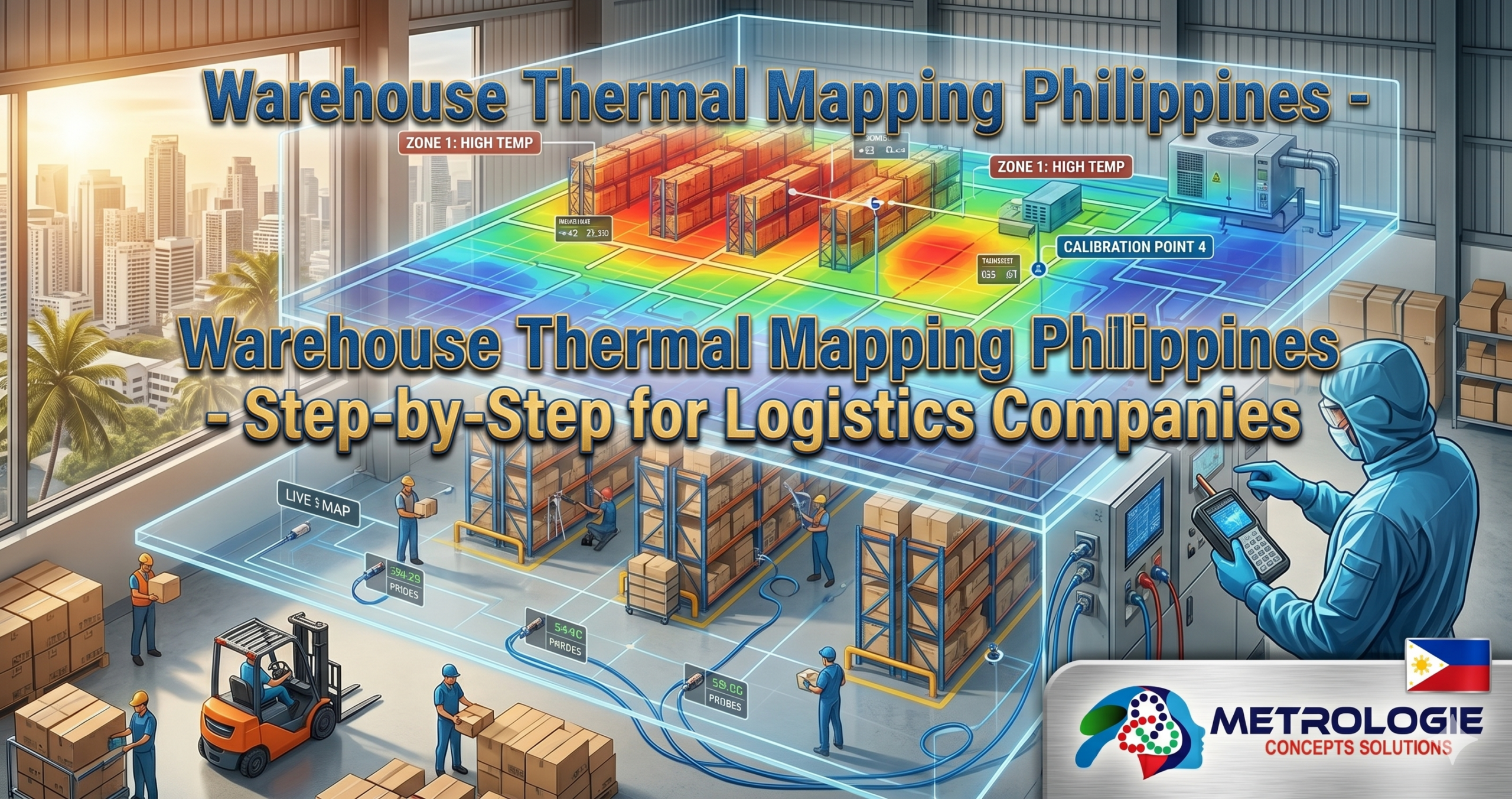
Warehouse thermal mapping is the foundation of that qualification. It is the systematic process by which calibrated temperature sensors are deployed throughout your warehouse volume — at corners, along walls, near loading docks, at multiple heights, and at every identified risk location — to measure and document how temperature actually distributes through your facility under real operating conditions.
This guide is written specifically for Philippine logistics companies, 3PL cold chain operators, pharmaceutical distributors, and food warehouse managers who need a complete, practical, step-by-step understanding of how warehouse thermal mapping works, what it requires, what Philippine and international regulations mandate, and how to implement a mapping programme that will satisfy every regulatory and client requirement your business faces.
| What This Guide CoversWhy warehouse thermal mapping is now a commercial necessity for Philippine 3PL operators — not just a regulatory requirementThe complete regulatory landscape: WHO GDP, FDA Circular 2021-003, HACCP, ISO 9001, and principal qualification requirementsThe six risk zones that every Philippine warehouse mapping study must coverStep-by-step walkthrough of the entire warehouse mapping process from protocol to reportSensor placement strategy for large pharmaceutical and food logistics warehousesThe OQ and PQ distinction — and why you need bothHow seasonal mapping applies to Philippine logistics warehousesThe documentation package that satisfies FDA inspectors AND multinational principal auditorsHow to choose the right warehouse mapping service provider in the Philippines |
1. Why Warehouse Thermal Mapping Has Become a Business Imperative for Philippine Logistics
Five years ago, thermal mapping was primarily discussed in the context of pharmaceutical manufacturers and cold room operators. Today, it is a requirement that reaches into every tier of the Philippine logistics and distribution industry. Here is why warehouse thermal mapping has moved from a niche regulatory concern to a mainstream business requirement for Philippine 3PL and logistics operators.
The Pharmaceutical Principal Requirement
Multinational pharmaceutical companies distributing products in the Philippines through local 3PL partners are tightening their distributor qualification requirements. Companies whose products must be maintained within specific temperature ranges — whether 15°C to 25°C for CRT products, 2°C to 8°C for refrigerated biologics, or -20°C for frozen vaccines — now routinely require their Philippine distribution partners to provide thermal mapping qualification documentation as a condition of partnership.
For a 3PL operator handling the distribution of products from international pharmaceutical principals, the absence of thermal mapping documentation is a direct threat to client retention. A pharmaceutical company conducting an annual distributor audit that finds no mapping qualification for the warehouse storing its products will flag this as a critical finding — potentially triggering suspension of the distribution agreement until the deficiency is corrected.
The FDA Circular 2021-003 Requirement
FDA Circular No. 2021-003 — the Philippine FDA’s revised guidelines on cold chain management — applies to all establishments handling temperature-sensitive pharmaceutical products, including 3PL cold chain operators who store pharmaceutical products as contracted partners. The circular requires that storage areas be qualified before use through documented studies demonstrating temperature uniformity and identifying hot spots and cold spots. For any 3PL warehouse holding pharmaceutical products, this means thermal mapping is a regulatory requirement — not an optional quality enhancement.
The HACCP Compliance Requirement
For food logistics companies and cold chain operators handling HACCP-regulated food products, temperature control at cold storage Critical Control Points must be validated. The HACCP plan requires documented evidence that storage environments maintain the required temperature conditions — which, at the warehouse level, means a thermal mapping study that validates the cold room or ambient warehouse environment.
The Commercial Differentiator
Beyond regulatory compliance, warehouse thermal mapping has become a powerful commercial differentiator in the Philippine logistics market. 3PL operators who can present complete thermal mapping documentation — seasonal studies, calibrated data, formal reports, permanent sensor positioning based on mapping results — demonstrate a level of quality management that distinguishes them from competitors operating without such documentation. In an increasingly sophisticated market where pharmaceutical, food export, and international retail clients conduct structured supplier qualification assessments, this documentation is a competitive asset.
The Philippine Cold Chain Market Context
The Cold Chain Association of the Philippines (CCAP) reports approximately 710,000 pallet positions of cold storage in the Philippines as of 2024, with capacity concentrated in CALABARZON, the National Capital Region, and Central Luzon. Cold storage supply is growing at 9% per year. This rapid capacity expansion creates an urgent need for professional warehouse qualification programmes — because every new cold room commissioned without thermal mapping is a compliance gap that will eventually be discovered by a client audit or an FDA inspection.
2. The Regulatory Framework: What Philippine and International Standards Require
Warehouse thermal mapping for Philippine logistics companies sits at the intersection of multiple regulatory frameworks. Understanding each framework — and how they interact — enables logistics operators to build a qualification programme that satisfies all applicable requirements simultaneously.
WHO Good Distribution Practice: TRS 961 Annex 9 and Supplement 8
The World Health Organization’s Good Distribution Practice guidelines — published in WHO Technical Report Series No. 961, Annex 9, and its supplements — are the global benchmark for pharmaceutical warehouse qualification. WHO TRS 961 Annex 9 requires that all new temperature-controlled storage areas be qualified before becoming operational, and that qualification exercises be repeated after any modification that may affect temperature distribution.
WHO TRS 961 Supplement 8, which provides detailed methodology for temperature mapping of storage areas, specifies the complete technical approach for warehouse mapping studies — including protocol development, sensor placement, study duration, data analysis, and report format. Supplement 8 also explicitly requires seasonal mapping for facilities in climates with significant seasonal variation — which applies to all Philippine warehouses. A Philippines-based pharmaceutical 3PL warehouse that has not been mapped in both the hot dry season and the wet season has not completed the qualification required by WHO Supplement 8.
FDA Philippines: Circular 2021-003
FDA Circular No. 2021-003 requires that all cold chain operators — including 3PL warehouses — qualify their storage areas before use through documented studies. The circular references WHO Good Distribution Practice guidelines, meaning that WHO TRS 961 compliance is embedded in the Philippine FDA requirement. Failure to comply can result in FDA findings during inspections, non-renewal of Licence to Operate, and potential suspension of pharmaceutical distribution operations.
ISPE Good Practice Guide: Controlled Temperature Chambers (2021)
The ISPE Good Practice Guide is the technical industry standard for commissioning, qualification, mapping, and monitoring of temperature-controlled storage. For 3PL operators serving multinational pharmaceutical principals, compliance with ISPE guidelines is often required by the principal’s own quality management system — making ISPE the de facto standard for high-end pharmaceutical logistics qualification in the Philippines.
HACCP Requirements for Food Logistics
Food cold chain operators operating under HACCP frameworks must validate temperature control at all critical control points in their storage and distribution process. For food cold room and ambient temperature warehouse operators, this means conducting and documenting temperature distribution studies of storage environments — in practice, thermal mapping — to demonstrate that critical temperature limits are reliably maintained.
ISO 9001 Quality Management Systems
3PL operators with ISO 9001 certification must validate their monitoring and measurement processes and control their monitoring equipment. Thermal mapping — as the validation of the temperature measurement environment — is a natural component of an ISO 9001-compliant quality management system for any logistics company handling temperature-sensitive products.
| Regulatory Framework | Applies To | Core Warehouse Mapping Requirement |
| WHO TRS 961 Annex 9 + Supplement 8 | 3PLs handling pharmaceuticals; any WHO GDP-compliant operator | Qualify all storage areas before use; seasonal mapping; repeat after changes; full documentation |
| FDA Circular 2021-003 | All 3PLs storing pharmaceutical products in the Philippines | Storage area qualification required for LTO compliance; references WHO standards |
| ISPE GPG CTC (2021) | 3PLs serving multinational pharma principals; high-end pharma logistics | Commission, qualify, map and monitor all controlled temperature storage; full IQ/OQ/PQ lifecycle |
| HACCP | Food cold chain logistics operators; cold storage for HACCP products | Validate temperature control at cold storage Critical Control Points; documented evidence required |
| ISO 9001 | ISO 9001-certified 3PL operators | Validate monitoring and measurement processes; control monitoring equipment |
| Principal qualification requirements | 3PLs serving MNC pharma and food clients with quality audits | Thermal mapping documentation required for distributor qualification; often seasonally |
3. The Six High-Risk Zones in Every Philippine Logistics Warehouse
Before diving into the step-by-step mapping process, it is essential to understand the specific locations within a Philippine logistics warehouse that consistently produce the highest temperature readings — the hot spots — and the zones that require the most careful sensor coverage. These risk zones are determined by the physics of heat transfer in a tropical climate, combined with the operational realities of active logistics warehouses.
Understanding these zones is critical because they drive the sensor placement strategy of any compliant mapping study, and because the hot spots and cold spots identified within them will determine where your permanent monitoring sensors must be placed after the study is complete.
Zone 1: The Loading Dock and Staging Area
The loading dock is consistently the highest-risk temperature zone in any Philippine pharmaceutical or food logistics warehouse. Every time a dock door opens, it introduces a pulse of ambient air at whatever temperature the outdoors currently offers — which in Philippine summer can be 35°C to 38°C. In a CRT warehouse trying to maintain 20°C to 25°C, a single dock door opening during peak afternoon hours can create a temperature spike of 8°C to 12°C in the dock-adjacent zone, with recovery times of 15 to 45 minutes depending on HVAC configuration.
In a high-throughput logistics warehouse with multiple deliveries per hour during peak operating periods, the cumulative effect of dock door openings can prevent the dock zone from ever returning to specification during business hours. Thermal mapping of the loading dock zone — with sensors placed at the dock door level, at mid-height, and at the first and second pallet row positions from the dock — is essential for characterising this risk and establishing operational protocols (restricted door-open times, air curtain requirements, staging time limits) that protect product integrity.
Zone 2: The Roof and Ceiling Zone
In Philippine warehouses, particularly those with metal roof panels or minimal ceiling insulation, the ceiling zone is often the most severely affected by solar heat gain during the hot dry season. Roof temperatures on metal-clad warehouse buildings in the Philippines can exceed 70°C to 80°C during peak afternoon hours in April and May, and the radiant heat from the underside of these roofs can drive ceiling-level air temperatures 6°C to 10°C above the mid-warehouse temperature.
Sensors must be placed at ceiling height throughout the warehouse — particularly in areas not covered by HVAC diffusers — to capture this ceiling-level hot spot. For rack storage warehouses where products are stored at the highest rack levels (which may be 6 to 8 metres from the floor), ceiling-level temperatures are directly relevant to product quality — products on the top rack tier are exposed to these elevated temperatures continuously.
Zone 3: External Wall Zones (South-Facing and West-Facing)
In the Philippine context, walls facing south or west receive the greatest solar radiation exposure during the afternoon hours, when the sun is at its hottest. Products stored against these walls, or in the aisles directly adjacent to them, are exposed to conducted heat from the wall surface — which in an uninsulated or poorly insulated warehouse can be 35°C to 45°C on the interior wall surface during a Philippine summer afternoon.
Sensors must be placed adjacent to south-facing and west-facing external walls at multiple heights to capture this thermal gradient. In some Philippine warehouses, the wall-adjacent zone may need to be designated as a no-storage zone for temperature-sensitive products, with minimum clearance distances established based on the mapping data.
Zone 4: HVAC Dead Zones and Areas with Poor Air Distribution
Large warehouse volumes with complex racking configurations create areas where HVAC airflow is restricted by racking structures, corners, or distance from supply air diffusers. These dead zones can be significantly warmer than well-served areas because cool supply air does not reach them effectively. In a poorly designed or older warehouse HVAC system, dead zones may be 3°C to 7°C warmer than the main warehouse area — a gap that is invisible without mapping.
Identifying HVAC dead zones requires strategic sensor placement in areas that a site assessment identifies as potentially poorly served — deep within rack structures, in corners away from diffusers, and in mezzanine areas or under-stair storage spaces that are served by extension of the main HVAC rather than dedicated conditioning.
Zone 5: The Near-Floor Zone
In warehouses with floor-level pallet storage, the near-floor zone is often the coldest area during cooler periods but can be a trap for hot, stagnant air during wet season conditions when humidity is high and air stratification is pronounced. Sensors at floor level (at pallet base height, approximately 10 to 15 centimetres from the floor) capture the temperature environment experienced by the lowest pallet position — which, in rack storage, may differ significantly from the mid-rack or upper-rack temperature.
Zone 6: The Refrigerated Cold Room Ante-Chamber and Entry Zone
For cold chain warehouses that include refrigerated cold rooms or freezer rooms adjacent to ambient warehouse space, the entry point and ante-chamber of the cold room is a critical transition zone. Products moving from ambient space into the cold room, or products staged near the cold room entry for short-term holding before loading, may be exposed to temperatures that are neither properly ambient nor properly refrigerated. Thermal mapping of this transition zone is essential for establishing maximum staging time limits and ensuring that products do not experience unintended temperature excursions during the transfer process.
4. Step-by-Step: The Complete Warehouse Thermal Mapping Process
The following is the complete step-by-step process for conducting a WHO TRS 961 Supplement 8 and FDA Circular 2021-003 compliant thermal mapping study for a Philippine logistics warehouse. This process applies to both pharmaceutical CRT warehouses and food cold storage facilities, with adaptations as noted for specific warehouse types.
Step 1: Site Survey and Risk Assessment
Before protocol development or sensor procurement, a qualified member of the mapping team conducts a comprehensive site survey of the warehouse. The site survey documents:
- Warehouse dimensions — total floor area, ceiling height, racking configuration and height, number of aisles
- Building construction — roof material and insulation, wall construction and insulation, window and skylight locations
- HVAC system — number, location, and capacity of supply air diffusers and return air grilles; thermostat setpoint and location; HVAC system age and maintenance history
- Loading dock configuration — number of dock doors, dock leveller type, presence or absence of dock seals, air curtains, or rapid-close doors
- External wall orientation — identification of south-facing and west-facing walls with greatest solar exposure
- Potential dead zones — areas where racking, partitions, or distance from HVAC diffusers may restrict airflow
- Existing monitoring equipment — location of any permanent temperature sensors currently installed
- Power supply — backup generator availability and switchover time
- Product storage layout — identification of the areas where the most temperature-sensitive products are typically stored
The site survey produces a risk map of the warehouse — a floor plan annotated with identified high-risk zones that will inform sensor placement strategy. This risk map is the foundation of the mapping protocol.
Step 2: Protocol Development and Approval
The mapping protocol is the governing document of the entire study. It must be prepared and approved before any sensors are deployed. A WHO TRS 961 and FDA-compliant warehouse mapping protocol for a Philippine logistics facility contains:
- Study scope and objectives — the specific warehouse area being mapped, the temperature category being validated (CRT, refrigerated, or frozen), and the regulatory standards the study is designed to meet
- Acceptance criteria — the precise temperature range that the warehouse must demonstrate compliance with throughout the study period
- Equipment list — all data loggers to be used, identified by model and serial number, with reference to their pre-study calibration status
- Sensor placement plan — the number and exact positions of all sensors, referenced to the warehouse floor plan and annotated risk map, with written justification for each sensor position
- Study conditions — whether the study will be conducted empty (OQ phase) or loaded (PQ phase), the HVAC operating settings, the loading dock access frequency to be simulated, and the ambient temperature and humidity recording requirements
- Study duration — the minimum number of hours of continuous data collection, with justification
- Power failure test protocol — how and when the power failure simulation will be conducted
- Data analysis methodology — how the data will be processed and reported
- Approval signatures — the protocol must be signed by a qualified person or QA manager before deployment begins
Step 3: Data Logger Selection and Pre-Study Calibration
All data loggers used in the warehouse mapping study must be calibrated before deployment. This is a mandatory requirement under WHO TRS 961, FDA Circular 2021-003, and GMP standards. The calibration requirements are:
- Calibration by a laboratory accredited by the Philippine Accreditation Bureau (PAB) to ISO/IEC 17025 — the only calibration that provides internationally recognised metrological traceability
- Calibration covering the full temperature range expected during the study — for a CRT warehouse, this typically means 15°C to 35°C; for a refrigerated cold room, 0°C to 12°C
- Accuracy of ±0.5°C or better at each calibration point — per WHO TRS 961 Supplement 8 specification
- A calibration certificate for each data logger that shows the reference standard used, the measured values, any corrections applied, and the measurement uncertainty
The data loggers must also be programmed before deployment with the correct recording interval — typically 5 to 15 minutes for warehouse studies — and sufficient memory and battery life to sustain the full study duration without interruption.
Step 4: Sensor Placement — The Critical Technical Step
Sensor placement is the most technically important decision in the warehouse mapping study. Sensors placed incorrectly miss risk zones and produce a misleading temperature profile. The WHO TRS 961 Supplement 8 and ISPE Good Practice Guide provide guidance on sensor density and placement principles for large warehouses.
For a standard pharmaceutical or food logistics warehouse, the minimum sensor placement requirements are:
- All eight geometric corners of the warehouse volume at product storage height (not ceiling height — the relevant height is where products are stored, typically at pallet level)
- Mid-height and near-ceiling sensors in the central area of the warehouse — capturing temperature stratification from floor to roof
- Sensors adjacent to all loading dock doors — the primary hot spot zone in any active logistics warehouse
- Sensors along south-facing and west-facing external walls at multiple heights
- Sensors in identified HVAC dead zones — areas where the risk assessment suggests limited airflow
- Sensors at the highest rack level in the warehouse — capturing the near-ceiling hot spot zone for rack storage operations
- Sensors at floor level (pallet base height) in multiple locations — capturing potential cold spots in near-floor zones
- Sensors adjacent to any existing permanent monitoring sensors — validating whether they are positioned at representative locations
- Sensors in the loading dock staging area — separate from dock door sensors, positioned at the product storage height in the staging zone
For large warehouses (above 1,000 square metres), WHO guidance recommends proportionally increasing the number of sensors to ensure adequate spatial resolution. As a practical minimum for a 3,000 square metre pharmaceutical distribution warehouse, 20 to 35 sensors are typically required for a compliant mapping study. Smaller but still significant gaps are commonly found when operators attempt to cut costs by deploying only 8 to 10 sensors in large warehouse volumes.
| The Minimum Sensor Number MistakeA common cost-cutting error in Philippine warehouse thermal mapping is deploying too few sensors — often 8 to 12 loggers in a warehouse that requires 25 to 40 for adequate spatial coverage.A mapping study with insufficient sensor density cannot claim to have characterised temperature distribution throughout the warehouse. Regulatory inspectors and principal auditors who see a mapping report for a 2,000 square metre warehouse covered by 8 sensors will immediately question the adequacy of the study.The appropriate number of sensors is determined by the warehouse volume, the racking configuration, and the risk profile identified in the site survey — not by the convenience of deploying fewer loggers. Metrologie Solutions Philippines designs sensor deployment plans based on WHO guidance and the specific characteristics of each warehouse. |
Step 5: Operational Qualification (OQ) — Empty Warehouse Mapping
The Operational Qualification mapping study is conducted in an empty or minimally loaded warehouse. The purpose of OQ mapping is to characterise the baseline temperature distribution of the warehouse under controlled conditions, without the moderating effect of the thermal mass of stored products.
During the OQ study:
- The warehouse is either empty or loaded with empty pallets/cartons that simulate the racking structure without providing thermal mass
- The HVAC system operates at its standard setpoint and configuration
- Loading dock doors are opened and closed at a frequency representative of normal operational patterns — or per a defined simulation protocol if the study is conducted outside normal operating hours
- Data collection runs continuously for a minimum of 72 hours — extended to 7 days for larger warehouses to capture full weekly operational cycles including lower-activity weekend periods
- Outdoor ambient temperature and humidity are recorded continuously throughout the study period
The OQ study is the foundation study. It identifies the worst-case temperature zones when the HVAC system is operating against the building envelope alone. The results establish the primary hot spots and cold spots that will be confirmed and refined in the Performance Qualification study.
Step 6: Performance Qualification (PQ) — Loaded Warehouse Mapping
The Performance Qualification mapping study is conducted with the warehouse loaded to a representative operational condition — typically 70% to 80% of normal stock holding capacity, using actual product or equivalent thermal mass.
The PQ study captures the effect of product thermal mass on temperature distribution. Stored products act as thermal buffers — they absorb and release heat slowly, moderating temperature swings but also creating their own thermal gradients within dense rack storage. The PQ study reveals:
- How temperature distribution changes when the thermal mass of stored products is present — hot spots may be moderated by product mass but cold zones can develop within dense pallet storage where airflow is restricted
- The impact of loading and unloading operations on warehouse temperatures — repeated product movements, forklift traffic, and pallet transfers create door openings, airflow disruptions, and thermal mass changes that affect temperature distribution
- How the warehouse temperature profile responds to peak operational throughput — during high-activity periods when dock doors are opened most frequently and HVAC systems are under maximum load
Step 7: Power Failure Simulation and Holdover Testing
Both OQ and PQ studies should include a power failure simulation test. This test is conducted by interrupting the warehouse HVAC system and monitoring how quickly temperatures rise at each sensor location until either a defined time limit is reached or temperatures approach the upper acceptance limit.
For a CRT pharmaceutical warehouse with a 30°C upper limit, the power failure test measures the time from HVAC shutdown to the point where any sensor reaches 28°C to 30°C. This data directly informs:
- The holdover time — the maximum duration of power interruption that can be tolerated before product temperatures are at risk
- The generator response time requirement — the HVAC must be restored before the holdover time is exceeded
- The emergency product transfer procedure — if the holdover time is shorter than the expected generator response time, a product evacuation protocol must be triggered simultaneously with the power failure alarm
In the Philippine context, where power interruptions outside Metro Manila can last from minutes to hours, this holdover data is among the most practically important outputs of the warehouse mapping study. Without it, emergency protocols are based on assumption rather than evidence.
Step 8: Seasonal Studies — Hot Dry and Wet Season
As described in our previous article on seasonal thermal mapping, Philippine logistics warehouses must be mapped in both the hot dry season (March to May) and the wet season (June to October) to demonstrate year-round compliance. For a new warehouse, the initial OQ and PQ studies should be conducted as close to peak summer conditions as possible — ideally in April or May — to ensure that the qualification is based on worst-case ambient conditions.
If the initial qualification is conducted during a cooler period (for example, because the warehouse commissioning timeline falls in December or January), a summer requalification study must be conducted in the first April to May period after commissioning to complete the seasonal qualification programme.
Step 9: Data Analysis and Reporting
After the study period, all sensor data is downloaded and analysed. The analysis produces:
- Time-temperature profiles for each sensor location — showing temperature behaviour over the full study period
- Statistical summary: minimum, maximum, mean, and standard deviation for each sensor and for the warehouse overall
- Hot spot identification — the sensor location with the highest recorded temperatures during the study
- Cold spot identification — the sensor location with the lowest recorded temperatures
- HVAC performance analysis — recovery time after door openings; response to loading/unloading cycles
- Power failure curve — temperature rise from HVAC shutdown to holdover limit, with time-to-exceedance at the hot spot location
- Seasonal ambient condition documentation — outdoor temperature and humidity data for the study period
- Compliance determination — does the warehouse meet the acceptance criteria throughout the study period?
- Permanent monitoring sensor placement recommendations — the hot spot and cold spot locations identified in the study are the mandatory positions for permanent sensors
All of this is compiled into a formal mapping report that constitutes the documentary evidence of warehouse qualification. The report must be reviewed and approved by a qualified person or QA manager and filed as part of the warehouse’s qualification documentation package.
5. The Permanent Monitoring System: Using Mapping Data to Position Your Sensors
One of the most important outputs of a warehouse thermal mapping study is not a number or a graph — it is the answer to a specific question: where should the permanent temperature monitoring sensors be installed?
This question is more consequential than it may appear. A permanent monitoring sensor installed in the most comfortable, moderate-temperature zone of the warehouse provides regulatory comfort but does not actually protect product quality. A sensor installed at the hot spot — the location identified by mapping as the zone where temperatures are highest and most likely to exceed acceptance criteria first — provides genuine early warning of temperature compliance problems.
The Principle: Monitor Where It Matters Most
WHO TRS 961 and the ISPE Good Practice Guide are explicit on this point: permanent temperature monitoring sensors must be positioned at the hot spot and cold spot locations identified by the thermal mapping study. This is not guidance — it is a requirement. An FDA inspector who reviews your mapping report, identifies the hot spot location, and then finds that your permanent monitoring sensor is installed three aisles away from that location has grounds for a compliance finding.
The mapping study therefore directly determines your monitoring system configuration. This is the technical link between thermal mapping and temperature monitoring that makes the two processes interdependent: you cannot design a meaningful monitoring system without first conducting a mapping study.
Sensor Count for Ongoing Monitoring
The number of sensors required for ongoing monitoring is significantly smaller than for the mapping study itself — but must cover the key risk positions identified by mapping. For a standard pharmaceutical logistics warehouse, the minimum permanent monitoring configuration based on mapping data typically includes:
- One sensor at the warehouse hot spot — the primary monitoring sensor that provides the earliest warning of temperature exceedances
- One sensor at the warehouse cold spot — monitoring the coldest zone to detect HVAC overcooling or cold air stratification
- One sensor at the loading dock zone — monitoring the highest-throughput high-risk area during operational hours
- One sensor in the most remote area from the HVAC supply — capturing the zone where conditioning is weakest
- Additional sensors in specific high-value product storage zones — where the commercial consequence of temperature failure is greatest
Alarm Threshold Setting
Once sensors are positioned based on mapping data, alarm thresholds must be set to provide adequate response time before product temperatures reach out-of-specification limits. For a CRT warehouse with a 30°C upper limit, setting the alarm at 28°C gives operations staff two degrees of buffer — and two degrees of warning time — before product compliance is breached. The response time available within this two-degree window must match the operational response capability (time to acknowledge alarm, initiate corrective action, and restore HVAC or move product to alternative storage).
The power failure holdover data from the mapping study informs how quickly temperatures rise after HVAC failure — and therefore whether the alarm-to-action window is adequate for the specific facility and its operational response capability.
6. Documentation Package: What Logistics Companies Need for FDA and Principal Audits
For a Philippine logistics company serving pharmaceutical principals, undergoing FDA inspection, or seeking ISO/HACCP certification, the warehouse thermal mapping documentation package is the primary evidence of temperature compliance quality. Here is the complete list of documents that a fully compliant warehouse mapping programme produces.
The Core Documentation Package
- Site survey report — documenting the risk assessment conducted before protocol development, including warehouse dimensions, HVAC layout, risk zone identification, and annotated floor plan
- Mapping protocol — the approved study design document, signed before deployment, covering scope, acceptance criteria, equipment list, sensor placement plan, study conditions, study duration, and power failure test protocol
- Data logger calibration certificates — pre-study PAB-accredited calibration certificates for every data logger used in the study; post-study calibration certificates where best practice is followed
- Ambient conditions record — continuous outdoor temperature and humidity data for the full study period, documenting the ambient conditions under which the study was conducted
- Raw data files — complete temperature data from all sensors for the full study duration, in a retrievable, tamper-evident format
- Data analysis report — statistical summary, hot and cold spot identification, HVAC performance analysis, power failure curve, seasonal context
- Mapping report — the complete formal report including all of the above as appendices, with conclusions and approval signatures
- Permanent sensor placement recommendation — a formal document specifying the recommended positions for permanent monitoring sensors based on mapping results
- Seasonal study pair — both the hot dry season study and the wet season study, with ambient condition records for each
- Change control log — documenting any changes to the warehouse or HVAC system after initial qualification, with impact assessments and remapping decisions
Principal Qualification Submission Format
When submitting thermal mapping documentation to a multinational pharmaceutical principal for distributor qualification, presentation matters. A well-organised submission package — with an executive summary, clear floor plan visuals, temperature trend graphs for key sensor locations, and a single-page compliance summary — makes a significantly better impression than a data dump of raw CSV files and photocopied calibration certificates.
Metrologie Solutions Philippines provides mapping reports formatted for both Philippine FDA submission and multinational principal qualification review, with supporting materials including annotated warehouse floor plans, temperature gradient heat maps, and executive summaries tailored to the specific qualification format required by the client.
7. Warehouse Types and Their Specific Mapping Requirements
Not all Philippine logistics warehouses are the same, and the mapping approach must be adapted to the specific characteristics of each warehouse type. Here is guidance for the four main warehouse types encountered in the Philippine logistics industry.
Pharmaceutical CRT Distribution Centres
The most regulated warehouse type in the Philippine logistics sector. CRT pharmaceutical distribution centres — handling the majority of commercial pharmaceutical products at 15°C to 30°C — require full IQ/OQ/PQ qualification per WHO GDP and ISPE standards. Both empty and loaded mapping studies are required. Seasonal mapping in both the hot dry season and wet season is mandatory. The loading dock zone, south-facing and west-facing wall zones, and ceiling-level hot spots are the primary risk areas. Principal qualification by multinational pharmaceutical clients is the additional compliance driver beyond Philippine FDA requirements.
Cold Chain Logistics Warehouses (Refrigerated and Frozen)
3PL cold chain warehouses operating refrigerated cold rooms at +2°C to +8°C and freezer rooms at -20°C or colder require thermal mapping of each temperature zone. Refrigerated cold rooms in Philippine 3PL facilities typically require seasonal mapping — particularly summer season studies — because the ambient load on the refrigeration system is significantly higher during the hot dry season, and hot spots near cold room doors can be more pronounced. Freezer rooms require power failure holdover testing as a priority, given the critical consequences of freezer failure for long-term stored products.
Food Cold Chain Distribution Centres
Food cold chain warehouses in the Philippines serve both domestic distribution and export operations. HACCP certification, FDA food licensing, and international export market requirements all create thermal mapping obligations. The combination of multiple temperature zones (ambient staging, pre-cooling rooms, cold storage, freezer storage), high door-opening frequency during active distribution shifts, and Philippine summer ambient conditions creates a complex thermal environment that requires comprehensive mapping coverage.
E-Commerce Fulfillment Centres with Cold Storage
The rapid growth of Philippine e-commerce cold chain — driven by online grocery delivery, pharmaceutical direct-to-patient delivery, and temperature-sensitive health and beauty products — has created a new category of warehouse requiring thermal mapping. E-commerce fulfillment centres typically handle smaller quantities of a wider product range, with more frequent picking and packing operations that create high door-opening frequency in cold storage zones. Mapping studies for e-commerce cold chain operations must simulate the picking frequency and packaging operations that are characteristic of this warehouse type, not just the bulk loading/unloading cycles of traditional logistics warehouses.
8. When to Repeat Your Warehouse Thermal Mapping Study
A completed warehouse mapping study is not a permanent certificate of compliance. It is a snapshot of your warehouse’s thermal performance at the time the study was conducted. Changes to the warehouse — in physical structure, operating systems, operational patterns, or seasonal conditions — can alter the temperature profile that the original study documented.
Understanding when remapping is required is essential for maintaining a compliant, continuously valid qualification status.
Mandatory Remapping Triggers
- HVAC system modification or replacement — any change to the air conditioning system, including changes to setpoints, ductwork reconfiguration, addition or removal of supply air diffusers, or replacement of the HVAC unit itself
- Building envelope modification — extension of the warehouse, addition of mezzanine levels, installation of skylights or new windows, changes to roof insulation or wall cladding
- Loading dock reconfiguration — addition of dock doors, changes to dock seal configuration, removal of air curtains, or significant changes to dock door operating procedures
- Racking layout reconfiguration — major changes to the racking configuration that alter airflow patterns through the warehouse volume
- Equipment failure and repair — significant HVAC system failure and repair that may have altered system performance characteristics
Scheduled Remapping Requirements
- Seasonal remapping — hot dry season (March to May) and wet season (June to October) studies, conducted at least in the first two years of operation to build a full seasonal baseline, and thereafter at a frequency determined by the warehouse’s quality system SOP
- Periodic requalification — WHO TRS 961 recommends requalification every 2 to 3 years for established facilities, even without specific changes, to demonstrate continuing compliance
- After major product portfolio changes — if the types of products stored in the warehouse change significantly (for example, adding ultra-cold products to a previously CRT-only facility), a new mapping study for the added temperature zone is required
| Metrologie Solutions Recommended Schedule for Philippine Logistics WarehousesYear 1: Initial OQ mapping (empty) → PQ mapping (loaded) → summer season study (if initial study was not in April-May) → wet season studyYear 2: Summer season remapping → wet season remapping → complete two-season pair establishes full baselineYear 3 onwards: Annual summer season study (mandatory for CRT warehouses in the Philippines); wet season study every 2 years or after any change; immediate remapping after any HVAC or building modificationContinuous: Annual calibration of all permanent monitoring sensors; monthly review of monitoring data for drift or emerging compliance issues |
9. How to Choose a Warehouse Thermal Mapping Provider in the Philippines
The quality of your warehouse thermal mapping study — and therefore the validity of your qualification documentation — depends entirely on the competence and methodology of the service provider you engage. In the Philippine logistics market, not all providers offer the same standards of technical rigour, regulatory knowledge, or documentation quality.
Non-Negotiable Selection Criteria
- PAB-accredited calibration: Every data logger used in the study must be calibrated by a laboratory accredited by the Philippine Accreditation Bureau (PAB) to ISO/IEC 17025. This is the only calibration that provides internationally recognised metrological traceability. Without PAB-traceable calibration, your mapping study cannot satisfy WHO TRS 961 Supplement 8 requirements.
- WHO TRS 961 Supplement 8 methodology: Your provider must be able to demonstrate specific familiarity with WHO Supplement 8 — including sensor density requirements, seasonal mapping requirements, power failure testing, and report documentation standards. A provider using generic temperature logging procedures without WHO-aligned methodology is not producing a compliant qualification study.
- Pharmaceutical and logistics sector experience: Warehouse mapping for pharmaceutical logistics has specific requirements that differ from general industrial temperature measurement. Your provider must have documented experience in pharmaceutical GMP/GDP-compliant mapping studies.
- Seasonal mapping programme: Your provider must understand and proactively advise on the Philippine seasonal mapping requirement. A provider who proposes a single-season study without discussion of the WHO seasonal mapping requirement is not providing complete compliance guidance.
- GMP-quality reporting: Request a sample warehouse mapping report before engagement. The report must contain all required elements — protocol reference, calibration certificates, annotated floor plan with sensor positions, statistical analysis, hot and cold spot identification, power failure curve, ambient conditions record, permanent sensor placement recommendations, and approval signatures.
| Why Metrologie Solutions Philippines Is the Right Partner for Your WarehouseMetrologie Solutions Philippines brings together ISO/IEC 17025-traceable calibration, deep expertise in WHO TRS 961 Supplement 8 methodology, and specific experience in Philippine pharmaceutical logistics and food cold chain warehouse qualification.Our warehouse mapping studies are designed to satisfy FDA Circular 2021-003 inspections, WHO GDP audits, multinational pharmaceutical principal qualification requirements, and ISO/HACCP certification needs — simultaneously, with a single comprehensive documentation package.We understand the Philippine logistics environment: the tropical climate, the seasonal variation, the power supply challenges, and the operational realities of high-throughput distribution centres in Metro Manila, CALABARZON, Central Luzon, Cebu, and Davao.Contact us at metrologiesolutions.com to schedule a consultation for your warehouse thermal mapping programme. |
10. Frequently Asked Questions: Warehouse Thermal Mapping for Philippine Logistics
How many sensors does a warehouse thermal mapping study actually need?
The number of sensors depends on the warehouse size, racking configuration, and risk profile identified during the site survey. As a practical guideline based on WHO TRS 961 and ISPE recommendations: a 500 square metre warehouse typically requires 15 to 20 sensors; a 2,000 square metre warehouse requires 25 to 35; a 5,000 square metre warehouse requires 40 to 60 or more. The correct number is determined by the risk-based approach in the protocol — covering all identified risk zones with adequate spatial resolution — not by minimising the number of loggers to reduce cost.
What is the difference between OQ and PQ mapping for a warehouse?
Operational Qualification (OQ) mapping is conducted in an empty or minimally loaded warehouse to characterise the baseline temperature distribution of the space without the thermal mass of stored products. Performance Qualification (PQ) mapping is conducted with the warehouse loaded to a representative operational condition, capturing how product thermal mass and loading/unloading operations affect temperature distribution. Both phases are required for a complete pharmaceutical warehouse qualification under GMP and WHO GDP standards. OQ identifies the baseline risk zones; PQ confirms performance under real operational conditions.
Our warehouse has never been mapped. Can we still operate while waiting for the study to be completed?
Yes — an unmapped warehouse can continue to operate while the mapping study is being scheduled and conducted, provided that continuous temperature monitoring is in place and records are being maintained. However, operating an unmapped warehouse for pharmaceutical products creates ongoing compliance risk under FDA Circular 2021-003. The mapping study should be scheduled as a matter of priority, and the interim monitoring records should be maintained to demonstrate that temperature control has been actively managed during the period before formal qualification.
How long does a warehouse mapping study take from start to finish?
For a standard pharmaceutical logistics warehouse, the timeline from initial consultation to final report delivery is typically three to five weeks. This includes approximately one week for site survey and protocol development, one to two weeks for data collection (OQ and/or PQ phases), and one to two weeks for data analysis, report writing, and review. Large or multi-zone warehouses may require additional time. Seasonal follow-up studies are typically faster because the protocol framework is already established.
Can the same mapping study satisfy both FDA Philippines and our multinational principal’s requirements?
Yes — a mapping study conducted to WHO TRS 961 Supplement 8 methodology and ISPE Good Practice Guide standards simultaneously satisfies FDA Circular 2021-003 requirements and the qualification requirements of most multinational pharmaceutical principals. The key is ensuring that the study design covers all required elements: proper sensor density and placement, both OQ and PQ phases, power failure testing, seasonal mapping, PAB-accredited calibration, and a complete GMP-quality report. A study that is compliant with WHO TRS 961 Supplement 8 will generally satisfy any principal qualification requirement that references GDP or GMP standards.
What if our warehouse fails its thermal mapping study?
A failing result — where any sensor records temperatures outside the acceptance criteria during the study — is a finding that requires corrective action. The root cause must be identified (HVAC capacity, building envelope, dock management, HVAC dead zone) and addressed. Corrective actions are implemented, and a follow-up mapping study is conducted to confirm that the corrections resolved the problem. Products stored in areas that exceeded specification during the study period may need a risk assessment. A failing result is an important finding — it identifies a real compliance risk that protects your clients and their products — not an indictment of your operation.
Conclusion: A Qualified Warehouse Is a Competitive Advantage
The Philippine logistics and cold chain industry is growing faster than its qualification infrastructure. As cold storage capacity expands across CALABARZON, Central Luzon, Cebu, and Davao, the gap between warehouses that are truly qualified — with WHO-compliant thermal mapping, PAB-traceable calibration, seasonal studies, and GMP-quality documentation — and those that simply have temperature monitoring equipment without formal qualification is widening.
For logistics companies and 3PL operators in the Philippines, closing this gap is both a regulatory obligation and a commercial opportunity. The pharmaceutical principals and food export clients who drive the most valuable logistics contracts are conducting increasingly rigorous distributor qualification processes — and thermal mapping documentation is becoming a threshold requirement, not a differentiator. Operators who have it compete; operators who do not may be excluded.
The step-by-step process described in this guide — site survey, protocol development, OQ and PQ mapping, power failure testing, seasonal studies, data analysis, and documentation — is the pathway to a warehouse qualification that satisfies every regulatory and commercial requirement your logistics business faces in the Philippines.
Metrologie Solutions Philippines is ready to be your partner in building that qualification. Our warehouse thermal mapping services combine technical excellence, regulatory expertise, and deep knowledge of the Philippine logistics environment to deliver studies that stand up to the most rigorous FDA inspection or multinational principal audit.
| Start Your Warehouse Thermal Mapping Programme TodayContact Metrologie Solutions Philippines to schedule a consultation for your warehouse thermal mapping study. Whether you operate a pharmaceutical CRT distribution centre in CALABARZON, a cold chain 3PL warehouse in Cebu, a food logistics hub in Mindanao, or an e-commerce fulfillment centre in Metro Manila — our team will design and conduct a mapping programme that qualifies your warehouse to the standard your clients and regulators require.Website: metrologiesolutions.com | Services: Warehouse Thermal Mapping · Calibration · Cold Chain Compliance · Training |
| About Metrologie Solutions PhilippinesMetrologie Solutions Philippines is the country’s leading provider of warehouse thermal mapping services for pharmaceutical distributors, food logistics operators, 3PL cold chain providers, and e-commerce fulfillment centres. Our studies follow WHO TRS 961 Supplement 8 methodology with PAB-accredited calibrated equipment, and produce GMP-quality documentation ready for FDA Circular 2021-003 inspections, WHO GDP audits, and multinational principal qualification reviews.Website: metrologiesolutions.com | Services: Warehouse Thermal Mapping · Calibration · Cold Chain Consulting · Training |