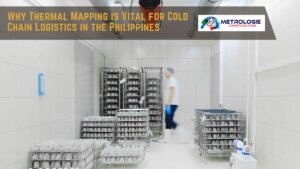

The dairy and beverage industries in the Philippines operate under a constant, dual threat: the high risk of microbial spoilage inherent to their products, and the relentless, challenging heat of the tropical climate. Maintaining product quality, stability, and, most crucially, consumer safety is an endeavor that hinges entirely on the integrity of the cold chain and the precision of thermal processing like pasteurization.
For these sectors, Thermal Mapping is not merely a recommended best practice; it is a fundamental scientific requirement for proving regulatory compliance and ensuring that Critical Control Points (CCPs) for temperature are consistently met. It is the documented, verifiable assurance that every cold room, storage chiller, and heat exchanger operates exactly as designed.
This article details the absolute necessity of thermal mapping across the Philippine dairy and beverage supply chain, focusing on how this scientific validation secures quality, prevents costly recalls, and meets the stringent standards demanded by the Philippines Food and Drug Administration (FDA).
Part I: The Regulatory and Tropical Imperative
Dairy and many modern beverages (especially fortified, low-sugar, or preservative-free types) are highly susceptible to microbial growth. In the Philippines, the risk is compounded by the environment.
1. The Critical Control Points (CCPs) for Safety
The foundation of food safety in this sector lies in HACCP (Hazard Analysis and Critical Control Points). For dairy and beverages, temperature is the primary CCP.
- Lethality of Heat: Pasteurization (the application of heat for a specific duration) is the CCP that eliminates pathogenic organisms (e.g., Listeria, Salmonella).
- Arrested Growth: Refrigeration (the application of cold) is the CCP that slows or stops the growth of spoilage organisms, maintaining shelf life.
Any deviation in measurement—a faulty thermometer during pasteurization or a sensor drift in a chiller—directly translates into a failed CCP and a hazardous product.
2. The Philippine Environmental Challenge
The high ambient temperatures (often exceeding $30^\circ\text{C}$ in key manufacturing hubs) and persistent humidity pose continuous threats to temperature control equipment.
- Cooling Load Stress: Refrigeration units must work harder, increasing the likelihood of failure and temperature instability.
- Door Openings: The rapid ingress of hot, humid air during loading or unloading operations challenges the system’s ability to recover to safe temperatures quickly (Recovery Time). Thermal mapping quantifies this critical response.
3. Philippines FDA and Verification
Local regulations require facilities to have a validated system—meaning the equipment must not only be capable of performing its task but must be scientifically proven to do so under actual operating conditions. Thermal mapping provides this proof, transforming a claim of temperature control into documented, auditable fact.
Part II: Thermal Mapping in Thermal Processing (Pasteurization)
For dairy (milk, yogurt, ice cream mix) and many juices, the most critical thermal validation occurs in the pasteurizer. This is not simply a mapping of space, but a precise temperature uniformity study of a dynamic process.
1. High-Temperature, Short-Time (HTST) Pasteurization
HTST is the most common method, heating product to a specified temperature (e.g., $72^\circ\text{C}$) for a minimum holding time (e.g., 15 seconds).
- Validation Focus: Thermal mapping (or thermal validation) of an HTST unit focuses on the Holding Tube. This tube provides the lethal time/temperature combination.
- Worst-Case Flow: The study uses highly accurate, calibrated sensors to measure the product’s temperature along the holding tube during the fastest flow rate possible. The fastest flow ensures the product spends the minimum time necessary in the holding tube—this is the worst-case scenario for lethality.
- Key Finding: The mapping must confirm that the temperature of the fastest flowing product never drops below the minimum required temperature (e.g., $72^\circ\text{C}$) during its entire $\text{15-second}$ travel time.
2. Ultra-High Temperature (UHT) Processing
UHT, used for long-life products, involves much higher temperatures (e.g., $135^\circ\text{C}$ or higher).
- Criticality: At UHT temperatures, even a 1-degree Celsius error can drastically change the final product’s quality (e.g., causing “cooked” flavor notes in milk) or compromise sterility.
- Calibration Requirement: The sensors and monitoring systems used to control and record UHT temperatures must be calibrated to a higher degree of precision and be checked more frequently, often using secondary reference standards traceable to national metrology institutes.
Part III: Thermal Mapping in Static Storage (Chillers and Freezers)
After heat processing, the product enters the cold chain, where the focus shifts to maintaining temperature uniformity across a static volume.
1. Cold Rooms and Chillers ($\text{0}^\circ\text{C}$ to $\text{8}^\circ\text{C}$)
Milk, fresh juice, and fermented products (like yogurts and cultured drinks) rely on chillers to extend shelf life.
- Identifying Hot Spots: In tropical environments, the most common hot spots are:
- Near Doors: Due to frequent opening and the constant influx of warm air.
- Ceilings/Near Lights: Heat rising from operational lights or poor roof insulation.
- Far from Cooling Coils: Areas where cold air struggles to circulate due to distance or obstruction.
- The Loaded Study: Mapping must be conducted with the room at its maximum operational load. Tightly packed pallets impede airflow, often revealing temperature stratification (layers of cold and warm air) that an empty study would miss.
2. Deep Freezers and Ice Cream Storage
Maintaining a consistent $-\text{18}^\circ\text{C}$ or colder is essential for quality (preventing freezer burn) and texture (preventing recrystallization in ice cream).
- Freezer Challenges: Freezer units often experience dramatic temperature fluctuations during their defrost cycles. A thermal mapping study must run for a sufficient period (e.g., $\text{72}$ consecutive hours or longer) to capture multiple complete defrost cycles and ensure the temperature spikes do not damage the product.
- Sensor Type: Specialized RTDs (Resistance Temperature Detectors) are often preferred over standard thermocouples for their high accuracy and stability in deep-cold environments.
Part IV: Thermal Mapping in Distribution and Logistics (GDP)
The distribution network is the most volatile link in the Philippine cold chain, where traffic, delays, and temperature abuses are common. This requires qualification under Good Distribution Practice (GDP).
1. Refrigerated Truck Qualification
Every vehicle used to transport finished dairy and beverage products must be qualified through thermal mapping.
- Route Simulation: The mapping should simulate the actual distribution route, including multiple stops, idling in traffic (where cooling power may drop), and periods of maximum door opening.
- Mapping Zones: Sensors must be placed to verify temperature integrity in the most vulnerable zones:
- The area near the truck’s rear door.
- The furthest point from the chiller unit (the “return air” zone).
- Floor level, where products often sit.
- Hold Time Validation: The mapping study determines the truck’s Thermal Hold Time—how long the product remains safe if the refrigeration unit fails during a traffic jam or emergency.
2. Retail Display Cases and Last-Mile Integrity
The final storage point before purchase is critical, as failure here directly impacts the consumer.
- Mapping Retail Chillers: Display chillers are often stressed by frequent customer interaction and ambient store heat. Mapping ensures the load line (the highest point where product is stacked) remains safe, as this is typically the warmest point.
- Documenting Conditions: Thermal mapping validates that the equipment meets standards, while continuous monitoring provides the ongoing proof that staff are adhering to correct loading and operational procedures.
Part V: Management and Compliance – The Audit Trail
A successful thermal mapping program is one that generates a clear, defensible, and comprehensive audit trail for the Philippines FDA.
1. Calibration Traceability
The reliability of the entire study rests on the accuracy of the instruments used.
- ISO 17025 Accreditation: All sensors (data loggers) used for the mapping must have calibration certificates traceable to international standards (ISO $\text{17025}$). This certificate must include the Measurement Uncertainty (MU), quantifying the potential error margin.
- In-House vs. Third-Party: Whether conducted by an internal validation team or an external contractor, the procedures must meet the same rigorous documentation standards.
2. The Out-of-Tolerance (OOT) Protocol
If the thermal map fails (an OOT event), the facility must have a documented crisis response:
- Immediate Quarantine: Any product stored or processed during the time the system was out of tolerance must be immediately quarantined.
- Impact Assessment: A scientific review is mandatory to determine if the thermal breach was sufficient to compromise the product (e.g., if the HTST unit dropped below $72^\circ\text{C}$).
- Mandatory CAPA: A Corrective and Preventive Action plan must be immediately launched to fix the root cause (e.g., repair insulation, shorten mapping intervals) and prevent recurrence.
Conclusion: Thermal Mapping as the Guardian of the Brand
For Philippine dairy and beverage manufacturers, thermal mapping is the essential investment that guards product safety, public health, and brand reputation. In a high-risk industry facing a high-heat environment, relying on assumptions or uncalibrated instrumentation is simply not a viable option.
By scientifically validating every thermal process and every storage space, facilities gain the documented assurance needed for regulatory audits, reduce costly inventory losses from spoilage, and, most importantly, fulfill their commitment to the consumer. Thermal mapping transforms temperature control from a mere guess into a certified, auditable, and reliable guarantee of quality.